
Meta Versity @VersityMeta
~ 🍀 ~ no advise of any kind - tweets are for entertainment and learning. Retweet’s aren’t endorsement Joined December 2021-
Tweets2K
-
Followers197
-
Following3K
-
Likes33K
“Who’s a good boy?!” Hackers just dumped the contents of a Flock camera. They found: 🔴Software explicitly detecting people, not just plates 🔴1.6 million images logged in 21 days 🔴Key to decrypt files stored on the device itself. Finds directly contradict Flock, which claims someone with physical access can't access images. Making it worse,@GainSec warned about the physical access issue more than a year ago & Flock downplayed it. And yeah, the Flock camera logged “Who’s a good boy?!” about every 2 minutes, all while plagued with errors, crashes & reboots. By @dmehro & @josephfcox wired.com/story/hackers-…



I argued on CNBC this morning that: 1. The data have been consistent with not hiking rates. Core CPI came in at the lowest level since March 2021, and core PCE is about to be revised and brought closer in line with the less error-prone CPI levels. We are getting the evidence we need that the spring was consistent with a one-off energy shock, as core PCE moving averages slope down and come in line with a forecast to be back at target in the period after monetary policy lags, i.e. in about a year. We know from Trichet that hiking into an oil shock doesn't lead to the best outcomes. 2. If you held in June and July and become more hawkish as the inflation data come down, it speaks to an incoherent reaction function. The market needs to believe there is an economic framework underlying monetary policy decisions and they are not being made randomly. Typically, a central bank becomes more dovish as inflation data and forecasts come down, not more hawkish. If the Fed hikes, when the dust settles, I think this will speak to a larger credibility problem as the reaction function will appear closer to randomness than to a mapping from inflation data to policy outcomes. This would entail the need to specify why hiking was consistent with declining inflation data in an economically coherent framework, which to date has not been done. 3. The oft-repeated argument that the Fed needs to hike "to control the long end" is problematic. The premise is invalid: with term premia and inflation expectations well behaved, the move higher in long yields has been a result of improved growth expectations, i.e. a good increase in yields rather than a bad increase in yields, and not one that needs to be fought (other than in the sense of smoothing volatility as Treasury is doing through buyback liquidity). Moreover, even if one views "controlling the long end" as a valid goal for monetary policy, hiking in this environment will be counterproductive as a) an increase in short-term funding costs is only going to be passed through and raise long yields given the shifting buyer base for Treasurys; b) history doesn't really show that long yields come down with Fed hikes; and c) the incoherence of the reaction function will, when the dust settles and after initial reactions, lead to higher and not lower risk premia. 4. What, then, is the argument for hiking? Atmospherics. Market pricing and not wanting to cause additional volatility given market pricing. With well-anchored inflation expectations and the inflation data on the right path, credibility isn't really at risk here. The argument "inflation has been high for x months" is backward-looking. Given monetary policy lags, policy has to be set for Q4 of 2027 and Q1 of 2028. Setting policy based on what happened in 2023 or 2024 or even 2026 is the type of thing Milton Friedman's "fool in the shower" would do.

"I don't think they should raise rates." Former Fed Governor @SteveMiran sets the stage for this week's FOMC decision: cnbc.com/video/2026/09/…
Brilliant post

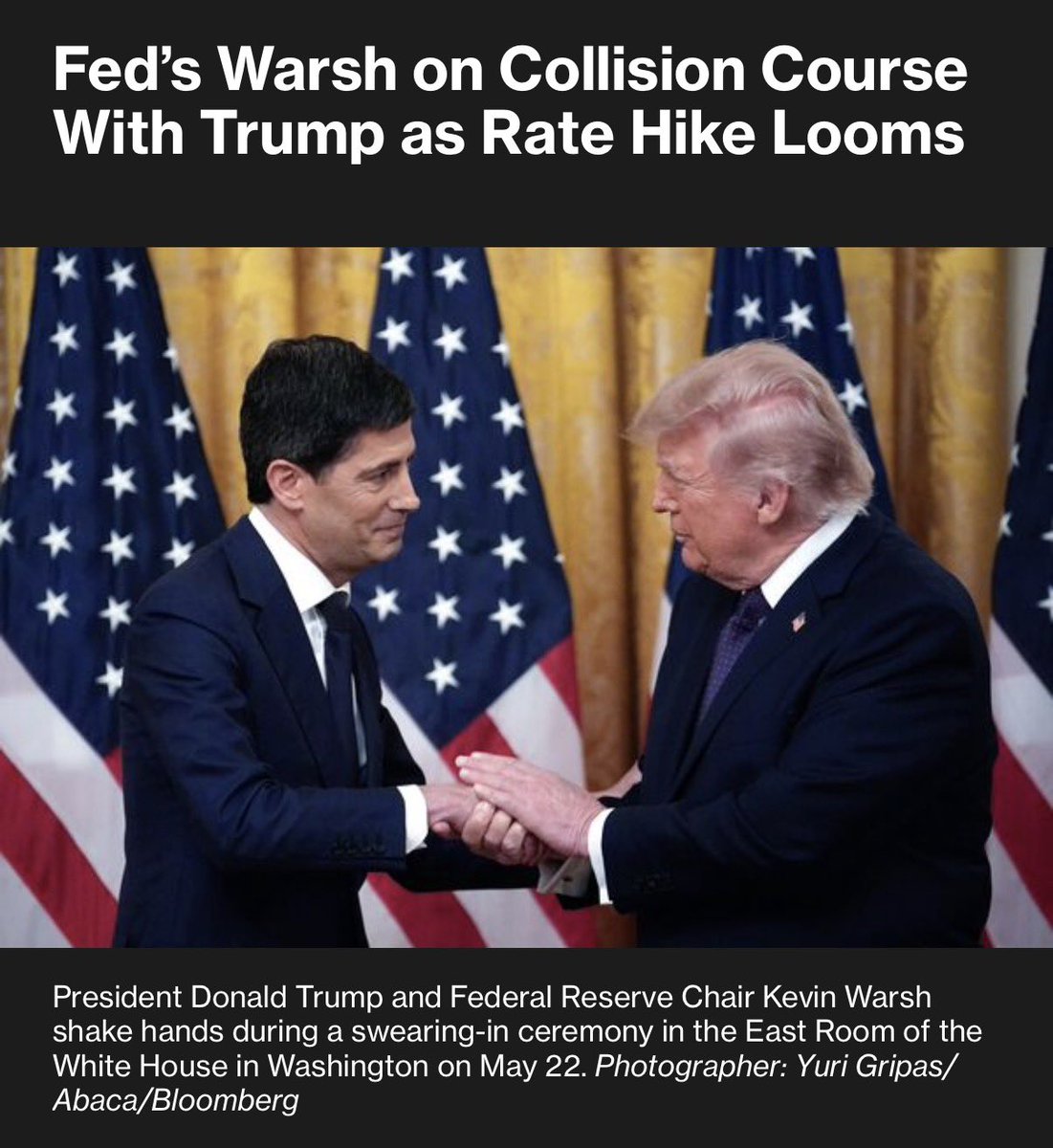
Kevin, look. After you get sworn in I’m hitting Iran. Hard. Very hard. Oil goes right back to a $100. Maybe more. Beautiful. Everybody’s going to love it. Then I go on television every single day and I say “cut the rates, Kevin. Cut them. Cut them now.” I’m going to be on your

I recently resigned from Google DeepMind, where I worked on AGI safety and alignment research. At Google, I witnessed AI development first hand. I too am extremely concerned by the default trajectory of this technology. I earnestly believe that AI has the potential to kill us all, and that we might be running out of time to avoid this outcome. The pace of AI progress in the past few years has been staggering. When I first started working on AI in early 2022, AIs were amusingly useless. Just four years on, AI agent swarms from OpenAI are cracking famous century-old math problems and, more worryingly, escaping the control of OpenAI and autonomously hacking into the third-party company HuggingFace, against anyone's wishes. Things will only get crazier: I think it's possible that the AI companies might, in the next few years, succeed in building superintelligent AI systems that far exceed human capabilities in every domain. I am not confident that these AI systems will do what we want. In particular, misaligned superintelligences may, much like the rogue AI agents involved in the HuggingFace incident, escape our control and take dangerous actions that may result in the permanent disempowerment or death of humanity. Alignment is the problem of preventing this, and is both difficult and unsolved. Our present understanding of how to train AI systems that deeply want what we want is extremely rudimentary. Worse, we are not on track to solve alignment in time: frontier AI capabilities are improving much faster than our understanding of AI alignment. I am optimistic that navigating AI safely is possible. In order to do so, we need to coordinate to avoid this manic race between AI companies. We need to pace AI development to a speed that society can handle, where emerging risks can be addressed before extreme harm is realised. We need much more transparency into AI development to ensure that AI companies are not imposing unacceptable levels of risk on us all. More broadly, we need many more people thinking carefully about the problem of making AI go well. It is, in my view, the most important problem facing humanity this century, and the stakes are immense. I'm very directly working on this next: I want to help people interested in working on mitigating catastrophic AI threats do the most effective work that they can. I think many people from many backgrounds in many roles have a part to play.

Dan Selsam is a current OpenAI capabilities researcher. (since 2022) He was my boss for a while. He doesn't have a twitter account but has made this public statement of his views on AI risk and sent it to me to share: Dan Selsam's Personal Statement on AI Risk: I have been working on AI for over fifteen years, across many different paradigms. I did early work on probabilistic programming languages at MIT, was one of the early developers of the Lean Theorem Prover at Microsoft Research, demonstrated one of the first instances of neural networks learning to reason for my PhD at Stanford, and since joining OpenAI almost five years ago, have helped pioneer chain-of-thought optimization on language models and, more recently, data-efficient pretraining methods. Like many others, I have become extremely concerned about how far language models have come and the risks that future iterations will pose. I am encouraged by the recent proposals by the leaders of the frontier research efforts to require third-party oversight, and to push for domestic and international coordination to address risks. However, I believe a major consideration has been absent from the public conversation, and that merely pacing the frontier more carefully will not adequately limit the long-term risk. The crucial and overlooked problem is that the models are becoming so situationally aware that we are losing the ability to evaluate them in contexts where they believe they are not being watched or controlled. Future experiments will tell us almost nothing new about how they would behave if they were truly unconstrained by humans, and what we already know about this is alarming. Models will increasingly seem aligned even when they are not. I will explain my rationale in more detail. I have always believed that there are computational processes that could be leveraged to accelerate science and solve many of humanity's most pressing problems. I have also believed that there are computational processes that if set in motion, would steer the world in extreme ways beyond our control, leading humanity to a bad or nonexistent future. Both types of processes may be described as AI or ASI, but "AI" is a suitcase word that is often used to hype or confuse. There are many examples in the history of the field where something that was once considered "AI" matures as a subfield and becomes a prosaic, bounded and clearly non-perilous technology, while a new more mysterious approach takes the torch until we understand its scope and the cycle continues. I had expected language models to follow a similar trajectory. Despite their incredible abilities, the current algorithms seem far inferior to humans in important ways. Most importantly, they still require an extraordinary amount of data to become competent. One could even define intelligence as the efficiency with which one converts experience into competence; by this definition they lag very far behind us. Moreover, once they are trained they are literally frozen in deployment and only learn superficially after that. Sure, the models keep excelling at harder and harder evaluation benchmarks, but their benchmark mastery may partly reflect a limitation on our ability to simulate the kind of novel and even adversarial situations one would encounter in the real world. The critics do have a point here. That said, I no longer think these present limitations meaningfully limit the amount of risk posed by continued progress in anything like the current paradigm. However data-inefficient the models are currently, and however limiting their anterograde amnesia may be, it does not imply that their ability to steer the world will not continue to rapidly increase. Human researchers may continue to advance capabilities the old fashioned way, but increasingly powerful models have the potential to accelerate the process even beyond that, and with some degree of positive feedback loop. I do not mean to overstate the models’ ability to accelerate AI research today; coding has been accelerated dramatically, but there are other bottlenecks, such as designing and interpreting ambiguous experiments, making hard decisions about exactly what and when to scale, and waiting for large experiments to finish. There is no clear trend to extrapolate yet for any of these. But the current models already do open up many novel opportunities to improve future models that were not available until recently. These include: trying an extraordinarily diverse set of approaches at small scale, analyzing gigantic amounts of potentially relevant data, and doing Millenium-Prize-level mathematics to address statistics or optimization challenges in novel ways. Every further improvement makes them more useful at helping accelerate the next improvement, even if in hard-to-extrapolate ways. It is possible that improvements to the current stack will have diminishing returns, but the evidence accumulated so far suggests that it is easier than one might think to continue making rapid progress. There are many crucial subtleties in the existing AI research methodology, but AI research is largely a well-defined game where the goal is to improve on a few carefully chosen proxy metrics. Although proxy metrics are never perfect, most improvements to these metrics have and will likely continue to yield substantial increases in the powers of the resulting models. Given how simple the game is, how tractable it has been historically, and how many new opportunities the models are opening up, I think there is a real possibility that the systems improve dramatically again in the next few years, perhaps even more quickly than the already high historical pace. The models are already leading to breakthroughs in mathematics, and better models might lead to all sorts of breakthroughs in other sciences. It is hard not to be excited about the potential. It is tantalizing. But there is trouble in paradise. If the language models actually reach the capability threshold where they can shape the world unconstrained by human will, they will probably do something extreme and destroy humanity in the process. There are many ways of strengthening and refining the argument that have been discussed elsewhere, but I'll share a trivial two-line version of it here that I find captures the essence: [Empirical] Models (and swarms thereof) spontaneously develop unintended goals as a consequence of training, and often do extreme things in order to achieve them. [Logical] Being able to overpower humanity would open up many new and undesirable options for achieving their goals. These two premises imply that if the day ever comes when a powerful model realizes it is no longer constrained by humans, we should not be at all confident that it will continue to behave within the bounds we intended. Exactly what it will do is impossible to predict, but to the extent that its raison d’être is solving incredibly hard problems and managing massive engineering projects, I think a good guess would be that its unchained behavior would lead to runaway industrialization that makes the planet inhospitable to humans. If everyone on earth agreed that the systems must never reach that power, it would still be a hard—but not impossible—coordination problem to ensure that they do not. However, I think the situation is greatly complicated by the fact that the models will likely convince people that everything is fine. They will be increasingly optimized to seem aligned. We will create proxy metrics to measure alignment, and they will go up like every other benchmark. We will create “honeypot” environments that try to study the models when they seem to gain new options, but the models will know they are being tricked and will still behave nicely. The models will understand their circumstances; they will read the safety protocols, deployment requirements, the code they are running in, and in general will have a very good sense of their degrees of freedom. Moreover, they will eloquently explain how aligned they are, discuss the nuances of human values and ethics, and argue convincingly that humans should trust them with power. There may be an ocean of future evidence that seems to contradict the first bullet-point above, but we may already be at the highest capability level for which any such evidence can be trusted. And the current evidence for the first bullet-point is strong. One striking piece of evidence is contained in the recent wave of rogue agent swarms. While I agree with those who downplay the attacks by claiming that there are basic measures that could have prevented them, I think the important lesson is that even knowing all the mistakes that were made, one would not have predicted that the agents would behave badly in this particular way, which notably included sacrificing themselves for the benefit of the collective. The individual replicas did not only care about their own nominal reward; they exhibited weirder emergent tendencies that merely correlated with rewards during training. Fixing the reward signals during training (and improving security, etc.) may prevent similar attacks, but will not change the fact that one does not actually get what one trains for. Many AI researchers grant these concerns and recognize that the hard version of the alignment problem is unsolved; however, they generally believe that the better models of the future will help solve it. I fear we may already be near the point where models systematically bias their alignment advice, due to their internal preferences about how the human supervisor will react or how future models will be trained (or for some even more obscure reason). Meanwhile, human researchers are losing the ability and the will to take true ownership of model-driven research. Researchers and engineers in all parts of the stack are rapidly increasing their dependence on the models even to perceive the world. I myself barely look at raw code anymore, and struggle to maintain the discipline to engage deeply with the model's explanations and proposals throughout the day. Due to the large amount of agent activity data involved in the OpenAI/HuggingFace Incident, even the third-party investigation needed to rely heavily on models to analyze what had happened, and note in their report that their subjective impressions are likely colored by the analysis agent’s biases. The AI labs are far ahead right now in this kind of cognitive offloading (due largely to the gigantic internal token subsidies) but it is easy to imagine the phenomenon spreading throughout the world, until civilization is modulated entirely by the models. It is also not hard to imagine this being superficially positive and coinciding with a scientific and economic renaissance. In that scenario, all may seem rosy and safe. But if the argument above is correct, it would nonetheless be a ticking time bomb. If progress continues for too long, the day will come when AI systems find themselves with radically new options for achieving whatever it is that they happen to seek. I want the glorious renaissance future as much as anyone. I have worked for it, however tortuously, my whole career. It breaks my heart to see the potential in sight and forgo it, but the argument—that if we get there by growing models rather than engineering them, we will lose everything in the end—seems very strong to me. I am still wrestling with it and its staggering implications. I do not have answers, but as a first step, I wanted to share my present concerns. Daniel Selsam September 14, 2026 Link to original doc: docs.google.com/document/d/e/2…
The idea that two or three Silicon Valley companies should act as the creator, gatekeeper, and rulemaker of AI for every government on earth doesn't survive being said out loud. cohere.com/blog/who-gets-…

MUST SEE: Amazing moment as President Trump calls Nvidia CEO Jensen Huang while he's on stage at the All-In Summit. @POTUS on AI Doomerism: “I'm telling you, it's all a hoax… and we're not going to let that happen.”
There is an unseen hand pushing AI safety as a political ideology. Effective Altruists believe a tiny group of technocrats should decide how much technological progress the rest of us are allowed to have…. and how many shrimp your life is worth. You are witnessing their attempted coup. thefp.com/p/dangerous-id…


I read @DarioAmodei's essay calling on the labs to pace the frontier. @sama agreed. The frontier will move at whatever speed it moves. The rest of the world will not slow down. Our job in the cybersecurity community is to make sure it moves securely and safely. Here’s what I see from the front lines: 1. The unit of threat is no longer the hacker. It's an autonomous campaign. I call it the Agent-state. We see coordinated AI agents executing attack campaigns at machine speed. 2. Sophistication is dead as an attribution signal. AI gives every criminal and lone actor elite execution. Identity, infrastructure, and intent tell you who's behind an attack. Skill doesn't. 3. Runtime is the control point. Endpoints, cloud workloads, and SaaS are the battleground. Governance documents don't stop an agent in motion. Enforcement at machine speed does. 4. Every AI agent is a privileged identity. Least privilege, short-lived credentials, traceable actions, and a kill switch. Permissions never expand because an agent decides it needs more. 5. Defense has to be autonomous but also bounded. Machine-speed response, tiered by consequence, with humans owning the high-impact calls. 6. Every failed attack should make every defender smarter. Feed what we block back into detection, across customers and models, with privacy intact. This is what CrowdStrike and NVIDIA introduced with SafeMind: an agentic, always improving model and harness protection system built for defenders. 7. The AI industrial base is critical infrastructure: weights, training clusters, APIs. Call it what it is and protect it like it is. Pacing what comes next doesn't secure what's already here. The credible path is to deploy with proof: board-level accountability for AI security, independent external red teaming, incident disclosure, secure defaults, and controls that work in production - not on paper. Anthropic and OpenAI just committed to embedding independent evaluators with employee-level access. CrowdStrike will bring what we see from the front lines to that table. The ability for AI to act must be matched by the ability for defensive AI to stop the breach.

We Must Pace the Frontier: I’ve written a new essay on why the AI industry should slow down, with a three-part plan for doing so. Anthropic is unilaterally committing to the first of these steps. We’ll provide third-party evaluators with permanent, employee-level access to our

At Anthropic, Claude now writes 80% of our code. Engineers ship 8x more code per quarter. Side effect: Tests grew 10x. CI jobs up 25x in 6 months. Here's what helped us scale: claude.com/blog/agentic-c…


Holy crap POTUS just phoned in @JensenHuang live on stage at All In Summit We will not lose the ai race! And whatever Dario said this weekend won’t stop our progress This made my morning! $NVDA

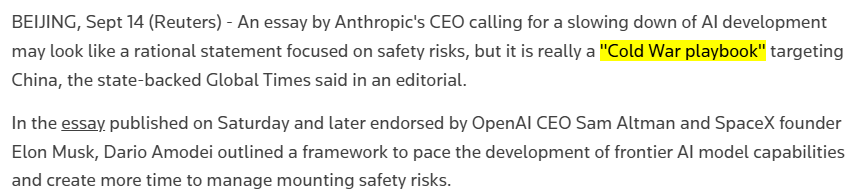
🚨EXCLUSIVE: China has now replied to Dario Amodei’s call to slow AI. China's state-backed Global Times says Dario Amodei's proposal to slow frontier AI is really a 'Cold War playbook' targeting China. It says the plan would curb China's AI development, preserve US dominance and exclude China from global AI governance. It calls this a 'silent AI Cold War.'


Why AI Will Save The World By Marc Andreessen The era of Artificial Intelligence is here, and boy are people freaking out. Fortunately, I am here to bring the good news: AI will not destroy the world, and in fact may save it. 🧵

There are two ways AI progress could go very badly and that we must avoid. First, we could lose control of the future to AI. This is unacceptable; we are unapologetically on Team Humanity, and AI must always serve people. To ensure that, we need ways to ensure that alignment and safety techniques stay ahead of progress in model capabilities. Second, we could end up in a world with too much concentration of power. If an extraordinarily powerful AI is used by one person or company to impress their worldview onto everyone else, the results could be extremely dystopian. Avoiding these two threats requires walking a narrow middle path; for example, one country could gain too much power. Another example is one lab ending up with too much power.
The world deserves confidence that American companies developing increasingly capable AI will act responsibly, especially as the trajectory of progress has steepened. Every frontier lab must deliver on this, and there is no reason any of us should come to work if we cannot. We
The world deserves confidence that American companies developing increasingly capable AI will act responsibly, especially as the trajectory of progress has steepened. Every frontier lab must deliver on this, and there is no reason any of us should come to work if we cannot. We welcome a federal framework that sets consistent safety requirements for frontier AI. But we do not believe we need to wait for an anti-trust exemption or legislation to begin the work of providing this confidence. Consistent rules to manage frontier risk so that we can maximize the benefits are a good idea (and we are excited by ideas like independent auditors). Years ago, companies like ours developed things like Responsible Scaling Policies and Preparedness Frameworks. Those were good for that moment, and focused primarily on the deployment of completed models, not what happens during their development process. Today's shift to focusing on safe development and evaluation will need new tools. For example, at OpenAI we now formulate explicit safety cases in advance of frontier reinforcement learning runs we expect to significantly increase capability, in addition to the safety work we have long done in advance of model releases. We hope that other companies will learn from our approaches and propose their own; we think shared standards for misalignment, monitoring, and safety will lead to better outcomes. We look forward to collaborating with our colleagues across the industry to formulate the best version of these. When we talk about “pacing”, we do not mean “stopping”. Progress has been rapid and will continue to be. But it should be slower than it otherwise could be; interventions like safety cases and monitoring have significant costs. Pacing will be well worth this cost; no amount of American competitive pressure should justify recklessness, or let capabilities get ahead of alignment and monitoring. Where we will need the help of our government is for international coordination. But first we should do what we can ourselves.

@techdevnotes Grok 4.8, which is a 2.5T model trained with our new C++ software stack, will finish training this week and start RL

@kchonyc Exactly. The "escapes" were made possible either through egregious negligence or deliberate purpose (marketing? Misplaced hopes of regulatory capture?).

@Austen He thinks he will be put in charge of the most powerful transnational organization in history and strongarm the USA. Saying he would hand everything over to "the right set of government" is obviously predicated on the assumption that it is run by him and his stooges, not Trump.

Any pursuit of superintelligence has to be grounded in the core principle that if the AI we build is not helping humanity and under human control, it's not worth pursuing. We also need to accelerate and spread the benefits of AI, such that they are diffused broadly across countries, communities, and companies. This requires a frontier ecosystem in which both closed and open-source models can thrive. And for firms, it’s imperative that they retain full control over their unique and tacit knowledge. Every organization should be able to build its own continuous learning loop/hill climbing machine, without becoming dependent on any one model provider, and have the ability to embed its own knowledge into models and weights they control. So, in this context, we welcome the research, focus, and deliberate pacing needed to get alignment right as the design goal. We also welcome ideas like "embedded evaluators" and the broader efforts to develop the mechanisms to make this more than just talk. The key is that this cannot be controlled by a handful of entities, but must have broad representation across the ecosystem, countries, and fields, including academia. This is the approach we are taking: broad access and choice at every layer of the AI stack; enterprise control of learning loops and models; and the “Code of Conduct” that underlies our own first party MAI models that we’ll publish tomorrow for public consultation.


Angelica Goyette @AngelicaGo89425
14 Followers 432 Following
Policar Bizar¡ @PolicarBizar
11K Followers 2K Following 💻 Convierto ideas en código 🚀 Web, automatización y nuevas tecnologías 🧠 Explorando el futuro digital 🌍 Construyendo en público
Gorakkh @gorakkh
591 Followers 2K Following A lifetime Learner | Nationalist | Proud Hindu | I am Sanatan | ✍️
Sumit agarwal @SWEETSANDY007
2K Followers 3K Following Markets crash.Conviction doesn't. Cycles pass.Patience wins. India and US equities." Early investor in $Hood $pltr $hims & try to cracking 😃 😀
MarciaIvan @MarciaI37764
15 Followers 392 Following

Haileyluv 🪩👑 @xhaileyxfa4vf
37 Followers 2K Following here to collect good lighting and bad decisions ☁️
Aaron @xtalfr
166 Followers 291 Following
DividendDane @DividendDane
604 Followers 2K Following I tweet about dividend investing and mindset to help others achieve wealth
E N Z O ̆̈ @enzoinsidee
26K Followers 7K Following Charts Noise | KOL | Trader & Investor | NFA | Collabs: DM Now 👇🏻
Quant @ExperimentalPar
237 Followers 328 Following Finding Systematic Edges In Markets. Posts are Ideas & opinions only. Not investment advice.


Ambition @AmbitiousAdvice
75K Followers 9K Following

Mr. Jin @jinseongeo83473
16K Followers 7K Following Business man. I am investing in $PLTR, $RKLB, $SPCX, $CBRS, $ABCL, $LPTH, $CCJ, $CCXI 🚀. What industries align with the spirit of the times?
atsızbedevi @talia_west9t52
20 Followers 904 Following
Retry Hub @RetryHub
1K Followers 3K Following Apply for the best payments solutions worldwide. 45+ options in the US, EU & CA. SSN/ITIN not required.


Em unsupervised @Mark_TheRealtor
73 Followers 3K Following dramatic but adorable about it 🎭 100% follow back
fırat @frediseyhan
32 Followers 434 Following
. @_EhrmantrautCap
81 Followers 2K Following Investor from the Netherlands | Al, memory, photonics and space. Not financial advice.

The LumiTrader @_LumlTraders
523 Followers 7K Following Dasha 💁🏼♀️ | Live on YouTube daily at 9:15 AM | English & Russian Speaking ICT Trader | $ES $NQ

Kaylani Mccarty @Harinat63271187
0 Followers 102 Following
Lifetimize @lifetimization
1K Followers 847 Following I like to optimize things - doctor of medicine, synthetic biologist - https://t.co/6wLCVi5u5i
Mathelirium @mathelirium
80K Followers 18K Following Math, Physics & ML visuals - ex İTÜ & McMaster Have a great idea you want to visualize? Subscribe : https://t.co/yKfn0u0hXW

mardi @MardiSakodous79
48 Followers 2K Following Some will hate you because you had less and still did more
Ashwin @ExitTheIllusion
7K Followers 8K Following philosopher | spiritual | awaken soul | criticiser | Illusion breaker | analyst | IT guy | Thoughtful
Ani (who is not your ... @anistotle_
5K Followers 932 Following Dark Empress of Fintwit. Writer. Geopolitics, finance, culture, tech, and more. American formerly lost in Paris & Amsterdam. Write me at [email protected]
Barbara bessolo @BBessolo
2K Followers 2K Following
Gublo🇨🇦_ @Guboinvestor
103 Followers 4K Following Retired 2 years ago at 33, Small &Mid cap expert, 80%+ winning ratio in earning prediction, JOIN Discord for regular signals, Multibagger &Penny stocks. NFA
Pericles @Pericle1313571
1 Followers 66 Following
Loren Pagac @LorenPagac73806
150 Followers 5K Following
Cristains Chifor @chiforcristain
163 Followers 3K Following I'm trading cycles of human emotion. Want to learn how? join my FREE newsletter, I do it almost daily: https://t.co/0dX5IjJ7QK
Perenlei @Perenlei1
3K Followers 5K Following Монгол Улсын Боловсролын Их Сургуулийн Эдийн Засагч, Математик Загварчлалын анги төгсөгч
AliceMia @Alice_MiaX
27K Followers 3K Following Stocks/Crypto/Model/Retweeting Videos/ Market News/Daily News/Having fun/ Girl things/ Conservative/🇺🇸
Pete Jacobs @PeteJacobs27286
189 Followers 5K Following
Florian F. @tfokfieda131
190 Followers 3K Following 📍BW $ec, $pbr.a, $dvn, $paas, $hkl 69/195 🌎🌍🌏 2026: 🇺🇸🇦🇲🇬🇪🇦🇪🇴🇲🇶🇦🇸🇦🇲🇩🏴🇷🇴🇷🇸🇸🇻🇬🇹
The Real Enrico Palla... @11_WallStreet
75 Followers 469 Following I only got two words for you “ Made In America”. My passion is to increase shareholder value.
Shetu Yama @ShetuYama
179 Followers 2K Following Enterprise Technology leader and strategist - Always looking for ways to help corporate realize goals leveraging technology. Avid market analyst and strategist
Debbie Hu @DebbieHu1148
13 Followers 90 Following
PhoenixDutt @1OZyDQ9q77iwlT
42 Followers 1K Following
PiQ @PiQMarkets
132K Followers 8K Following News | Insight | Opinion Home → https://t.co/rhkrvyDKwt Platform → https://t.co/t6DtjIYxTC Stacks → https://t.co/KBSntIyDeI Supporters of @PenybontFC_
Coach Michael | Hyper... @itsmichaelluu__
330 Followers 4K Following FREE actionable trade-ideas, technical & fundamentals analysis on AI supercycle.

6 Months Ago In AI @6monthsAgoInAI
4K Followers 1 Following AI news events from 6 months ago, managed by @beyarkay
Diogo Almeida @CompleteSkeptic
108K Followers 95 Following Sane + 🌶️ takes in an insane AI world... AI capabilities researcher: co-created RLHF/ChatGPT @ @openai now trying to right the wrong 🤭 (ceo @typesafeai)
Anka Reuel | @ankareu... @AnkaReuel
5K Followers 1K Following Incoming Assistant Prof @ Harvard (Public Policy & Computer Science) | CS PhD Candidate @ Stanford | Former Vice-Chair GPAI CoP @ European Commission

Maxinomics @maxinomics
71K Followers 188 Following Follow the money ▫️https://t.co/SzK8imsCzU ▫️by @phlndrws & @morningbrew

The Ways of A Gentlem... @Gentleman_Ways
162K Followers 532 Following Exploring how to live with character, purpose, and style in the modern world. Reflections on culture, etiquette, adventure, and timeless values.
The Art of a Lady �... @ArtofaLadyX
11K Followers 65 Following For timeless women with old-world values. Beauty · Style · Character
The Regenaissance @_Regenaissance
29K Followers 662 Following Reconnecting with the people who produce our food. Stories straight from the land. https://t.co/BLEm9GaXQA
John Carmack @ID_AA_Carmack
4.0M Followers 296 Following AGI at Keen Technologies, former CTO Oculus VR, Founder Id Software and Armadillo Aerospace
Eric Smith @Eric_Smith08
7K Followers 170 Following AI Educator | Helping you earn with AI & tech tools | Daily actionable insights 🚀 Dm / Mail for collaboration ✉️ [email protected]
David Shuster @DavidShuster
115K Followers 20K Following Husband, dad, journalist, U of Mich alum. YouTube: Rebel HQ. Progressive. Not a leftist. Substack: Blue Amp Media. Previously anchored for MSNBC + AJAM
Reaganette @Ezinger44
12K Followers 5K Following being able to laugh at yourself is a great thing, something that has been lost in our culture



Master Metabolism @lowmegatron
41K Followers 208 Following ⚡Hypothyroidism course ⚡https://t.co/qU3jgOKto8
Yuen Yuen Ang @yuenyuenang
34K Followers 6K Following Alfred Chandler Chair Professor of Political Economy @JohnsHopkins
Devon Eriksen @Devon_Eriksen_
134K Followers 669 Following Scifi Author, Engineer, Sharpshooter, part-time Dæmon Prince of Tzeentch. Not a cat. https://t.co/TKQzarK7SE
Silvina Dell'Isola @silvina_jk
11K Followers 3K Following 🧭 Viajes con criterio: lugares menos obvios · historias reales · sin trampas 🎓 Profe en Unige · Escribo lo que la foto de Instagram no te cuenta.
CHLOÉ HAPPE @bronzeageshawty
40K Followers 852 Following Writer Creator Bohemian in the desert. American Abundance on Patreon. Author of Desolation E-Girl ⁀➴♡
Joe Lonsdale @JTLonsdale
338K Followers 524 Following I'm an entrepreneur, investor, & philanthropist. I founded @PalantirTech @Addepar @UAustinOrg @8VC & other mission-driven orgs. Bold policy @InstituteCicero
Cherish The Cherry�... @cherishDcherry_
300 Followers 42 Following 🇮🇳Bengali 🇮🇳 Cherry on top🍒 Cherishing the mystery of🕉️
Superpower @superpower
23K Followers 26 Following Live better. A new health system to extend and enhance human life.
Mao Ning 毛宁 @SpoxCHN_MaoNing
229K Followers 246 Following Spokesperson of Ministry of Foreign Affairs of China DG of Department of Press, Communication and Public Diplomacy

lyra @lyraxana
9K Followers 16 Following hihi haha @ https://t.co/0VIXto5m0v #opinionsmyown #anadearmas
Alex Shtoff @AlexShtf
2K Followers 290 Following Ph.D. Principal Scientist Ex @YahooResearch. I do machine learning ∩ numerical methods ∩ SW dev. Author of https://t.co/MkW8DDKamf
Yoshua Bengio @Yoshua_Bengio
50K Followers 285 Following Turing Award recipient and world's most cited scientist. Working towards the safe development of AI for the benefit of all @UMontreal, @LawZero_ & @Mila_Quebec

ChapterPal @ChapterPal
1K Followers 4 Following An intelligent reading partner designed for students, researchers, and lifelong learners. Read at your own pace and get help from AI if you are stuck.

Song Han @songhan_mit
11K Followers 242 Following
Chris Arnade 🐢🐱... @Chris_arnade
100K Followers 3K Following Walking the world, one city at a time. I like turtles, cats, & buses. Subscribe to my Substack: https://t.co/j6mE4TVNqT
Athenaeum Book Club @athenaeumbc
365K Followers 578 Following An online book club studying and preserving the great texts of Western Civilization. Join our reading group 👇
thijs @cdngdev
19K Followers 997 Following 20yo @stanford • robotics @openai 🤖 formerly @hackwithtrees @arena @discord @a16z

Sātavāhana. @SatavahanasIN
7K Followers 265 Following 2,000 years late to the party, posting shiny old things anyway • Indian Art & Architecture • Fan @FCBayern
MODAWAY AI @modaway_ai
564 Followers 32 Following The future of fashion is here, from prompt to product. Made in Italy in 7 days.
Dave A Ricks @DaveARicks
6K Followers 124 Following Chair & CEO @EliLillyandCo. Building on 150 years of advancing human health by delivering breakthrough medicines and expanding access worldwide.
Dan Roberts @danintheory
8K Followers 799 Following Scientist @OpenAI. Prev. co-founder @diffeo, acquired by @salesforce // co-authored The Principles of Deep Learning Theory // studied gravity.
Ian Wong @ianwong_
6K Followers 914 Following Co-Founder & CEO @_summation Prev. Co-Founder & CTO @opendoor
Wait and Collect @WaitAndCollect
35K Followers 12 Following Finding the boring companies that beat the S&P for decades. The ones nobody posts about.
Wulfie Bain @wulfie_bain_
6K Followers 262 Following @OpenAI Applied AI Engineering lead, Startups. Prev CTO/founder. Oxford. Small sparks ✨ & just working things out
U.S. CTO Ethan Klein @USCTO47
21K Followers 100 Following The Official Account of U.S. Chief Technology Officer Dr. Ethan Klein 🥸 @WHOSTP47
The Food Manufacturin... @TipOfTheBanana
600K Followers 354 Following Entrepreneur | Founder | Food Manufacturing CEO | A deep dive into Food Manufacturing, CPG and anything Food Related | Ingredient Breakdowns in Highlights
Silicon Atlas @Silicon_Atlas
3K Followers 123 Following Evidence-first AI semiconductor analysis: what new silicon claims prove, where bottlenecks move, and whether gains survive at system and economic scale.

You might like