Andy Wheeler @CrimeDecoder
Technical consulting for coding, predictive analytics, and optimization. Focused on public sector applications, mostly with police departments. crimede-coder.com Joined August 2024-
Tweets1K
-
Followers217
-
Following307
-
Likes2K
There was a fad about personalized medicine maybe 10~20 years ago. This was mostly focused on genetics, and some folks thought analysis of "big data" (like claims) might also be the path. Humans are too varied, and these are pretty much hopeless. But one path that does make sense is regular measures and self-experimentation. Even with incredibly large studies, you can still only estimate a quite noisy dose-response curve. If you have easy access to personal measures, you can however measure it for yourself. So my money is on LabCorp will figure out personalized medicine before anyone else. Making MRIs cheaper is another major innovation in measuring. Making them cheaper so people can just pay out of pocket and see progress on whatever condition they want would be excellent. In-situ devices I expect will also be important to get to real personalized medicine (expanding beyond blood sugar).
There's a startup in the current YC batch that built an MRI machine in 101 days.
If you are actually spending a decent amount of time copy editing and using prior source material to mimic your voice, Pangram will not flag it, andrewpwheeler.com/2026/03/20/usi… It is pretty clearly AI slop that Pangram flags (which is good!)


More basic than a bank account -- there should be a mechanism via parole release plans to get inmates a new state ID (and then get replacement documents like birth cert and SSN if they need it). So they just have that when they get out.
Most of us log into our bank accounts online without a second thought. But for many people reentering society, accessing basic banking services isn't always that simple 👀
andrewpwheeler.com/2014/09/25/qua… Debated on making a slide rule to figure this out for lawyers/judge to use during during voir dire (@OrinKerr 's recent post on slide rules reminded me of it). But probably just a web app is fine.
In the US when seating a panel of jurists for a trial, each counsel can either strike a juror for cause, or use a limited number of peremptory challenges in which you can eliminate a juror for whatever reason. Except that you cannot eliminate entire protected classes from the jury pool. E.g. if there were 3 Asians in the pool and the defense eliminated 2 of them, the prosecution could raise a *Batson* challenge. This blog post (linked in 2nd comment) shows how to use the hyper-geometric distribution to determine the probability of eliminating P protected classes out of N potential jurors with K challenges by chance. Batson challenges are determined on appeal, so often it is difficult to exactly know N (and sometimes P given the way venire is run), so this post shows some simple bounding exercises for the case in question. The probability of randomly striking 2 out of 3 Asian jurists, given the large number of challenges, was not that small. So to me this particular appeal should have been thrown out in the first stage of the Batson challenge. Most people do not have a good intuitive sense of these by chance probabilities, so 2 out of 3 seems bad but is not that rare even if just choosing people randomly. It also highlights one way to eliminate the possibility of racial bias in peremptory challenges -- the fewer the challenges the less likely one can eliminate entire classes. Each side should only get 1 in my opinion (2 for defense if you insist).

Anthropic models (and Claude Code) are good products. These blog posts are not. The long story short of this post is have good, human readable documentation and save evals in a table. (Which does not take 4k words to say, but fine.) They do not mention *at all* data access patterns. Agent should only have read? Maybe some sane timeouts if you have a long running query? Or a locally cached copy/reporting server for testing? Sensitive data only send summaries to Claude Code or only sends whether query was successful? It is fine if you want to have a crazy agent and deal with table schemas that change daily (which I would suggest folks rethink their schemas a bit if that is occurring, it is not normal). But how about even giving a token sentence about not letting the agent drop all your tables on prod because it fails your test.
How do we automate business analytics with Claude? New blog post covering our best practices for skills, data foundations, and evaluations when building agents to perform data analysis: claude.com/blog/how-anthr…
@catmcgee @pedrobarretto_ The compliance API for codex is not turned on by default (or at least it was not as of like two months ago), the admin has to at least turn it on. Once turned on, conversations are saved for 30 days.
While it is definitely the case that chronic offenders also commit domestic crimes at higher rates, the macro level time series trends between the two do not correlate (like Nicole shows for traffic). Most of the volatility is driven by outdoor violence between young men (not per se gang). Here is homicides in Chicago for example. DV homicides have a long term downward trend (above population loss in Chicago).

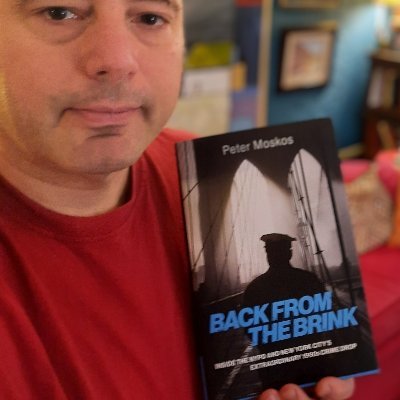
For a few graphs to go with Peter's observation, Dallas/NYC/Chicago when superimposed follow very similar trajectories over time, and are good bell weathers for the national trend. Baltimore basically never came back down from the 90's beak.
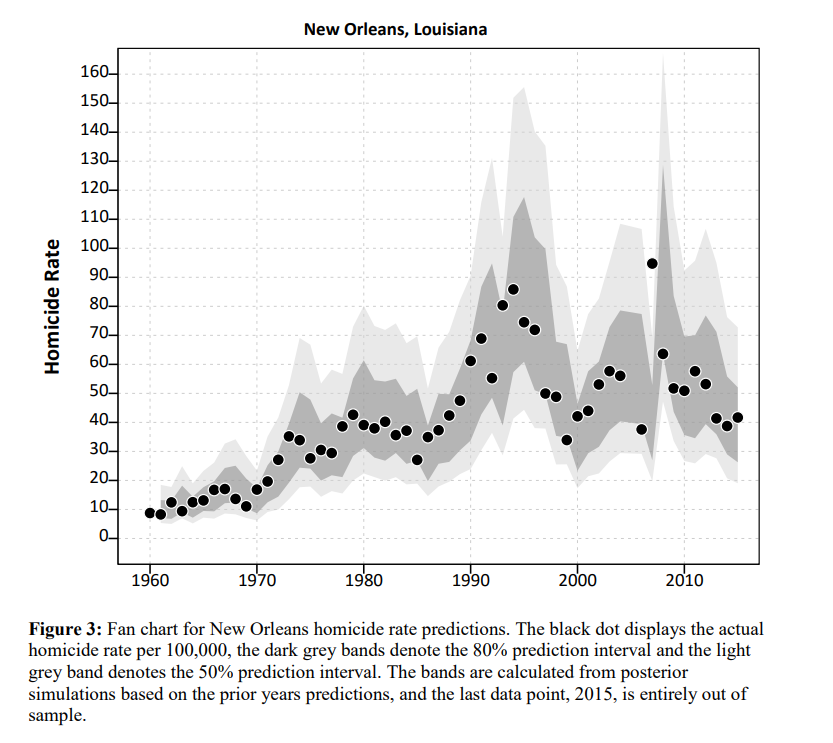

Baltimore has always been a bit resistant to national trends. And sure, it's fun to say: "That's just Baldimore, hon!" But looking at _why_ the city bucks so-called trends is revealing. (thread)
One of my favorite maps, proportion differences in violent crimes vs pedestrian stops in NYC.


7 Days to Destroy Her Garden... Or Else!
@ashleytrubin It is more so because people are overly risk averse. So even when the expected value of change is positive, because of potential variance people do not make the change.

Notes on 100+ Recent Technical Interviews I interview a ton of engineers. Recruiting is the single most important technical CEO activity. Here are a bunch of impressions 1. There is a severe ZIRP engineering overhang that is currently washing out. They're getting laid off, managed out, etc. after having been massively overhired around 2020-2022. This is worst for Tier-2 big tech (think PayPal, Bill, etc.) but also FAANGs. These are overwhelmingly bad engineers. 2. This flood of unqualified but good-on-paper candidates makes this the hardest SF hiring market I have ever seen, due to the amount of nominally strong-looking candidates that you need to grind through. 3. I am highly skeptical of "AI as a cause for engineering layoffs". I think this is a large-scale polite fiction -- the companies don't want to admit they overhired, the engineers don't want to admit they are bad at their jobs. Everyone's blaming AI when it's really just the market rectifying itself. 4. Many of these engineers appear never to have had a real engineering function at their corporations. They're sitting in meetings, "making decisions about technology" but are unable to write software. I leave many interviews baffled by what exactly they were doing for so many years, let alone what their manager was doing. 5. I have interviewed some engineers from FAANG companies so shockingly nontechnical that I am forced to conclude that there is either (1) a lot of resume fraud going on or (2) that there are kickback grifts within those organizations -- people hiring their cousins and splitting the pay, that kind of thing. I have no other explanation. 6. There's a fun side-effect where after interviewing 20+ people from certain small but public companies, I actually feel like I am gaining a short sellers' advantage: there are financial technology companies out there that, knowing what I now know, I would never deposit a single dollar into. 8. Based on this "exhaust" data, and extrapolating a little bit, maybe aggressively so: I think folks like @pmarca are basically right when they say that ~every tech company is overstaffed by a factor of 2-4x. Whatever the reason -- staffing ahead of need, monopolizing certain engineer types (Google-style), headcount-driven promotion incentives, the reality is that a lot of these companies are not being run for the shareholders. The aggregate SBC expense is insane, and I expect this is going to get rectified eventually. I'm sure that AI will play a role in rectifying this -- but I fear that people are going to blame AI for taking people's jobs when the reality is that the jobs were already long-gone, possibly always useless, but the highly-paid butts-in-seats remained. People will be mad at AI for taking away their lucrative sinecures. Maybe that's the same effect from a public policy perspective, but it feels different morally.
Blog post is here, andrewpwheeler.com/2017/03/31/usi… The test is currently in my ptools R package, github.com/apwheele/ptools
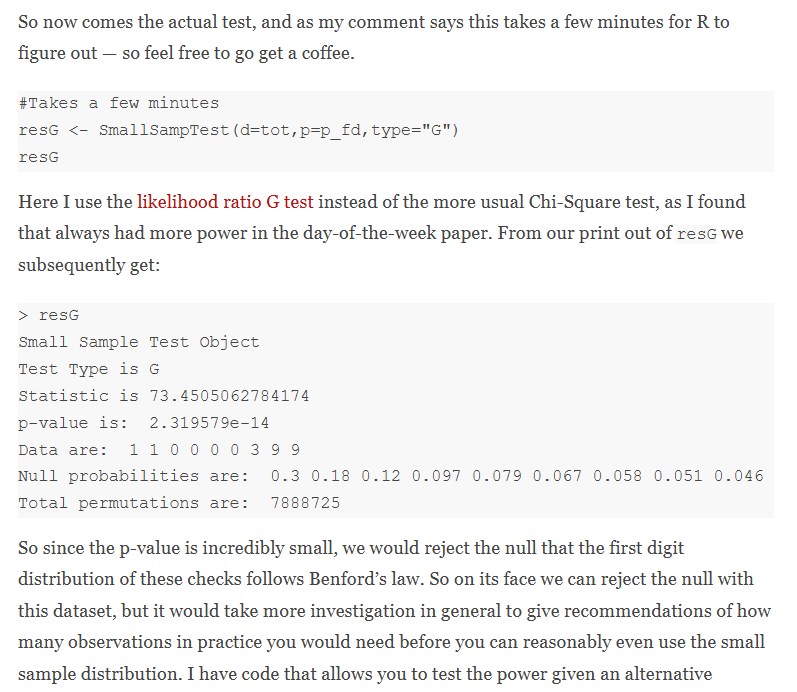
When I was a crime analyst, I developed a small sample test to determine if an offender showed a random distribution to offend on different days of the week. The same work can be applied to Benford analysis of digit distributions. This blog post I go through an example of fraudulent checks in the Nigrini book (which he states is too small a sample to conduct analysis on, 23 checks). I show the p-value in his example with my test is incredibly small. And even if people are using a random number generator (which is unlikely, as most people when they fudge tend to be much less random), the power with 20 some checks is around 50% for my test.


For what it is worth (professional software engineer), I do not believe the total disruption of the software industry will happen. AI will be a complement, not a replacement. Many white collar organizations are fat (think when Elon took over X and fired more than half the staff and everything was fine). Most software companies would similarly survive that. Nothing to do with AI (and the hiring glut for Covid free money has only really recently leveled back to equilibrium). The software industry is the most easily replaced by AI (for reasons John mentioned). What engineers do though is too varied to get 100% replacement. (The exception are companies being built now that 100% leverage AI to build everything.) I had been using the AI tools before they were popular (before the 180 John talks about, I taught myself Claude Code on Sonnet 3.5 and then 3.7, so early 2025). It really has not been that big of a shift, people who 180'd were not familiar with the tools to begin with. They can be very helpful, folks saying they are writing 30k+ lines of code a day though are full of it. I am happy if I have a session of 1k lines (and after the product base is built, it is often not even that, but more tedious small incremental testing). There is a happy path for everyone even with AI just being a complement (still makes the AI companies a ton of money, and most people are not squeezed out of jobs). So I just do not foresee total replacement. I also do not foresee massive gains in productivity. AI can be a real boon for very good engineers, most engineers are just not at the caliber though to effectively 10x their output and produce quality work. (One of the reasons I harp on wanting more good social science grads to go into software engineering, the median software engineer is not good. Giving a not good software engineer AI will currently just mostly compound the not good output, not on average improve it.) So my overall take is very boring. Marginal improvements across a wide variety of white collar jobs are likely to occur, but not massive disruption.

After many conversations over past year with friends, business associates & policymakers about the future of AI job disruption, I’ve tried to get my thoughts in order. With the caveat that I have no specific AI expertise, here they are. Comments and corrections encouraged.🧵 1/n
I presume PLoS One already collected their fees, so they probably don’t care if a paper is retracted after that. (Assuming they do not give refunds.)

Incentives to replicate articles are so bad. Even when your comment leads to the retraction of a PLOS One article, the reward is a (10 days late) email with a thank you at the bottom. Retraction notice: journals.plos.org/plosone/articl…. But we are not complaining about PLOS One 🧵

I have always viewed my career as "we have a problem, what is the best solution to solve that problem". This not uncommonly involves combining either existing algorithms to new scenarios, or entirely creating new algorithms. For example, here is an algorithm I created to help identify *the best* individuals to deliver the message to in a focused deterrence intervention. The idea behind FD is a collective action problem, you can't get a single gang member to stop carrying a gun if everyone else is carrying a gun. So you tell all the groups at once, if you shoot at another gang member, we are coming after the entire gang. You deliver this message via a call-in. The rub is you often cannot dictate every gang member attend the call-in. When looking at data for a few jurisdictions in upstate New York I worked with, they tended to call in very sub-optimal individuals on the periphery of the network. So I developed a greedy algorithm that identified the best people to spread the message in the network. You can apply the algorithm on your own networks on a web-app on my site, crimede-coder.com/graphs/network. (This is run on your local computer, so you can input sensitive data on here and I cannot see it.)

Dan Goldstein @dggoldst
12K Followers 1K Following Partner Research Manager at Microsoft Research NYC. AI, Economics, Decision Science.
Rachael Songalewski @RachSongalewski
121 Followers 773 Following Wife | Mom | Boss | Analyst *My views are my own*
Dr. Ashleigh Wojslawo... @therealdr_wojo
122 Followers 305 Following Researcher 👩🔬 Photographer 📸 Traveller 🧳
Ahmed @ibnmisr73
60 Followers 2K Following
Thaddeus Lateef Johns... @docthadjohnson
2K Followers 3K Following Senior Fellow, @CouncilonCJ. Criminologist, @GSUCJC, Andrew Young School of Policy Studies Opinions, my own.
Rosmine @rosmine
3K Followers 567 Following Independent researcher | AI advisor | Distribution Fine Tuning (DFT) for better LLM writing quality
J @J1862223128896
0 Followers 92 Following
Ihor Stepanov @ihor_step
188 Followers 274 Following I am the CEO and co-founder of Knowledgator. We are advancing the #information_extraction field with #opensource #AI models.
Kelsey Piper @KelseyTuoc
63K Followers 1K Following We're not doomed, we just have a big to-do list.

コウラジ @courage1632
40 Followers 243 Following
Greg Drake @GregDrake1989
10 Followers 189 Following
Luis Pedro Coelho @luispedrocoelho
4K Followers 4K Following group leader at @CMR_QUT science. microbiome. content creator for Elsevier, NPG and others! traveling salesman of second hand ideas
medium warm @mediumwarmtakes
38 Followers 285 Following
egodystonic🍁 @rec0nc11e
23 Followers 461 Following ☀️ the loss does not deter me and the victory does not praise me, i need more ☀️
Shawn Walker @walkeroh
876 Followers 2K Following Assistant Professor @asu's @asunewcollege. Studying social media, resistance, methodology, collection, archiving, and analysis. Views are my own.



Charles Nathan @CharlesENathan
159 Followers 2K Following Assistant Professor of Political Science at University of Houston
Manas Kaushik @MANas8U
1K Followers 5K Following Healthcare doer.Immigrant/Pilgrim. Internist, solo developer, Invested in people & a microSAAS. This is life,not dress rehearsal.
jayxenos @jayxenos
72 Followers 953 Following Jay. Australian, gay, writer, politics. A man's character is his fate.
Pat Brady @Patrickology_
2K Followers 2K Following Just a millennial criminologist standing in front of a room of students, asking them to laugh at the memes in my lecture slides. You should follow me (legally).
Debora Newman @debora_newman__
2K Followers 3K Following
sammy_ds @sammyds7
3 Followers 187 Following
Abishek Sankararaman @abishek90
442 Followers 6K Following Researcher by day at Amazon. Interested in Machine Learning, Networks, Probability. Fan of South Indian Food. Dabbles in arm chair philosophy.
Ziyaad Omar @Z_O5013
34 Followers 4K Following
Trial12345 @Trial123457
20 Followers 2K Following
Megan Denver @megandenver
361 Followers 461 Following Associate Professor, Northeastern University. Formerly @urbaninstitute
世界かぶりもの... @matg31
1K Followers 2K Following Notiono, ex-Amazonian security,JEF United CHIBA,YOKOHAMA Baystars,sanpo,Brompton Bicycle,Bridgestone 発言は、組織的な何かではなく、個人的なものです
Adversarial Minds @adversarialmnds
115 Followers 239 Following AI Security Architect and Strategist | Helping organizations secure what they build with AI | Founder, Speaker, Board Advisor

Jeff Camp @JeffreyCamp
671 Followers 433 Following I'm not who you think I am. Mets & Isles & Phins. No. Hoops.
Zack Korman @ZackKorman
12K Followers 2K Following Cofounder @ Embroidery. Building AI cybersecurity stuff.
Rachel Morgan @minirmorgan
1K Followers 1K Following PhD researcher in crime science. 2x 🌎, 3x 🇬🇧 totally blind 🎾 champion, TeamGB. Play, fight, win. Often found in a dojo 🥋.
Adam Watkins @adammwat
0 Followers 36 Following
Dr Hannah Jones @drhannahjones
700 Followers 2K Following Forensic Psychologist | Programme Director/Reader | Expert Witness | All views my own (despite/as a result of what Freud might think)

Dr. Christine Sartesc... @DrSarteschi
14K Followers 7K Following Full Professor of SW & Criminology | Extreme violence researcher. Books about #Sovereigncitizens | Mass violence | Opinions own & RPs not endorsements

Degres @degres361
40 Followers 2K Following
Oral History Criminol... @OHCP_CCJ
813 Followers 165 Following Interviews w CCJ’s biggest names. Great for teaching & research. Open access. Supporters: @ascrm41, @ACJS_National, Member @CrimConsortium Tweets by @lonecrim
Aaron McLean @rnmcln
163 Followers 6K Following
Pablo @_dominguezpablo
81 Followers 184 Following Hi, I'm data analysis, software developer | python | learning everyday 🔥💻
Greg J. Marchand MD @MarchandSurgery
300K Followers 119K Following Dual board certified #MIGS & #OBGYN CV: https://t.co/l3Aixp5wxK My opinions are my own. (They're also correct.)
Human Agency @mekalav
748 Followers 6K Following 25 years making tech actually land at Unilever, Mars, Shell, BP. Now building AI that fits into real life. No IT team required. Founder @HumanAgencyAI
José (Joe) Eleuterio @eleuteriopmpr
617 Followers 554 Following A Brazilian retired cop researching cop stuff. PhD student @TXST_CJC. Research Associate @alerrtcenter. BJJ. 'Numa mão a pena e noutra a lança'
Carolyn D. Gorman @CarolynGorman_
2K Followers 2K Following mental health ≠ mental illness • fellow @ManhattanInst • mental illness policy • opinions mine • rt/likes are not endorsements
Lauren W @LaurenW_CJ
111 Followers 498 Following M.A. in Criminology. @GVSU & @LoyolaCJC alum. Research Scientist at @ICJIA_Illinois. Lover of cats. She/her. Tweets/views are my own.
Dr. Daniel Lytle @dlytle21
2K Followers 2K Following Ph.D. in Criminal Justice and teaching a variety of classes in MD, I also fancy cooking, F1, and other nerd things. Happily married to a wonderful man. (he/him)
xAI @xai
2.0M Followers 5 Following
Dan Goldstein @dggoldst
12K Followers 1K Following Partner Research Manager at Microsoft Research NYC. AI, Economics, Decision Science.

Shengzhe @shengzheyao
3K Followers 28 Following Antigravity@Google DeepMind | Creator of Antigravity CLI
Daniel Lockyer @DanielLockyer
60K Followers 142 Following • I make sites faster and cloud/LLM bills lower 🚀 • 2:43 marathoner (🔜 2:39 in Berlin)
Dr. Ashleigh Wojslawo... @therealdr_wojo
122 Followers 305 Following Researcher 👩🔬 Photographer 📸 Traveller 🧳
Right On Crime @RightOnCrime
17K Followers 2K Following Conservative criminal justice solutions for less crime, fewer victims, and safer communities
National Institute of... @OJPNIJ
12K Followers 859 Following Strengthen Science. Advance Justice. Official account. We don't collect comments/messages. RTs/follows not endorsements. Privacy policy https://t.co/tqp3VXHkLL
National Policing Ins... @PolicingInst
9K Followers 2K Following NPI is an independent and nonpartisan nonprofit dedicated to creating excellence in policing through the development, translation, and application of research.
Criminal Justice at A... @CJ_at_AV
84 Followers 1 Following Americans deserve a safe society that builds thriving communities while upholding people’s constitutional and civil rights.

Corey Quinn @QuinnyPig
103K Followers 1K Following Chief Cloud Economist at Duckbill. Author, Artificial Confidence. Professional skeptic with receipts.
Rosmine @rosmine
3K Followers 567 Following Independent researcher | AI advisor | Distribution Fine Tuning (DFT) for better LLM writing quality
Ihor Stepanov @ihor_step
188 Followers 274 Following I am the CEO and co-founder of Knowledgator. We are advancing the #information_extraction field with #opensource #AI models.
Marc Krupanski @mkrupanski
4K Followers 324 Following Working for healthy, safe + strong communities | now: Director of Criminal Justice Policy @Arnold_Ventures | before: a bunch of stuff

DuckLabs @ducklabs_com
4K Followers 2 Following DuckLabs provides services for the DuckStack (DuckDB, DuckLake, and Quack)
MotherDuck @motherduck
9K Followers 166 Following The data warehouse built for getting answers from your data. Works with AI agents and SQL. Built in collab with @ducklabs_com
Mehdi Ouazza @mehd_io
2K Followers 683 Following 🥑 DevRel @motherduck (Cloud-based DuckDB) ✍️ 🎥 Teach about data, AI, software engineering
Theo - t3.gg @theo
341K Followers 4K Following Full time CEO @t3dotchat. Part time YouTuber, investor, and developer
Jamie Quint @jamiequint
16K Followers 1K Following GP @uncommon_cap. First round investor: @hellofora, @joinyendo, @AntaresNuclear, etc. Past: Early Growth/Monetization @Mercury @NotionHQ @Reddit. YC W08.
Andy Masley @AndyMasley
15K Followers 2K Following When the going gets weird the weird turn pro. Researching and writing AI and other topics from a broadly EA perspective. On a grant from CG.


Pangram @pangram
11K Followers 17 Following Keeping the world free of AI slop. This account has automated replies: Tag @pangram with 'ai?' to get an AI check on any post.
Andy Jassy @ajassy
2.0M Followers 284 Following Lead Amazon, married and father of two kids, big sports/music/film fan, experienced buffalo wings eater. Go Kraken!
Christopher F. Rufo �... @christopherrufo
850K Followers 1K Following Working with @CityJournal, @ManhattanInst, @Hillsdale. Sign up for my free Substack: https://t.co/azjaTnUCKh.

Andrew Wimer @andrewwimer
3K Followers 533 Following Director of Media Relations at Institute for Justice (@IJ). Former Hill staffer, former speechwriter, current Dad. Opinions are my own.
Jason Kerwin @jt_kerwin
5K Followers 2K Following Development Economist @UWecon, Research Associate @nberpubs, Affiliate @JPAL. Hawaiʻi born, Stanford alum, Michigan PhD. Former Minnesotan.
keysmashbandit @keysmashbandit
16K Followers 1K Following First thing you need to know about me is that on an animal level I believe that 30 is half of 100 Doing my best @pangram
Qiusheng Wu @giswqs
51K Followers 4K Following Associate Professor @UTKGeography | @Amazon Scholar | Talk about #opensource #geospatial #dataviz #GeoAI
Steren @steren
11K Followers 2K Following Engineer turned Product Manager @Google https://t.co/FQDIl9gUWR founder+lead

ClaudeDevs @ClaudeDevs
467K Followers 3 Following Official updates for developers building with @ClaudeAI
Dave Khey @4n6dave
583 Followers 1K Following Criminologist, expertise in drug policy, criminal justice programming, & mental health. #stigmafree
Nate Silver @NateSilver538
3.0M Followers 2K Following Silver Bulletin, not the only thing I'm doing but the main thing and the best thing! https://t.co/mYtb4rgUyT
Zack Korman @ZackKorman
12K Followers 2K Following Cofounder @ Embroidery. Building AI cybersecurity stuff.
ar.io @ar_io_network
57K Followers 1K Following Critical data, always accessible - even when systems fail.

Orin Kerr @OrinKerr
126K Followers 4K Following Professor, Stanford Law School. Senior Fellow, Hoover Institution. Read my book: https://t.co/NScgWkDNEI
Jessica S. Tisch @NYPDPC
171K Followers 453 Following The official X of the Police Commissioner of the City of New York. Not monitored 24/7. Please call 311 or 911. https://t.co/wu3bxWVyQ0
Wesley Smith, PhD @WesleyTSmith3
420 Followers 288 Following PhD from @SHSUCJ • US Army Veteran • SAR K9 Handler • Adjunct Instructor • Researcher for a large U.S. Correctional Agency • Views are my own
Forensic OSINT @ForensicOsint
3K Followers 132 Following - Chrome Extension for OSINT Web Capture - Capture Evidence Quickly Before It Disappears - Includes: OSINT Knowledge base, Video Download and Data Insights!
Dr. Christine Sartesc... @DrSarteschi
14K Followers 7K Following Full Professor of SW & Criminology | Extreme violence researcher. Books about #Sovereigncitizens | Mass violence | Opinions own & RPs not endorsements
joseph francis @joefrancis505
11K Followers 2K Following Economic historian. Honorary Fellow @unibirmingham. Work: https://t.co/hd6On6Wtwx. Agent: https://t.co/p5h3kCMVNY. Also: https://t.co/mXtyIGOiSm.
Joshua Tucker @j_a_tucker
8K Followers 3K Following Politics Prof, NYU; Director @NYUJordanCenter for Adv Study of #Russia; Co-Director @CSMaP_NYU (https://t.co/9wrSlowG1L); @jatucker.bsky.social; he/him
Philip Kiely @philipkiely
8K Followers 806 Following Author of Inference Engineering | Early @baseten | Not an LLM (yet)
Peter Hull @instrumenthull
55K Followers 3K Following Professor @Brown_Economics, studying econometrics, discrimination, education, and healthcare. Editor @AEAjournals, affiliate @nberpubs, scholar @amazonYou might like