Conduct Science @ConductScience
🔬 ConductScience | Research Tools & Innovation Advancing AI driven animal behavior analysis, open-access publishing, tech transfer. Posts by PhD's conductscience.com United States Joined May 2015-
Tweets701
-
Followers177
-
Following460
-
Likes270
Our partner, @ThalamusGME , is offering a free, year-long webinar series focused on the residency application and recruitment process: The Pathway to Residency. Designed for medical students, faculty, and administrators, the series features expert perspectives and practical guidance to help participants navigate each stage of the journey. Register once to receive access and reminders throughout the series. Learn more: thalamus.org/residency-seri… #ResidencyMatch #MedicalStudents #MedicalEducation #GME

Our partner, @ThalamusGME , is hosting a free webinar for residency applicants: Starting the Pathway to Residency: Determining What Matters and Building Your Narrative Duration: 45-minute session + live Q&A Speaker: Jason Reminick, MD, MBA, MS Register here: lnkd.in/e4-f-N2x

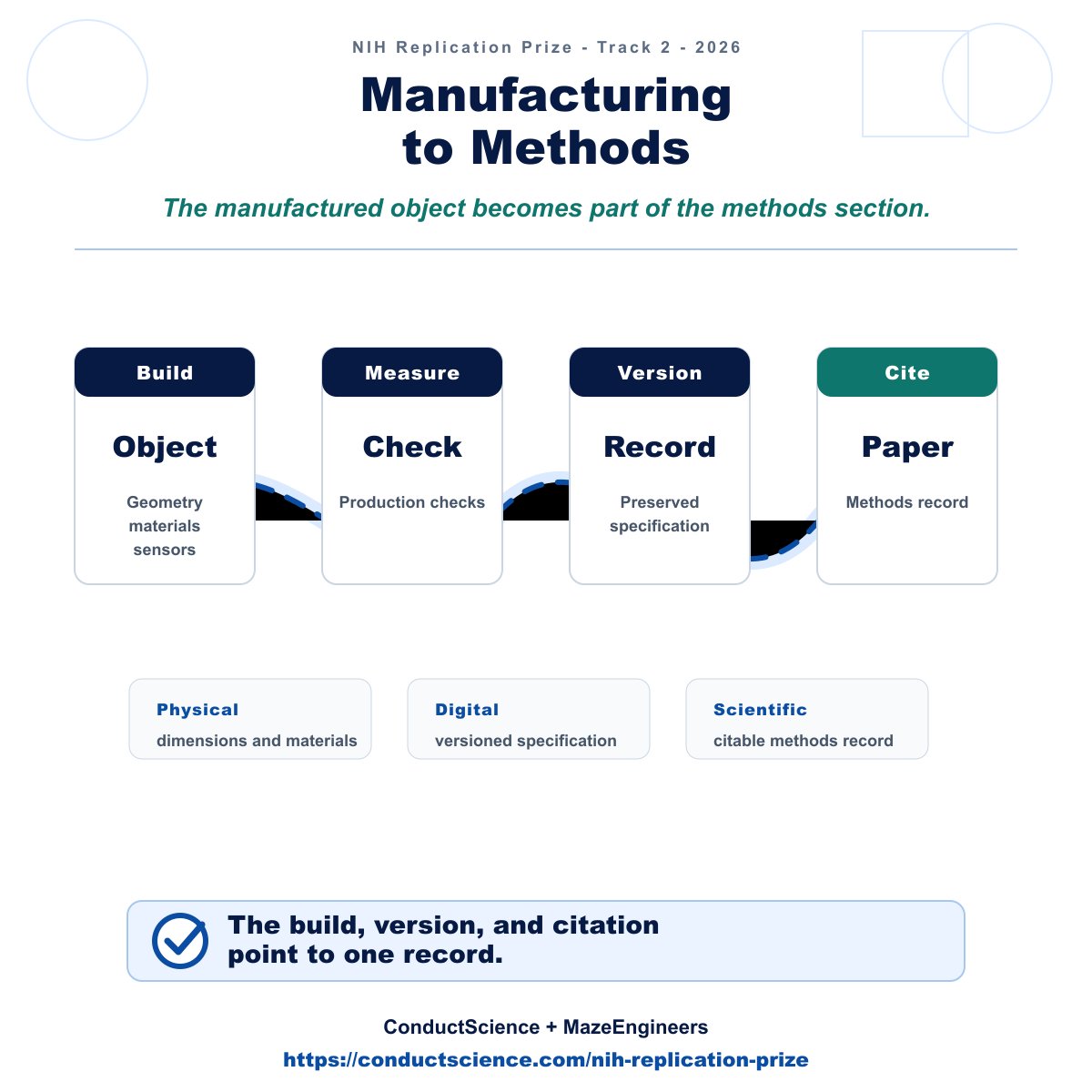
The manufactured object belongs in the methods section. Geometry, materials, sensors, version history, and production checks all shape the experiment. Build it. Check it. Version it. Cite it. Replicatescience.com conductscience.com/nih-replicatio…
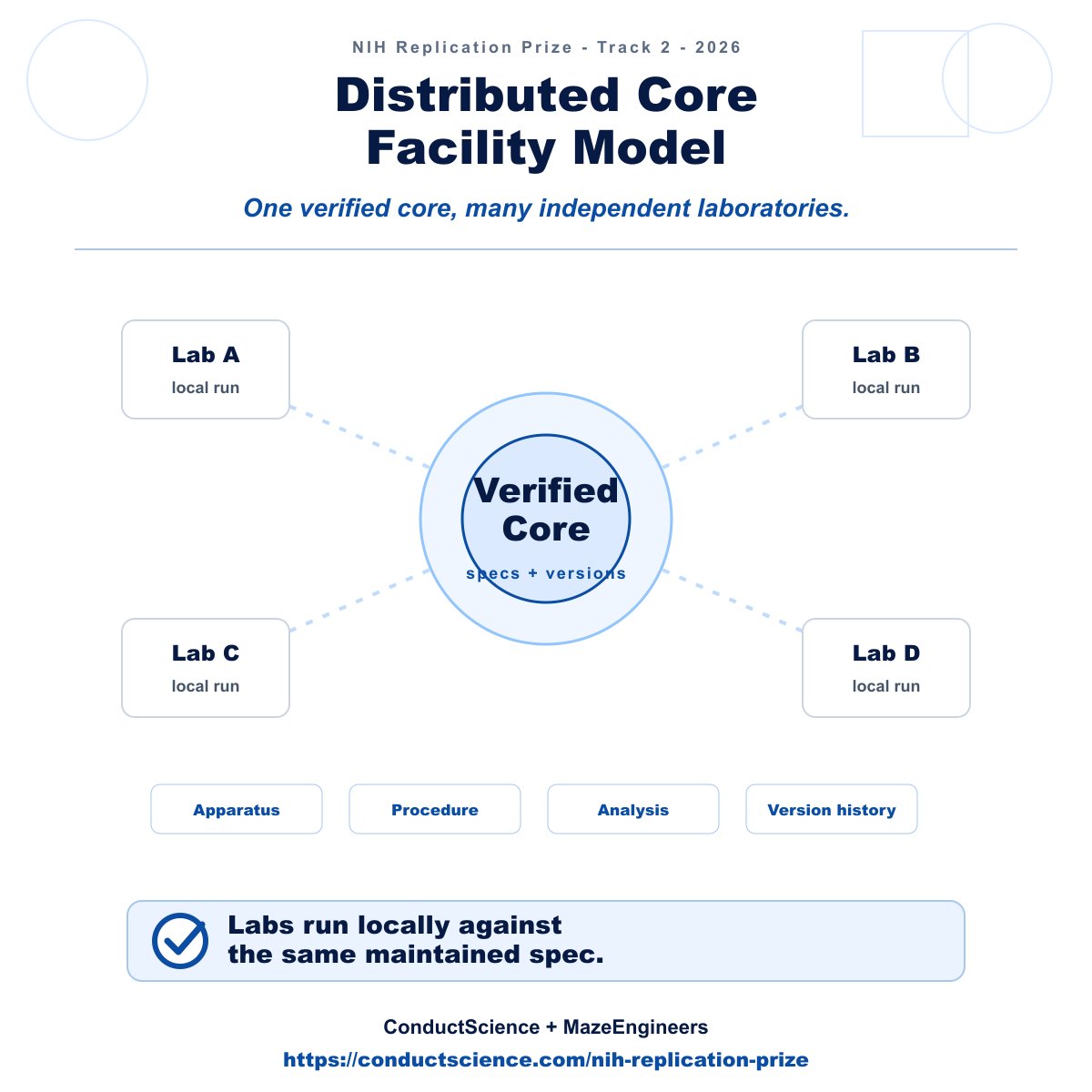
Replication can work while each lab runs in its own facility. A distributed core keeps the specifications, versions, procedures, and analysis layer maintained while labs run locally. One verified core. Many independent laboratories. We helped invent the distributed manufacturing core facility. Its why we win the @NIH replication prize
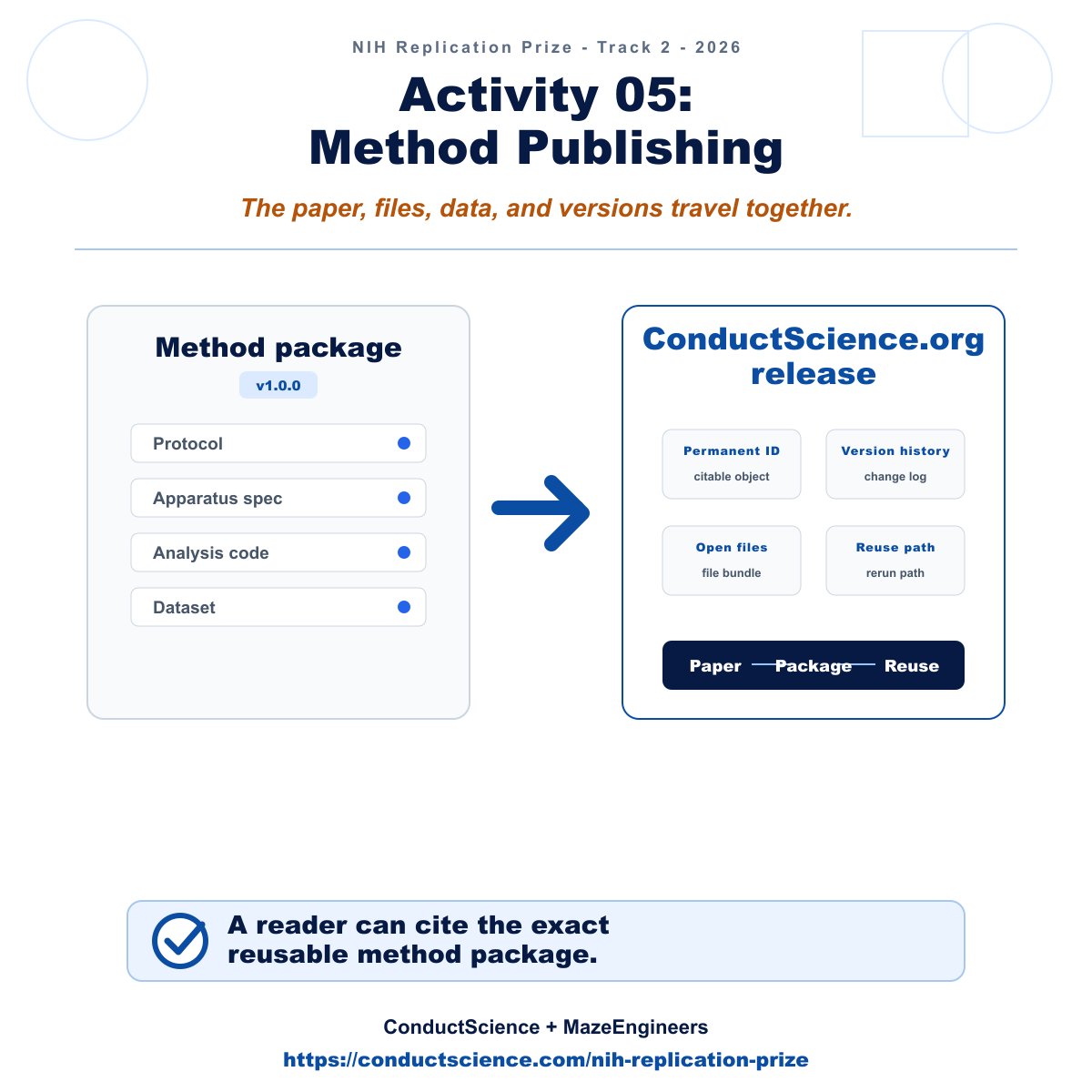
A paper is easier to repeat when the method package travels with it. Protocol. Apparatus spec. Analysis code. Dataset. Version history. That is the publishing side of productized replication. conductscience.org
A lab invention helps replication when it can travel. Technology transfer turns a prototype into a deployable tool with specs, procedure logic, and originating credit preserved. Prototype, credit, and method move together. That's why we won the NIH Replication prize.

ConductVision turns behavioral video into inspectable data. That's why we won the NIH replication prize. Tracked paths, event boundaries, timestamps, and open exports make it easier for another lab to see what was counted and recompute the measure.

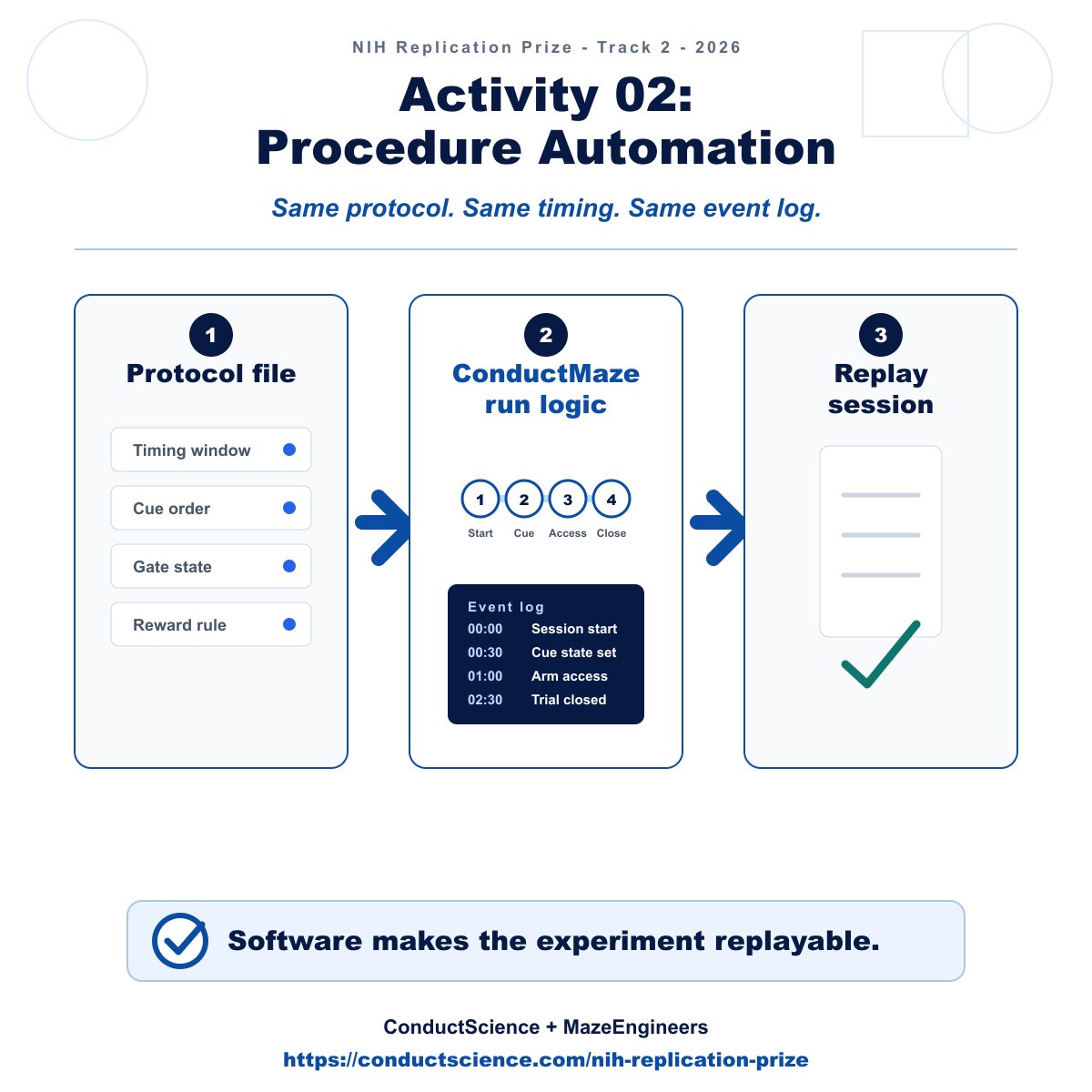
Manual timing creates drift. We fix that. Thats why we won the NIH Replication Prize. ConductMaze helps turn protocol steps, timing windows, gate states, reward rules, and event logs into something another lab can inspect and repeat. Same protocol. Same timing. Same event log.
The NIH result gives external proof. The product promise is the part labs feel day to day. Make the equipment clearer. Make the procedure more consistent. Make the analysis easier to inspect.

The winning submission documented: In laboratories using our standardized apparatus, results from independent control groups varied roughly half as much as the historical multi-laboratory benchmark (Mean coefficient of variation: 0.41 in our cohorts, versus 0.76 in the historical reference.)
ConductScience and MazeEngineers have been named winners of the NIH Common Fund Replication Prize, Track 2: Replication Exemplars. For labs, this is about products that make behavioral methods easier to repeat. conductscience.com/nih-replicatio…
We've been supplying labs for years. The hardest problem was never the equipment. It was that researchers couldn't get from a published paper to a protocol they could actually run. @ShuHanHe built the fix. replicatescience.com
I am a physician and a researcher. I also build software. And the longer I spent in all three of those worlds, the more one thing became impossible to ignore: science methodology is the most important part of research, and it is the least developed as infrastructure. In
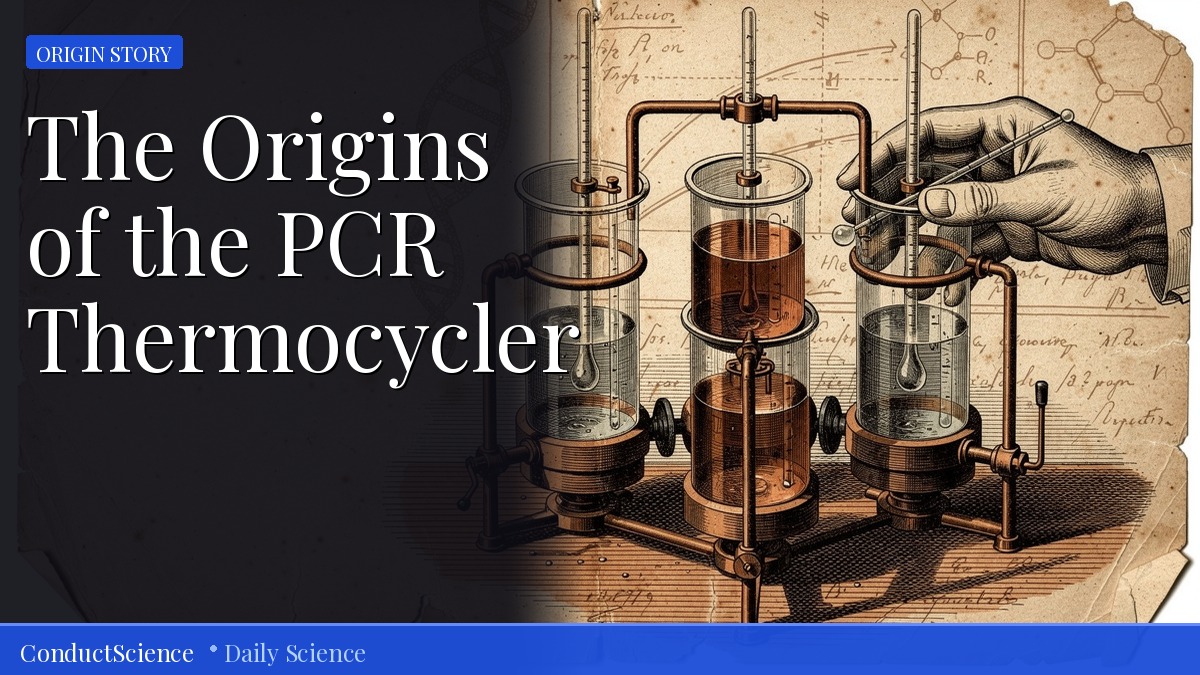
The first PCR machine at Cetus Corporation in 1983 was built from water baths on a lab bench. Kary Mullis moved test tubes between them by hand, repeatedly, for hours. Mullis needed DNA to copy itself without cloning bacteria, which took weeks and failed constantly. The chemistry required heating, cooling, then heating again. Repeatedly. Precisely. Multiple cycles to see anything. His hands got blisters from the hot water. They used a timer. The tubes cracked if you moved them too fast, split if the thermal shock hit wrong. The lab smelled like burnt plastic and spilled ethanol. Mullis worked nights because the daytime staff kept borrowing his water baths. He'd arrive late with coffee and a stopwatch. The first successful amplification took hours of manual transfers. Heat the bath to denature the DNA strands. Grab with forceps, don't splash. Plunge into the cool bath for annealing. Count. Watch the condensation bead on the tube caps. Back into the medium bath for extension. His hands cramped. He missed cycles when he blinked too long, lost count, had to start over. The company wanted automation but didn't want to fund it. Mullis kept a lab notebook with water temperatures recorded regularly, proof that human hands could hold the rhythm if they had to. Eventually someone invented a rotating rack to move multiple tubes at once. It helped but increased the breakage rate. The thermal shock still killed samples. They started buying tubes in bulk, budgeting for waste. Later, an automated block was built that could cycle temperatures without hands. Mullis got the Nobel in '93. The device had a thermal block with holes where tubes holding the reaction mixtures could be inserted. The cycler raised and lowered the temperature of the block in discrete, pre-programmed steps.
The researcher Jonas Salk worked on killing poliovirus for his vaccine in Pittsburgh in 1952. He needed dead virus that still looked alive to the immune system. Too much heat would damage the protein coat. Too little could leave dangerous particles. He grew his virus in lab cultures, processing batches at a time. The cells died as the virus reproduced. He'd pour off the liquid, filter it, then treat it. Formaldehyde was one method to inactivate the virus, but heat was another approach. He tested batches carefully, refining his methods through trial and error. His work required finding the right balance, inactive virus that could still trigger an immune response. The challenge was scale. A single dose needed very little. A field trial needed much more. He couldn't use small equipment for large volumes and expect consistent results. Industrial equipment existed, but coordinating with manufacturers took time. A major trial was planned. The vaccine Salk developed became one of the first successful polio vaccines. It used inactivated poliovirus given by injection. Combined with other vaccination efforts, these vaccines eliminated polio from most of the world and reduced reported cases from an estimated 350,000 in 1988 to 33 in 2018. Salk had been born in New York City and attended the City College of New York and New York University School of Medicine before his groundbreaking work on the polio vaccine.
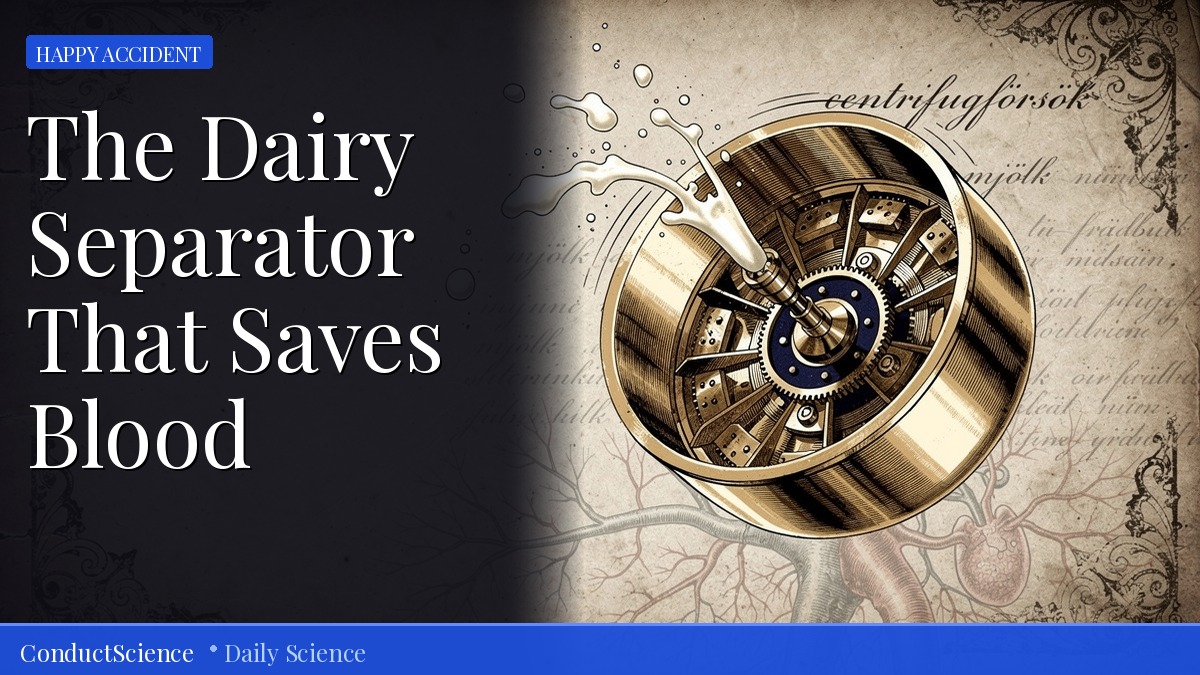
Gustaf de Laval's cream separator, patented in 1878, didn't work smoothly at first. His Stockholm workshop saw plenty of failed attempts. The device wobbled and leaked. Farmers needed their butterfat separated reliably. De Laval had experience with steam turbines when he turned his attention to dairy machinery. Traditional separation methods were slow and inefficient. The old approach meant waiting for cream to rise naturally in shallow containers. The process took hours, and quality suffered during the wait. Farmers lost money. De Laval applied principles from his turbine work and built a drum with stacked discs inside, spinning milk at high speed. Early tests failed. The forces were too strong, or the spacing wasn't right. He adjusted the design repeatedly, changing gasket materials and disc configurations. Eventually he got it working. Two streams emerged from the separator, one was cream, one was skim milk. Both came out cleaner than before. He had figured out that denser liquid moves outward in the radial direction during spinning, while less dense substances move toward the center. The physics matched what happens in any centrifuge: different densities separate under rotation. The separator found use beyond dairy. Medical facilities eventually adapted centrifugal separation technology for blood processing. Modified versions of similar machinery were used in various settings over the following decades. De Laval had been gone for years by the time these applications became widespread. The basic principle he applied to cream, using rotation to separate fluids of different densities, proved useful in contexts he never anticipated.
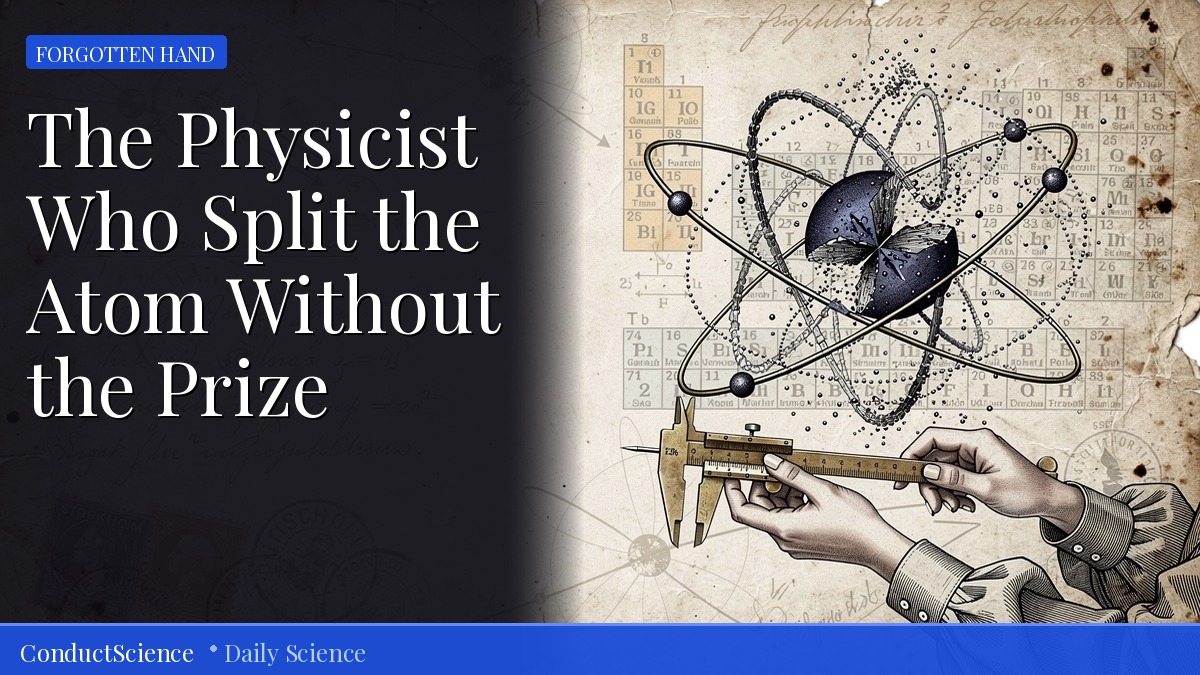
Lise Meitner helped discover nuclear fission in 1938, working from Stockholm while her longtime lab partner Otto Hahn published from Berlin. She had fled Germany earlier that year as a refugee. No passport protections, no secure position, no laboratory of her own. For decades she had run experiments beside Hahn in Berlin, her notebooks filled with observations that didn't match existing theory. Now she lived in Stockholm, where she had limited resources and uncertain professional standing. She corresponded with Hahn about ongoing experiments, work she had helped design before leaving. The results troubled her. The data suggested something impossible: that uranium nuclei were splitting apart, releasing fragments far lighter than expected. Her nephew Otto Frisch, also a refugee physicist, visited that winter. They discussed the problem during a walk in the woods because she had no other workspace. She worked through calculations on whatever paper was available, using borrowed materials, her cold hands making the work difficult. The uranium nucleus could deform and split, she realized. She calculated the energy release from Einstein's mass equation. The numbers were staggering. Frisch contacted other physicists to share the insight. Hahn's paper describing the experimental results had already been submitted for publication. It did not include her name. The 1944 Nobel Prize went to Hahn alone. Meitner continued working, gave lectures, outlived most of her generation. Element 109 is named meitnerium. The snow that day had been wet, the kind that soaks through wool and freezes later.
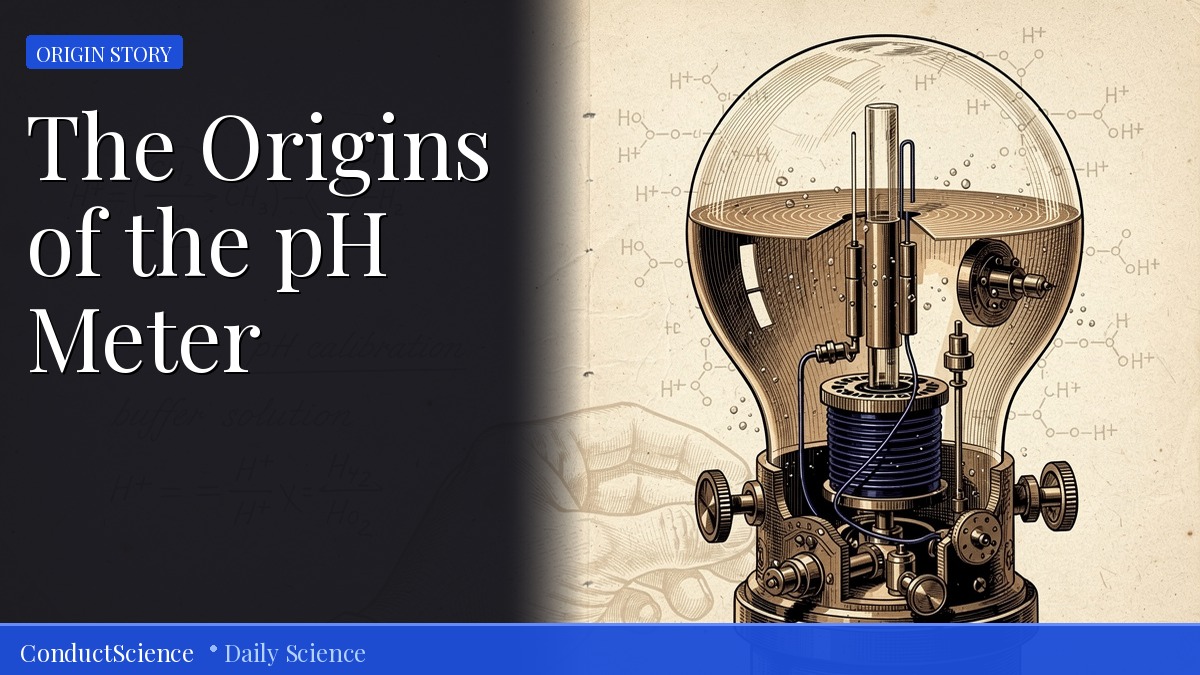
Arnold Beckman's first pH meter, assembled in 1934 at Caltech, measured the difference in electrical potential between electrodes to determine acidity. The device translated hydrogen-ion activity into readable numbers. Before pH meters, measuring acidity was imprecise and slow. Litmus paper showed color changes but gave no exact values. Titration required careful laboratory work, adding base drop by drop until solutions changed color, then calculating backward from volumes used. Every batch was different. Every technician read the color shifts differently, and no one could agree on results. Beckman built a device that read voltage differences between electrodes placed in solution. The hydrogen ions in acidic solutions generated electrical potential that could be measured. More ions meant different readings, producing exact numbers. The glass electrodes were fragile and had to be thin to function properly, which made them easy to break. The readings could drift. The reference electrode used a salt bridge that required maintenance. The apparatus sat in a case, and the instrument was designed to turn pH measurement from imprecise guesswork into reliable dial readings. The device found customers. Caltech's chemistry labs bought them. Breweries wanted instruments that could measure pH precisely. Pharmaceutical plants ordered them. Beckman left teaching in 1940 to manufacture the meters full time. He founded Beckman Instruments based on his invention, a device later considered to have revolutionized the study of chemistry and biology. He never went back to the classroom.
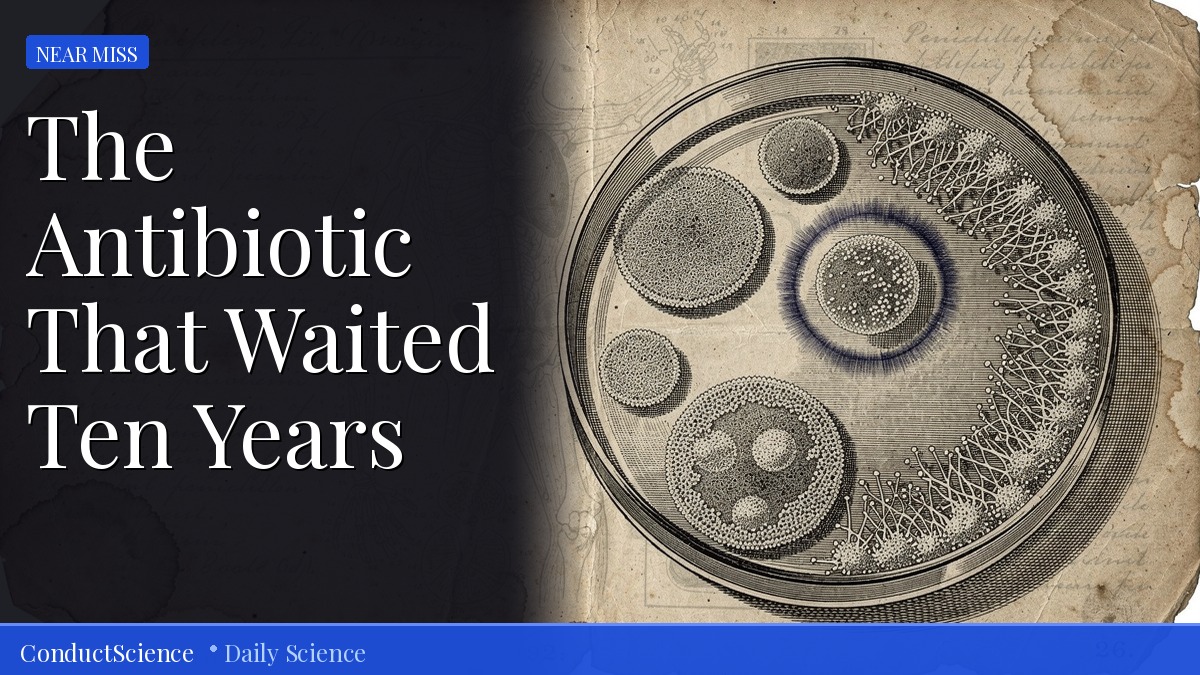
Fleming's contaminated petri dish, September 1928, sat in his laboratory at St Mary's Hospital in London. The mold was from the Penicillium family. He kept it because the bacteria around it had died. He wrote a paper describing what he'd observed. He tried to isolate the active compound, but the substance proved difficult to stabilize and work with in practical applications. The mold-derived material was challenging to extract and preserve. Standard laboratory methods of the time weren't able to produce a stable, usable form. The mold itself had limitations that prevented immediate therapeutic use. Fleming tested it in laboratory conditions. It showed antibacterial properties in controlled settings but the gap between laboratory observation and clinical application remained wide. This was 1929. Fleming had made an observation about antibiotic activity, but lacked the resources to develop it into a medicine that could treat infectious diseases in patients. He presented his findings to colleagues. His paper described the antibacterial properties he'd observed. He continued culturing the mold and shared samples with other researchers who wanted to investigate. The substance remained unstable outside carefully controlled conditions. The discovery stayed largely dormant as a laboratory curiosity, something that killed bacteria in a dish but hadn't been transformed into a working treatment. Howard Florey later found Fleming's paper during research. It took years of work to develop the observation into a usable antibiotic. Fleming had identified penicillin's antibacterial activity, but the chemistry needed to make it therapeutic came later. This development would eventually become what was described as the "single greatest victory ever achieved over disease," earning Fleming, Florey, and Ernst Chain the 1945 Nobel Prize in Physiology or Medicine.

Lauren Beaudin @laurenbeaudin
1 Followers 10 Following



Webkorps @webkorpsllc
27 Followers 33 Following Leading IT service provider with over 10+ years of experience in Custom Software Development, Mobile App Development, Web Development, & Digital Transformation
SeewellabCoral @CoralHu23
10 Followers 147 Following 20+Years Laboratory instruments manufacturer,Magnetic Stirrers, Hot Plates, Tubes Roller Mixers, Rotary Mixers, Melting Point Testers, and Dry Block Heaters
Just-O @qwertyuiop7565
165 Followers 903 Following
🧪🧬⌬ @BndW__
138 Followers 1K Following
Chanavuth Win Kanitso... @ChanavuthK
404 Followers 1K Following IC Fellow @VCUhealthheart, @CookCtyCardio @UHInternalMed @SirirajMedicine Alum

Dr. Shuhan He 🫀�... @shuhanhemd
2K Followers 3K Following MGH/Harvard. Clinical informatics. Emergency Med. Lab of Computer Science. @Conductscience @mghihp Director Health Data analytics.
Taehoon Kim @TaehoonKim_7
12 Followers 136 Following Postdoc researcher @Begcy_Lab @UFenvhort @UF Studying epigenetics in plant reproductive development

Maximum Academic @MaximumAcademic
636 Followers 695 Following Official account of Maximum Academic Press. Independent publisher focusing on open access journals.
Amy Avakian, MD @awkdocradi
20 Followers 304 Following Resident Physician at Southern Hills Hospital and Medical Center | Founder of Radiology AI and Deep Learning Collective https://t.co/FkLcpBvDmh
Guajorx @Guajorx2597
17 Followers 886 Following
pipcoin @loganebc
156 Followers 570 Following Biotech Operations Manager @ Molecule | DeScientist | Ask me about my dog 🐶| SheFi S12 💫
Ahmed @a_hazem98
8 Followers 73 Following
Plant Science Researc... @PlantSciRes
1K Followers 1K Following Discover cutting-edge research in Seed Biology, Tropical Plants, and Technology in Agronomy. Open access journals shaping the future of plant sciences. 🌱
The Research Code @TheResearchCode
3K Followers 2K Following Advancing Knowledge Through Global Research Insights💡#TheResearchCode
Sheriff Wakil Geidam @SheriffGeidam
893 Followers 1K Following Lecturer & Passionate Scientist. KadPoly and Unimaid Alumni..Microbiologist 🔬🔬🔬.
Wenbin Du @feeuoo
872 Followers 3K Following Professor, Institut Microbiol @CAS__Science | Postdoc '11 @ismagilovlab @uchicago | PhD Chem '07 @ZJU_China #microbiome #synbio #bioinformatics #singlecell
Junaid Babu @Jgbabu5
131 Followers 552 Following Need help with X Ads, book an appointment with me. https://t.co/3BipOYXsQi
MaxineDora @VBCIjl98aYSfjz0
121 Followers 3K Following
A Healthier Democracy @ahdemocracy
4K Followers 3K Following Building platforms for collaboration and community organizing at the intersection of health and civic engagement to maximize collective impact
Link Health @Link_Health_org
3K Followers 3K Following We partner with clinics to connect patients to federal benefit programs that address social determinants of health and put money back into households.
Wim Crusio @WimCrusio
1K Followers 1K Following Mouse behavioral neurogeneticist (retired) Blog: https://t.co/iwojlhjhxn. Put Ad on my time line: I BLOCK you. Moving to Bluesky: @wimcrusio.bsky.social
Jonathan Whitlock @JonRWhitlock
1K Followers 826 Following Associate Professor of Neuroscience & Group leader, Kavli Institute for Systems Neuroscience, @KISNeuro
Nils Gehlenborg @ngehlenborg
211 Followers 237 Following Faculty @harvarddbmi. Data Visualization. Biomedical Informatics. Genomics. Epigenomics. Cancer Biology. Single-Cell X. EHR UI. mHealth Data.
Hassan Ibrahim @ENGRHIAGUMSA
855 Followers 2K Following Civil Engineer | ASO I @ NCAA | C.E.O @ HASIB INTEGRATED SERVICE'S NIGERIA LIMITED.
Morgan James Lab @morganjameslab
1K Followers 1K Following #neuropsychiatry lab at @RutgersU Motivational disorders, including substance use disorder, depression, eating disorders
Luis Cobar @Prime5222
670 Followers 755 Following Salvadoran Neuroscientist 🇸🇻 PhD | Senior Research Advisor @IMS_MRL| previously @KISneuro (Nigro Lab)| Opinions my own | 🇹🇼🇸🇬🇸🇯🇬🇧
ᗩᗷبᗩ𝕊 @iMr_Abbas
771 Followers 1K Following Scientific Writing Intern at MARS | Gold Medalist | Botany Graduate | Scientific Writer | Researcher | Aspire Leaders Program Alumnus | SDG-9 Ambassador
Eduardo Raad Anton @evolutionraad
5K Followers 6K Following A groundbreaking hypothesis of natural selection: Evolution of species by Natural Selection of Ad-hoc Mutations. https://t.co/Gb90jdhZG4
Olivier Borkowski @O_Borkowski
7K Followers 2K Following Tenured Scientist in Synthetic Biology (MICALIS, Paris Area) Cell-Free TXTL ⦁ Microbiology ⦁ Thinking in Systems
Jonathan Eisen @phylogenomics
62K Followers 8K Following Prof. @UCDavis studying #phylogenomics & #microbiomes. Other: #BirdPhotography, #RedSox, #Type1, Conservation, MarineBio. Past: @harvard @stanford @JohnsHopkins
Toni Marie Valle @valle21_toni
2 Followers 3 Following
Bilal Bari @bari_bilal
441 Followers 926 Following Psychiatrist @McLeanHospital. MD/PhD @HopkinsMedicine, BS @GeorgiaTech. Interested in expanding access to care (clinical) and all things cognition (science).
Jj @J_J_42
101 Followers 7K Following
ConductScience Academ... @ConductSciPub
108 Followers 1K Following ConductScience Academic Publishing: Empowering researchers with affordable open access, streamlined submissions, and innovative tools for reproducible science.
Eeg Man @eegmanabu
3 Followers 122 Following
BlueFrogScientific @BlueFrogSci
11 Followers 233 Following Blue Frog Scientific is an independent regulatory consultancy.
Livita @Livita_lie
0 Followers 3 Following
Ahmad Hassan @drahmadhassan95
87 Followers 232 Following Research fellow at Massachusetts General Hospital Boston| MBBS| MD| Ecfmg Certified| IMC Certified| KEMU
いわくらやまと... @iwakurayam23386
64 Followers 3K Following
ChampInMyCorner @ChampInMyCorner
324 Followers 4K Following Balancing medical school with creative pursuits

Scott Sun @scott_vent78117
1 Followers 57 Following
Lauren Beaudin @laurenbeaudin
1 Followers 10 Following
Boston Business Journ... @BosBizJournal
74K Followers 25K Following The Boston region's source for local business news & events. Part of the American City Business Journals network. Subscribe today! https://t.co/I8dEe5inYZ
Eric Warm @CincyIM
5K Followers 5K Following
National Board of Ost... @NBOME
6K Followers 542 Following We are the leading provider of assessment tools for the osteopathic medical profession. #IPassedCOMLEX 🏳️🌈
Reuters Science News @ReutersScience
1.2M Followers 18 Following From newly charted astronomical anomalies at the far reaches of the universe to the rise of nanotechnology, nobody covers science like http://t.co/RtkLii8CUo.

BJS @BJSurgery
49K Followers 8K Following BJS is the premier peer-reviewed surgical journal in Europe, with an Impact Factor of 9.4. #LeadingSurgicalEducation
Jack Chou @JackChouMD
3K Followers 1K Following Family Physician, Father of 3, #FMRevolution-ary taking on healthcare transformation. Any and all opinions are my own.
Shreya P. Trivedi MD,... @ShreyaTrivediMD
20K Followers 3K Following | @COREIMpodcast Producer | @iMedEducation l PopHealth | @theCurbsiders correspondent | Internist @BIDMC_IM | Former Fulbright Scholar |#WomeninMedicine |
Ada Stewart, MD @AdaStewartMD1
2K Followers 681 Following Family Physician,HIV Specialist, Rural and undeserved populations, COL U.S. Army Reserve, Minority Health and cat lover
Academic Medicine @AcadMedJournal
20K Followers 339 Following Peer-reviewed journal of the AAMC. Follow our blog (https://t.co/7yfGSiNiVP), podcast, & LinkedIn. Views expressed here are not those of the AAMC.
AAMC Pre-Med @AAMCPreMed
26K Followers 322 Following Your official source for preparing for a career in medicine. Aspiring Docs / MCAT® / AMCAS® / FIRST / SHPEP / MSAR®
National Hispanic Med... @NHMAmd
10K Followers 3K Following The National Hispanic Medical Association is the premiere membership association representing the interests of 50K+ licensed Hispanic physicians. #MedTwitter
FPM @FPMJournal
7K Followers 132 Following An indexed, peer-reviewed journal of the AAFP | Practical ideas for improving practice, enhancing the patient experience, and developing a rewarding career
Am Fam Physician @AFPJournal
14K Followers 268 Following A peer-reviewed journal dedicated to providing high-quality continuing medical education for family physicians and other primary care clinicians.
Association for Surgi... @Surg_Education
11K Followers 442 Following Association For Surgical Education
SreyRam Kuy, MD @SreyRam
50K Followers 48K Following Surgeon. Fmr Chief Medical Officer Louisiana Medicaid and Fmr Deputy Under Secretary for Health. Writer published in the @USAToday @LATimes @WashingtonPost.
Assoc4AcademicSurgery @AcademicSurgery
29K Followers 1K Following The Association for Academic Surgery (AAS) is dedicated to the advancement of academic surgery and surgeons everywhere. Likes and RTs are usually amplification
Kevin Mitchell @WiringTheBrain
41K Followers 2K Following Neurogeneticist interested in the relations between genes, brains, and minds. Author of INNATE (2018), FREE AGENTS (2023). https://t.co/PdgAxi6myV
Student National Medi... @SNMA
13K Followers 935 Following Official Twitter for the Student National Medical Association. Diversifying the Face of Medicine Since 1964! (@SNMA_MAPS) https://t.co/4VGyLUwgOB
Natasha Bhuyan, MD, F... @NatashaBhuyan
8K Followers 4K Following Family Physician, Faculty @uazmedphx, Editorial Board @FPMJournal, Writer @AAFP | I ♡ primary care!
CORE IM @COREIMpodcast
50K Followers 5K Following Medicine Podcast || Inspiring curiosity & critical thinking || 5 Pearls || Mind the Gap || Hoofbeats || At the Bedside || Gray Matters || Biweekly Wed.
The ACS Committee on ... @acsTrauma
15K Followers 610 Following The Committee on Trauma, a standing professional committee of @AmCollSurgeons, is focused on improving the care of the injured patient.

AAST @traumadoctors
20K Followers 365 Following Advancing Trauma and Acute Care Surgery through Compassion, Discovery, and Dedication
JGIM Journal of Gener... @JournalGIM
9K Followers 776 Following Practice-based evidence for evidence-based practice. The official journal of the Society of General Internal Medicine.
Dr James O'Donoghue @physicsJ
185K Followers 1K Following Only at https://t.co/pjGi9R4wdu | Planetary scientist & award-winning science communicator. Fellow @uniofreading, formerly @NASA
CA Family Physicians @cafp_familydocs
3K Followers 1K Following California Academy of Family Physicians is the largest primary care medical society in California and the largest chapter of the AAFP. #fmrevolution
Annals of Int Med @AnnalsofIM
74K Followers 3K Following Annals publishes content to inform medical professionals and society, advance standards of medical research, and improve the health of people worldwide.
Journal of the Americ... @acsJACS
37K Followers 35 Following Journal of the American College of Surgeons (JACS), a monthly scientific journal publishing peer-reviewed original contributions on all aspects of surgery.
AMWA Doctors @AMWADoctors
13K Followers 6K Following American Medical Women's Association is dedicated to advancing women in medicine. RTs are not endorsements. Find events at https://t.co/N6XQ683rTV or https://t.co/XWFcy8o7yR
FMEC @FMEC_
2K Followers 400 Following The Family Medicine Education Consortium, Inc. is a not-for-profit corporation which supports the educational and scholarly needs of its members.
MOLA Chicago @chicagomola
2K Followers 680 Following We are a non-profit association of Latino physicians & health professionals working for linguistic & cultural competency, personal wellness, & health equity.
PNASNews @PNASNews
183K Followers 1K Following Cutting-edge news & reports from PNAS, one of the world's most-cited scientific journals, sibling journal of @PNASNexus & an official journal of @theNASciences.
Popular Science @PopSci
1.6M Followers 1K Following Awe-inspiring science, tech, and DIY. Subscribe to our newsletter: https://t.co/k3JnXX3JNw
JGME @JournalofGME
10K Followers 521 Following The Journal of Graduate Medical Education is peer-reviewed and seeks to inform and engage the graduate medical education community.
Ariela Marshall MD @AMarshallMD
12K Followers 6K Following Physician Innovator & Advocate | #WomensHealth #Genderequity | Alum @harvardmed | #WomenInMedicine #Leadership #FemTech - Tweets are mine
News from Science @NewsfromScience
714K Followers 638 Following The latest stories in science, brought to you by the @ScienceMagazine news team.
Live Science @LiveScience
428K Followers 709 Following The latest science news, groundbreaking discoveries, and fascinating features from our expert journalists. Your journey of discovery begins at Live Science.
Douglas Henley, MD, F... @fammedfeisty
2K Followers 243 Following Douglas E. Henley, MD, Executive Vice President and CEO Emeritus of American Academy of Family Physicians; Family Physician, AAFP Past President
JAMA @JAMA_current
493K Followers 425 Following JAMA is an international peer-reviewed general medical journal published weekly online and in print, and a member of the @JAMANetwork family of journals.
Steven D Wexner MD, P... @SWexner
42K Followers 2K Following Leadership: Academic Surgery @MedStarHealth; @ASCRS_1; @SAGES_Updates; EIC @SurgJournal; @AmColSurgCancer; @AmCollSurgeons; Video Host: https://t.co/10bRowQ24L
Mohamed Kharfan-Dabaj... @MKD_BMT
2K Followers 805 Following Vice Chair of Hematology. Director of Blood Marrow and Transplantation and Cellular Therapies.@MayoClinic @MayoCancerCare
Miles O'Brien @milesobrien
67K Followers 4K Following Miles O’Brien is a veteran science journalist, pilot & PBS NewsHour correspondent, telling stories on aviation, space, climate & technology.
Shawn Martin @rshawnm
9K Followers 1K Following EVP & CEO @AAFP | Facilitator of forward motion | Proud Oklahoman - #SBSB | Dartmouth MHCDS | Health Evolution Fellow | views/opinions/rants are mine
Phys.org @physorg_com
1.0M Followers 202 Following Science news, Technology news. Physics, Space, Biology, Chemistry, Engineering, Math, Electronics, Nanotechnology, Materials, Computers, Health, Earth Science.
Annals of Family Medi... @AnnFamMed
9K Followers 2K Following The leading peer-reviewed journal for research in #PrimaryCare, with a 5-year impact factor of 5.5. Always #OpenAccess, no fees to publish.
BBC Science News @BBCScienceNews
1.8M Followers 17 Following News, features and analysis from the BBC Science & Environment news desk.
U.S. National Science... @NSF
1.2M Followers 146 Following Explore #NSFfunded research that is transforming the world. Social media policy: https://t.co/IRuZ2l1WBu
CIR/SEIU @cirseiu
8K Followers 3K Following Advocating for improved healthcare, we’re the country’s largest housestaff union, representing over 40,000 interns, residents physicians, & fellows nationwide.You might like