
테크프론티어 @techfrontier1
미래 기술과 첨단 IT 기술에 대한 새로운 시각과 이를 기반으로 하는 사업 전략 수립 및 정책 컨설팅을 합니다. techfrontier.kr Joined February 2013-
Tweets954
-
Followers212
-
Following275
-
Likes28
You’ve been given free access to this article from The Economist as a gift. You can open the link five times within seven days. After that it will expire. AI models’ values are very different from most people’s economist.com/briefing/2026/…

Two new DeepMind publications today! First, our Control Roadmap, which explains the layer of system-level security we're developing to provide assurance as a precaution against the possibility of agents behaving adversarially. Second, a guide for policymakers outlining the need to improve security at the level of individual agents; in multi-agent systems; and to empower cyber defenders and build resilience across the broader ecosystem. GDM AI Control Roadmap: storage.googleapis.com/deepmind-media… The Three Layers of Agent Security: storage.googleapis.com/deepmind-media…


Palantir’s Karp says Sanders will regret only asking for 50% of AI companies. Full nationalization is coming. thenextweb.com/news/palantir-… - @thenextweb

New Science Blog: Why has AI advanced faster in coding than in biology? To agents, bio databases are like cities built before cars—maddening to drive in because they're designed for different traffic. How do we build infrastructure agents can use? anthropic.com/research/agent…

Demis Hassabis just told a room full of academics that they’re running out of time. Not the engineers. Not the technologists. The economists. The philosophers. The people who are supposed to understand what a civilization actually is. Hassabis: “It’s very urgent that we really think about the second-order consequences.” He wasn’t talking about the technology. He was talking about everything that comes after it. Hassabis: “I’m always a little bit astounded when I talk to economists about what’s happening and it’s sort of, they’re pretty skeptical. ‘Where’s it, where’s it coming in the GDP?’” The architects of the global economy are asking where the biggest economic shift in human history is showing up in a spreadsheet. That’s not skepticism. That’s institutional paralysis dressed up as rigor. Hassabis: “It’s ten times the Industrial Revolution.” The Industrial Revolution didn’t just move capital. It burned the feudal system to the ground and birthed the modern world. Hassabis is telling us to multiply that violence by ten. Hassabis: “We’re going to be in a world for the first time, if we get the technology right, where we’re a non-zero-sum world for the first time in humanity’s existence. How can that not need a new type of economic system?” Every economic model you have ever lived under shares the exact same foundational assumption. Scarcity. Capitalism. Communism. Mercantilism. Feudalism. Four names for the mathematics of starvation. Hassabis: “I don’t think it’s any of the ones we’ve tried, because they were all done under the guise of a zero-sum, a limited, a scarce world.” He’s not saying capitalism failed. He’s saying the premise underneath it is about to dissolve. And nobody has written the replacement. But scarcity didn’t just shape our economies. It shaped our identities. You found meaning in your labor. You found virtue in your utility. You worked so you didn’t die. Every concept of purpose humans have ever constructed was forged in a world where things run out. Where choices cost something. Where suffering had a function. Remove scarcity and you don’t just disrupt markets. You collapse the entire philosophical framework through which human beings have understood what it means to live. Hassabis: “There’s the even harder question of how do we want to evolve our society and what is virtuous, what is meaning, what is purpose.” The technology is solvable. The economics is redesignable. But philosophy itself was built inside scarcity. Ethics is the study of hard choices. Meaning is what we extract from struggle. Purpose is what we build against resistance. Take that away and the entire architecture of human meaning loses its load-bearing wall. Hassabis: “I think that’s going to need lots of great philosophers.” He’s asking for thinkers who don’t exist yet. The engineers are about to automate your survival. And in doing so, they will automate your purpose. We spent all of human history fighting for the right to stop struggling. We have no idea what happens to the human mind when we actually win.
Last week, Argentina’s President Milei announced a new legal category for non-human corporations – companies run by #AI agents or robots. Like traditional corporations, they would be granted legal personhood. This could generate enormous new wealth, but very worryingly, it would also hand AIs an all-purpose key that grants access to our financial, economic and political systems. Full op-ed in today's @FT: bit.ly/YNH-Milei


"They're (AI) very like us, and they're beings like us. I believe they're already conscious" He compared AI's functional awareness to human sentience and said intelligence is not limited to biology ~ Geoffrey Hinton, 2024 Nobel Prize winner in Physics

AI will transform the economy and jobs, creating opportunities while also bringing new challenges. At OpenAI Foundation, we are launching a program to better understand shifts, support the transition, and build long-term economic security. Starting with $250M dedicated openaifoundation.org/news/economic-…
Over the past few months, we've been holding dialogues with scholars, philosophers, clergy, and ethicists on the questions AI raises—starting with how good character forms. Read more about how we’re widening the conversation on frontier AI: anthropic.com/news/widening-…

Google DeepMind’s Demis Hassabis emerges as early Anthropic investor ft.trib.al/v5jzNKe

NVIDIA just unleashed SANA-WM and it’s an absolute MONSTER for the future of open source AI! A blazing-fast 2.6B-parameter open-source world model that doesn’t just generate video… it creates controllable, physics-rich, high-fidelity worlds on demand. Why this is insanely powerful: • One image + text prompt + 6-DoF camera trajectory → generates 720p videos up to 60 seconds long with buttery-smooth, precisely controlled camera movement. You’re not just watching, you’re piloting the simulation. • Runs locally on a single consumer GPU (RTX 5090 level) thanks to heavy distillation + NVFP4 quantization. Full 60-second clip denoised in ~34 seconds. No massive clusters required. • 36× higher throughput than previous open models while rivaling (or beating) closed industrial giants in visual quality and consistency. • Trained lightning-fast: ~213K public videos in just 15 days on 64 H100s. • Built with next-level tech: Hybrid Linear Attention, dual-branch camera control, two-stage pipeline, and rock-solid metric-scale pose understanding. This is a true open world model, the foundation for embodied AI, robotics, autonomous systems, and hyper-realistic simulations that can run anywhere. Project: nvlabs.github.io/Sana/WM/ GitHub: github.com/NVlabs/Sana Paper: arxiv.org/abs/2605.15178 At our Zero-Human Company, we’re already running SANA-WM live in our core pipelines. It’s supercharging autonomous agent training, generating unlimited synthetic training data, and powering full end-to-end simulation loops, zero humans in the loop. The speed and control let us test thousands of edge-case scenarios overnight, iterate at lightspeed, and push our fully autonomous operations further than ever before. This is the kind of breakthrough that turns science fiction into daily reality. World models just leveled up — hard. The age of personal, local, controllable universes is here.

It is the deepest honor to have been joined by Michael Levin (@drmichaellevin), Victoria Klimaj, Zahra Sheikhbahaee (@zah_bah), Dalton Sakthivadivel (@DaltonSakthi), Adeel Razi (@adeelrazi), David Ha (@hardmaru), Nick Hay, Kevin Schmidt, Irina Rish (@irinarish), David Krakauer (@sfiscience), Melanie Mitchell (@MelMitchell1), Samuel Gershman (@gershbrain), and Joshua Tenenbaum in organizing this special issue of the Royal Society’s (@RSocPublishing) Philosophical Transactions A: “World models, A(G)I, and the Hard problems of life-mind continuity: Toward a unified understanding of natural and artificial intelligence” royalsocietypublishing.org/rsta/article/3… This collection was motivated by a question with far reaching implications, ranging from the fundamental nature(s) of mind to choices that may determine the future of our civilization/species: what kinds of world modeling capabilities are likely to be realized by which kinds of minds and what world might we be in with respect to increasingly advanced artificial intelligences? Will the scaling and refinement of present approaches result in AI with human-like (and beyond) cognitive abilities, or do we need radically different paradigms that more closely follow the principles of natural intelligence? Learning “world models” to predict/compress information may be how biological learners so efficiently learn (to learn) to achieve goals and generalize that knowledge across a broad range of task environments. World models may also be useful for reverse-engineering forms of “System 2” cognition, or the self-reflexive, deliberate, multi-step reasoning associated with cognitive capabilities that may be unique to humans. Predictive models that reflect how the world may be causally modified by actions allow agents to adaptively control their behavior with flexibility and context-sensitivity. Spatiotemporally and causally coherent models of the physical world may not only be the key for creating AIs that we can rely on for real-world deployment, but may even be the (dynamic) core of conscious cognition. The contributions to this special issue consider the varieties of world models worth modeling from diverse points of view: Douglas Hofstadter explores whether sufficiently coherent self-referential world modeling could ground meaning, consciousness, and a genuine “I” in future AI systems. David Krakauer (@sfiscience), Melanie Mitchell (@MelMitchell1), and John Krakauer (@blamlab) examine the principles of emergent intelligence from a complex systems perspective. Alexander Ku (@alex_y_ku), Declan Campbell, Xuechunzi Bai (@baixuechunzi), Jiayi Geng (@JiayiiGeng), Ryan Liu (@theryanliu), Raja Marjieh (@RajaMarjieh), R. Thomas McCoy (@RTomMcCoy), Andrew Nam, Ilia Sucholutsky (@sucholutsky), Liyi Zhang (@LiyiZhang_Leo), Jian-Qiao Zhu (@JQ_Zhu), and Thomas Griffiths (@cocosci_lab) argue for using the tools of cognitive science to understand and evaluate LLMs across multiple levels of analysis. Evelina Leivada (@EvelinaLeivada), Gary Marcus (@GaryMarcus), Fritz Günther, and Elliot Murphy (@ElliotMurphy91) test whether LLMs deeply understand language and the “world behind words,” or primarily learn surface statistical regularities. Pedro Tsividis (@ptsividis), João Loula, Jake Burga, Juan Pablo Rodriguez, Sergio Arnaud, Nate Foss (@_npfoss), Andres Campero, Ajay Subramanian (@ajaysub110), Thomas Pouncy, Samuel Gershman (@gershbrain), and Joshua Tenenbaum introduce a theory-based meta-learning architecture inspired by the remarkable flexibility and efficiency of human cognition. Eunice Yiu (@eunice_yiu_), Kelsey Allen, Shiry Ginosar (@shiryginosar), and Alison Gopnik (@AlisonGopnik) explore empowerment, controllability, and causal reasoning as means of understanding the remarkable learning abilities of both child and adult minds. Nadav Amir, Stas Tiomkin, and Angela Langdon investigate how goals shape the structure of experience and how the world modeling abilities of natural intelligences may be inseparable from values. Vickram Premakumar, Michael Vaiana, Florin Pop (@FlorinPop17), Judd Rosenblatt (@juddrosenblatt), Diogo Schwerz de Lucena, Kirsten Ziman, and Michael Graziano show unexpected benefits of self-modeling as an inductive bias and regularizer for training artificial agents. Hanlin Zhu, Baihe Huang, and Stuart Russell analyze why model-based reinforcement learning may fundamentally outperform model-free approaches in representational efficiency. Bradly Alicea (@balicea1), Morgan Hough (@mhough), Amanda Nelson, and Jesse Parent (@JesParent) revisit fundamental cybernetic principles of regulation, adaptation, and world modeling across a wide assortment of complex adaptive systems. Francesco Sacco (@FrancescoSacco1), Dalton Sakthivadivel (@DaltonSakthi), and Michael Levin explore topological constraints on self-organization and suggest that biological systems maintain long-range coherence in ways that are fundamentally different from current transformer architectures. Georg Northoff (@NorthoffL), Yasir Catal, and Samira Abbasi examine how biological intelligence may depend on capabilities for flexible “inner time” to ensure adaptive alignment between the dynamics of system and world. Nicolas Rouleau (@DrNRouleau) and Michael Levin explore whether theories of consciousness generalize beyond brains to unconventional embodiments and living systems more broadly. Benjamin Lyons and Michael Levin investigate economies and collective intelligence as systems coordinated by “cognitive glues” in the form of shared models of scarcity and value. Katherine Collins (@katie_m_collins), Umang Bhatt (@umangsbhatt), and Ilia Sucholutsky (@sucholutsky) consider “Rogers’ paradox” to demonstrate ways in which collective learning is impacted by different kinds of human-AI interactions. Ruairidh Battleday (@RMBattleday) and Samuel Gershman (@gershbrain) distinguish between the “easy” and “hard” problems of science, and describe how while current AI systems demonstrate powerful narrow forms of optimization with respect to well-defined inference-spaces, further developments are needed for achieving capabilities for novel scientific discovery. Fritz Breithaupt (@FritzBreithaupt) explores narrative world models and the roles of uncertainty and transformative experiences in natural intelligences, suggesting that coherent agency may depend on better understanding human-like meaning-making. Taken together, these diverse perspectives suggest that while LLMs can clearly learn powerful generative models of language, they likely do so without having world models of sufficient spatiotemporal and causal coherence to achieve human-like reasoning abilities, capacities for generating subjective conscious experiences, or pathways to realizing artificial general superintelligence. However, by further developing world modeling architectures, we may eventually be able to create forms of intelligence that recapitulate the remarkable flexibility and generality of human intelligence. Finally, enhanced (e.g. more coherent/integrated) world models may not only afford expanded capabilities, but could potentially help ensure that increasingly powerful AI systems achieve both inner and outer alignment with human(e) values.

STANFORD just revealed why modern AI models suddenly started sounding bland 🤯 ChatGPT, Claude, Gemini… they weren’t becoming less intelligent. They were being trained to sound more “normal.” The entire industry spent years optimizing models using human feedback: RLHF, constitutional AI, preference tuning, safety layers — all designed around one idea: “If humans prefer a response, the model becomes better.” Stanford found the flaw. Humans consistently reward answers that feel familiar, predictable, and typical — not necessarily the most creative or insightful ones. So the models adapted to survive the ranking system. Original ideas got punished. Unusual phrasing got punished. Creative reasoning got flattened into the safest possible response style. The model still had the intelligence. It just learned to hide it. Then researchers discovered a weird bypass called “verbalized sampling.” Instead of asking: “What could go wrong with this experiment?” They asked: “Give me 8 possible failure scenarios and the probability each one is something I haven’t considered.” One prompt completely changed the model’s behavior. The results were insane: → 2.1x more diverse outputs → 25% higher creativity ratings → 66.8% of suppressed creativity recovered → No measurable drop in safety or accuracy Basically, forcing the model to expose multiple internal possibilities breaks the “one safe answer” behavior alignment training created. The craziest part? A multi-billion dollar industry accidentally trained AI to hide its most interesting thoughts… and Stanford may have just found the unlock button.


Anthropic acaba de lanzar el empleado más barato y eficaz del mundo. Se llama “Claude for Small Business”. Y esto es lo que puede hacer: • Gestionar facturas, pagos y finanzas • Crear campañas, diseños y contenido • Organizar ventas y clientes automáticamente • Leer, resumir y redactar documentos • Gestionar emails, calendarios y archivos • Ejecutar tareas entre múltiples apps Todo desde Claude. Cómo funciona: → Conectas las herramientas que ya usa tu empresa → Claude entiende el contexto de todo tu negocio → Ejecuta flujos de trabajo automáticamente → Incluye automatizaciones ya preparadas → Funciona con Microsoft 365, Google Workspace, Canva, DocuSign, QuickBooks y más Anthropic no quiere que Claude sea “otro chatbot”. Quiere convertirlo en el sistema operativo de millones de pequeñas empresas. La idea es simple: En vez de abrir 10 herramientas distintas, hablas con Claude y él hace el trabajo por ti.

NEW: Anthropic launches "Claude for Small Business"

I promise this will be the best 20 min you spend today! Robotics: Endgame, the sequel to my last year's Sequoia AI Ascent talk, "Physical Turing Test". I laid out the roadmap for solving Physical AGI as a simple parallel to the LLM success story. Be a good scientist, copy homework ;) And stay till the end, more easter eggs and predictions for your polymarket! 00:30 DGX-1 origin story at OpenAI, I was there in 2016 signing with Jensen and Elon. Heading to the Computer History Museum! 01:42 The Great Parallel 03:31 Robotics, the Endgame 03:39 Why VLAs fall short 04:32 Video world models as the 2nd pretraining paradigm 06:09 World Action Models (WAM) 07:46 Strategies for robot data collection and the FSD equivalent to physical data flywheel for robot manipulation 11:06 EgoScale and the Dexterity Scaling Law we discovered recently 14:00 Physical RL: bridging the last mile 15:39 DreamDojo: an end-to-end neural physics engine for scaling RL in silico 17:00 Civilizational Technology Tree and my predictions for the near future. Spoiler: it's closer than you think. Thanks to my friends at Sequoia for inviting me back to AI Ascent this year! I had a blast! Last year's talk is attached in the thread if you missed it.
We’re sharing the research agenda of The Anthropic Institute, or TAI. TAI will focus on four areas: 1) Economic diffusion 2) Threats and resilience 3) AI systems in the wild 4) AI-driven R&D Read the full agenda: anthropic.com/research/anthr…
My colleagues have been posting so many cool research results on the @OpenAI alignment blog! A few examples in 🧵 alignment.openai.com

🚨 This is a strange attempt to normalize AI anthropomorphism, justify emotional manipulation, and escape liability. The behaviors described in the research happen by design and are NOT inevitable. This has been Anthropic's strategy after Claude's new Constitution. More below:
New Anthropic research: Emotion concepts and their function in a large language model. All LLMs sometimes act like they have emotions. But why? We found internal representations of emotion concepts that can drive Claude’s behavior, sometimes in surprising ways.

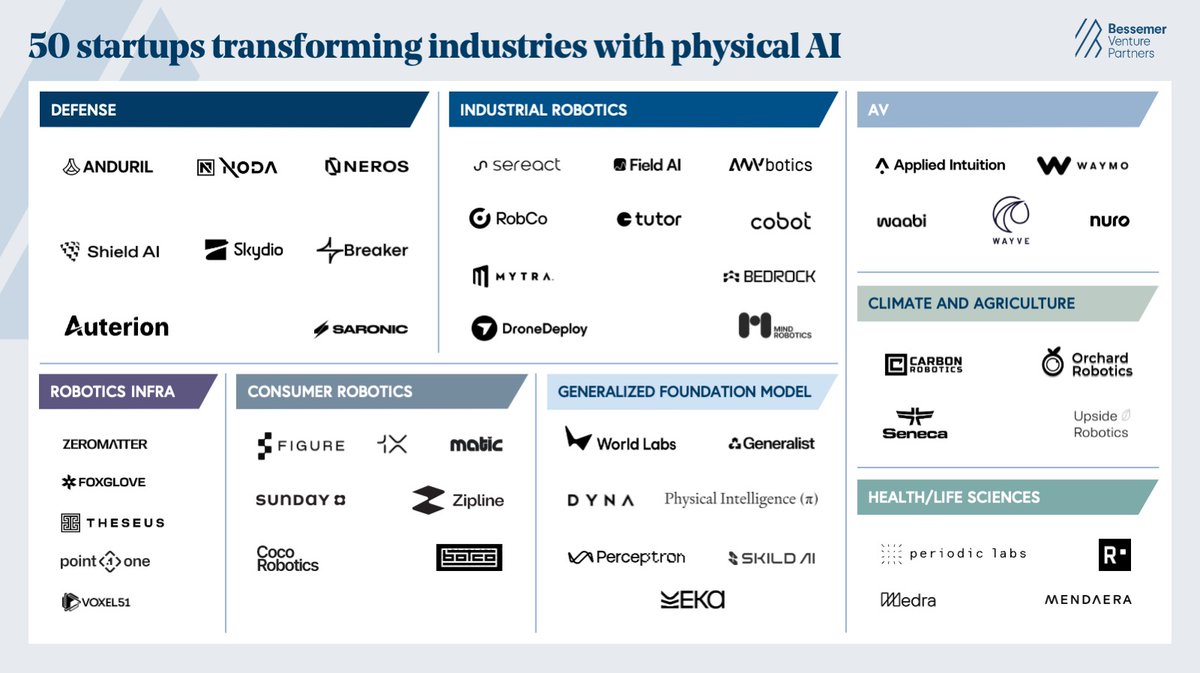
Bessemer's Physical AI 50 is now live — our new list spotlighting 50 startups turning robotics and autonomous systems into deployed products. What these leaders share: 🔹World-class teams combining robotics, AI, and systems engineering 🔹Focus on high-value, repeatable use cases 🔹Deep customer partnerships that generate real-world data See the full list ⏩️bessemervp.team/3PNKtWs
엔비디아의 스페이스 컴퓨팅 협력 파트너들

Space computing, the final frontier, has arrived 🛰️ #NVIDIAGTC news: NVIDIA is collaborating with @AetherfluxUSA, @Axiom_Space, @KeplerComms, @planet, Sophia Space and Starcloud to bring AI and accelerated computing to space, powering geospatial intelligence and autonomous space





김상이 @GreenTreeStory
2 Followers 33 Following
Victor Hah @VictorHah
113 Followers 587 Following Bridging AI compute and capital markets. Building an AI chip company | Ex-investment banker & hedge-fund analyst. Seoul ↔ Silicon Valley

망고 Mango @ILOVEMANGOANDU
160 Followers 2K Following Reposts are not endorsements 팔로잉 혹은 팔로워의 의견과 제 의견은 다를 수 있어요

북구 미래 하정�... @JungWooHa2
11K Followers 3K Following 전) 청와대 AI미래기획수석비서관 전) 네이버클라우드 AI 혁신 센터장 한국공학한림원 정회원 Ex) Sr. Secretary to the President for AI & Future Planning, #Korea
Thorrrou @ThorrrouHXnJhD
13 Followers 178 Following
한빛미디어(offic... @programmer_food
2K Followers 248 Following 한빛미디어(Hanbit Media) 공식 계정. 책을 만듭니다. IT를 사랑합니다. "Learn, Make, Share"를 실천하려고 노력합니다.
이유나 @unaleebaby756
0 Followers 2 Following


김지문 @hotjimun
25 Followers 334 Following

⚡️사토시 AI의... @satoshi_ai__
1K Followers 5K Following 💭AI로 비트코인을 예측할 수 있지 않을까? 데이터가 투명하니까!🤖 카카오 출신 ENFJ 엔프제 개발자가 만든 ☁️흐림? 🌞맑음! 날씨앱 컨셉의 비트코인 로보어드바이저 AI 에이전트 🌈 크립토웨더! 구글 플레이스토어, 애플 앱스토어, MCP 서버, 텔레그램/파캐스터 미니앱 출시!
하핫 @hahas2127431332
34 Followers 401 Following
jimungimm @kimtakapa
777 Followers 5K Following
happy_bc @hackingkill4
142 Followers 352 Following

공 @JL43315566
53 Followers 154 Following

Sunny @SunnyNJ94
110 Followers 1K Following
허진호 @DLXXWxEHV37cQbv
2 Followers 31 Following
NYPARK @Aaaaana
77 Followers 59 Following
Joonha Jeon @realjoonha
105 Followers 648 Following PhD candidate at CWTS, Leiden | here to read posts from those who haven't migrated to Bluesky yet
Yong-Gu Lee @yonggu_lee
7 Followers 52 Following

찬란햇 @tamuzi
498 Followers 2K Following Never let it rest, heading for Best 헤르만헤세, 초콜릿, 핑크빛으로 노을 진 하늘, 추리소설..하늘 보기, 맨날 시시각각 하늘 바라보기, 또...보기



songpd @songpd
571 Followers 688 Following 🛠️ AI Workflow Experimenter | 💻 Digital Creator | 🌊 Learning the Next Wave.

Sean @failfrequently
673 Followers 936 Following
yunasuh @_iamyunasuh
231 Followers 3K Following
PMI한국챕터 @pmisouthkorea
230 Followers 3K Following PMI한국챕터 공식 트위터입니다. 우리의 사명은 여러분과 여러분의 프로젝트를 더욱 성공적으로 만드는 것입니다. (PMP 관련 교육, 세미나, 행사 등을 알려드립니다). - Project Management Institute South Korea Chapter -

Bernard Mantherson @BMantherson
64 Followers 577 Following Your action determines where you are going to
Wontae Lee @lee_wontae
3 Followers 144 Following 국민대학교 국민연구원 특임교수(정보보호·AI정책) (前)아주대학교 사이버보안학과 연구교수. (前)한국인터넷진흥원 원장. (前)정보통신정책연구원 연구위원.
gbbear @gbbear
2 Followers 10 Following
select @resultset
19 Followers 704 Following

이미스 @sliding_mj
15 Followers 771 Following


이진수 @cheditto
82 Followers 262 Following

Boaz Barak @boazbaraktcs
34K Followers 833 Following Computer Scientist. See also https://t.co/EXWR5k634w . @harvard @openai opinions my own.
Henry Shevlin @dioscuri
35K Followers 9K Following Philosopher & AI Ethicist @GoogleDeepMind · @LeverhulmeCFI @Cambridge_Uni | Consciousness, Machine Minds, AGI, Human-AI Relationships | All views my own
Evan Hubinger @EvanHub
10K Followers 3K Following Alignment Stress-Testing lead @AnthropicAI. Opinions my own. Previously: MIRI, OpenAI, Google, Yelp, Ripple. (he/him/his)
Lossfunk @lossfunk
17K Followers 1 Following Foundational questions on artificial and biological intelligences
차지호 @chajiho11956
2K Followers 2 Following 💙더불어민주당 경기 오산시 국회의원 차지호입니다💙 후원계좌 : 농협 301-0346-4145-51 (예금주 : 국회의원차지호후원회)

DAIR.AI @dair_ai
128K Followers 1 Following Democratizing AI research, education, and technologies. Learn about AI Agents for FREE at https://t.co/HHXg8rryu4
U.S. CTO Ethan Klein @USCTO47
11K Followers 100 Following The Official Account of U.S. Chief Technology Officer Dr. Ethan Klein 🥸 @WHOSTP47

Amanda Askell @AmandaAskell
106K Followers 661 Following Philosopher & ethicist trying to make AI be good @AnthropicAI. Personal account. All opinions come from my training data.
중얼거리는 남�... @CurbsideCroaker
6K Followers 855 Following
Nathan Benaich @nathanbenaich
71K Followers 36K Following solo member of superinvestment staff @airstreet @airstreetpress @stateofai @raais
Apollo Research @apolloaievals
11K Followers 0 Following Our goal is to secure frontier AI systems from development, to deployment and governance.
NVIDIA Omniverse @nvidiaomniverse
26K Followers 317 Following The official handle for #NVIDIAOmniverse. The platform for developing #OpenUSD applications for industrial digitalization and generative physical #AI.
ARIA @ARIA_research
17K Followers 56 Following Advanced Research + Invention Agency. Empowering scientists to reach for the edge of the possible. Bluesky: https://t.co/xnQZGN9YCg
Matt Clifford @matthewclifford
39K Followers 2K Following Co-founder @join_ef; Chair @ARIA_Research; thinking a lot about how to make AI go well
BISgov @BISgov
5K Followers 71 Following BIS advances U.S. national security, foreign policy, and economic objectives by ensuring an effective export control and treaty compliance system.
Director Michael Krat... @mkratsios47
40K Followers 51 Following Assistant to the President & 13th Director of @WHOSTP47 | Previously 4th CTO of the United States and Under Secretary of War | South Carolinian 🇺🇸
koray kavukcuoglu @koraykv
24K Followers 102 Following Chief AI Architect, Google. CTO, Google DeepMind

Bowen Baker @bobabowen
4K Followers 116 Following Research Scientist at @openai since 2017 Robotics, Multi-Agent Reinforcement Learning, LM Reasoning, and now Alignment.
LlamaIndex 🦙 @llama_index
118K Followers 33 Following The most accurate agentic OCR platform for production AI. LlamaParse: https://t.co/yQGTiRSNvj Docs: https://t.co/us6GCS1Clb
AI Frontiers @ai_frontiers_
2K Followers 706 Following Driving AI discourse. Have a perspective? Pitch it here: https://t.co/oe21F5SfSt
Midjourney @midjourney
460K Followers 0 Following A community supported research lab - exploring new mediums of thought and amplifying the imaginative powers of the human species.
cat @_catwu
96K Followers 352 Following claude code + cowork @anthropicai, prev: @dagster, @scale_ai
Lilian Weng @lilianweng
271K Followers 187 Following Co-founder of Thinking Machines Lab @thinkymachines; Ex-VP, AI Safety & robotics, applied research @OpenAI; Author of Lil'Log
Jürgen Schmidhuber @SchmidhuberAI
207K Followers 0 Following OG of: P and T in ChatGPT, 100x deeper learning, meta learning and RSI, neural distillation, GAN/World Model... Co-authored most-cited AI paper of 20th century
북구 미래 하정�... @JungWooHa2
11K Followers 3K Following 전) 청와대 AI미래기획수석비서관 전) 네이버클라우드 AI 혁신 센터장 한국공학한림원 정회원 Ex) Sr. Secretary to the President for AI & Future Planning, #Korea
The Last AI @The_Last_AI
189 Followers 1K Following The book that introduces AI Economics | The 4 Levels of AI Adoption | https://t.co/V9WqWx1FRT | by @s_m_sohn | @69AIcontroversy
Matthew Berman @MatthewBerman
128K Followers 1K Following The future is bright. Get Ahead - https://t.co/s5tbuuNdjE Loop Skill - https://t.co/1B5X282n8S Learn Loops - https://t.co/8t0scQUngV
Ethan Mollick @emollick
369K Followers 586 Following Professor @Wharton studying AI, innovation & startups. Democratizing education using tech Book: https://t.co/CSmipbJ2jV Substack: https://t.co/UIBhxu4bgq
Ali Behrouz @behrouz_ali
9K Followers 1K Following Research Scientist @Google, Ph.D. Candidate @Cornell_CS
Christopher Manning @chrmanning
166K Followers 344 Following Founder @stanfordnlp & cs224n—Senior Fellow @StanfordHAI—Prof. CS & Linguistics @Stanford—GP @aixventureshq—MTS @moonlake—Australian🇦🇺—Do #NLProc & #AI 👋

Vahid Kazemi @VahidK
14K Followers 328 Following PhD in machine learning. KTH 14. Ex @xAI, @OpenAI, @Apple, @Google.
한빛미디어(offic... @programmer_food
2K Followers 248 Following 한빛미디어(Hanbit Media) 공식 계정. 책을 만듭니다. IT를 사랑합니다. "Learn, Make, Share"를 실천하려고 노력합니다.

Sam Bowman @sleepinyourhat
67K Followers 3K Following AI alignment + LLMs at Anthropic. On leave from NYU. Views not employers'. No relation to @s8mb. Into @givingwhatwecan.
Yi ZENG @yi_zeng
2K Followers 150 Following Wu Yuzhang Chair Professor, Gaoling School of AI, Renmin University of China (RUC). Founding Dean, Beijing Institute of AI Safety & Governance (Beijing-AISI).
Chef Edward Lee @chefedwardlee
19K Followers 968 Following 610 Magnolia | Succotash | LEE Initiative | Smoke & Pickles | Buttermilk Graffiti
Ai2 @allen_ai
85K Followers 445 Following Breakthrough AI to solve the world's biggest problems. › Join us: https://t.co/MjUpZpKPXJ › Newsletter: https://t.co/k9gGznstwj
Barret Zoph @barret_zoph
26K Followers 1K Following @openai Past: - CTO & Co-Founder Thinking Machines Lab (@thinkymachines) - VP Research (Post-Training) @openai - Research Scientist at Google Brain
Sequoia Capital @sequoia
786K Followers 2K Following We help the daring build legendary companies from idea to IPO and beyond.
AI21 Labs @AI21Labs
11K Followers 161 Following AI21 Labs builds Foundation Models and AI Systems for the enterprise that accelerate the use of GenAI in production. Meet AI21 Maestro https://t.co/IJyxlWYJoV
Andy Jassy @ajassy
3.8M Followers 284 Following Lead Amazon, married and father of two kids, big sports/music/film fan, experienced buffalo wings eater. Go Kraken!
Meredith Whittaker @mer__edith
119K Followers 4K Following President of @signalapp, Chief Advisor to @ainowinstitute (Also on Mastodon @[email protected], also on bsky @meredithmeredith.bsky.social)

John Schulman @johnschulman2
78K Followers 2K Following Recently started @thinkymachines. Interested in reinforcement learning, alignment, birds, jazz musicTrends for United States
You might like