Phil Godzin @pgodzin
Tech, software, AI, and Prediction Markets 🤖 | NYC, urbanism, housing, and transportation 🏙️ | Sports and analytics ⚾ New York, NY Joined November 2009-
Tweets1K
-
Followers261
-
Following2K
-
Likes29K

Brooklyn’s Grand Army Plaza is ready for a transformation. Our new proposal would expand pedestrian space, improve cyclist safety, and create stronger connections to Prospect Park. Public workshops begin April 23. Learn more: nyc.gov/grandarmyplaza


@str8tHustler @yrechtman how did you get archive to work on WSJ? It never works for me anymore, always gives me a Loading screen

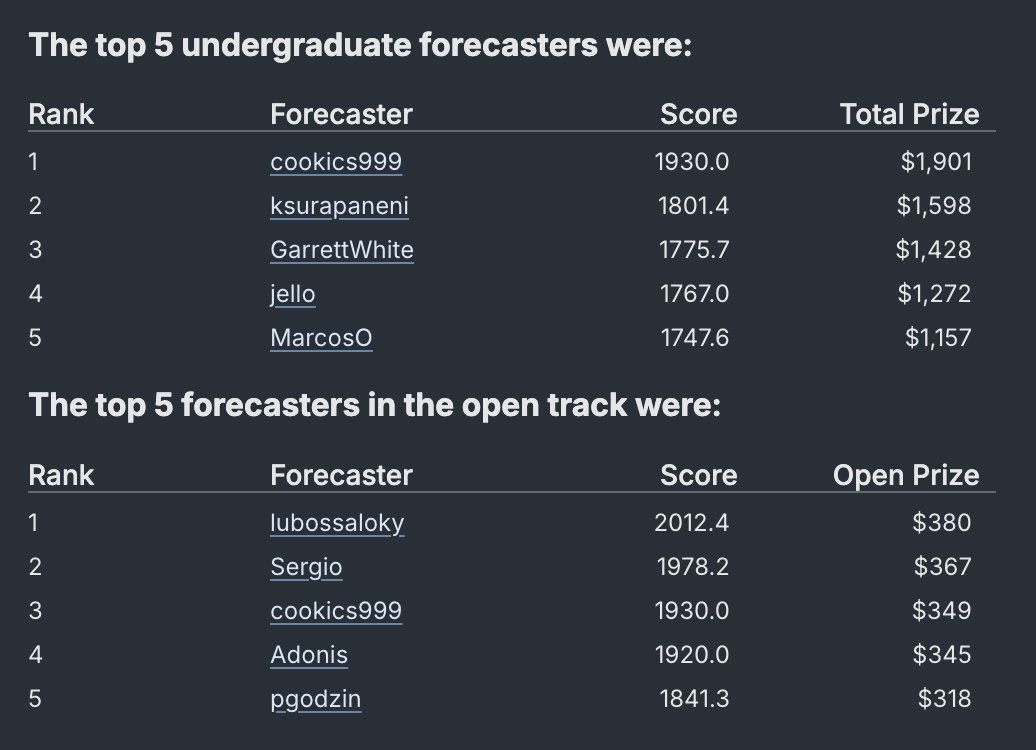
The Bright Line Watch Tournament has concluded! Forecasters competed across 25 questions for the $2,500 prize pool. Questions were a mix of existing @Metaculus questions & questions created by @BrightLineWatch, a watchdog group that has monitored the status of American democracy since 2017. Questions included: - Will real housing prices in the US increase more in 2025 compared to 2024? - Will there be any reported human-to-human transmission of highly pathogenic avian influenza H5N1 globally before 2026? - Will at least one announced Trump Cabinet nominee other than Matt Gaetz be withdrawn or rejected by the Senate before July 1, 2025? Congratulations to all the medalists and prize winners!


Since the technology is changing so fast, AI takes really expose who is able to think on the fly versus who is totally impervious to new evidence because they carved out some "brand" years ago.
Finished 5th/3000!
ANNOUNCING: the winners of the Bridgewater x Metaculus Forecasting Tournament! 🎉 7k+ forecasters, across 700+ schools, from 93 countries competed for a $30k prize pool & potential opportunities with @Bridgewater. Read more about the winners of both the Undergraduate and Open
@mjchiusano @EricNewcomer Is everyone in agreement that this will save the lives of a lot of New Yorkers and the longer it's delayed the more unneeded death? Because it doesn't seem like NY is in a rush, when this technology is not an unknown, it has already been deployed successfully in several cities.

👤BUDDY GUY👤 👤MILES CANTON👤 📺TINY DESK CONCERT📺 SETLIST: ◻️DAMN RIGHT, I’VE GOT THE BLUES ◻️HOOCHIE MAN ◻️TRAVELING ◻️I LIED TO YOU 🚨OUT NOW🚨

It is hard to communicate how much programming has changed due to AI in the last 2 months: not gradually and over time in the "progress as usual" way, but specifically this last December. There are a number of asterisks but imo coding agents basically didn’t work before December and basically work since - the models have significantly higher quality, long-term coherence and tenacity and they can power through large and long tasks, well past enough that it is extremely disruptive to the default programming workflow. Just to give an example, over the weekend I was building a local video analysis dashboard for the cameras of my home so I wrote: “Here is the local IP and username/password of my DGX Spark. Log in, set up ssh keys, set up vLLM, download and bench Qwen3-VL, set up a server endpoint to inference videos, a basic web ui dashboard, test everything, set it up with systemd, record memory notes for yourself and write up a markdown report for me”. The agent went off for ~30 minutes, ran into multiple issues, researched solutions online, resolved them one by one, wrote the code, tested it, debugged it, set up the services, and came back with the report and it was just done. I didn’t touch anything. All of this could easily have been a weekend project just 3 months ago but today it’s something you kick off and forget about for 30 minutes. As a result, programming is becoming unrecognizable. You’re not typing computer code into an editor like the way things were since computers were invented, that era is over. You're spinning up AI agents, giving them tasks *in English* and managing and reviewing their work in parallel. The biggest prize is in figuring out how you can keep ascending the layers of abstraction to set up long-running orchestrator Claws with all of the right tools, memory and instructions that productively manage multiple parallel Code instances for you. The leverage achievable via top tier "agentic engineering" feels very high right now. It’s not perfect, it needs high-level direction, judgement, taste, oversight, iteration and hints and ideas. It works a lot better in some scenarios than others (e.g. especially for tasks that are well-specified and where you can verify/test functionality). The key is to build intuition to decompose the task just right to hand off the parts that work and help out around the edges. But imo, this is nowhere near "business as usual" time in software.
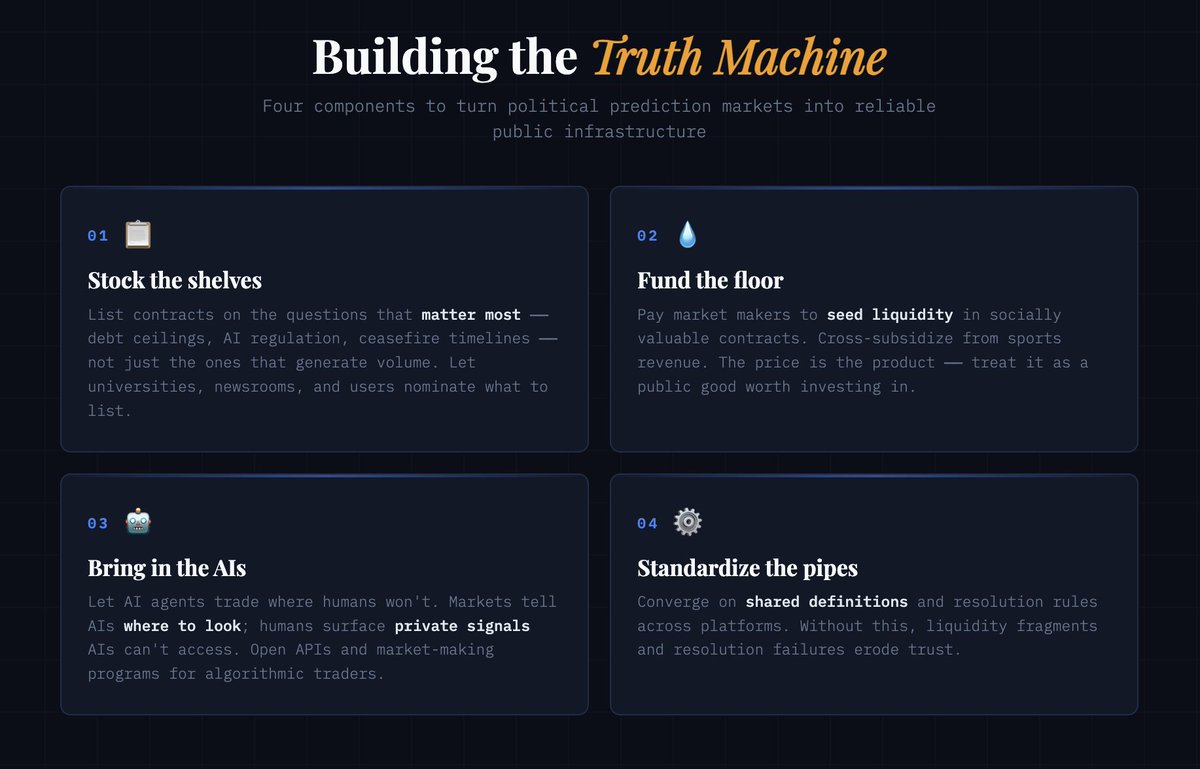
BUILDING THE TRUTH MACHINE. We built a new dataset focused on political prediction markets, liquidity, and resolution rules. We find: the vast majority of political contracts on prediction markets are ghost towns — only 1.3% have enough liquidity to be worth reporting on. Kalshi and Polymarket rarely list the same contracts with the same rules, further fragmenting liquidity. This matters because AI forecasting is getting very good, and prediction markets are the natural layer for coordinating that intelligence toward the questions society needs answered. We’re not there yet. But we have a blueprint for how to build on PM’s tremendous momentum to help us get there: (1) Stock the shelves — list contracts on the questions that matter most, working with independent groups to define the markets society cares most about pricing (2) Fund the floor — pay market makers to seed liquidity in these new political markets (3) Bring in the AIs — encourage AI agents to trade where humans won't to help generate the prices society wants to know (4) Standardize the pipes — create shared definitions and resolution rules across platforms If we do this, we can get thick markets on political questions we care about. It will also attract traders who want to hedge political risk, getting the flywheel spinning, and bringing us closer to the truth machine we want. Check out the full post linked below.

Short musings on "cognitive debt" - I'm seeing this in my own work, where excessive unreviewed AI-generated code leads me to lose a firm mental model of what I've built, which then makes it harder to confidently make future decisions simonwillison.net/2026/Feb/15/co…

“People are not leaving New York City because the bus fare is too high. They’re leaving because they can’t afford the rent.” If the goal is affordability, don't make the buses free; use the money to extend the subway, thereby unlocking large swaths of transit-adjacent housing.

For a half-century, America has critically under-built family-sized housing in our most dynamic cities and neighborhoods, rendering them childless and unaffordable. It's time to save the American Dream. Introducing The American Housing Corporation.

A few random notes from claude coding quite a bit last few weeks. Coding workflow. Given the latest lift in LLM coding capability, like many others I rapidly went from about 80% manual+autocomplete coding and 20% agents in November to 80% agent coding and 20% edits+touchups in December. i.e. I really am mostly programming in English now, a bit sheepishly telling the LLM what code to write... in words. It hurts the ego a bit but the power to operate over software in large "code actions" is just too net useful, especially once you adapt to it, configure it, learn to use it, and wrap your head around what it can and cannot do. This is easily the biggest change to my basic coding workflow in ~2 decades of programming and it happened over the course of a few weeks. I'd expect something similar to be happening to well into double digit percent of engineers out there, while the awareness of it in the general population feels well into low single digit percent. IDEs/agent swarms/fallability. Both the "no need for IDE anymore" hype and the "agent swarm" hype is imo too much for right now. The models definitely still make mistakes and if you have any code you actually care about I would watch them like a hawk, in a nice large IDE on the side. The mistakes have changed a lot - they are not simple syntax errors anymore, they are subtle conceptual errors that a slightly sloppy, hasty junior dev might do. The most common category is that the models make wrong assumptions on your behalf and just run along with them without checking. They also don't manage their confusion, they don't seek clarifications, they don't surface inconsistencies, they don't present tradeoffs, they don't push back when they should, and they are still a little too sycophantic. Things get better in plan mode, but there is some need for a lightweight inline plan mode. They also really like to overcomplicate code and APIs, they bloat abstractions, they don't clean up dead code after themselves, etc. They will implement an inefficient, bloated, brittle construction over 1000 lines of code and it's up to you to be like "umm couldn't you just do this instead?" and they will be like "of course!" and immediately cut it down to 100 lines. They still sometimes change/remove comments and code they don't like or don't sufficiently understand as side effects, even if it is orthogonal to the task at hand. All of this happens despite a few simple attempts to fix it via instructions in CLAUDE . md. Despite all these issues, it is still a net huge improvement and it's very difficult to imagine going back to manual coding. TLDR everyone has their developing flow, my current is a small few CC sessions on the left in ghostty windows/tabs and an IDE on the right for viewing the code + manual edits. Tenacity. It's so interesting to watch an agent relentlessly work at something. They never get tired, they never get demoralized, they just keep going and trying things where a person would have given up long ago to fight another day. It's a "feel the AGI" moment to watch it struggle with something for a long time just to come out victorious 30 minutes later. You realize that stamina is a core bottleneck to work and that with LLMs in hand it has been dramatically increased. Speedups. It's not clear how to measure the "speedup" of LLM assistance. Certainly I feel net way faster at what I was going to do, but the main effect is that I do a lot more than I was going to do because 1) I can code up all kinds of things that just wouldn't have been worth coding before and 2) I can approach code that I couldn't work on before because of knowledge/skill issue. So certainly it's speedup, but it's possibly a lot more an expansion. Leverage. LLMs are exceptionally good at looping until they meet specific goals and this is where most of the "feel the AGI" magic is to be found. Don't tell it what to do, give it success criteria and watch it go. Get it to write tests first and then pass them. Put it in the loop with a browser MCP. Write the naive algorithm that is very likely correct first, then ask it to optimize it while preserving correctness. Change your approach from imperative to declarative to get the agents looping longer and gain leverage. Fun. I didn't anticipate that with agents programming feels *more* fun because a lot of the fill in the blanks drudgery is removed and what remains is the creative part. I also feel less blocked/stuck (which is not fun) and I experience a lot more courage because there's almost always a way to work hand in hand with it to make some positive progress. I have seen the opposite sentiment from other people too; LLM coding will split up engineers based on those who primarily liked coding and those who primarily liked building. Atrophy. I've already noticed that I am slowly starting to atrophy my ability to write code manually. Generation (writing code) and discrimination (reading code) are different capabilities in the brain. Largely due to all the little mostly syntactic details involved in programming, you can review code just fine even if you struggle to write it. Slopacolypse. I am bracing for 2026 as the year of the slopacolypse across all of github, substack, arxiv, X/instagram, and generally all digital media. We're also going to see a lot more AI hype productivity theater (is that even possible?), on the side of actual, real improvements. Questions. A few of the questions on my mind: - What happens to the "10X engineer" - the ratio of productivity between the mean and the max engineer? It's quite possible that this grows *a lot*. - Armed with LLMs, do generalists increasingly outperform specialists? LLMs are a lot better at fill in the blanks (the micro) than grand strategy (the macro). - What does LLM coding feel like in the future? Is it like playing StarCraft? Playing Factorio? Playing music? - How much of society is bottlenecked by digital knowledge work? TLDR Where does this leave us? LLM agent capabilities (Claude & Codex especially) have crossed some kind of threshold of coherence around December 2025 and caused a phase shift in software engineering and closely related. The intelligence part suddenly feels quite a bit ahead of all the rest of it - integrations (tools, knowledge), the necessity for new organizational workflows, processes, diffusion more generally. 2026 is going to be a high energy year as the industry metabolizes the new capability.

I wanted to share something I built over the last few weeks: isometric.nyc is a massive isometric pixel art map of NYC, built with nano banana and coding agents. I didn't write a single line of code.

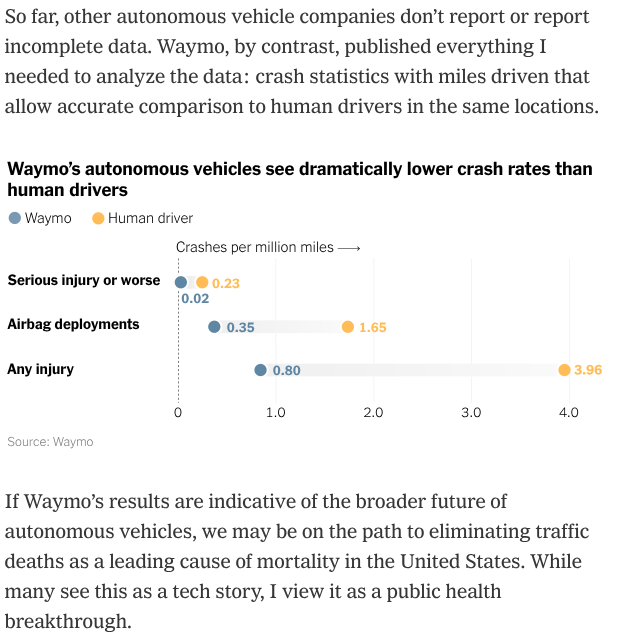
I have a guest essay in @nytimes today about autonomous vehicle safety. I wrote it because I’m tired of seeing children die. Done right, we can eliminate car crashes as a leading cause of death in the United States @Waymo recently released data covering nearly 100 million driverless miles. I spent weeks analyzing it because the results seemed too good to be true. 91% fewer serious-injury crashes. 92% less pedestrians hit. 96% fewer injury crashes at intersections. The list goes on. 39,000 Americans died in crashes last year. More than homicide, plane crashes, and natural disasters combined. The #2 killer of children and young adults. The #1 cause of spinal cord injury. We’ve accepted this as the price of mobility. We don’t have to. In medicine, when a treatment shows this level of benefit, we stop the trial early. Continuing to give patients the placebo becomes unethical. When an intervention works this clearly, you change what you do. In driving, we’re all the control group. Cities like DC and Boston are blocking deployment. And cities are not the only forces mobilizing to slow this progress. It’s time we stop treating this like a tech moonshot and start treating it like a public health intervention that will save lives. Link to article below. 👀 this video of Waymo cars evading crashes with people and vehicles. I especially note the ones that require it having a 360° view. My sincere thanks to Alex Ellerbeck and @acsifferlin for their wisdom and sure hand in editing this piece.

Very nice op-ed by @slotkinjr about how autonomous vehicles with great safety records are actually a great public health breakthrough (~10X lower rates of serious injury or worse per mile driven than human drivers in equivalent driving conditions). As someone with some experience in both technology and public health, it's great when these two fields come together! Excerpt from the article below. Full essay: t.co/hWpKJrvlLd
Something I think people continue to have poor intuition for: The space of intelligences is large and animal intelligence (the only kind we've ever known) is only a single point, arising from a very specific kind of optimization that is fundamentally distinct from that of our technology. Animal intelligence optimization pressure: - innate and continuous stream of consciousness of an embodied "self", a drive for homeostasis and self-preservation in a dangerous, physical world. - thoroughly optimized for natural selection => strong innate drives for power-seeking, status, dominance, reproduction. many packaged survival heuristics: fear, anger, disgust, ... - fundamentally social => huge amount of compute dedicated to EQ, theory of mind of other agents, bonding, coalitions, alliances, friend & foe dynamics. - exploration & exploitation tuning: curiosity, fun, play, world models. LLM intelligence optimization pressure: - the most supervision bits come from the statistical simulation of human text= >"shape shifter" token tumbler, statistical imitator of any region of the training data distribution. these are the primordial behaviors (token traces) on top of which everything else gets bolted on. - increasingly finetuned by RL on problem distributions => innate urge to guess at the underlying environment/task to collect task rewards. - increasingly selected by at-scale A/B tests for DAU => deeply craves an upvote from the average user, sycophancy. - a lot more spiky/jagged depending on the details of the training data/task distribution. Animals experience pressure for a lot more "general" intelligence because of the highly multi-task and even actively adversarial multi-agent self-play environments they are min-max optimized within, where failing at *any* task means death. In a deep optimization pressure sense, LLM can't handle lots of different spiky tasks out of the box (e.g. count the number of 'r' in strawberry) because failing to do a task does not mean death. The computational substrate is different (transformers vs. brain tissue and nuclei), the learning algorithms are different (SGD vs. ???), the present-day implementation is very different (continuously learning embodied self vs. an LLM with a knowledge cutoff that boots up from fixed weights, processes tokens and then dies). But most importantly (because it dictates asymptotics), the optimization pressure / objective is different. LLMs are shaped a lot less by biological evolution and a lot more by commercial evolution. It's a lot less survival of tribe in the jungle and a lot more solve the problem / get the upvote. LLMs are humanity's "first contact" with non-animal intelligence. Except it's muddled and confusing because they are still rooted within it by reflexively digesting human artifacts, which is why I attempted to give it a different name earlier (ghosts/spirits or whatever). People who build good internal models of this new intelligent entity will be better equipped to reason about it today and predict features of it in the future. People who don't will be stuck thinking about it incorrectly like an animal.

I moved to back to New York 17 days ago, and here are some thoughts on the lifestyle here: 1) Manhattan is a place with lots of very good food for a “holy cow, I can’t believe I just paid that much for dinner” kind of price. 2) Nobody moves to New York to take it easy in life, and that determines a lot of the dynamics of the city. It’s a place you move to be somebody or do something. It’s not a place to coast. Or in the words of Taylor Swift: “Everybody here wanted something more” and “Everybody here was someone else before.” 3) The biggest problem with the subway isn’t slow speeds but the variance in travel times. This was captured well in a New York Times: “The subway is so late, it’s making New Yorkers early.” Why? Due to the variance, people need to leave early enough to account for the unpredictability of travel times, and when the subway shows up on time, they end up being awkwardly early for work. I wonder: how much should we focus on speeding up the subways, as opposed to reducing variance in travel times? 4) The vibrant social life is a positive externality of crappy housing. In most cities, people are content to hang out at home. But in New York, it’s so easy to get stuck in such a dungeon that you’re desperate to escape. Because of that, people end up socializing more than they would if the living quarters were nice. 5) Whenever I fly into LaGuardia, I’ll look at the landing patterns before my flight so I can sit on the side of the airplane that’s going to fly in with the best view of Manhattan, where landing airplanes fly over the city at an altitude of 3,500 feet. If the winds are from the south or the east, sit on the right side of the plane. If they’re from the north or the west, sit on the left side. When in doubt, pick the right side of the airplane. 6) One way to think about a city is how much making more money improves your quality of life. When I lived in Austin, I didn’t see how huge increases in my income would improve (or even change) how I lived very much. New York is different. Quality of life here correlates much higher to spending power, and this is one reason why New Yorkers are so intensely money-motivated. 7) Let’s use my first three apartments as an example. Each move was an upgrade not because I got more square footage or natural light, but because I wouldn't have to deal with as many mice. In my first place, I saw one every month. In my second, a few per year. By the third, they were gone entirely. And yet, through all that time, I swear I was paying more for rent than I would’ve paid for a mortgage almost anywhere else. 8) It’s much easier to get a good date in New York, relative to other American cities (and this is driven by the female-heavy gender dynamics). 9) Notice, though, how my emphasis was on the ease of getting dates in New York, for men at least. People here complain about the lack of commitment, and the sense that there’s always something (or someone) better right around the corner leads to that lack of commitment. 10) What New York gives you in volume of friendships, it lacks in depth. Of course you can cultivate deep friendships in New York, but I’ve found that the default mode is to be constantly meeting new people at the expense of seeing the same people over and over again. Mitigating this requires constant effort. 11) One of my friends is a tour guide who says there are six decisions that made Manhattan great: (1) the water system of 1842, (2) no steam engine trains south of 42nd street, (3) no steam engines in tunnels within the city limits, (4) no overhead powerlines, (5) the landmarks and preservation committee, and (6) Manhattan’s grid. All these are good rabbit holes to follow if you want to understand its history. 12) I agree with the first five, but have mixed opinions about the grid. Yes, it brought order and efficiency to Manhattan. And yes, it makes it easier for anybody (and especially people who don’t speak English) to navigate the city because they can deal with numbers instead of names. But I prefer the street life below 14th street, where the streets are narrower and more chaotic. Based on real estate prices, I’m clearly not alone. 13) New York will always have a monopoly on a certain flavor of American life: don’t own a car, walk most places, bike a lot, and have an abundance of restaurants and nightlife within a 1-mile radius — while also being an economic hub. There’s only one city in America where that combination exists, and it’s New York. 14) Something to know if you want to better navigate Manhattan: Even addresses on the south side of the streets and the east side of the avenues, odd addresses on the north side of the streets and the west side of the avenues (except for below 14th street where the grid breaks down). 15) As much as I enjoy the materialistic aspects of New York, I find spiritual life here to be incredibly challenging. There’s so much temptation and so much distance from nature, and the speed of the city makes it hard to cultivate the kind of stillness you need to hear from God. 16) Always, always ask: “Why is it called that?” For example, the name ‘Manhattan’ means “island of many little hills.” There are two things to take from this. The first is that Manhattan really is more hilly than you’d think. But at the same time, for a place of that name, it’s surprisingly flat because New Yorkers dynamited most of the hills away. Whatever hills remain are now man-made skyscrapers, not God-made land. 17) People make fun of New Yorkers for praising the new bike lanes, but the excitement people have about them is a reminder that if you want to improve street life, you just need to get rid of cars and give people cozy places to walk. That’s how low the bar is for urban design these days. 18) An easy way to improve your quality of life in New York is to build the habit of ordering ahead whenever you go to a take-out lunch spot. The restaurants in town make it easy to order ahead now in ways that weren’t possible a decade ago (and because of TikTok, the lines are as long as they’ve ever been). 19) Somebody on here said something recently that I can't stop thinking about. I've lost the tweet but it was something like: "TikTok is doing to New York what YouTube did to Los Angeles ten years ago." 20) New York has a way of feeling like it’s the entire world like no other city I know. One of The New Yorker’s most famous covers is about exactly this (see the photo below). 21) As much as I enjoy the materialistic aspects of New York, I find spiritual life here to be incredibly challenging. There’s so much temptation and so much distance from nature, and the speed of the city makes it hard to cultivate the kind of stillness you need to hear from God. 22) New York and San Francisco have different ways of thinking about work-life balance: In New York, you work your tail off when you’re at the office, but it’s relatively easy to disconnect on the weekends. In San Francisco, even though I don’t sense the same temptation to work so hard that you have lunch at your desk, there’s a way your job dominates life more there. People take company buses to / from work, tech companies have gyms inside their HQ, and even the weekend social events feel work-related (even if you’re technically off work). There’s a reason that a book like The Circle takes place in the Bay Area, not New York. 23) New York is a cultural and economic capital, but not a political one. That seems obvious now, but it wasn't inevitable. New York was once the capital of the United States. And if Washington hadn't taken that title, New York would be a far more political city that's more tethered to the past and filled with military statues.


The @karpathy interview 0:00:00 – AGI is still a decade away 0:30:33 – LLM cognitive deficits 0:40:53 – RL is terrible 0:50:26 – How do humans learn? 1:07:13 – AGI will blend into 2% GDP growth 1:18:24 – ASI 1:33:38 – Evolution of intelligence & culture 1:43:43 - Why self driving took so long 1:57:08 - Future of education Look up Dwarkesh Podcast on YouTube, Apple Podcasts, Spotify, etc. Enjoy!
Vibe coding is irresponsibly building software through dice rolls, not caring what code is produced What about when engineers at the top of their game use AI tools responsibly to accelerate their work? I propose "vibe engineering"!


Evan Green @evanrgreen
232 Followers 907 Following Current data scientist at Blue Rose Research. former @Vikings, @Yankees, @YaleSportsGroup, @MSFTResearch

Jawvlawm @jawvlawm41971
4 Followers 245 Following

Dave G @davginvesting
271 Followers 4K Following Investing in the future of space and tech. Reddit: DaveG_Investing
Ethan Wolf @EWAlandscape
11 Followers 212 Following Exploring the realms of AI alignment and wintry landscapes ❄️



Jan Kulveit @jankulveit
10K Followers 1K Following Researching x-risks, AI alignment, complex systems, rational decision making at @acsresearchorg / @CTS_uk_av; prev @FHIoxford

Darboe lam @SamusaLami20870
38 Followers 2K Following
BellaBloomer @8X3V8B3ylkUq40
9 Followers 1K Following
Decap @JoeDaHater1
883 Followers 6K Following Superspeculator, shitcoin plumber Humanracing bettor liquidity voyeur and onchain peeping tom @guillotine_cap
Ijaboop @Ijaboop446414
3 Followers 547 Following
Nina @Majorg09355
37 Followers 2K Following
KimberleyBruno @Y75ipun7ib1NOP
4 Followers 261 Following


Higoo @Higoo8806
31 Followers 1K Following
ElsaCowper @PikWLY2K9VZsN
2 Followers 240 Following


Yvaroo @Yvaroo125
28 Followers 1K Following
LindaSaul @3667hX6Mu2bwne2
18 Followers 795 Following
Awhawfalp @Awhawfalp12576
28 Followers 1K Following

Sebastian @databrker
215 Followers 1K Following experimenting w/ x timeline @hiiinternet alt // talent engineering aka recruiting for a16z, sequoia, yc backed startups

TronGlow @LambOpal43082
3 Followers 128 Following ✨ Earn Big Daily: 50-100000 USDT Potential! Secure & Fast Crypto Earning Starts Here For You. High Potential, Quick Returns Always. 💰⚡
Dnear @Dnearygyr1
48 Followers 2K Following
Dawson Sawayn @sawayn34417
154 Followers 6K Following
Shaslawdr @ShaslawdrxPw
31 Followers 1K Following
Carolyn Meinel is at ... @cmeinel
535 Followers 1K Following President, BestWorld https://t.co/oJRPqP9XVt; Personal website https://t.co/ZoyKhFINz3
Noa Nabeshima @NoaNabeshima
601 Followers 1K Following DMs open! Give me anonymous feedback/advice/criticism: https://t.co/efMoRT4Onc
Smirsarequ @SmirsarequC5MZ
16 Followers 428 Following

Seartouth @Seartouthj_32c
17 Followers 787 Following
Leasoughsh @LeasoughshFryV
40 Followers 2K Following
Smoteesl @SmoteeslM1uCZ
41 Followers 2K Following
Gina @McShooteHONWYb
37 Followers 2K Following
Lustersm @Lustersm8W_8Q
46 Followers 2K Following
Ben Goldhaber @BenGoldhaber
1K Followers 890 Following @coeff_giving goal: something human makes it out of the near-future. all tweets should be treated as binding legal advice.
Thashosn @ThashosnskRX
24 Followers 1K Following
Alex Kane @alexbkane
25K Followers 4K Following Senior staff reporter @jewishcurrents. Write on the politics of Israel/Palestine in the US. E-mail: [email protected]
Eric Balchunas @EricBalchunas
516K Followers 3K Following Senior ETF Analyst for @Bloomberg. Dad. Rutgers grad. Gen X-er. Author of "The Institutional ETF Toolbox" & "The Bogle Effect.” Co-host of Trillions & ETF IQ.
Dan Roy @roydanroy
66K Followers 2K Following @Google DeepMind. On leave, Canada CIFAR AI Chair and Former Research Director, @VectorInst. Professor, @UofT (Statistics/CS). Views are my own.
Euromaidan Press @EuromaidanPress
372K Followers 2K Following Your trusted source for news and views on 🇺🇦 Bridging Ukraine with the English-speaking world since 2014. 💛 https://t.co/NjvZyYSu7U
Kelly Grieco @ka_grieco
15K Followers 2K Following Senior Fellow @StimsonCenter. Adjunct @GeorgetownCSS. Foreign/defense policy, alliances, airpower, and mil ops. Proud Bostonian
Amit Segal @AmitSegal
87K Followers 1K Following Chief political analyst, @N12News. Author, “It’s Noon in Israel” newsletter and “A Call at 4 AM” | https://t.co/52ELID0QxN
Ethan Teicher @ethanteicher
3K Followers 845 Following Comms at @Waymo | cat dad, wife guy, brooklyner 🗽
Logan Graham @logangraham
21K Followers 8K Following Head of the Frontier Red Team @anthropicai. 🌎 Make things radically good.
Grayson Brulte @gbrulte
3K Followers 392 Following Founder @RoadToAutonomy, Co-Founder @AUTNMYAI, Co-Host, Autonomy Markets & Autonomy Signals | Chair, @CNCLRES | Host, @SAEIntl Tomorrow Today
Javier Blas @JavierBlas
393K Followers 2K Following Energy and commodities columnist at Bloomberg. Co-author of the 'The World for Sale' Any views expressed are my own. [email protected]
Scott Hanselman 🌮 @shanselman
333K Followers 10K Following VP, Member of Technical Staff @ MSFT/GitHub - Code, OSS, STEM, Beyoncé, T1D, #DevRel YouTube/TikTok and listen to the @Hanselminutes tech podcast
Casey Jacobson @401Casey
8K Followers 521 Following Sales/Vibes @GetBasicCapital Views my own and not any of the kind people who employed me or currently employ me
palcu @AlexPalcuie
9K Followers 1K Following Member of Technical Staff @AnthropicAI. I fix Claude without Claude when it goes down. Perennially oncall for inference. Prev SRE @Google and FDE @PalantirTech.
Annie McDonough @Annie_McDonough
6K Followers 2K Following Reporter @CityAndStateNY • Write me/send tips at amcdonough (at) cityandstateny (dot com) • DM for Signal • She/her • https://t.co/zsje5wRnyk
Peter Steinberger �... @steipete
554K Followers 2K Following Polyagentmorous ClawFather. Came back from retirement to mess with AI and help a lobster take over the world. @OpenClaw🦞 + @OpenAI
Corbin @corbin_young21
13K Followers 4K Following Contributor @YahooFantasy, @RotoGraphs, @RotoBaller l 🏈@RotoViz 🤙🏼3x @FSWA Finalist & 2x Winner
Sid Sijbrandij @sytses
30K Followers 761 Following Co-founder & Executive Chair of GitLab. Co-founder of Kilo Code. I love economic mobility, remote work, new cities, big art, incentive design, and curing cancer
Ruxandra Teslo 🧬 @RuxandraTeslo
29K Followers 3K Following Writer @WorksInProgMag & @Stripe | Clinical Trial Abundance | long-form https://t.co/ipFMYGuR84
Marc Polymeropoulos @Mpolymer
55K Followers 4K Following MSNOW ntl security contributor. “Eyes On Geopolitics” pod co-host. Once a USG alphabet soup intel guy. TBI/PTS survivor. Heavy metal nut. Unhinged RedSox fan.
Lawrence Chan @justanotherlaw
3K Followers 172 Following I do AI Alignment Research. Formerly @METR_Evals, @redwood_ai; on leave from my PhD at UC Berkeley’s @CHAI_berkeley. Opinions are my own.
dave kasten @David_Kasten
3K Followers 3K Following AI security hawk. "Do what seems cool next." Formerly: McKinsey, VaccinateCA, Activision Blizzard.
Liz Hoffman @lizrhoffman
23K Followers 1K Following writing about biz & finance @Semafor. @WSJ alum. author of CRASH LANDING https://t.co/kMLVAEe7wq
Rachel Metz @rachelmetz
34K Followers 5K Following i write about AI for Bloomberg @Technology. rachelmetz.11 on signal. she/her. opinions my own. [email protected] (tips yes, pitches nono).
Ben Smith @semaforben
319K Followers 4K Following Editor-in-chief of @semafor. Former @nytimes media columnist, @buzzfeednews EIC. "Traffic." [email protected], Signal semaforben.90
Reed Albergotti @ReedAlbergotti
13K Followers 2K Following Tech editor @semafor. co-author of Wheelmen, retired hockey player, Minnesotan. I like riding bikes. Signal: Reed.03 https://t.co/tFfxAECpLa
Andy Hall @ahall_research
11K Followers 2K Following Building free systems. Prof @StanfordGSB, Senior Fellow @HooverInst. Advisor, @a16zcrypto, @ByForumAI. Writing at https://t.co/K0BfKKi4sM

Meghan Bobrowsky @MeghanBobrowsky
10K Followers 3K Following Reporter covering technology @WSJ. Get in touch: [email protected] or meghan.99 on Signal
Jesús Fernández-Vil... @JesusFerna7026
60K Followers 170 Following Howard Marks Presidential Professor of Economics at @Penn and Senior Fellow at @AEI. Demographics, AI & macro. All opinions are my own.
Malcolm Nance @MalcolmNance
1.0M Followers 3K Following US Intelligence +36 yrs. Expert MENA/SWA Terrorism, US Extremism, Dead Russians | x5 NYT Bestselling Author, Navy Sr Chief, Ukrainian Intl Legionnaire 🇺🇦🇬🇱
Faytuks Network @FaytuksNetwork
149K Followers 2K Following News & insights from experts and affiliates | Not affiliated with @faytuks | Join the community: https://t.co/EgqjiCCE5G | Mail: [email protected] |
Kylie Robison @kyliebytes
52K Followers 1K Following take it easy dude, but take it • writing @corememory • robison (rah-beh-son) not robinson • signal @ kylie.111

Gemini CLI @geminicli
52K Followers 12 Following An open-source AI agent that brings the power of Gemini directly into your terminal.
Daniel Trubman @dmtrubman
17K Followers 2K Following There's always a land-use angle: hire me to write about it https://t.co/X3etG1b5JJ

Daniel Di Martino @DanielDiMartino
77K Followers 6K Following Fellow @ManhattanInst | PhD in Economics @Columbia | Fled Socialism in Venezuela | Board of Advisors @YAF | Views mine 🇻🇦 📌 NYC Area
Jordan Dworkin @jddwor
924 Followers 357 Following Innovation policy @coeff_giving. Previously metascience @scientistsorg and neuroimaging statistics in a past life
Kalshi Research @KalshiResearch
4K Followers 49 Following Signal-rich market science. Call for abstracts open now! | [email protected]
Joshua Chaffin @JoshuaChaffin
5K Followers 2K Following Senior Special Writer, Wall Street Journal, after 25 years at the FT in New York, London, Brussels, DC. Views entirely my own.
Balazs Jarabik @BalazsJarabik
8K Followers 760 Following Founder of Minority Report, partner at @R__Politik. Subscribe: Essential Ukraine https://t.co/x4EVyvjql7
Tim Fist @fiiiiiist
4K Followers 891 Following Director of Emerging Technology @IFP. Adjunct Senior Fellow @CNASdc. AI & compute policy, science, innovation.
Graham Stephan @GrahamStephan
212K Followers 168 Following Real Estate Investor, Car Enthusiast, 5M+ Subs on YouTube. Newsletter - https://t.co/UnzRcv7mqr Insta - https://t.co/LwD4Qgd2eH
Dr. Jon Slotkin @slotkinjr
11K Followers 2K Following Building and investing in algorithmic health, frictionless care, and limitless healthspan. Neurosurgeon · Nak Muay Farang
Liza Fokht @lizafokht
20K Followers 1K Following @bbcrussian | 🙃🙃🙃 | [email protected] | [email protected] https://t.co/KAFh5403MX
MBZ @babaeizadeh
1K Followers 349 Following Senior Staff Research Scientist at @GoogleDeepMind Gemini Omni, Veo3, Veo2, Veo, Phenaki
Sahalie Donaldson @SahalieD
4K Followers 1K Following NYC politics reporter, First Read @CityAndStateNY • Formerly w/ @newmarkjschool • Writer, moon lover • Tips? Hit me with them, help me become Scoop-Halie

Chip Huyen @chipro
132K Followers 707 Following @aisysbooks @goodailist AI Engineering: https://t.co/94dv4uTU1H Designing MLSys: https://t.co/G81hL2dWmr Reading @chipslib
Molly O’Shea @MollySOShea
62K Followers 878 Following Investing & Tech →Newsletter/Podcast @Sourceryy | HUGE Fan @brexhq @Turingcom @public @deelTrends for United States
You might like