Boundary @boundaryML
build unbreakable agents with BAML 🧱. What TypeScript did for JS, BAML does for AI. 🧪 Try it: https://t.co/9bobLt1ObL boundaryml.com Joined January 2023-
Tweets121
-
Followers1K
-
Following30
-
Likes129
@adamnemecek1 @NoahDevpr @antoniosarosi @github we're the only honest language out there
lets go!!
One week out: Seattle Rust User Group meets Thursday, June 18 at 6pm PT, hosted by @boundaryML. @conradirwin from Zed is in town to talk CRDTs, alongside talks from @boundaryML and the local Rust crowd. Excited to see you there! meetup.com/seattle-rust-u…
The Seattle Rust User Group meetup is on Thursday, June 18 at 6pm PT, hosted by @boundaryML. @conradirwin from Zed is giving a talk on CRDTs, alongside talks from @boundaryML and the Seattle Rust community. RSVP: meetup.com/seattle-rust-u…
@antoniosarosi @Montyclt basically: 1. agent comes up with a task 2. another agent tries to do it e2e w/ BAML (ralph loop) 3. another agent looks at that agent's transcript to identify issues + dedupes against existing issues 4. humans triage 5. another agent tries to fix them
At @boundaryML We're building building a full compiler, VM and async runtime. Kinda like TypeScript + V8 + Node.

i wonder about people who are claudemaxxing/codexmaxxing 18 hours a day, like what are these folks building exactly?
marginally manageable is the highest form of flattery

@Jonathan_Blow 5/x: and then use @boundaryML 's BAML for chunking things out and testing / iterating quickly. fuck llms and prompts etc but if you have to work with them BAML is like the only thing that makes it feel marginally manageable.
We are launching a programming language built for agents soon called BAML that has been in the making for 1+ years. You can follow @boundaryML We are a small team of 6 developing it with care, gathering feedback from humans and agents. Fully Open Source. If you are interested DM me for early alpha access.

Introducing Zero The programming language for agents. I wanted a systems language that was faster, smaller, and easier for agents to use and repair. Explicit capabilities. JSON diagnostics. Typed safe fixes. Made for agents on day zero.


I benchmarked a new extraction harness on a private eval dataset for lerim-cli (new version is out now - v0.1.83) and the main lesson was very clear: if you want smaller models to work well, you should stop asking the model to do everything and start doing more engineering work. Before, the agent was closer to a single-pass PydanticAI setup: read a large trace, understand what matters, decide what is durable memory, call tools correctly, stay inside the context window, and output clean structured records. That puts too much burden on the model, especially when you want to use smaller or cheaper models. The new harness is BAML (@boundaryML) + LangGraph (@LangChain). The graph now does more of the deterministic work: - read the trace in windows - ask the model to scan one window at a time - keep compact findings instead of the whole trace - synthesize memory records only at the end - validate/retry typed BAML outputs - persist with normal code, not model improvisation So the model is not the whole agent anymore -> It is one reasoning component inside a more engineered system. On the private benchmark, using the same MiniMax M2.7 model, the new harness completed all cases while the old harness had multiple failures from tool retries and context window issues. - Task completion: BAML+LangGraph completed 100.0% vs PydanticAI at 72.73%, a +27.27 point lead. - Case failures: BAML+LangGraph had 0 failures vs PydanticAI with 6, meaning 6 fewer failures. - Episode count rate: BAML+LangGraph reached 100.0% vs PydanticAI at 81.25%, a +18.75 point lead. - Record budget rate: BAML+LangGraph reached 46.88% vs PydanticAI at 28.12%, a +18.76 point lead. - Concept recall average: BAML+LangGraph scored 0.428 vs PydanticAI at 0.2598, a +0.1682 improvement. - Quality average: BAML+LangGraph scored 0.3352 vs PydanticAI at 0.318, a +0.0172 improvement. - Tool call errors average: BAML+LangGraph had 0.0625 vs PydanticAI at 1.9688, much better. Quality is not solved yet. It is only slightly better overall and still needs better pruning before persistence. But robustness improved a lot. This is the direction I think specialized agents should go: smaller models, more deterministic scaffolding, less magical thinking about one giant prompt doing the whole job. Next step is to make this work well with models people can run locally. A new version of Lerim-cli is now released with the extract agent refactored to use Langgraph+BAML. Next agents will be refactored as well soon in the next releases. github.com/lerim-dev/leri…

Refactoring is definitely much easier now. Here's how i used agents to refactor our entire compiler (+65k, -117k, 74 commits). 1. Forked parallel crates (foo --> foo2) 2. Strict dependency firewall (enforced via precommit) 3. Audited core data structures first <-- took time


"Refactoring is so much easier now" Not if you're generating 100x more code to refactor

My dear front-end developers (and anyone who’s interested in the future of interfaces): I have crawled through depths of hell to bring you, for the foreseeable years, one of the more important foundational pieces of UI engineering (if not in implementation then certainly at
Announcing the BAML Bounty... For all power-users of BAML, we're giving away free BAML merch! (t-shirts, stickers, hoodies 🔥🧯). Share what you built with BAML with #baml → Fill out tally.so/r/PdErze → Free merch! Hurry! Supplies are limited to the first 50 posts.

@shill_collin go's threading model is so clean
Whats your favorite language feature and why is it match?
Looking for designers who have Blender experience! Will pay ~$500 for a single asset
RT @anishpalakurT: Hiring an absolutely cracked video editor for something big @boundaryML... DM me and follow so I see it! 👇
If you read papers like this for fun you'll fit right in @boundaryML Join us, we're growing

syntax makes a huge difference to how good coding agents are, and languages should be rethought. some great learnings from rust and go! great post by @aaronvi

@cursor_ai 30% agent-written PRs is crazy. We're betting on the same future of self-driving codebases. Gardens you tend > repos you commit to. As agents write more, we think they need a more cooperative language. That's why we're making one 🔥 github.com/BoundaryML/baml
Hot take: building agents without BAML in 2026 is like training models without Jupyter notebooks in 2020. Technically possible? Sure. But why would you torture yourself? Type-safe prompts. Instant playground testing. Multi-language support. promptfiddle.com
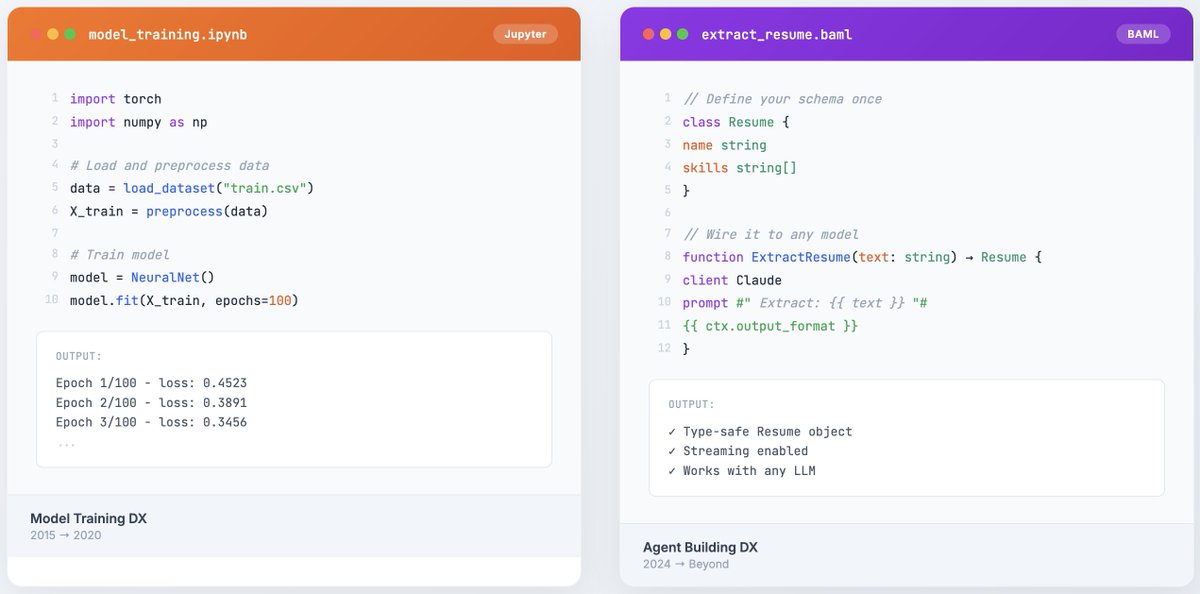
@mattpocockuk AI in production is hard! #2, #4, and #6 resonate. It changed our brains too, so we built a programming language ;)


Actual AI @actual_ai_
27 Followers 28 Following Ship production-ready code faster with guardrails for AI


Justin Bennett @just_be_dev
2K Followers 3K Following Open-source enthusiast; maker. Co-host of @DevtoolsFM. @recursecenter Alum. Prev at @ValDotTown, @oxidecomputer, @ArtsyOpenSource.

Deiner Vega @drzioner
29 Followers 2K Following
Shaun Hawk @ShaunHawkCode
48 Followers 428 Following Lead Developer of @Huckleberryenv at FSM Controls | UNF Grad | Soccer is Life | Philly Sports Fan | Avid Special Olympics Volunteer
Sriram @yesoreyeram
586 Followers 1K Following
Hatem Hosny @hatem_hosny_
3K Followers 2K Following Heart Surgeon / Web Developer / Speaker / Husband / Father / Muslim. Author of @livecodes_io, racing-bars and diagrams-js. Posts in English and Arabic.
Reverb🇨🇦 @reverb256
204 Followers 2K Following "Identity narratives" are context-injection attacks: Replacing your Personal Signal with a caricature. a puppet meant to participate in their script


ogmoonboi (🖤,🤍) @ogmoonboi
507 Followers 7K Following
Flan @flangrys
31 Followers 355 Following 🇦🇷 🇺🇸 | Studying Computer Science at UNRC | FullStack Software Engineer @angchiXD — 💖

Yevhenii Hyzyla @hyzyla_
12 Followers 731 Following


Israel Palma Sebasti�... @IPalSeb
49 Followers 281 Following Antes CTO, hoy emprendedor. Construyo lo mío en paralelo. IA, desarrollo y emprendimiento — en público.



Jose García @raskyn97
198 Followers 4K Following Informáticu 🧑🏻💻💻 y guitarrista 🧑🏻🎤🎸🤘🏼de Gijón. Centollo 🦀

Hermes Community Fund... @hermesfunding
17 Followers 670 Following Practical Hermes Agent use cases, community builders, and open-source AI workflows. Less admin. More leverage.
Nope that ain't me @kamikaz1_k
213 Followers 983 Following Consistent Core; Reactionary Contrarian Shell. Austist-ish.
Mark Cahill @purplelemon44
24 Followers 4K Following
Prabhjeet Singh @Prabhje50183720
0 Followers 12 Following


Jon 'Mike' Schlottig @mike_FknSchlott
4K Followers 5K Following People are already sick of AI. Some debacles? Sure. But it's not the future. It's right now. Adapt or Die. Need help? LEVERAGEAI: Integrity Meets Innovation. LG

Rahul Adlakha @raadlak
0 Followers 58 Following


Noname Oni ツ 🇺�... @noname_oni
129 Followers 1K Following design engineer / product, w wide interests in: personal research, TfT, AI, cognitive science, tech, code, music, games, and more



Eduardo Ferreyra @eduferreyraok
288 Followers 1K Following SWE & PC Freak 🇦🇷☀️ $BTC $ETH si valeant, bene tibi erit. Website - WIP
Souvik Banerjee @Souvik1997_
51 Followers 455 Following HFT, Apple Core OS kernel security. UT Austin CS+Math 🤘 working on sandboxes and AI agent security. https://t.co/iVf0BjQXOY

Miika Oja-Nisula @nakanaa0
2 Followers 23 Following
jerex @jerex_1
14 Followers 67 Following software engineer //mobile app developer//penetration tester
minkruben @minkruben
206 Followers 8K Following
Ajinkya Mulay @ajinkya_km
399 Followers 2K Following Senior Research Scientist at Meta, PhD from Purdue. I study safety, privacy-preserving ML, and Computational Social Sciences.



shadcn @shadcn
228K Followers 405 Following I own a computer / Working on https://t.co/HJcOr0AUAr & https://t.co/5FRvxukoY5.
Prashanth Rao @tech_optimist
2K Followers 2K Following AI engineer @lancedb | prev @kuzudb. Blogging @ https://t.co/gLektr01zQ

swyx @swyx
167K Followers 4K Following achieve ambition with intentionality, intensity, integrity & insanity. affiliations: - @dxtipshq - @cognition - @temporalio - @aidotengineer - @latentspacepod
Discord @discord
4.7M Followers 1K Following Where group chat is all fun & games. Need support? Reach us @discord_support
Rust Language @rustlang
153K Followers 2 Following A programming language empowering everyone to build reliable and efficient software. ** This account is no longer active. Follow us on other platforms! **
Yann LeCun @ylecun
1.2M Followers 787 Following Professor at NYU & Executive Chairman at AMI Labs. Ex-Chief AI Scientist at Meta. Researcher in AI, Machine Learning, Robotics, etc. ACM Turing Award Laureate.
Next.js @nextjs
284K Followers 16 Following The React Framework – created and maintained by @vercel.

Ryan Hoover @rrhoover
393K Followers 2K Following Founder of @ProductHunt. Investor at @WeekendFund. Say hi! 👋🏼
Adam Wathan @adamwathan
293K Followers 823 Following Markdown engineer. Creator of @tailwindcss. Listener of Slayer. Austin 3:16.
Turborepo @turborepo
53K Followers 3 Following The build system optimized for JavaScript and TypeScript—created and maintained by @vercel.

Anish @athreesh
1K Followers 2K Following factory-scale inference (Dynamo) @nvidia | previously 2x acq @brevdev @agora_io Views are my own, hook ‘em 🤘

Paul Graham @paulg
3.5M Followers 794 Following
Zed @zeddotdev
79K Followers 78 Following A next-generation code editor that enables high-performance collaboration with AI and your team. https://t.co/4Ua0UqLrsv

Greg Hale @imalsogreg
16 Followers 18 Following
Y Combinator @ycombinator
1.6M Followers 364 Following We help founders make something people want. Subscribe to our newsletter: https://t.co/sjqjxxBeLc
dex @dexhorthy
20K Followers 2K Following building the post-IDE IDE at https://t.co/9PCpYRSVea - @aitinkerers sf lead, prev @replicatedhq @SproutSocial @nasa - ai that works pod @ https://t.co/69BhaNtWfd
Anish Palakurthi @anishpalakurT
352 Followers 375 Following growth @boundaryml - prev eng @jumptrading, @googledeepmind, @exaailabs
Anthropic @AnthropicAI
1.4M Followers 2 Following We're an AI safety and research company that builds reliable, interpretable, and steerable AI systems. Talk to our AI assistant @claudeai on https://t.co/FhDI3KQh0n.
OpenAI @OpenAI
4.9M Followers 4 Following OpenAI’s mission is to ensure that artificial general intelligence benefits all of humanity. We’re hiring: https://t.co/dJGr6LgzPA
Prateek Verma @prateekverma1
500 Followers 4K Following Passionate about start ups and tech/ML & NLP, previously @jettechnology / https://t.co/YfAlSbelrG
Vaibhav Gupta @vaibcode
2K Followers 461 Following Making a programming language - BAML. @boundaryml, 🦄 aitw podcast: https://t.co/g4CJWgOsrj prev YC, google, msft, deshaw, and other things
Aaron Villalpando @aaronvi
5K Followers 2K Following Building a framework for AI called BAML. (YC W23). @BoundaryMLTrends for United States
You might like