-
Tweets89
-
Followers1
-
Following180
-
Likes739

Parsers don’t have to be complicated bkaradzic.github.io/posts/scanner/
For my first post, I’m sharing a letter @NVIDIA signed on why open models matter. AI will transform every industry, power every company, and be built by every country. Open models strengthen safety and cybersecurity, accelerate innovation and diffusion, and enable sovereignty. The world needs both frontier closed models and frontier open models. images.nvidia.com/pdf/Open-Weigh…


[ #compiler ] I wrote a study notes blog post on Day 11 of Matt Godbolt's Advent of Compiler Optimisations 2025 series: "Counting Bits". Read more here: gapry.github.io/2026/05/31/Adv…

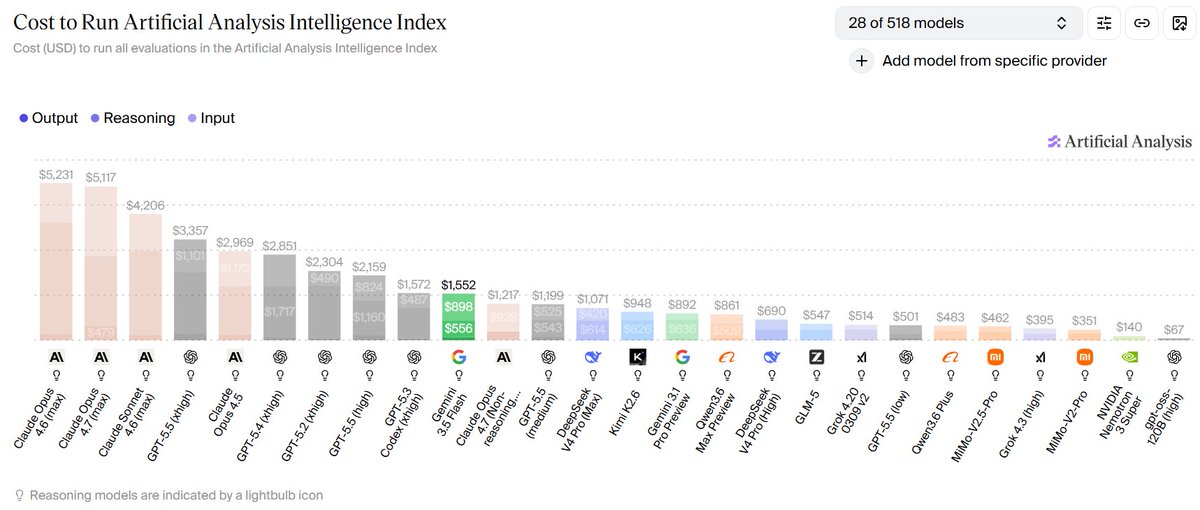
GPT-5.5-medium has lower end-to-end latency, uses less tokens and is overall smarter and cheaper than Gemini 3.5 Flash it might genuinely be over for anyone not named OpenAI or Anthropic
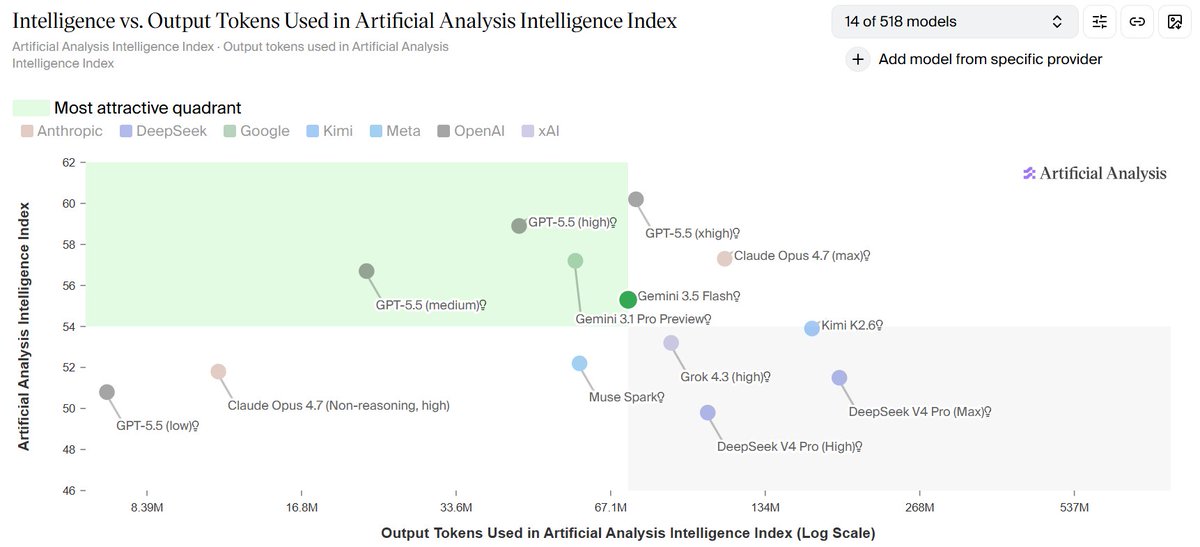
some more Gemini 3.5 Flash benchmarks by Artificial Analysis AI: - the APEX-Agents-AA score is excellent - expected higher on CritPt - reasoning efficiency could also be better, but it kind of depends on what setting they used. if it's the max then it's very good - Price/Perf



2026 is 32% complete.

[ #compiler ] I wrote a study notes blog post on Day 10 of Matt Godbolt's Advent of Compiler Optimisations 2025 series: "Unrolling loops". Read more here: gapry.github.io/2026/04/30/Adv…

TIL the demoscene (which heavily used hand written assembly, long before FFmpeg did) is a form of UNESCO intangible cultural heritage demoscene-the-art-of-coding.net

@thr0wsException @FFmpeg It's called the demoscene and it's recognised by UNESCO as an intangible cultural heritage in Germany and Finland.

Introducing MiniDXNN: a new MLP library built for #DirectX12 HLSL, enabling neural rendering without compute API interop: 🧠 Optimized MLP inference kernels. ⚡ Acceleration via cooperative vector APIs. 🎮 Sample apps & full source code. Get started ⬇️ gpuopen.com/learn/minidxnn…

Merkle trees are everywhere: - ZFS uses them to detect data corruption - Git uses them to verify repo integrity - Cursor uses them for codebase sync - Bitcoin uses them for transaction verification Talked through how they work on the latest database stream.
MAD Bugs: Claude Wrote a Full FreeBSD Remote Kernel RCE with Root Shell (CVE-2026-4747) To our knowledge, this is the first remote kernel exploit both discovered and exploited by an AI. blog.calif.io/p/mad-bugs-cla…
Finally, with Clang 22's release, here's v1 of Linux kernel slab cache partitioning with help of Clang's AllocToken feature: lore.kernel.org/all/2026033111…
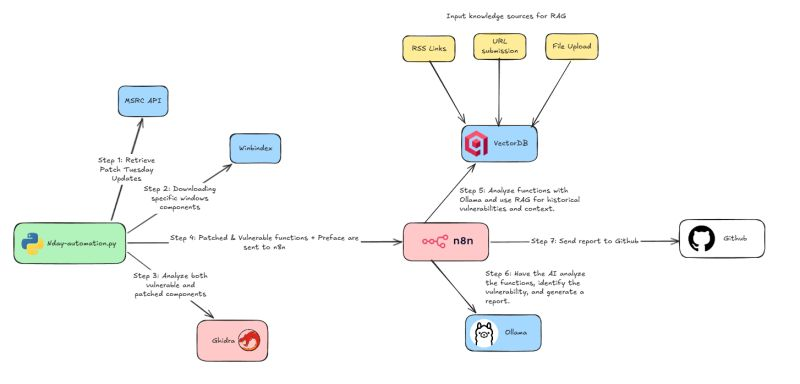
An automated N-day research pipeline at PwnFuzz. Ghidra + Ollama + n8n →Diffs Patch Tuesday binaries → LLM analyzes the output → Structured vuln reports, monthly AI-generated reports gets you oriented fast! Blog: ghostbyt3.github.io/blog/nday-rese… Repo: github.com/ghostbyt3/nday…

The FLARE team now freely distributes its quality reverse engineering and malware analysis educational content at github.com/mandiant/flare…. Launched with: - Malware Analysis Crash Course - Go Reversing Reference - Intro to TTD

Samsung used RISC-V in one of their consumer commercial products for the first time. For the BM9K1, a PCIe 5.0 QLC SSD with 11.4GB/s speeds coming in 2027, it used RISC-V cores instead of the usual ARM Cortex-R in the controller.

2026 is 26% complete.


LLM Knowledge Bases Something I'm finding very useful recently: using LLMs to build personal knowledge bases for various topics of research interest. In this way, a large fraction of my recent token throughput is going less into manipulating code, and more into manipulating knowledge (stored as markdown and images). The latest LLMs are quite good at it. So: Data ingest: I index source documents (articles, papers, repos, datasets, images, etc.) into a raw/ directory, then I use an LLM to incrementally "compile" a wiki, which is just a collection of .md files in a directory structure. The wiki includes summaries of all the data in raw/, backlinks, and then it categorizes data into concepts, writes articles for them, and links them all. To convert web articles into .md files I like to use the Obsidian Web Clipper extension, and then I also use a hotkey to download all the related images to local so that my LLM can easily reference them. IDE: I use Obsidian as the IDE "frontend" where I can view the raw data, the the compiled wiki, and the derived visualizations. Important to note that the LLM writes and maintains all of the data of the wiki, I rarely touch it directly. I've played with a few Obsidian plugins to render and view data in other ways (e.g. Marp for slides). Q&A: Where things get interesting is that once your wiki is big enough (e.g. mine on some recent research is ~100 articles and ~400K words), you can ask your LLM agent all kinds of complex questions against the wiki, and it will go off, research the answers, etc. I thought I had to reach for fancy RAG, but the LLM has been pretty good about auto-maintaining index files and brief summaries of all the documents and it reads all the important related data fairly easily at this ~small scale. Output: Instead of getting answers in text/terminal, I like to have it render markdown files for me, or slide shows (Marp format), or matplotlib images, all of which I then view again in Obsidian. You can imagine many other visual output formats depending on the query. Often, I end up "filing" the outputs back into the wiki to enhance it for further queries. So my own explorations and queries always "add up" in the knowledge base. Linting: I've run some LLM "health checks" over the wiki to e.g. find inconsistent data, impute missing data (with web searchers), find interesting connections for new article candidates, etc., to incrementally clean up the wiki and enhance its overall data integrity. The LLMs are quite good at suggesting further questions to ask and look into. Extra tools: I find myself developing additional tools to process the data, e.g. I vibe coded a small and naive search engine over the wiki, which I both use directly (in a web ui), but more often I want to hand it off to an LLM via CLI as a tool for larger queries. Further explorations: As the repo grows, the natural desire is to also think about synthetic data generation + finetuning to have your LLM "know" the data in its weights instead of just context windows. TLDR: raw data from a given number of sources is collected, then compiled by an LLM into a .md wiki, then operated on by various CLIs by the LLM to do Q&A and to incrementally enhance the wiki, and all of it viewable in Obsidian. You rarely ever write or edit the wiki manually, it's the domain of the LLM. I think there is room here for an incredible new product instead of a hacky collection of scripts.
[ #compiler ] I wrote a study notes blog post on Day 9 of Matt Godbolt's Advent of Compiler Optimisations 2025 series: "Induction variables and loops". Read more here: gapry.github.io/2026/03/31/Adv…
[ #compiler ] I wrote a study notes blog post on Day 8 of Matt Godbolt's Advent of Compiler Optimisations 2025 series: "Going loopy". Read more here: gapry.github.io/2026/03/31/Adv…
[ #compiler ] I wrote a study notes blog post on Day 7 of Matt Godbolt's Advent of Compiler Optimisations 2025 series: "Division by a Constant". Read more here: gapry.github.io/2026/03/31/Adv…

@soyjuanarbol @golang Why not both?




Xudong Han @Xudong07452910
9K Followers 551 Following 🎓PhD ing @ University of Sussex | LLM & AI Agents 📖Building Personal AI Agents | Vibe Coding 🛠️分享AI 技术解析 | AI 应用心得 📩DM for collab
Graham Neubig @gneubig
45K Followers 784 Following Associate professor @LTIatCMU. Co-founder/chief scientist @OpenHandsDev. I mostly work on modeling language.
HyperFrames @HyperFrames_
9K Followers 23 Following Write HTML. Render video. Built for Agents. originated & open-sourced by @HeyGen
ComfyUI @ComfyUI
53K Followers 136 Following The most powerful open source workflow engine for visual AI https://t.co/uKlvRQ6fW4
SpaceXAI @SpaceXAI
2.0M Followers 6 Following
Saito @SaitoWu
16K Followers 650 Following 🌈 创业 10 年,👨🚀 现投身硬地骇客 🤨 正在探究这个世界是如何运转 👉🏻 Ex🦄 Co-Founder 👉🏻 Podwise https://t.co/zwrz2oB0mw 👉🏻 GitLab Alumni https://t.co/fCTGsoZUuc 🪙 每个人都应该拥有一个小生意
Gate and Kernel @insidecomput
12K Followers 12K Following Explaining how computers really work—from logic gates, CPUs, memory, C Language, and Linux to RISC-V, ARM, x86, AI, and large language models.
Calif @calif_io
6K Followers 31 Following We're https://t.co/KTEDnC2VUV. Join us to make the Internet safer for your mum and everyone else: https://t.co/eUFMLkW9t2.
Marco Elver @maelver
407 Followers 133 Following Build reliable systems. Tweets about: Open source & Linux kernel. Opinions are my own.
PwnFuzz @pwnfuzz
240 Followers 1 Following Advanced exploitation techniques, reverse engineering insights, and cutting-edge security research. From zero-day discovery to sophisticated exploit development
adr @aaaddress1
3K Followers 566 Following Team Lead of PSIRT and Threat Research, TXOne Networks. Speaker at Black Hat USA, CODE BLUE, DEFCON, HITB, HITCON, S4, SECTOR. Author of Windows APT Warfare
Frontier Systems @CS153Systems
4K Followers 19 Following Field notes from the people building the future.
Chao Huang @huang_chao4969
14K Followers 62 Following HKU-Data Intelligence Lab | nanobot, CLI-Anything, LightRAG, RAG-Anything, DeepTutor, AI-Trader, DeepCode, OpenHarness, Vibe-Trading, OpenSpace, AI-Researcher
Brendan Gregg @brendangregg
50K Followers 154 Following Makes things fast. Expert in computer performance and eBPF. OpenAI, ex-Netflix. Created flame graphs. Aussie. Opinions my own. [email protected]
Zephyr Project @ZephyrIoT
11K Followers 1K Following An #opensource project that builds a safe, secure & flexible RTOS for resource-constrained devices. #ZephyrRTOS #ZephyrDevSummit
Lup Yuen Lee 李立�... @MisterTechBlog
6K Followers 4K Following IoT Techie and Educator / Apache NuttX PMC @[email protected]
Vivek Galatage @vivekgalatage
21K Followers 896 Following browser baker • chromium contributor • enjoys compilers, systems, teaching • director of engineering: ai & systems @visteon • prev founding eng @browsercompany
Math, Inc. @mathematics_inc
13K Followers 0 Following Solve math, solve everything. Dedicated to superintelligence via autoformalization
Nikita Popov @nikita_ppv
20K Followers 71 Following LLVM toolchain engineer at @RedHat. Open source contributor, mainly PHP / LLVM / Rust. Studied computer science and physics at TU Berlin.
Hao Zhang @HaoZhang623
745 Followers 649 Following PhD Candidate @ UIUC | Research Intern @ World Labs | Ex-Snap|Ex-Stability AI | Working on 3D/4D Reconstruction/Generation. On job market next year early.
CNX Software @cnxsoft
29K Followers 1K Following News about Linux and Android, ARM & RISC-V processors, open-source hardware, embedded systems, single board computers, Arduino, Raspberry Pi and more

Geometry Collective @GeomCollective
3K Followers 12 Following We are a group of researchers @CarnegieMellon @SCSatCMU studying the interaction between geometry and computer science. (Threads & Insta: geometry.collective)


Alastair Donaldson @afd_icl
3K Followers 420 Following Professor of Programming Languages at Imperial College London
D4m0n @d4m0n_8
774 Followers 685 Following Vulnerability Researcher & Exploit Developer | Pwn2Own Winner
Seth Jenkins @__sethJenkins
3K Followers 133 Following Project Zero Security Researcher - Hang glider pilot - Loved by Jesus @[email protected]
immortalp0ny @immortalp0ny
928 Followers 297 Following Passionate in puzzle solving All tweets are my own https://t.co/WvGoeDGB8B
Chromium Disclosed Se... @BugsChromium
8K Followers 0 Following Tweets publicly disclosed bugs in Chromium. Not an official Google product. Run by @SecurityMB. Mastodon: @[email protected]
Project Zero Bugs @ProjectZeroBugs
37K Followers 0 Following A bot that posts the latest blog posts and disclosures from Google's Project Zero
TrendAI Zero Day Init... @thezdi
89K Followers 18 Following TrendAI Zero Day Initiative™ (ZDI) is a program designed to reward security researchers for responsibly disclosing vulnerabilities.


Samuel Groß @5aelo
25K Followers 524 Following Working on Project Zero, Big Sleep, and V8 Security. Personal account. Also @[email protected] and https://t.co/aVitnPjBie
Anton Obukhov @AntonObukhov1
3K Followers 514 Following Research Scientist in Computer Vision and Generative AI
Soumith Chintala @soumithchintala
315K Followers 1K Following Building new things @thinkymachines. Also dabble in robotics at NYU. Cofounded @PyTorch. AI is delicious when it is accessible and open-source.
DeepLearning.AI @DeepLearningAI
343K Followers 114 Following We are an education technology company with the mission to grow and connect the global AI community.
Turing Post @TheTuringPost
87K Followers 9K Following On X we surface the AI research that matters and explain the ideas behind it. In the newsletter, we connect the dots between AI’s past, present, and future ⬇️

Piotr Sarna @sarna_dev
2K Followers 10 Following @poolsideai https://t.co/uOTCCBUUsz https://t.co/MjAwfREfqr https://t.co/C01u5Ps0Jt Writing For Developers https://t.co/8mJ7fPbtDc @tursodatabase Database Performance at Scale @ScyllaDB
Mistral AI @MistralAI
201K Followers 2 Following Frontier AI in your hands. Get work done with @MistralVibe at https://t.co/JsGnCVMUFq.
TiDB, powered by Ping... @PingCAP
7K Followers 130 Following The company behind #TiDB, a #MySQL compatible, #OpenSource #DistributedSQL database for building scalable modern apps.
Alliance for OpenUSD @allianceopenusd
1K Followers 38 Following An open organization fostering the standardization, development, evolution and growth of #OpenUSD to promote interoperability of 3D content.
Chrome for Developers @ChromiumDev
421K Followers 128 Following The official Chrome Devs X account from Google. We want to help you build beautiful, accessible, fast, & secure websites that work for everyone, everywhere.
WebKit @webkit
36K Followers 26 Following Official Twitter account for the WebKit Open Source Project — the web browser engine that powers Safari and other apps on macOS, iOS, Windows, and Linux.
Servo @ServoDev
9K Followers 30 Following Servo: The embeddable, independent, memory-safe, modular, parallel web rendering engine written in Rust. @LF_EuropeYou might like