World Brand Lab @WorldBrandLab
World Brand Lab, a division of World Executive Group, is a world leading brand consultancy, specializing in digital marketing and brand valuation. WorldBrandLab.com Global Joined April 2012-
Tweets36
-
Followers2K
-
Following21
-
Likes28
Google Tops World's Most Influential Brands List. The 22nd edition of the World’s 500 Most Influential Brands list, compiled by World Brand Lab, was unveiled on December 17 in New York. Google, Microsoft, and Apple claimed the top three slots. The US has the most representation.

Asia Brand Summit occurred in Hong Kong on September 24, hosted by World Brand Lab. The 20th Asia's 500 Most Influential Brands of 2025 list highlighted top brands from 20 countries, led by Toyota, State Grid, and Samsung. China, Japan, and South Korea dominated the selections.

The 22nd World Brand Summit occurred on June 18th in Beijing. World Brand Lab released the "2025 China's 500 Most Valuable Brands" list, with State Grid leading at a brand value of 715.26 billion RMB. PetroChina, Haier, ICBC, and China Resources also ranked in the top five.

The 21st edition of the list of the World's 500 Most Influential Brands, exclusively compiled by World Brand Lab, was unveiled in New York, US. Apple, which ranked second last year, surpassed Microsoft to take the top spot. Microsoft moved to second place, while Amazon ranked third. The United States dominated the list with 187 entries, maintaining its position as the leading brand powerhouse. France, China, Japan, and the UK formed the second tier of global brand powerhouses. China, with 50 entries, surpassed Japan’s 42, firmly securing the third position.

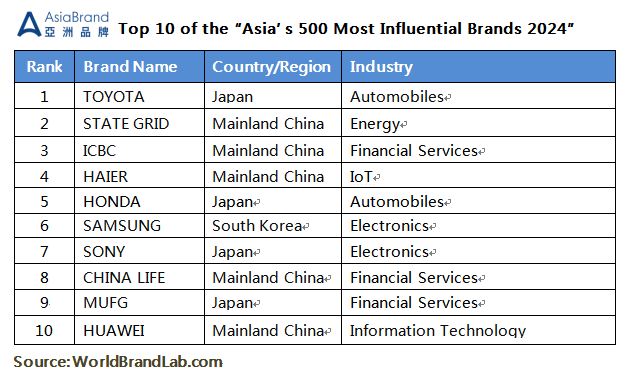
世界品牌实验室发布2024年亚洲品牌500强年报,丰田、国家电网、工商银行名列前三,中国、日本和韩国是入选品牌最多的三个国家。世界品牌实验室学术委员会主席、牛津大学荣誉教授斯蒂芬•沃格(Steve.WOOLGAR)说,中国品牌的崛起,是中国经济崛起的核心动力。沃格博士回忆,在他小时候,德国制造就是劣质商品的代名词,如今已经是高品质的象征。剑桥大学制造业研究院教授斯蒂芬·埃文斯博士(Steve.EVANS)也表示,1980年代,日本制造的品牌也非常普通。中国制造的品牌价值,完全有机会赶上并超越德国制造或日本制造,关键要在设计、可持续和创新上持续发力。 The "Asia Brand Summit," organized by the World Brand Lab, took place in Hong Kong on September 25. At the summit, the "Asia's 500 Most Influential Brands of 2024" list was unveiled, with Toyota, State Grid, and ICBC leading the rankings. Other top 10 brands include Haier, Honda, Samsung, Sony, China Life, MUFG, and Huawei. China, Japan, and South Korea had the highest representation. Keynote speakers included Steve Woolgar (University of Oxford), Steve Evans (University of Cambridge), Sara Kim (University of Hong Kong), and Jane Wang (Fu Jen Catholic University).
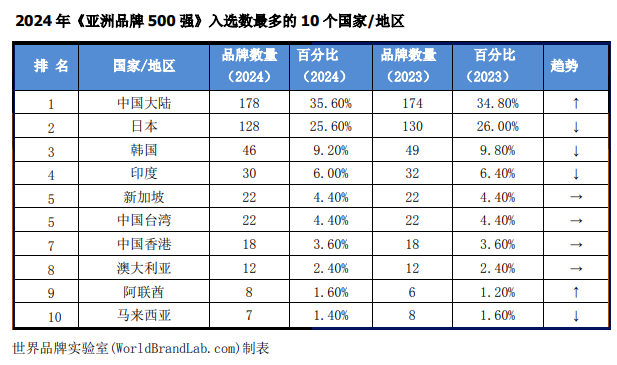
World Brand Lab Releases 'Asia's 500 Most Influential Brands of 2024'.Toyota, State Grid, and ICBC are listed as the top three influencers. Haier, Honda, Samsung, Sony, China Life, MUFG and Huawei are also listed in the top 10. China, Japan, and South Korea are the three countries with the most selected brands.The selection criterion is the brand's Asian influence. Steve Woolgar, Chairman of the World Brand Lab Academic Committee and marketing professor at University of Oxford, concludes that the indicators used by World Brand Lab to evaluate the influence of Asian brands include market share, brand loyalty, and Asian leadership. Among them, brand loyalty is measured using the rating data from iTrust Rating, and Asian leadership, especially ESG scores, is referenced from Super Finance's ESG database. The "Asia's 500 Most Influential Brands of 2024" list was released at the summit. The 2024 list includes brands selected from 20 countries and regions. China has 219 brands, accounting for 43.80% of the entire list, ranking first among all countries; of these, 178 brands were from mainland China. Japan ranked second with 128 brands, while South Korea ranked third with 46 brands. The topic for this year's Asia Brand Summit is "Sustainable Leadership: The Rise of Asian Brands in Global Markets." Dr. Steve Evans, Professor at the Institute for Manufacturing at University of Cambridge, believes that the connection between sustainability and brand building is becoming increasingly close. People no longer expect companies to merely minimize their environmental impact; now, they also demand that businesses actively drive change and demonstrate a true commitment to sustainable practices. Dr. Sara Kim, Professor of Marketing at University of Hong Kong Business School, contends that Asian brands are having a transformative impact on the global economic landscape. As these brands rise, they reflect a shift towards sustainability-oriented leadership, which is crucial for establishing a resilient global identity. Although the ESG strategies of Toyota and Hyundai have their respective strengths and weaknesses in promoting sustainability, both are striving to prioritize governance within the ESG framework to enhance brand reputation. Dr. Haisen Ding, founder of World Executive Group and World Brand Lab, believes that there is an invisible hand guiding the economic system, which he refers to as the reputation ecosystem. Sustainable brand building is about adapting to, establishing, and maintaining a reputation ecosystem. It requires companies to align their values with broader global social and environmental responsibilities, integrating ethical practices into all aspects of the business—from supply chain management to product development.
掌握技术或品牌的国家,很少会遭遇经济衰退。例如,这款瑞士宝格丽(BVLGARI)手表,是史上最薄的机械表,厚度仅为1.7毫米,限量发行20块,售价67万美元。世界品牌实验室(WorldBrandLab)认为,中国应该从低成本竞争,转向专注于工业和品牌卓越。A country with control over technology or prestigious brands rarely faces economic decline. For instance, the Swiss BVLGARI watch, the thinnest mechanical watch ever at 1.70 mm, is a limited edition of 20 pieces priced at $670,000. World Brand Lab suggests that China should move from low-cost competition to a focus on industrial and brand excellence.
这就是全球最大的12家消费品牌集团,通过旗下的550个品牌控制着世界消费者的视觉和味觉。中国要保持经济的可持续增长,就必须从生产型向品牌型转型。世界品牌实验室认为,品牌是一个国家软实力的象征。These are the world's 12 largest consumer brand groups, controlling the sight and taste of consumers worldwide through their 550 brands. For China to maintain sustainable economic growth, it must transition from production to branding. According to the World Brand Lab, brands are a symbol of a country's soft power.

World Brand Lab Releases China's 500 Most Valuable Brands 2024. Dr. Steve Woolgar, Chairman of the Academic Committee of World Brand Lab and Emeritus Professor of Marketing at Oxford, said, "Over the past 20 years, I have witnessed the remarkable rise of Chinese brands, some of which have already had a strong global influence”.
The 21st World Brand Summit was held on June 19th in Beijing. The organizer, World Brand Lab, released the "China's 500 Most Valuable Brands 2024" report. The top three brands in China are State Grid(653.89B RMB, ICBC(563.07B RMB), and Haier(540.83B RMB). There are 108 Chinese brands valued at more than 100 billion RMB. The total value of China's 500 Most Valuable Brands in 2024 is 38.57 trillion RMB, which represents a 12.35% increase compared to last year. Dr. Steve Woolgar, Chairman of World Brand Lab, expressed his observations on the remarkable growth of Chinese brands over the past 20 years. According to him, these brands have not only gained significant influence within China but also made a strong global impact. Some of the notable Chinese brands mentioned by Dr. Woolgar include State Grid, Haier, Sinochem, China Resources, China Southern Power Grid, Poly, HBIS, China Huadian, Wuliangye, Xuzhou Construction Machinery, TSINGTAO Beer, Air China, Beidahuang, Dongfang Electric, Tongwei, Bosideng, Feihe, China National Aviation Fuel, Hengli, Golden Concord Group, Power Dekor, JOMOO, Changhong, Double Star, and many more. According to this year's report by World Brand Lab, the competitive strength of a region mainly depends on its comparative advantages while brand and regional economic growth are interlinked. In terms of the regional distribution of China's 500 Most Valuable Brands, Beijing ranked first with 91 brands. Guangdong and Shanghai ranked second and third with 79 and 42 brands respectively. According to the scope of influence of these selected brands, there are 431 brands with national influence and 69 brands with global influence. The topic of this year's World Brand Summit is "Disruption and Reinvention: A roadmap for enhancing brand value through digital technology". Dr. John Deighton, Emeritus Professor of Business Administration from Harvard Business School, indicated that first, all marketing is now digital marketing. The effect of the digital transformation is that marketing now feels much more personal than in earlier times. But the new challenge is to find the mass scale of those earlier times. Second, we are on the brink of the age of generative artificial intelligence. It holds out the promise of being the solution to the challenge of intimacy at scale. Dr. Ziv Carmon, Chaired Professor at INSEAD, breaks down AI and branding from the perspective of behavioral economics, a field founded by professor’s mentor and Nobel Laureate Professor Daniel Kahneman. Dr. Carmon reminded that a notable challenge is customer resistance to AI and information perceived as coming from an algorithm can be rejected. However, AI is increasingly pivotal in branding efforts. Currently, 75% of CMOs have utilized AI-driven tools. Marketers deploy AI for diverse branding activities, including emotional analytics, AI-driven interactions, and deep data analysis. Dr. Ravi Dhar, a professor of management and marketing from the Yale School of Management, highlights five new AI applications in branding. Firstly, AI can help with product design and testing. Secondly, we can also use AI to generate consumer insights and know what AIs "think" about your brand. Thirdly, AI can be used for brand innovation to develop new recipes, product names or marketing writing. Fourthly, AI can be used for brand creative. Finally, we can use AI for brand personalization to improve audience relevance. Dr. Haisen Ding, CEO of World Executive Group and World Brand Lab and a PhD from the University of Oxford, remarked that AI is not only an iconic concept but also a catalyst for an industrial revolution. He emphasizes that 90% of the market value of technology giants like Nvidia, Apple, and Microsoft, who compete in the AI industry, is attributed to intangible assets represented by brands. Dr. Steve Woolgar concluded that brands need to develop long-term AI strategies and find ways to connect effectively with consumers and investors. World Brand Lab is an international brand value research institute wholly owned by World Executive Group, the world's leading digital business and strategy consulting firm. World Brand Lab was co-founded on the initiative of Nobel Laureate Robert Mundell, who served as its first chairman. The experts and consultants of World Brand Lab hail from Harvard Yale, MIT, Columbia, Oxford, Cambridge, INSEAD, and other top universities around the world. Its research results have become an important basis for intangible asset valuation in the process of M&A of many enterprises.

How brands are using generative AI. World Brand Lab unveiled the 20th edition of "China's 500 Most Valuable Brands" list, with State Grid topping the list at a value of 626.87 billion RMB.The top five spots also included the ICBC, Haier, PetroChina, and China Life. Esteemed experts from prestigious institutions like Harvard, Yale, Oxford, Stanford, and UC Berkeley attended the World Brand Summit, where they discussed 'Global Branding in the Age of AI and Web 3.0: Pushing the Boundaries'. Dr. Elie Ofek, from Harvard Business School, emphasizes AI's transformative potential in rebranding and highlights that entrepreneurs must explore how intelligent technologies reshape brand management. AI goes beyond efficiency and can shape brand identity, fostering customer relationships. Establishing a framework to identify AI's roles in brand management is vital for success across industries. Dr. Jennifer Aaker from Stanford believes AI should deepen meaning, not just generate short-term happiness. Essential questions include human values, trust-building AI, and what it means to be human.Dr. Haisen Ding, CEO of World Executive Group, believes that AI and Web 3.0 will disrupt global brand building. This era offers equal innovation chances for Chinese and foreign brands. Using AI, companies can revolutionize marketing by analyzing data, predicting consumer behavior, and personalizing messaging. Dr. Ravi Dhar, from Yale School of Management, notes the impact of the metaverse on brand strategy. Brands can build trust through user experiences and influencers, while creating immersive virtual experiences and offering virtual goods. As AI tools like ChatGPT grow, brands must address the challenge of disinformation, considering effective responses to avoid negative consequences. Brands actively use generative AI, with 32% of brand respondents adopting text-prompted copy generation and 26% for image/idea generation and language translation. Dr. David A. Aaker from UC Berkeley recognizes AI's role in marketing, emphasizing personalized interactions with stakeholders and the need for expertise in data-driven software.Looking ahead, 82% of brand respondents plan to adopt AI for instantaneous creative optimisation, while 71% aim for real-time personalised marketing. However, over half will not use AI for text-prompted code generation(61%)and SEO workflow automation(50%) within the following year.

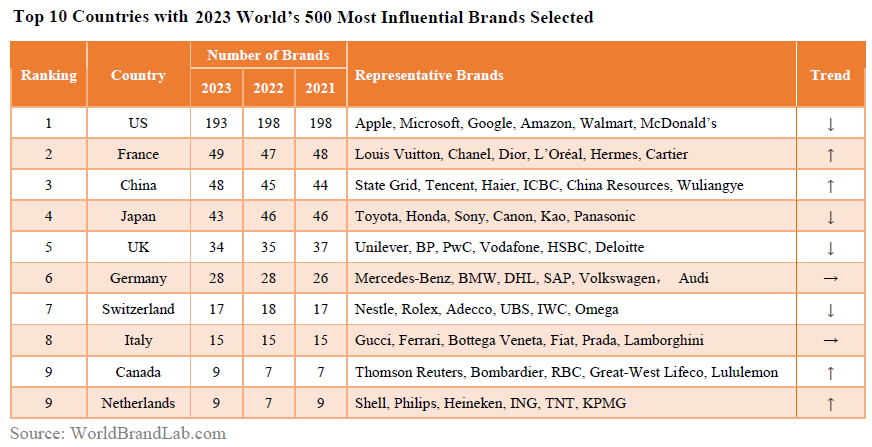
The 20th edition of the 2023 World's 500 Most Influential Brands, compiled by World Brand Lab, was released in New York on Dec. 13. Microsoft claimed the top spot, surpassing last year's leader Apple, which now holds second place. Amazon secured third place. The United States dominated with 193 brands in the top 500, while France, China, Japan, and the United Kingdom followed as major contributors. The evaluation of brands for the World's 500 Most Influential Brands is based on global influence, measured by a brand's ability to develop markets and generate profits. Following three key indicators of brand influence, namely market share, brand loyalty and global leadership, World Brand Lab tracked more than 8,000 leading brands around the globe to pioneer the World's 500 Most Influential Brands list. When measuring brand loyalty, iTrust Rating's data were consulted. Dr. Steve Woolgar, Chairman of the World Brand Lab academic committee, notes the 20th-year milestone of the analysis report, covering 32 countries in 2023. U.S. companies maintain a dominant position, with 193 in the top 500, solidifying their global brand leadership. France, China, Japan, and the United Kingdom form the second tier, while Germany, Switzerland, and Italy constitute the third tier.
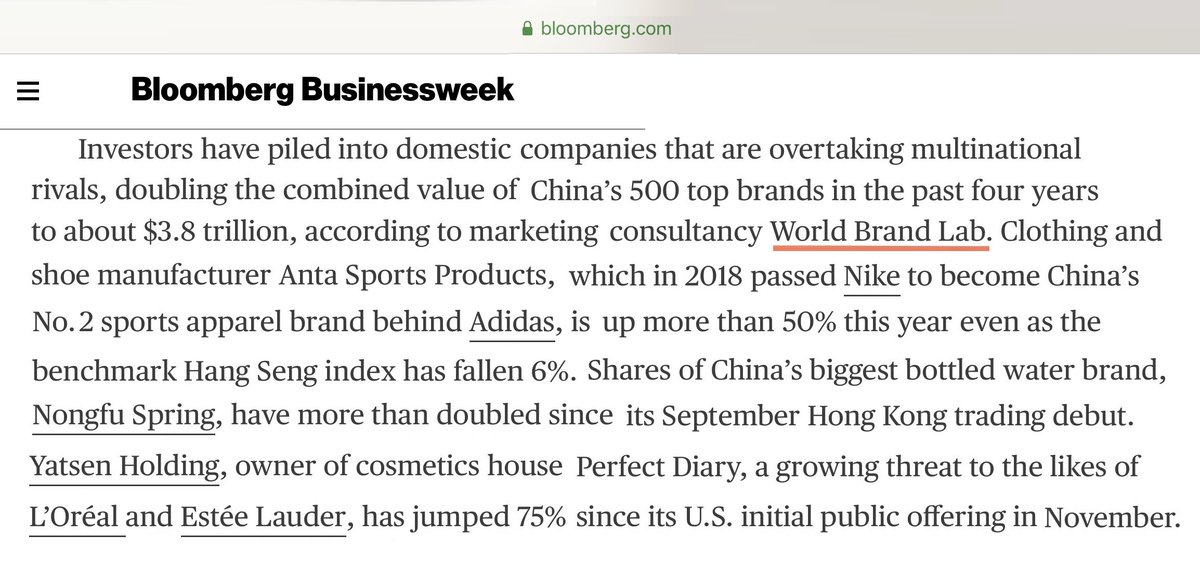
Investors have piled into domestic companies that are overtaking multinational rivals, doubling the combined value of China’s 500 top brands in the past four years to about $3.8 trillion, according to marketing consultancy World Brand Lab. ‘Made in China’ Finds New Fans in China!
World Brand Lab Unveils '2023 World's 500 Most Influential Brands'. Microsoft claimed the top spot, surpassing last year's leader Apple, which now holds second place. Amazon secured third place. The United States dominated with 193 brands in the top 500, while France, China, Japan, and the United Kingdom followed as major contributors. Notably, the list showcases the ascent of Chinese brands, with 48 making the cut, surpassing Japan for the first time and securing third place globally. Standout brands on the list include State Grid, Tencent, Haier, Huawei, China Resources, China Life, Wuliangye, China Southern Power Grid, TSINGTAO, Sinochem, Hengli, XCMG, Shenghong, and ITG Holding. The evaluation of brands for the World's 500 Most Influential Brands is based on global influence, measured by a brand's ability to develop markets and generate profits. When measuring brand loyalty, iTrust Rating's data were consulted. SuperFinance's ESG database was referred to when measuring brand leadership, especially ESG performance. Dr. Steve Woolgar, Chairman of the World Brand Lab, notes the 20th-year milestone of the analysis report, covering 32 countries in 2023. U.S. companies maintain a dominant position, with 193 in the top 500, solidifying their global brand leadership. France, China, Japan, and the United Kingdom form the second tier, while Germany, Switzerland, and Italy constitute the third tier. There are 25 new brands on this year's list. The highest-ranking new brand is the CIGNA GROUP from the U.S., securing the 85th position overall. Notable brands like SpaceX (U.S.), ENEL (Italy), and ASML (Netherlands) also feature. Brands like Credit Suisse (Switzerland) and MGM (U.S.) dropped off due to serious crises, scandals, and negative societal impacts. The listed brands have an average age of 98.57 years, a slight increase from last year's 98.22 years. Notably, 225 brands, constituting over 40% of the list, have reached the venerable age of 100 years or more. The oldest brand, Saint-Gobain from France, is 358 years old, followed closely by Aviva and Moutai, both with histories exceeding 300 years. Among the 48 Chinese brands, Moutai, TSINGTAO, Wuliangye, Bank of China, and AIA have surpassed the century mark. Dr. John Deighton, Emeritus Professor at Harvard Business School, attending the World Executive Summit and the World's 500 Most Influential Brands release event in Hong Kong on Dec. 19, suggests that brands should use creators and influencers for branding, avoiding direct engagement with global conflicts. He cites examples dating back to 2008, like Coca-Cola on Facebook and Ford's use of creators for the Fiesta launch. Given China's lead in creator marketing over America, this branding approach is likely appealing to Asian marketers. Dr. Jean Claude Larreche, Emeritus Professor at INSEAD, notes the increasingly VUCA (volatile, uncertain, complex, and ambiguous) world, emphasizing two strategic priorities: corporate value growth, not just revenue, and corporate value capture, not just customer value creation. Dr. Haisen Ding, CEO of the World Executive Group and the World Brand Lab, underscores the escalating pressures on global brand strategies amid declining consumer trust. He emphasizes the imperative for future CEOs to master uncertainty. Additionally, for CMOs or CBOs, leveraging AI becomes crucial for continuous monitoring of the global brand footprint. Dr. Sara Kim, Professor of Marketing at Hong Kong University, emphasizes the importance of localization for globalized brands, including a dedicated crisis management team for geopolitical risks, adherence to local regulations, unique product lines based on local preferences, and a focus on ESG standards. Dr. Jing Xu, Professor of Marketing at Peking University, asserts that a brand's purpose must remain clear despite the real world's complexity. Genuine sustainable development, as seen in many exemplary and growing brands, involves incorporating goals that benefit humanity and the world into their mission. The World Brand Lab's year-end report indicates that over the past decade, economic, political, social, and technological factors hindered globalization, leading to an era of diverse localization. Companies are adapting organizational structures to integrate brands with local communities, industries, cultures, and customs. Since 2003, World Brand Lab has tracked over 80,000 major brands in 60 countries. Initially chaired by Nobel laureate in Economics, Professor Robert Mundell, this premier brand consulting firm is now wholly owned by the World Executive Group.

World Brand Lab published the 20th edition of the '2023 China's 500 Most Valuable Brands' list. This annual report, which examined financial data, brand strength, and consumer behavior, ranked State Grid as the most valuable brand, with an estimated value of 626.87 billion RMB.


亚洲金融 Asia Fin... @AsiaFinance
407K Followers 612 Following 亚洲金融:政经领域的有意思的事儿。 AsiaFinance: For the Rich and Powerful.
总裁简报 CEO Brie... @CEOBriefing
177K Followers 306 Following 总裁简报:企业家和投资者的决策指南。 CEO Briefing: Decision Guide for Entrepreneurs and Investors.
超级财经 SuperFin... @SupFin
116K Followers 88 Following 超级财经:带来超级回报的财经信号。 SuperFinance: Financial Signals That Bring Super Returns.
全球货币 Global M... @GlobalMoney
132K Followers 193 Following 全球货币:人工智能让金融决策更简单。 Global Money: Making Financial Decisions Easier with AI.


💋Katie🎁sextoy_U... @KingKatie66151
101 Followers 437 Following 🌟 Amazon Adult Toy Seller🌟 Looking for honest reviewers to try our sex toys 💞100% free, no strings attached 💞Leave a message, I'll reply ASAP @Sextoy_wing
Z @WYZethan
9 Followers 1K Following
Sk ranjan Ranjan @sk_ranjan2452
49 Followers 1K Following
love you boy @IrfanShaik22974
15 Followers 660 Following
Fare Ahmed @fare_ahmed77516
8 Followers 118 Following
John @yo5617561
212 Followers 7K Following
Prakash Jb @KumaraKuma3737
121 Followers 819 Following

NYYR @nyyrslxc
663 Followers 65 Following
ghut @ghut238
13 Followers 936 Following
lvtaste @lvtaste
3 Followers 203 Following
LD @TOR5168
19 Followers 2K Following

Andrew Rosener 🛒 �... @andrewrosener
24K Followers 9K Following #1 Domain Broker in the World | Chairman @MediaOptions & Chief Mule @DomainSherpa | Love #Domains | Question Everything | Return 🛒


新溪(100%互fo) @EpRmPzFyO5yLH6x
16 Followers 555 Following
DOG @dogg67555
20 Followers 177 Following

Asenyang @Asenyang7250591
5 Followers 229 Following


wuyong @wuyong20001116
154 Followers 793 Following
Max @Max_easyluck
173 Followers 3K Following

12345 @meinvlele
5 Followers 97 Following

king Melensky @KMelensky48965
107 Followers 2K Following Refuse to pick your feet and trick people into downloading the applet! Why do it?
Christina @ChristinaLeung5
46 Followers 229 Following 有过那样的一个人,是生命中不可磨灭的烙印。有了他,世上别的人都可以被忽略。即使把握不住任何有关于爱情的线索,也深深感激他陪同我度过的漫漫人生。即使暮黄昏黯然回望,也庆幸曾经有泪是为他而流。
UNICEF España @unicef_es
269K Followers 63K Following Trabajamos para que se cumplan los derechos de los #niños a la supervivencia, la salud, la educación y la protección. ¡Y nunca nos rendimos! ¿Te sumas? 👧🏽👦🏽


Minh Anh Trần @TranAnh69012
11 Followers 227 Following
Muskan Mahi @MuskanMahi582
0 Followers 15 Following


james corely @CorelyJame64200
23 Followers 474 Following
toppshoda @xtopshoda
32 Followers 598 Following takegod. rackking. richjunkie richniggaproblems. bmxdamobb
horny bottom in ahmed... @bottomdubai4
1K Followers 1K Following im bottom from India 26 year old..looking for top who can fu.k me harder... I am so horny. I want big dick 🍌 to full fill my hole😋
库^_ @chenzijie9898
48 Followers 764 Following
Rachel Qiu @RachelQ33339
3 Followers 62 Following

jun mao @junmao227773
105 Followers 1K Following
总裁简报 CEO Brie... @CEOBriefing
177K Followers 306 Following 总裁简报:企业家和投资者的决策指南。 CEO Briefing: Decision Guide for Entrepreneurs and Investors.
超级财经 SuperFin... @SupFin
116K Followers 88 Following 超级财经:带来超级回报的财经信号。 SuperFinance: Financial Signals That Bring Super Returns.
全球货币 Global M... @GlobalMoney
132K Followers 193 Following 全球货币:人工智能让金融决策更简单。 Global Money: Making Financial Decisions Easier with AI.

亚洲股市 AsiaStoc... @AsiaStock
16K Followers 45 Following 赢在亚洲:股市、经济和宏观趋势的策略 Winning in Asia: Stock Markets, Economies, and Macrotrends
iTrust Rating @iTrustRating
486 Followers 29 Following iTrust Rating: A Leading Authority in the Domain of AI-based Rating Products, Catering to the Discerning Needs of Both Consumers and Investors.
John Deighton @HBSmktg
6K Followers 44 Following Daily newsfeed on digital & data-driven marketing from HBS Prof. John Deighton. Tweets are not endorsements. Note: Feed pausing mid July 2023 amid the meltdown.
David Aaker @DavidAaker
13K Followers 245 Following Vice Chairman of @prophetstrategy, a global consultancy, Professor Emeritus, UC Berkeley, Author of 18 books including "The Future of Purpose-Driven Branding"
Jennifer Aaker @aaker
24K Followers 211 Following General Atlantic Professor, Stanford GSB. Author of Humor, Seriously and The Dragonfly Effect.
Kent Larson @Larson_MIT
2K Followers 99 Following MIT Professor of the Practice | Director of City Science: MIT Media Lab | Co-Director: Norman Foster Institute | Founder: L3Cities & ORI Living
Group Gordon @GroupGordon
2K Followers 1K Following Award-winning communications firm working in corporate, public affairs, and crisis. A best place to work.
BBDO Worldwide @BBDOWorldwide
116K Followers 533 Following The Work. The Work. The Work. 289 offices in 81 countries work day by day, client by client, to create the world’s most compelling commercial content.

WPP @WPP
123K Followers 820 Following WPP is the trusted growth partner for the world’s leading brands.
David Haigh @davidhaighbrand
780 Followers 459 Following Founder and CEO of @BrandFinance, the world’s leading independent brand valuation and strategy consultancy.
Brand Finance @BrandFinance
17K Followers 2K Following Brand Finance is the world’s leading #brand #valuation #consultancy. Founded by @davidhaighbrand in 1996. Bridging the gap between #marketing and #finance.
Interbrand @Interbrand
52K Followers 4K Following We are a global brand consultancy pioneering the future of brand building.
FTChinese @FTChinese
712K Followers 109 Following FT中文网是英国《金融时报》集团旗下唯一的中文商业财经网站,旨在为中国商业菁英和决策者们提供每日不可或缺的商业财经新闻、深度分析以及评论。
世界资本 World Ca... @WorldCapitalAI
68K Followers 152 Following 世界资本:以人工智能简化金融决策和信息。 World Capital: Simplifying Financial Decisions with AI.
You might like