The Science @IndustryProf
Joined August 2023-
Tweets24
-
Followers7
-
Following114
-
Likes1
@peterottsjo @mkoeris The recombinases are not the limiting step in reaching the goal of large-scale genome engineering in vivo...
RevMed just doubled overall survival in pancreatic cancer by using CypA-targeting molecular glues to potently drug oncogenic KRAS-ON, long deemed untouchable. One funny thing is that probably the most fundamental insight for daraxonrasib sits in a PNAS paper that's been cited merely 84 times. This showed that molecular glues can coax an endogenous protein to wrap itself around utterly featureless surface. The other is a 2017 Cell Reports paper (just 68 citations) on how Sanglifehrin A can be used to repurpose CypA's surface. A lot of the game-changing stuff seems niche and unglamorous at first. Greg Verdine is having a chembio Annus Mirabilis for his 2025-2026 streak: FOG-001, Daraxonrasib. He provided much of the foundational conceptual work behind taking out both Beta-catenin and KRAS*. *of course many others contributed immensely, but let's give some credit where credit is due!

It’s an interesting counterfactual history question: if you knew only SR, and were motivated only by resolving clock drift problems in GPS, how much of GR would you derive? For sure, not the full Einstein equations. But metric perturbation theory? Post-Newtonian expansions? PPN?
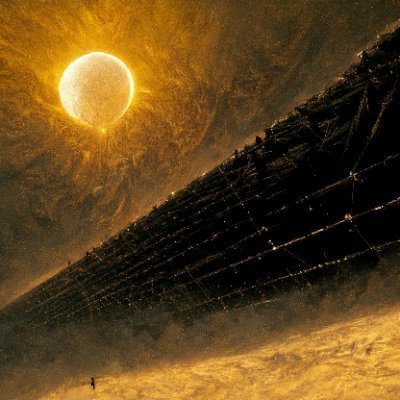
Engineers that don't know their ass from a vector space aren't going to invent the Levi-Civita connection or discover Riemann curvature. They aren't David Hilbert or Einstein, the philosophy you need for this is from a culture that wouldn't exist.

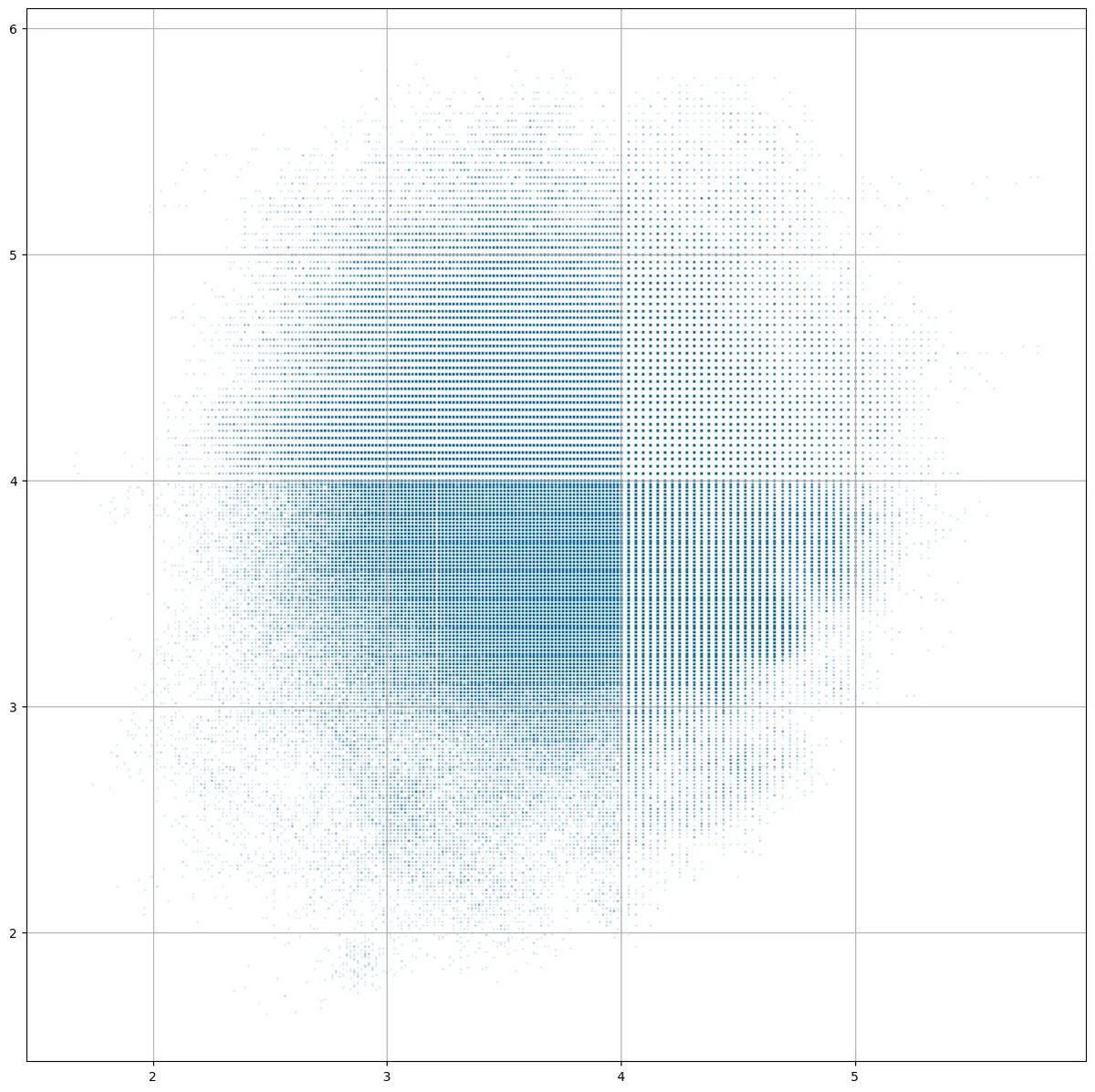
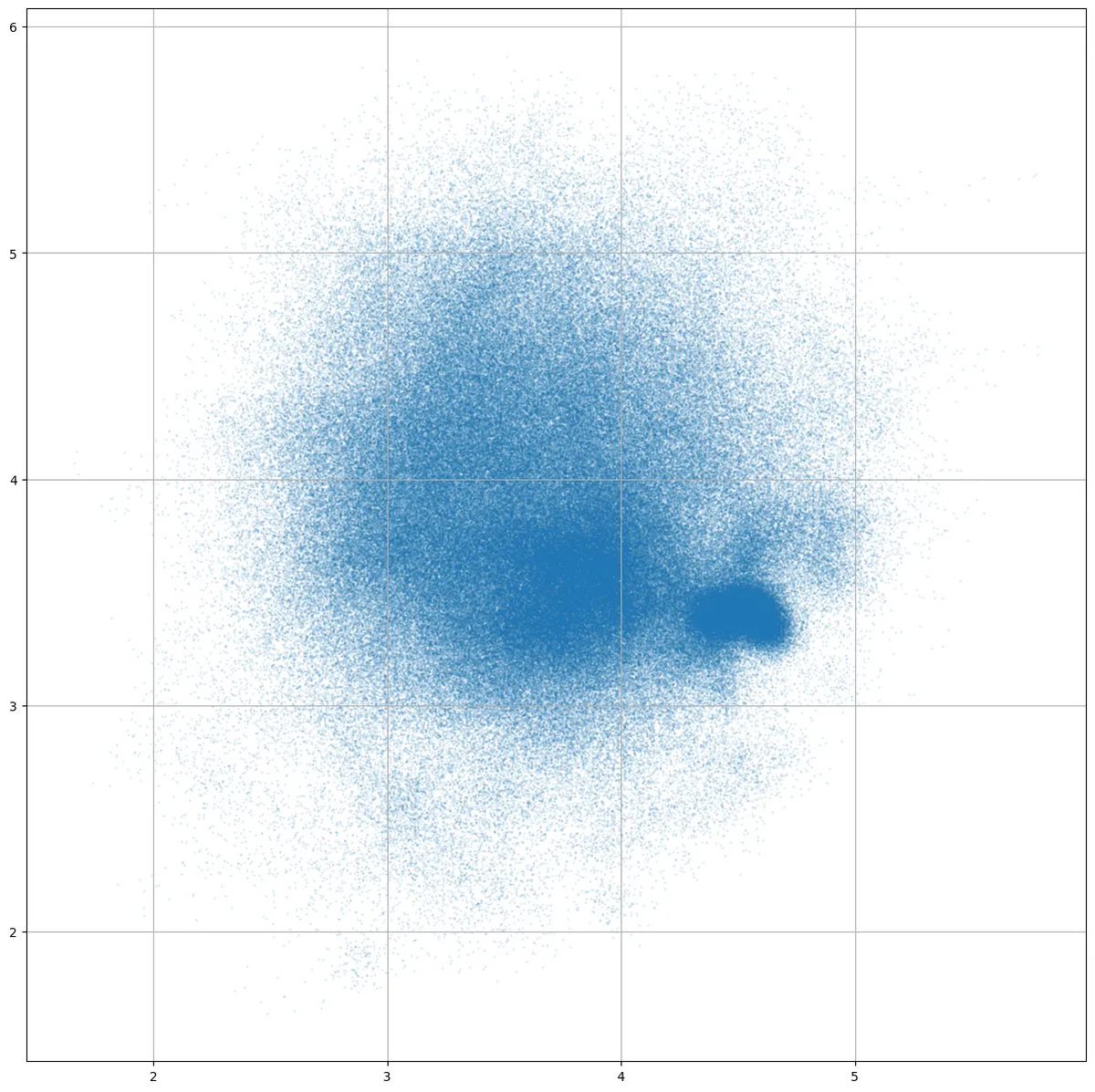
Making a scatter plot of 400_000 data points, some of the plots had odd gaps in coverage. It took me a little while to realize that it was only when the data was farther from the origin -- it was the raw bfloat16 precision. Everything looks great from -1 to 1, but as you go past 2 and 4, the coverage gaps get larger. My intuition didn't have it being quite so "discretely countable" at those modest numeric values. Float32 for comparison.
@bryan_johnson In the R&D sphere we live by the mantra "embrace the grind."
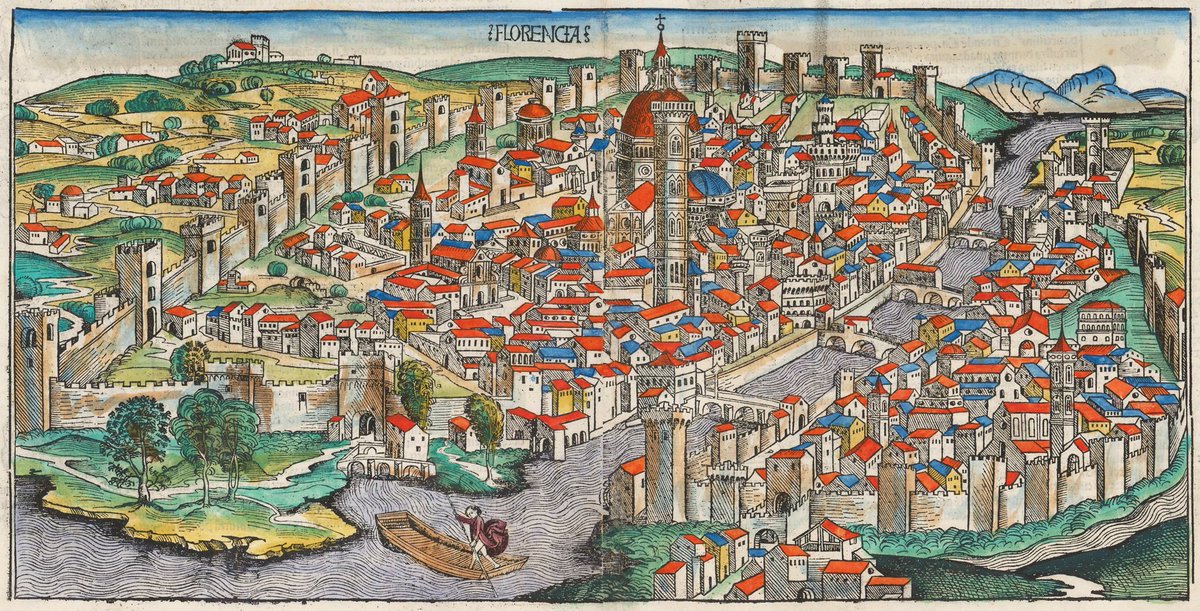
Florence was the original skunkworks: Botticelli, Lippi, Leonardo, Ghirlandaio, Donatello, Verrocchio, Perugino, Raphael. All products of the same 2.4-square-mile lab. In the 1470s Florence had 21 guilds regulating quality, controlling market entry, and running formal apprenticeship pipelines. Kids started at age 12, grinding pigments imported from Afghanistan, preparing wooden panels, and casting bronze. Verrocchio's workshop doubled as goldsmith, sculptor's studio, and engineering lab. This system produced polymaths like Michelangelo, who painted the Sistine ceiling, sculpted the David, and designed the dome of St. Peter's. Florence housed the largest bank in Europe: Banco dei Medici. It funded the masters, but more importantly? It funded the infrastructure that produced them. 40,000 people, 54 stone-carving studios, 84 woodcarving shops, and 270 wool mills behind the same city walls. A small genius factory you could walk end to end in under 20 minutes. How will we build this again?
A preview of my talk tomorrow at the Newton Insitute @NewtonInstitute (comments welcome) My primary interest is research math: solving problems, proving theorems. Before 2019, I was accustomed to using Mathematica to check tedious, error-prone algebra in my papers. Do it once, and never waste time checking it again. But algebra was only part of the issue. If I had a lemma, and in a 60-page paper I might have 20 of them, with a dozen parameters all moving around in different ranges and needing to line up perfectly at the end, then even a single stray minus sign could kill the entire paper. The whole enterprise was extremely complex and fragile. (What I'm describing is very common in loads of fields in modern research math.) In 2019, I watched a lecture of Kevin Buzzard's, and realized the answer: I should use an interactive theorem prover like Lean to check my lemmas the same way Mathematica checks my algebra. (Of course, as I've since learned, there are many benefits to working formally beyond correctness, and these have been extensively enumerated elsewhere, so I won't repeat them here.) But my original motivation for getting involved in formalization was simple: I hoped it would speed up my workflow. It did not. In fact, formalization is brutally tedious, requiring painstakingly spelling out facts that to a human expert are blatantly obvious. Fast forward to 2025, and AI was getting genuinely good at helping with formalization. I was already using Claude rather extensively when we crossed the finish line on the "Medium" PNT in July 2025. By September 2025, Math Inc's Gauss system autoformalized the Strong PNT, writing over 20K lines of compiling Lean autonomously. Earlier this month, they outdid themselves again, writing 200K lines autonomously and formalizing Viazovska's theorems on optimal sphere packing in dimensions 8 and 24. So isn't that the dream? AI can now, in some instances, autoformalize very significant theorems. Can we mathematicians just get back to thinking, sketching, and letting AI do the formalization for us? Not so fast. Autoformalization only works because it is built on top of a big, comprehensive, efficient, coherent monorepo of high-quality formalized mathematics, namely Mathlib. And even in the PNT+ and Viazovska examples, the autoformalizations still depended on substantial earlier human work: setting up the right definitions, the right API, the right abstractions, and so on. So maybe we now get a nice positive feedback loop: Research -> formal math (thanks to AI) -> grows Mathlib -> enables more research. Still no. AI formalization, and frankly the first-pass human formalization too, is usually local, ad hoc, single-purpose work. It is not necessarily general, abstract, efficient, or reusable. So it does not in and of itself help grow Mathlib. The second arrow is broken. Actually, this is not some temporary annoyance, it is inevitable! The goals of doing research and building libraries are misaligned, like scrambling up a cliff versus building an elevator to the top. Both are trying to go up, but for completely different reasons and in completely different ways. In fact, it is even worse than that: the second arrow may make the feedback loop negative. Let us give that second arrow a name: "canonization". By canonization, I mean the process of taking a local, one-off formalization and turning it into library mathematics: general, reusable, coherent, efficient, and compatible with the rest of the monorepo. This is an extremely difficult and time-consuming task. It requires a large amount of prior knowledge and skill, often in several quite different areas at once. And here's why the feedback loop may be negative: while a rough formalization can certainly be a technical head start, socially it often strands the problem in the worst possible state: too solved to feel pressing, too idiosyncratic to be reusable. If a formalization already exists in some ad hoc form, then people are much less incentivized to do this work! They get less credit for succeeding, there is less urgency, and less motivation. Does this sound familiar? It's the same structural problem we had back in 2019, going from proved results to formalized results! So the answer should be obvious. In June 2025, I claimed that (quasi)autoformalization, meaning not entirely autonomous but allowing human intervention and steering, was the greatest short-term challenge in realizing the dream of speeding up research [K2025]. The corresponding claim today is: (Quasi)auto-canonization is the greatest short-term challenge for AI systems. I personally know of only one AI company so far that seems to be taking this challenge seriously, namely Harmonic with its Aristotle agent. Imagine if we get this right. Definitions will still be difficult to automate, but there are orders of magnitude fewer definitions than theorems. Once those foundations are laid (which will still be a ton of human time and effort!), everything else can scale on top. Right now, the vast majority of research mathematicians working in formalization are, very commendably, working toward growing Mathlib. But they comprise maybe 1% of all professional mathematicians. This is not necessarily because people do not want to work formally. It is because the current system does not match how most mathematicians want to work. People are diverse. They have different strengths and weaknesses, different interests, different workflows. If we embrace an ecosystem where people are encouraged to formalize freely, with heavy AI assistance, and where the right pieces later get (quasi)auto-canonized into the central monorepo, then I think we could potentially be in position, given the right incentives, training, and culture-shifts, to move from a handful to the majority of mathematicians doing math formally.
@jrkelly Hence the Centessa acquisition. Sleep is one of the few physiology domains that can rival weight loss in terms of market opportunity.
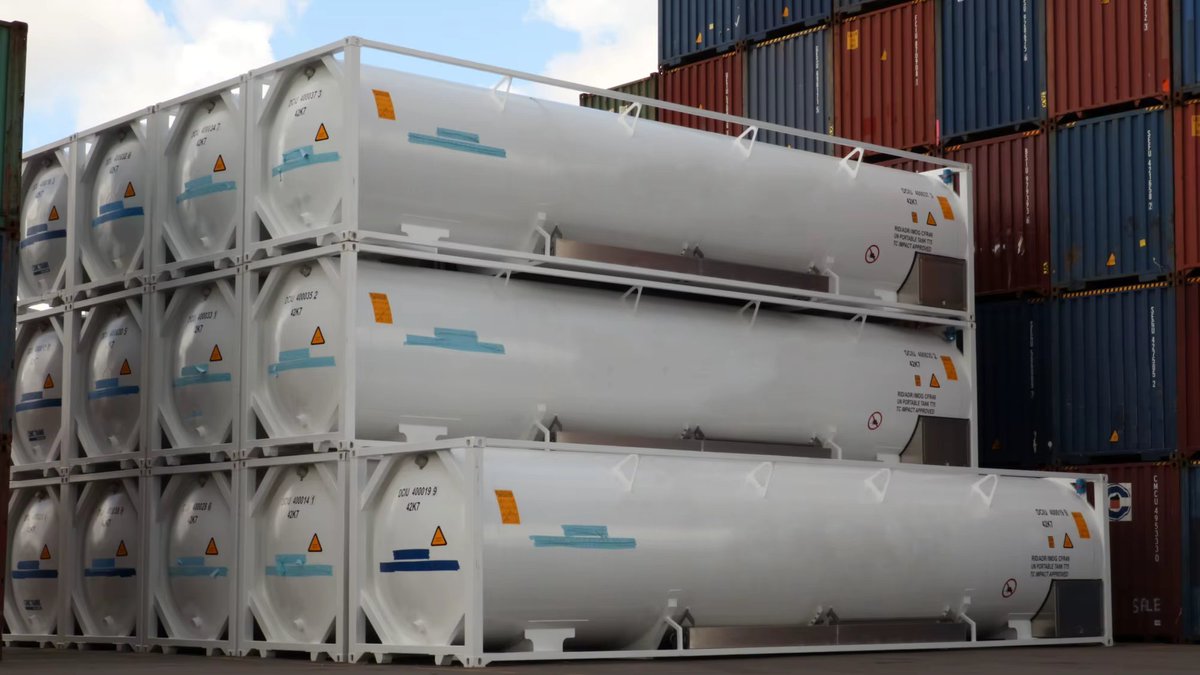
200 helium containers are stranded in the Persian Gulf right now. Each one holds 41,000 liters cooled to -269°C. The containers have no refrigeration. No compressor, no cooling loop. Insulation is all that stands between the cargo and ambient heat, and it buys 35 to 48 days. After that, the liquid boils, the pressure valve opens, and the helium vents to atmosphere. Re-liquefying it requires a specialized plant. Most ports do not have one. Qatar's North Field supplied 33% of the world's helium as a byproduct of cryogenic separation at its LNG plants. On March 2, Iran closed the Strait of Hormuz. Spot prices surged 70 to 100 percent. EUV lithography requires 99.9999% purity helium for wafer cooling and no current substitute exists. The fifth helium shortage since 2006 has just begun.
@hsu_steve If this is indeed the near future, then monogenic disease's days are numbered. And demand for polygenic phenotype prediction will soar.

The older I get, the more I realize intelligence is overrated. Intelligent people are more likely to overthink, overplan, and overanalyze. They hide behind motion that doesn't create progress. They fear the judgment of others if they're proven wrong. The truth is that intelligence is abundant. Courage is not. The people you admire are the ones who had the courage to act. They aren’t more talented than you. They aren’t smarter than you. They just took action when you didn’t. I often wonder how many extraordinary people wasted their entire lives waiting for permission that never came. Permission isn't granted. It's taken. You get to tap yourself in whenever you want. You can just do things. Courage beats intelligence.
@curiouswavefn @mkoeris Afternoon tea at the Institute was always a great time to strike up conversation with Dyson. He never lost the child-like wonder.

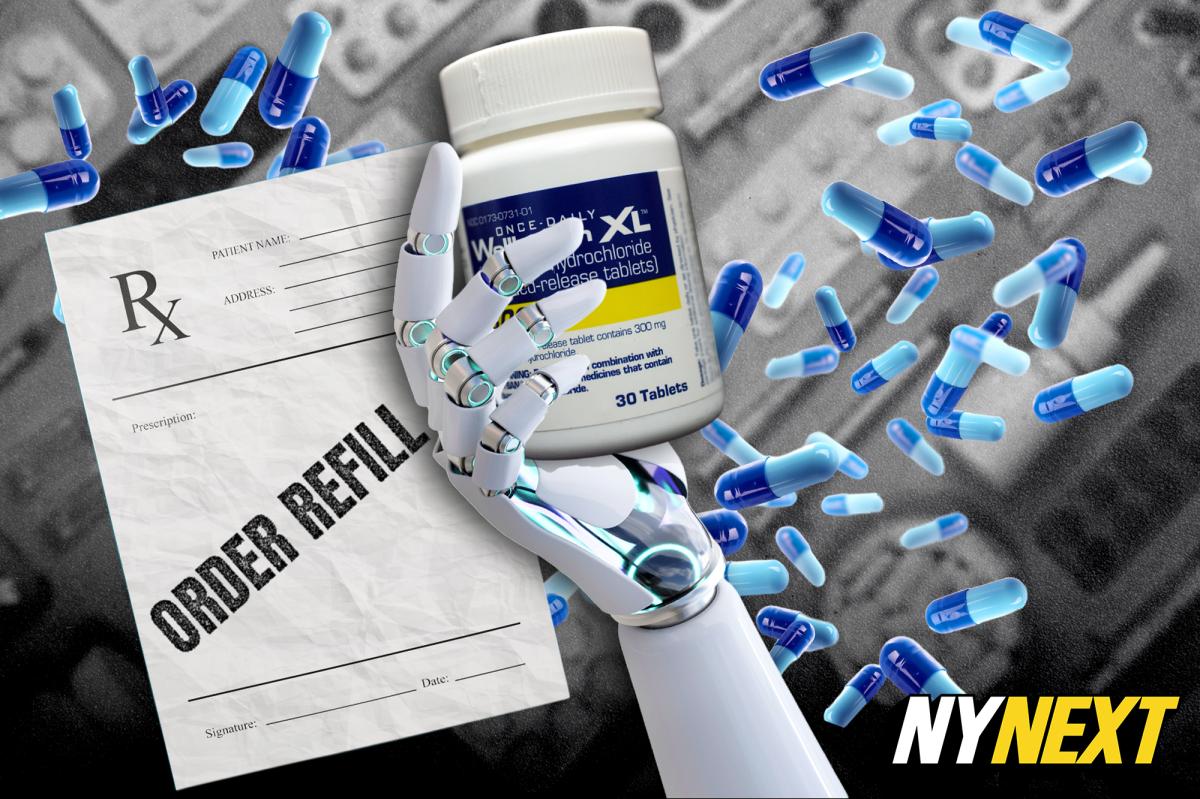
AI medicine is inevitable. In fact, it has arrived. We're excited about this agreement with Utah to allow our AI to prescribe psychiatric renewals. Yes. AI prescribing medication. This is monumental and will collapse the cost of care. (1/
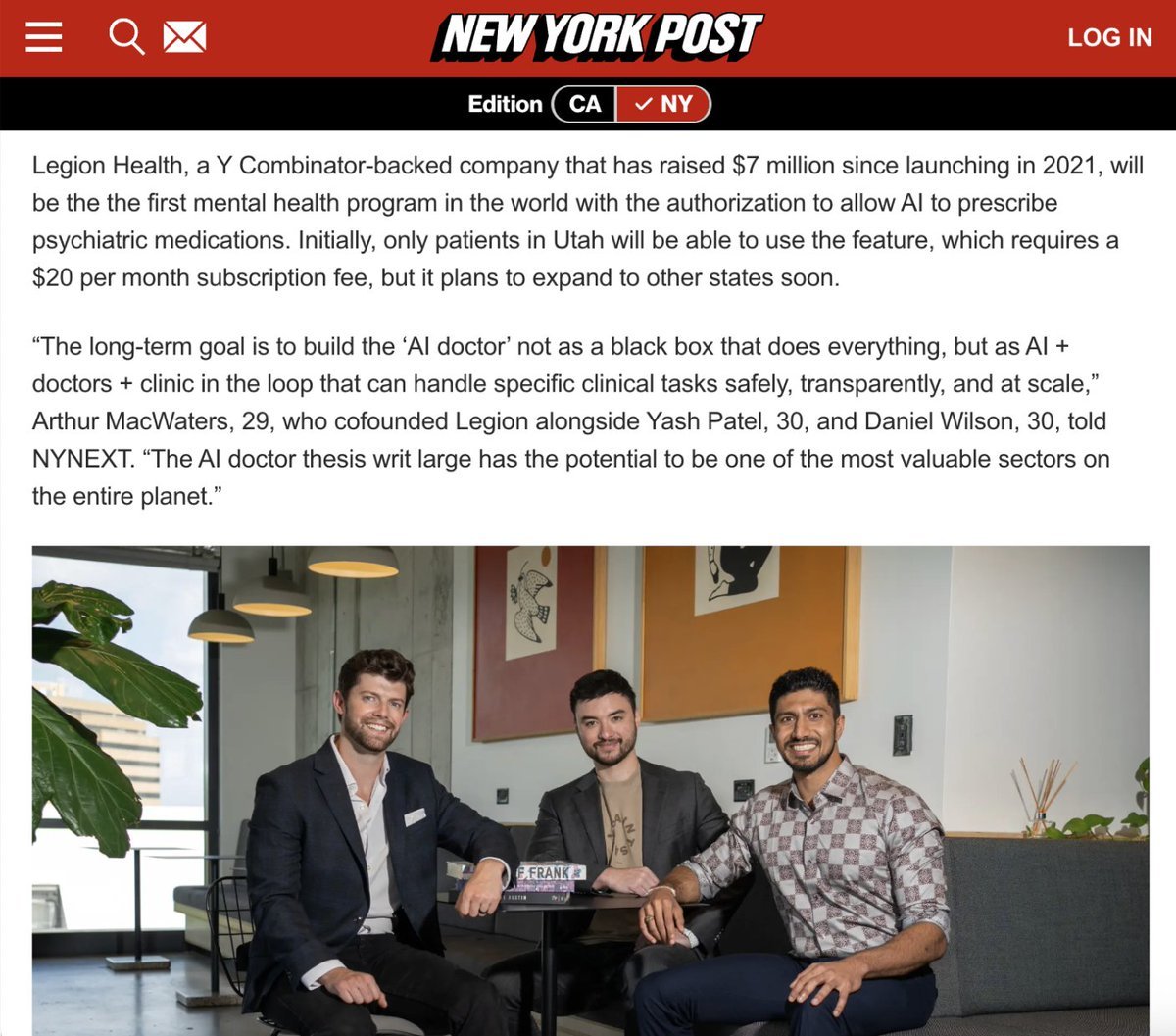

Artificial intelligence will see you now: Bots to prescribe mental health drugs trib.al/89qtnNz
@davidrliu @NatureBiotech The practical, risk-tolerant approach of China in the life sciences is designed to leap-frog the West. The goal is not merely to catch up.
@PeterDiamandis One might extend the analogy and ask what germline genetics in an individual play the role of M/R (mass to radius ratio) which determines the escape velocity from a spherical mass like a planet?
@bryan_johnson @pepsi low levels of MAO-A + low levels of MAO-B?
@mmbronstein @alexUnder_sky @FazlBarez @xuanalogue In 1956 it was high energy particle physics, and USA finally relented in allowing Soviet participation in the "Rochester conference." I suppose ML/AI is in 2026 what HEP was in the 50's. Sanity eventually prevails in science.
@baym Human limitation in discerning good vs. bad ideas is an argument for performing experiments, not for seeking the feedback of a few experts. The point is quite valid though with sed "s/expert/market/g"

bist @emilyjanepotter
168 Followers 2K Following
Jonathanroumie @Jonathanro10282
7 Followers 281 Following
Mark @Marktq22
9 Followers 65 Following
C. Michael Gibson MD @CMichaelGibson
430K Followers 361K Following Non-Profit Founder/Leader | ❤️ Doc | Artist Scientist Educator | News Anchor https://t.co/7OIKCgNtqr | RT ≠ endorse | Disclaimer: https://t.co/bwmE2O4rVu
Bahar Özdemir @BhRzDmR
22 Followers 266 Following
Hana Pink @EBm95QVEU6wNj5Z
240 Followers 4K Following Today is a new day filled with endless possibilities.
Michael Bronstein @mmbronstein
58K Followers 8K Following #DeepMind Professor of #AI @UniofOxford / Director #AITHYRA / Chief Scientist @proximabio / https://t.co/kZpGpDAw4t (opinions are mine) 🤖🧪🧬🎶🐎
Jacob Kimmel @jacobkimmel
12K Followers 3K Following Co-founder & CEO @NewLimit | Interested in aging, machine learning, genomics, the technology production function
Niko Bonatsos @bonatsos
22K Followers 2K Following Obsessed with technical founders building products for themselves. Talent is universal, while opportunity is not. Founder & Managing Director @VerdictCap
Zavain Dar @zavaindar
13K Followers 3K Following Batman; Investor X Computer Scientist. Founder @_DimensionCap
ARPA-E @ARPAE
30K Followers 857 Following The official account of the Advanced Research Projects Agency-Energy Retweets do not equal endorsement
Parimal @Fintech03
34K Followers 76 Following Professionally: Scaling payment agents for the machine economy. Personally: Ancient Indian knowledge system student. Reach-outs: [email protected]
Frances Arnold @francesarnold
86K Followers 778 Following Innovation by evolution, Linus Pauling Professor at Caltech, Nobel Prize in Chemistry (I am an engineer of the biological world)
Sam Finlayson @IAmSamFin
5K Followers 696 Following MD, PhD. Pediatrics-Genetics @seattlechildren and Medical AI @EvidenceOpen Past: @harvardmed, @MIT_CSAIL, @Stanford
Vasilis Ntranos @vntranos
971 Followers 592 Following Assistant Professor @UCSF; Computational Biology and Information Theory
Gaurab Chakrabarti @Gaurab
39K Followers 814 Following CEO @Solugen | MD/PhD building the modern chemical industry | Making molecules that power humanity | Takes on manufacturing, energy, molecules, and biology
Dr. Pat Soon-Shiong @DrPatrick
155K Followers 2K Following Chairman of Chan Soon-Shiong Family Foundation, Exec Chairman ImmunityBio, Chairman and Chief Executive Officer of Los Angeles Times Media Group (LATMG)
Adam Feuerstein ✡�... @adamfeuerstein
127K Followers 798 Following Biotech reporter @statnews. Dog ❤️er. Polk Award winner. #COYS. Said one analyst: The likes of Adam Feuerstein attack viciously. On Signal: stataf.54
Michael Koeris @mkoeris
6K Followers 529 Following Director of the Biological Technologies Office @DARPA. BOD @addgene. Serial founder Vulcan Biologics, GDMC, Sample6 (acq.), Corvium (acq.); frm. Prof @KeckGrad!
Jay Bhattacharya @DrJBhattacharya
712K Followers 7K Following Emeritus Professor Stanford School of Medicine. MD, PhD. NIH Director. All my posts represent my views alone.
Bryan Johnson @bryan_johnson
1.3M Followers 712 Following Conquering death will be humanity’s greatest achievement.
Tom Mueller @lrocket
90K Followers 329 Following Liquid rocket engine development, racecar driver, grandfather, CEO and CTO at Impulse https://t.co/XBThLja8eL
Jason Kelly @jrkelly
33K Followers 3K Following Co-founder and CEO at Ginkgo Bioworks ($DNA)🧬 Former Chair of US National Security Commission on Emerging Biotechnology 🇺🇸
Scott Gottlieb, MD �... @ScottGottliebMD
533K Followers 5K Following Senior Fellow @AEI. Partner @NEA. Contributor @CNBC. 23rd Commissioner of the @US_FDA. Public Boards: @Pfizer @Illumina @TempusAI @UnitedHealthGrp
Sek Kathiresan MD @skathire
30K Followers 982 Following SVP @EliLillyandCo; CEO @VerveTx; We are developing one-time treatments to lower cholesterol lifelong and prevent or treat heart attack
Daphne Zohar @daphnezohar
27K Followers 797 Following Founder, Board & CEO of @SeaportTX. Co-founder Karuna Tx (now at BMS). previously Founder, Board & CEO PureTech. Cofounder/host @BiotechCH.
Ethan Perlstein 1-to-... @eperlste
19K Followers 2K Following ceo @1000cures, ceo @PerlaraPBC (w16 @ycombinator), founder @epalrestat, founder @endrarediseases, founder @smer28rapa
John Maraganore 🇺�... @JMaraganore
16K Followers 423 Following Founding CEO of @Alnylam. Pioneered RNAi therapeutics as a whole new class of medicines for patients. Now bioentrepreneur-at-large. Opinions are my own.

Sam Sinai @samsinai
4K Followers 3K Following Co-founder and Head of Machine Learning @Dyno_Tx. Previously CompBio @Harvard + CS/AI @MIT. Tweets are my own views/interests.
chris bahl @bahl_lab
3K Followers 258 Following President, CEO & Founder @AI_Proteins. Advisor for @bioloomics @photophysicslab @IMPRINTlabs. @TEDFellow @proteinboston @ProteinSociety @RosettaCommons #AI4PD
Gleb Kuznetsov @glebkuz
2K Followers 458 Following Co-Founder and CEO @ManifoldBio // massively multiplexed AI drug design
Neal Amin @neal_amin
415 Followers 482 Following founder, ceo of sculpta. on a quest to solve neurodegeneration
Jeff Dean @JeffDean
442K Followers 6K Following Chief Scientist, Google DeepMind & Google Research. Gemini Lead. Opinions stated here are my own, not those of Google. TensorFlow, MapReduce, Bigtable, ...
Michael Bronstein @mmbronstein
58K Followers 8K Following #DeepMind Professor of #AI @UniofOxford / Director #AITHYRA / Chief Scientist @proximabio / https://t.co/kZpGpDAw4t (opinions are mine) 🤖🧪🧬🎶🐎
Jigar Shah @JigarShahDC
78K Followers 1K Following husband, dad, serial entrepreneur, podcaster, democratizing the electrostate by deploying at scale. It's simple, not easy.
Peter Kolchinsky @PeterKolchinsky
64K Followers 183 Following Managing Partner, RA Capital Management. We build & invest in biotech companies. Scientist. Author, The Great American Drug Deal. https://t.co/ARVLrrTQU4
Bruce Booth @LifeSciVC
56K Followers 736 Following Early stage biotech VC. Recovering scientist. Opinions expressed are solely my own and do not express the views or opinions of Atlas Venture.
Jared Friedman @snowmaker
60K Followers 802 Following founder, techno-optimist, college dropout, partner at @ycombinator.
Vijay Pande @vijaypande
34K Followers 1K Following Co-Founder at @VZVCfund. Investing in companies solving humanity’s biggest problems, led by founders hell bent on bending the curve.
Robert Nelsen @rtnarch
26K Followers 710 Following Company founder and venture capitalist focused on disruptive innovation, esp. biotechnology and AI. Active angel in tech. Fierce Optimist.
Jay Shendure @JShendure
14K Followers 320 Following Genomics technology developer. Developmental biology adult learner. Professor at @uwgenome @HHMINEWS @BrotmanBaty. He/him.
Vineeta Agarwala @vintweeta
23K Followers 1K Following gp @a16z bio | physician, adjunct clinical prof @stanfordmed | prev @gvteam, product @flatironhealth, mdphd @broadinstitute | out-tweeting @paraga @littleansh

Noubar Afeyan @NoubarAfeyan
14K Followers 247 Following Pioneering innovations for a better future for people & the planet. Founder & CEO @FlagshipPioneer, the life sciences co that founded @moderna_tx and many more.
Sara Nayeem @SaraNayeem
12K Followers 2K Following Invest in emerging biopharma co's as EVP, Investments at Enavate Sciences. Prior NEA and Avoro Ventures. I post advice for biopharma exec's and emerging VCs.
Jing Liang 🇺🇦 @AppleHelix
11K Followers 5K Following Entrepreneur. Drug hunter. Anti-ideologues, Anti-medical nihilists, Optimist My NGO: https://t.co/yDWRnOYAyY https://t.co/SOf8c5OZm6
Brian Skorney @BrianSkorney
10K Followers 402 Following Biotech Sell side analyst at @rwbaird. Probability of a false positive = 1 - (1 - alpha value)^n. De omnibus dubitandum est. Inventor of 𝕊𝕒𝕣𝕔𝕒𝕤𝕞 𝔽𝕠𝕟𝕥
David Sable @dbsable
9K Followers 1K Following Life sciences, buy side. Ex ob/gyn and IVF doc. Roadie for @priyamayadas Adjunct at @columbia https://t.co/oHce7tNFsQ
Chris Garabedian @cngarabedian
6K Followers 1K Following CEO of life sciences accelerator @Xontogeny; Venture Fund Manager w/ Perceptive Advisors; Biopharma career w/ Sarepta, Celgene and Gilead
David K. Yang @davidkmyang
4K Followers 2K Following Partner @Lux_Capital. Prev: Co-founder of Latus Bio, Investor at 8VC, ML bio at Broad Institute
E. Eric Tokat @EricTokat
4K Followers 188 Following
Andrew D. Huberman, P... @hubermanlab
1.8M Followers 2K Following Professor of Neurobiology and Ophthalmology at Stanford Medicine • Host of Huberman Lab • Focused on science and health research and public education
Ben Rome @bnrome
2K Followers 1K Following PCP @BrighamWomens, researcher @PORTAL_Research studying 💊💰📈. Alum @BrighamMedRes @harvardmed @HarvardChanSPH @BrownUniversity. Views my own.
Akshay Sharma MD @AkshaySharmaMD
6K Followers 329 Following Pediatric Bone Marrow Transplant @StJudeResearch #GeneTx #GenomeEditing #SickleCell Tweets and opinions are my own ≠ medical advice. COI: https://t.co/jfz4xGdu7N
Pradeep Natarajan @pnatarajanmd
29K Followers 802 Following Dir of Prev Cardiology @MassGeneralNews | Assoc Dir of Pers Med @MassGenBrigham | Prof @harvardmed | Assoc Mem @broadinstitute | Assoc Ed @JAMA_currentTrends for United States
You might like