Code Artist @CodeeArtist
United States Joined January 2017-
Tweets68
-
Followers9
-
Following160
-
Likes69
Why I Won't Use Next.js by @kentcdodds epicweb.dev/why-i-wont-use…
Hi everyone, Hope everyone hope your week is off to a good start and are ready to conquer it with spirit in the heart. Hope you enjoy the articles and mostly important hope it helps you to pick up the best framework according to your project's needs. leerob.io/blog/using-nex…
@DeborahKurata Thanks Deborah Kurata, for always set the tone in the Angular world with awesome material to get the right way on the Angular learning path.

Yep! I'm working on a new Pluralsight course: "RxJS and Angular Signals Fundamentals". It's still "in progress", but here's a sneak peek big picture overview of how to use RxJS and Signals together (from the upcoming course). youtu.be/MQwn1cGJ5z0 #angular #rxjs #signals
𝗪𝗵𝗮𝘁 𝗶𝘀 𝗞𝘂𝗯𝗲𝗿𝗻𝗲𝘁𝗲𝘀 and why should you 𝗹𝗲𝗮𝗿𝗻 𝗶𝘁 𝗮𝘀 𝗠𝗟𝗢𝗽𝘀/𝗠𝗟/𝗗𝗮𝘁𝗮 𝗘𝗻𝗴𝗶𝗻𝗲𝗲𝗿? Today we look into the Kubernetes system from a bird's eye view. 𝗦𝗼, 𝘄𝗵𝗮𝘁 𝗶𝘀 𝗞𝘂𝗯𝗲𝗿𝗻𝗲𝘁𝗲𝘀 (𝗞𝟴𝘀)? 𝟭: It is a container orchestrator that performs the scheduling, running and recovery of your containerised applications in a horizontally scalable and self-healing way. Kubernetes architecture consists of two main logical groups: 𝟮: Control plane - this is where K8s system processes that are responsible for scheduling workloads defined by you and keeping the system healthy live. 𝟯: Worker nodes - this is where containers are scheduled and run. 𝗛𝗼𝘄 𝗱𝗼𝗲𝘀 𝗞𝘂𝗯𝗲𝗿𝗻𝗲𝘁𝗲𝘀 𝗵𝗲𝗹𝗽 𝘆𝗼𝘂? 𝟰: You can have thousands of Nodes (usually you only need tens of them) in your K8s cluster, each of them can host multiple containers. Nodes can be added or removed from the cluster as needed. This enables unrivaled horizontal scalability. 𝟱: Kubernetes provides an easy to use and understand declarative interface to deploy applications. Your application deployment definition can be described in yaml, submitted to the cluster and the system will take care that the desired state of the application is always up to date. 𝟲: Users are empowered to create and own their application architecture in boundaries pre-defined by Cluster Administrators. ✅ In most cases you can deploy multiple types of ML Applications into a single cluster, you don’t need to care about which server to deploy to - K8s will take care of it. ✅ You can request different amounts of dedicated machine resources per application. ✅ If your application goes down - K8s will make sure that a desired number of replicas is always alive. ✅ You can roll out new versions of the running application using multiple strategies - K8s will safely do it for you. ✅ You can expose your ML Services for other Product Apps to use with few intuitive resource definitions. ✅ … ❗️Having said this, while it is a bliss to use, usually the operation of Kubernetes clusters is what is feared. It is a complex system. ❗️Master Plane is an overhead, you need it even if you want to deploy a single small application. Are you deploying your ML applications in Kubernetes? What are the main pain points you are facing? Let me know in the comments 👇 -------- Follow me to upskill in #MLOps, #MachineLearning, #DataEngineering, #DataScience and overall #Data space. Also hit 🔔to stay notified about new content. 𝗗𝗼𝗻’𝘁 𝗳𝗼𝗿𝗴𝗲𝘁 𝘁𝗼 𝗹𝗶𝗸𝗲 💙, 𝘀𝗵𝗮𝗿𝗲 𝗮𝗻𝗱 𝗰𝗼𝗺𝗺𝗲𝗻𝘁! Join a growing community of Data Professionals by subscribing to my 𝗡𝗲𝘄𝘀𝗹𝗲𝘁𝘁𝗲𝗿: newsletter.swirlai.com
@joshbloch awesome job Joshua explaining best practices and giving an detailed insights of how and when to use the different Java big features from java 8 ahead.
A "friend" just sent this picture to me:
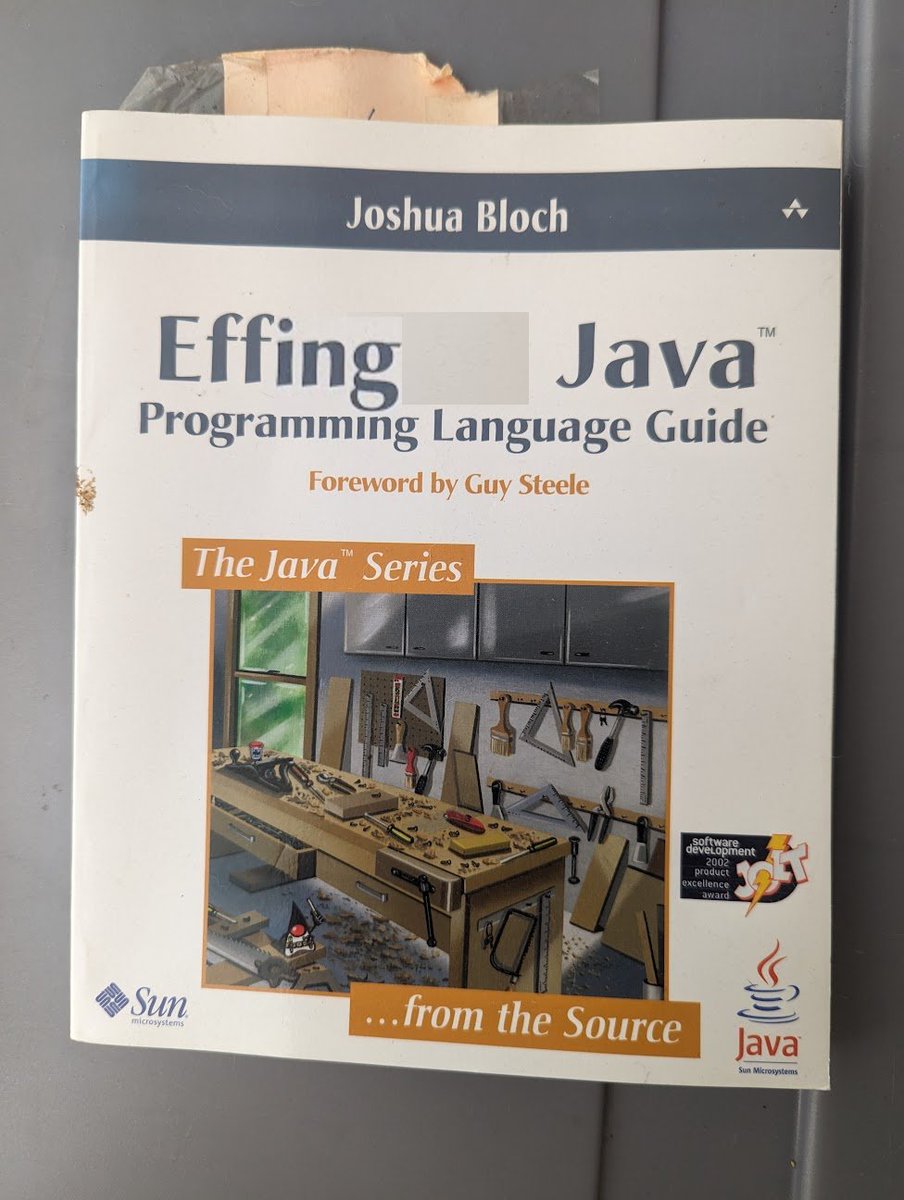
@DeborahKurata I am sorry to heard that. The loss of a parent is one of the deepest challenging moments we face in this journey called life, but I hope you had many fond memories of your dad and be grateful for the time I spent with him and your family. God bless!
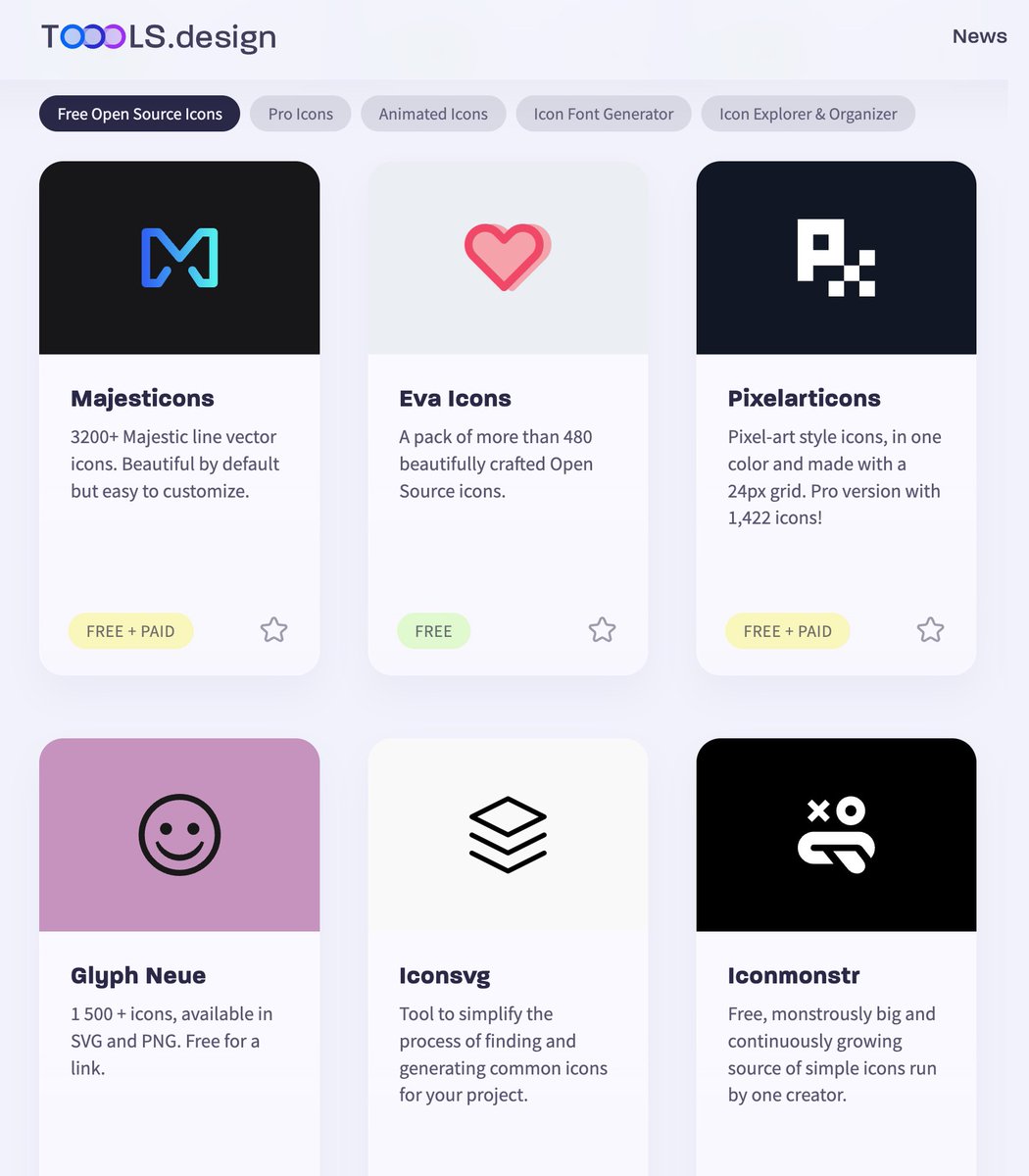
¡Brutal recurso web para diseñadores y programadores! Toools Design ofrece una colección inmensa de: - Diseños para inspirarte - Iconos e Ilustraciones - Herramientas y mockups - Recursos para aprender ¡En un sólo lugar y mucho totalmente gratuito! ➡️ toools.design
Wow! 20 years*! My thanks to the Microsoft Developer community. It's been fun! #csharp #visualstudio #typescript #developers (*more if you count the prior awards in the 1990's 😊)
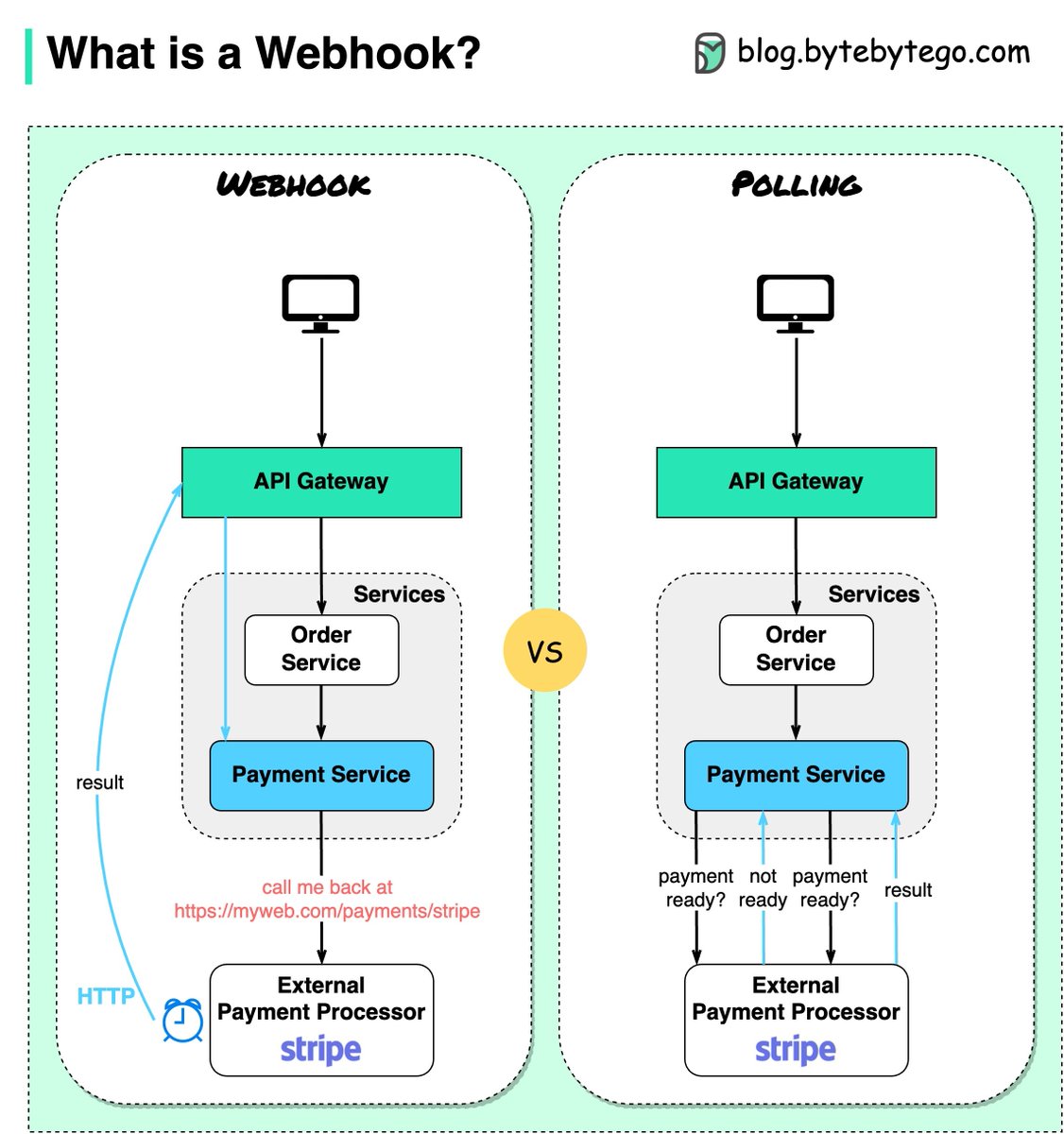
What is a webhook? The diagram below shows a comparison between polling and webhook. Assume we run an eCommerce website. The clients send orders to the order service via the API gateway, which goes to the payment service for payment transactions. The payment service then talks to an external payment service provider (PSP) to complete the transactions. There are two ways to handle communications with the external PSP. 🔹 1. Short polling After sending the payment request to the PSP, the payment service keeps asking the PSP about the payment status. After several rounds, the PSP finally returns with the status. Short polling has two drawbacks: 1) Constant polling of the status requires resources from the payment service. 2) The External service communicates directly with the payment service, creating security vulnerabilities. 🔹 2. Webhook We can register a webhook with the external service. It means: call me back at a certain URL when you have updates on the request. When the PSP has completed the processing, it will invoke the HTTP request to update the payment status. In this way, the programming paradigm is changed, and the payment service doesn’t need to waste resources to poll the payment status anymore. What if the PSP never calls back? We can set up a housekeeping job to check payment status every hour. Webhooks are often referred to as reverse APIs or push APIs because the server sends HTTP requests to the client. We need to pay attention to 3 things when using a webhook: 1) We need to design a proper API for the external service to call. 2) We need to set up proper rules in the API gateway for security reasons. 3) We need to register the correct URL at the external service. – Subscribe to our weekly newsletter to get a Free System Design PDF (158 pages): blog.bytebytego.com
Live streaming explained How do video live streamings work on YouTube, TikTok live, or Twitch? The technique is called live streaming. Livestreaming differs from regular streaming because the video content is sent via the internet in real-time, usually with a latency of just a few seconds. The diagram below explains what happens behind the scenes to make this possible. Step 1: The raw video data is captured by a microphone and camera. The data is sent to the server side. Step 2: The video data is compressed and encoded. For example, the compressing algorithm separates the background and other video elements. After compression, the video is encoded to standards such as H.264. The size of the video data is much smaller after this step. Step 3: The encoded data is divided into smaller segments, usually seconds in length, so it takes much less time to download or stream. Step 4: The segmented data is sent to the streaming server. The streaming server needs to support different devices and network conditions. This is called ‘Adaptive Bitrate Streaming.’ This means we need to produce multiple files at different bitrates in steps 2 and 3. Step 5: The live streaming data is pushed to edge servers supported by CDN (Content Delivery Network.) Millions of viewers can watch the video from an edge server nearby. CDN significantly lowers data transmission latency. Step 6: The viewers’ devices decode and decompress the video data and play the video in a video player. Steps 7 and 8: If the video needs to be stored for replay, the encoded data is sent to a storage server, and viewers can request a replay from it later. – Subscribe to our weekly newsletter to get a Free System Design PDF (158 pages): bit.ly/42Ex9oZ

What are the differences between a data warehouse and a data lake? The diagram below shows their comparison. 🔹 A data warehouse processes structured data, while a data lake processes structured, semi-structured, unstructured, and raw binary data. 🔹 A data warehouse leverages a database to store layers of structured data, which can be expensive. A data lake stores data in low-cost devices. 🔹 A data warehouse performs Extract-Transform-Load (ETL) on data. A data lake performs Extract-Load-Transform (ELT). 🔹 A data warehouse is schema-on-write, which means the data is already prepared when written into the data warehouse. A data lake is schema-on-read, so the data is stored as it is. The data can then be transformed and stored in a data warehouse for consumption. Over to you: Do you use a data warehouse or a data lake to retrieve data? – Subscribe to our weekly newsletter to get a Free System Design PDF (158 pages): bit.ly/42Ex9oZ

Why is Kafka fast? Kafka achieves low latency message delivery through Sequential I/O and Zero Copy Principle. The same techniques are commonly used in many other messaging/streaming platforms. The diagram below illustrates how the data is transmitted between producer and consumer, and what zero-copy means. 🔹Step 1.1 - 1.3: Producer writes data to the disk 🔹Step 2: Consumer reads data without zero-copy 2.1: The data is loaded from disk to OS cache 2.2 The data is copied from OS cache to Kafka application 2.3 Kafka application copies the data into the socket buffer 2.4 The data is copied from socket buffer to network card 2.5 The network card sends data out to the consumer 🔹Step 3: Consumer reads data with zero-copy 3.1: The data is loaded from disk to OS cache 3.2 OS cache directly copies the data to the network card via sendfile() command 3.3 The network card sends data out to the consumer – Subscribe to our weekly newsletter to get a Free System Design PDF (158 pages): bit.ly/42Ex9oZ

Twitter has enforced very strict rate limiting. Some people cannot even see their own tweets. Rate limiting is a very important yet often overlooked topic. Let's use this opportunity to take a look at what it is and the most popular algorithms. A thread. #RateLimitExceeded

Popular Interview Question: What happens when you type a URL into your browser? The diagram below illustrates the steps. 1. Bob enters a URL into the browser and hits Enter. In this example, the URL is composed of 4 parts: 🔹 scheme - http://. This tells the browser to send a connection to the server using HTTP. 🔹 domain - example .com. This is the domain name of the site. 🔹 path - product/electric. It is the path on the server to the requested resource: phone. 🔹 resource - phone. It is the name of the resource Bob wants to visit. 2. The browser looks up the IP address for the domain with a domain name system (DNS) lookup. To make the lookup process fast, data is cached at different layers: browser cache, OS cache, local network cache, and ISP cache. 2.1 If the IP address cannot be found at any of the caches, the browser goes to DNS servers to do a recursive DNS lookup until the IP address is found (this will be covered in another post). 3. Now that we have the IP address of the server, the browser establishes a TCP connection with the server. 4. The browser sends an HTTP request to the server. The request looks like this: 𝘎𝘌𝘛 /𝘱𝘩𝘰𝘯𝘦 𝘏𝘛𝘛𝘗/1.1 𝘏𝘰𝘴𝘵: 𝘦𝘹𝘢𝘮𝘱𝘭𝘦.𝘤𝘰𝘮 5. The server processes the request and sends back the response. For a successful response (the status code is 200). The HTML response might look like this: 𝘏𝘛𝘛𝘗/1.1 200 𝘖𝘒 𝘋𝘢𝘵𝘦: 𝘚𝘶𝘯, 30 𝘑𝘢𝘯 2022 00:01:01 𝘎𝘔𝘛 𝘚𝘦𝘳𝘷𝘦𝘳: 𝘈𝘱𝘢𝘤𝘩𝘦 𝘊𝘰𝘯𝘵𝘦𝘯𝘵-𝘛𝘺𝘱𝘦: 𝘵𝘦𝘹𝘵/𝘩𝘵𝘮𝘭; 𝘤𝘩𝘢𝘳𝘴𝘦𝘵=𝘶𝘵𝘧-8 <𝘩𝘵𝘮𝘭 𝘭𝘢𝘯𝘨="𝘦𝘯"> 𝘏𝘦𝘭𝘭𝘰 𝘸𝘰𝘳𝘭𝘥 6. The browser renders the HTML content. -- Subscribe to our weekly newsletter to get a Free System Design PDF (158 pages): bit.ly/42Ex9oZ

How does HTTPS work? Hypertext Transfer Protocol Secure (HTTPS) is an extension of the Hypertext Transfer Protocol (HTTP.) HTTPS transmits encrypted data using Transport Layer Security (TLS.) If the data is hijacked online, all the hijacker gets is binary code. How is the data encrypted and decrypted? Step 1 - The client (browser) and the server establish a TCP connection. Step 2 - The client sends a “client hello” to the server. The message contains a set of necessary encryption algorithms (cipher suites) and the latest TLS version it can support. The server responds with a “server hello” so the browser knows whether it can support the algorithms and TLS version. The server then sends the SSL certificate to the client. The certificate contains the public key, hostname, expiry dates, etc. The client validates the certificate. Step 3 - After validating the SSL certificate, the client generates a session key and encrypts it using the public key. The server receives the encrypted session key and decrypts it with the private key. Step 4 - Now that both the client and the server hold the same session key (symmetric encryption), the encrypted data is transmitted in a secure bi-directional channel. Why does HTTPS switch to symmetric encryption during data transmission? There are two main reasons: 1. Security: The asymmetric encryption goes only one way. This means that if the server tries to send the encrypted data back to the client, anyone can decrypt the data using the public key. 2. Server resources: The asymmetric encryption adds quite a lot of mathematical overhead. It is not suitable for data transmissions in long sessions. Over to you: how much performance overhead does HTTPS add, compared to HTTP? –- Subscribe to our weekly newsletter to get a Free System Design PDF (158 pages): bit.ly/42Ex9oZ


Let's dive into the Twelve-Factor methodology, a set of best practices that will revolutionize your app development process. 1️⃣ Codebase: Maintain a single codebase tracked in version control, enabling seamless collaboration and easier deployments. 🌱💻 2️⃣ Dependencies: Isolate dependencies, ensuring consistency across different environments and reducing the risk of conflicts. 🧩🔗 3️⃣ Config: Store configurations in the environment, allowing easy modifications without code changes. 🧪🔧 4️⃣ Backing Services: Treat backing services (databases, caches) as attached resources, decoupling them from your app. 💾🔌 5️⃣ Build, Release, Run: Keep the build, release, and run stages separate, enabling reproducible and independent deployments. 🏗️🚀🏃♀️ 6️⃣ Processes: Execute your app as one or more stateless processes, enabling easy scaling and fault tolerance. 🔄🔁 7️⃣ Port Binding: Expose services via a port binding mechanism, making your app self-contained and easily deployable. ⚓🔌 8️⃣ Concurrency: Scale out via process model, allowing multiple processes to handle incoming requests efficiently. 📈🎢 9️⃣ Disposability: Maximize robustness with fast startup and graceful shutdown, facilitating rapid scaling and fault recovery. 🚀🔌 🔟 Dev/Prod Parity: Keep development, staging, and production environments as similar as possible to minimize discrepancies. 🏗️🧪🚀 1️⃣1️⃣ Logs: Treat logs as event streams, aiding in debugging, monitoring, and troubleshooting. 📝🐞🔍 1️⃣2️⃣ Admin Processes: Run administrative tasks as one-off processes, allowing them to be easily executed in various environments. 🧑💼🔨 By embracing the Twelve-Factor App approach, you'll unlock the true potential of your applications, making them scalable, robust, and future-proof. 🌟💪 ✅ Join Amigoscode today for premium programming courses - bit.ly/40ujtvS Image Creds: DZone #softwareengineering #programming #microservices #cleancode #cloudcomputing #amigoscode

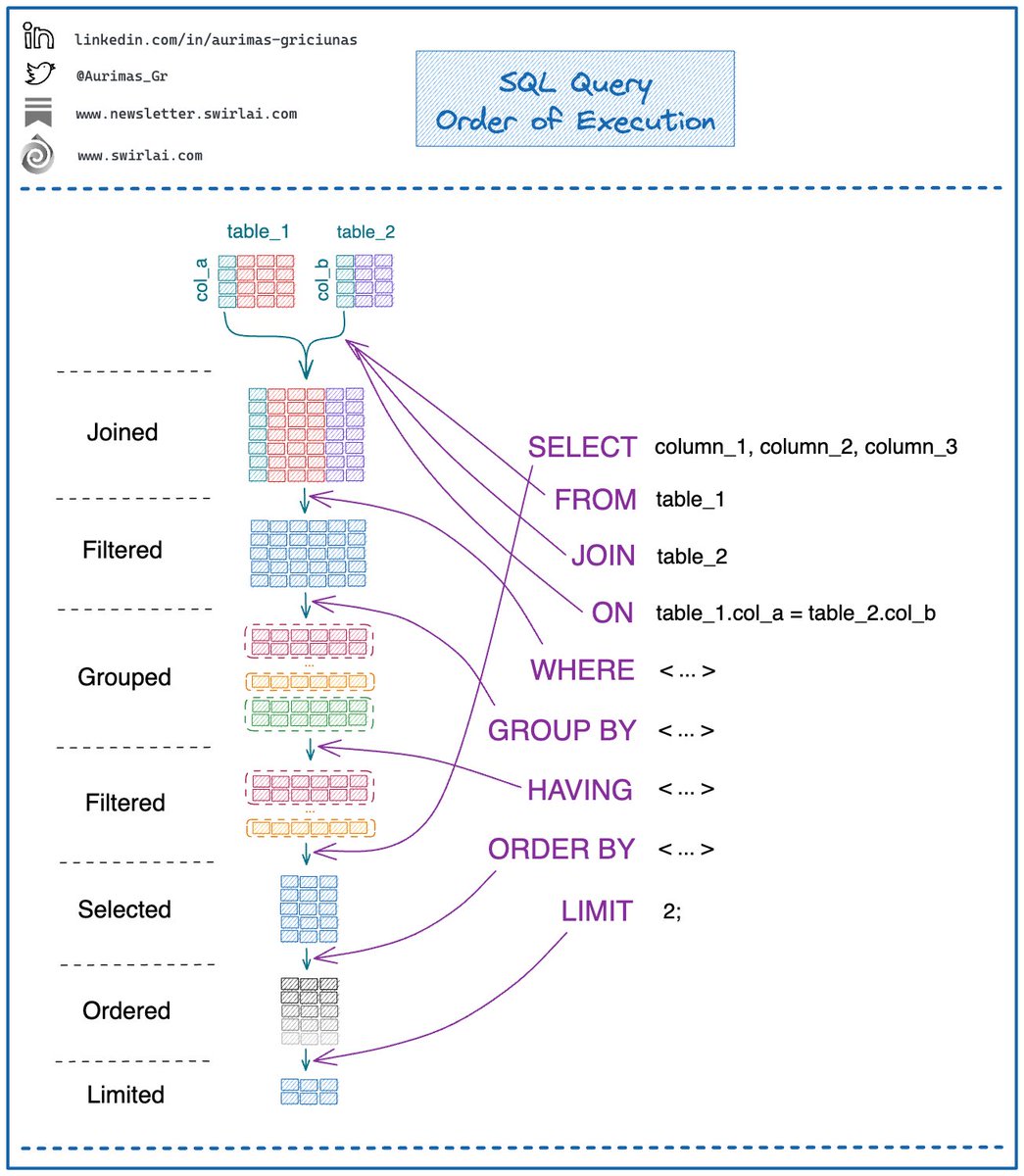
What is the 𝗦𝗤𝗟 𝗤𝘂𝗲𝗿𝘆 𝗼𝗿𝗱𝗲𝗿 𝗼𝗳 𝗘𝘅𝗲𝗰𝘂𝘁𝗶𝗼𝗻? There are many steps involved in optimising your SQL Queries. It is helpful to understand the order of SQL Query Execution as we might have constructed a different picture mentally. The actual order is as follows: 𝟭. 𝗙𝗥𝗢𝗠 𝗮𝗻𝗱 𝗝𝗢𝗜𝗡: determine the base data of interest. 𝟮. 𝗪𝗛𝗘𝗥𝗘: filter base data of interest to retain only the data that meets the where clause. 𝟯. 𝗚𝗥𝗢𝗨𝗣 𝗕𝗬: group the filtered data by a specific column or multiple columns. Groups are used to calculate aggregates for selected columns. 𝟰. 𝗛𝗔𝗩𝗜𝗡𝗚: filter data again by defining constraints on the columns that we grouped by. 𝟱. 𝗦𝗘𝗟𝗘𝗖𝗧: select a subset of columns from the filtered grouped result. This is also where 𝗪𝗜𝗡𝗗𝗢𝗪 𝗳𝘂𝗻𝗰𝘁𝗶𝗼𝗻 𝗮𝗴𝗴𝗿𝗲𝗴𝗮𝘁𝗶𝗼𝗻𝘀 happen. 𝟲. 𝗢𝗥𝗗𝗘𝗥 𝗕𝗬: order the result by one or multiple columns. 𝟳. 𝗟𝗜𝗠𝗜𝗧: only retain the top n rows from the ordered result. Below is a nice way to visualise it. What are your thoughts? Let me know in the comment section 👇 -------- Follow me to upskill in #MLOps, #MachineLearning, #DataEngineering, #DataScience and overall #Data space. Also hit 🔔to stay notified about new content. 𝗗𝗼𝗻’𝘁 𝗳𝗼𝗿𝗴𝗲𝘁 𝘁𝗼 𝗹𝗶𝗸𝗲 💙, 𝘀𝗵𝗮𝗿𝗲 𝗮𝗻𝗱 𝗰𝗼𝗺𝗺𝗲𝗻𝘁! Join a growing community of Data Professionals by subscribing to my 𝗡𝗲𝘄𝘀𝗹𝗲𝘁𝘁𝗲𝗿: newsletter.swirlai.com


Thoblearn @Thoblearnalc
40 Followers 3K Following
Whisper Mia @mia_whispe53427
80 Followers 4K Following

HeyScrum @HeyScrum
16 Followers 170 Following 🏆 #Agile #Certification made easy. 🎯 Ace #Scrum #Exams. 📚 Practise, pass, and get hired. 👇 Over 1500+ questions at your fingertips. #HeyScrum
Austin Murphy @ausmurp
2K Followers 2K Following #UI #UX #designer #developer #entrepreneur #founder @thumbyte
Jörg @c0da86
73 Followers 222 Following 📍Wolfratshausen 🇩🇪 🏃🏻♂️ HM - / 10km 0:59 / 5km 0:28 Hobbys:🛹🏊🏻♂️🧗🏻♂️🏋🏻♂️⚽️ 👦 👧 Job:👨🏻💻👨🏻💻Teamlead, Developer, Productowner, Ausbilder
Agile Alliance @AgileAlliance
46K Followers 11K Following #Agile Alliance is a global nonprofit membership organization dedicated to people and organizations that apply the values and principles of the #AgileManifesto
readlearncode.com @readlearncode
2K Followers 2K Following Learn all about #JavaEE, #JAX_RS, #JSON, #JavaSE, #Microservices. https://t.co/P7dWDM4iAJ. Also follow @alextheedom
Olivia Guzzardo McVic... @OliviaGuzzardo
1K Followers 201 Following Cloud advocate for @code @microsoft ☁️
Josie @javavvitch
18K Followers 608 Following Staff Software Witch, Founder of Git Cute “You’re like tech famous though.” **All thoughts and opinions are my own** ✨💫
Natalia Panferova @natpanferova
26K Followers 1K Following iOS | macOS | Swift | SwiftUI | Previously SwiftUI at Apple | Author of books for Swift developers: https://t.co/pu12ODUXyQ
Danijela Vrzan @dvrzan
9K Followers 880 Following Indie iOS Developer working on @nunch_app • sharing what I learn while building things I love • Croatian 🇭🇷
Marit van Dijk ☕️... @MaritvanDijk77
5K Followers 3K Following Software Developer | Java Champion | Java Developer Advocate @ JetBrains | International Keynote Speaker | Pronouns: She/her
Aurimas Griciūnas @Aurimas_Gr
36K Followers 795 Following 🔨 Founder & CEO @ SwirlAI 📖 Writing about #LLM, #AI, #DataEngineering, #MachineLearning and #Data ✍️ Author of SwirlAI Newsletter.

decodeVeroniKa @decodeVeronika
6K Followers 1K Following Founder @ Unfreeze. Building for the people who wake up frozen.
Alex Xu @alexxubyte
291K Followers 567 Following Co-Founder of ByteByteGo | Author of the bestselling book series: ‘System Design Interview’ | YouTube: https://t.co/9gPSJSrtPU
Joshua Bloch @joshbloch
65K Followers 198 Following Effective Java author, API Designer, CMU Prof, Swell guy, No longer posting here. Find me at https://t.co/bNAfciJvWM
OfferZen @OfferZen
9K Followers 80 Following Connecting devs with opportunities to build awesome futures 🚀 👩💻 100 000+ SA devs 💼 2000+ companies 💰 Upfront info on skills, roles and salary
Vibali Joshi @VibaliJoshi
40K Followers 462 Following A twentysomething software engineer surviving corporate Bangalore :)
Shalini Tewari @maybeshalinii
56K Followers 287 Following always experimenting | hope you learn something cool here
International JavaScr... @JavaScriptCon
5K Followers 2K Following Global Community and Events for Fullstack JS Engineering. Upcoming Community Events: 📍 London: May 11 - 15, 2026 📍 San Diego: June 1 – 5, 2026
NgRx @ngrx_io
10K Followers 7 Following Reactive State for Angular. Discord: https://t.co/JB1LtLMk1G Workshops: https://t.co/v9qt0nv2tv Swag: https://t.co/gECSYg1byP
Angular inDepth @Angular_InDepth
13K Followers 154 Following A community of passionate engineers with focus on advanced Angular development. Grow and become an extraordinary engineer with us.
Netanel Basal @NetanelBasal
15K Followers 63 Following A FrontEnd Tech Lead, blogger, and open source maintainer. The founder of ngneat, husband and father.
CodeBeauty @TrueCodeBeauty
6K Followers 27 Following 🚀 Helping you to learn programming & get a better job 📌 260k+ thriving students ✨Learn to code and start earning 💸 in 3 months!
Miguel Ángel Durán @midudev
329K Followers 374 Following 🧠 Enseño Programación e Inteligencia Artificial 👨💻 Software Engineer y Speaker ⭐ +18 años de experiencia · +3M comunidad ✉️ Contacto: [email protected]
javinpaul @javinpaul
106K Followers 7K Following Blogger - https://t.co/Cxgp9zzN3y Creator - https://t.co/GYls4Lx9DW newsletter - https://t.co/P8jiQ5GW16 youtube - https://t.co/vs4WjwaEQ6
Josh tried coding @joshtriedcoding
23K Followers 298 Following i like coding and talking about it // head of propaganda @upstash // building @ralv_ai
Kamran Ahmed @nilbuild
45K Followers 679 Following Building https://t.co/IeeRUu3pt0, https://t.co/s9zIL7TEAs, https://t.co/Cy1iWLNKgo, https://t.co/yg4CThzqrG, https://t.co/PH5jYmnEEn, https://t.co/72mAUBytCo & more.
Bytebytego @bytebytego
131K Followers 2 Following Weekly system design topics you can read in 10 mins.
Jeff Atwood @codinghorror
263K Followers 2 Following Indoor enthusiast. Co-founder https://t.co/e62S5uByfO / https://t.co/Tuh5wHPHTI. Let’s be kind to each other. I am no longer on twitter. Find me @[email protected]
Martin Fowler @martinfowler
353K Followers 164 Following Author on Software Development. Works for Thoughtworks. Also hikes, watches theater, and plays modern board games. He/him.
George Hotz 🌑 @realGeorgeHotz
304K Followers 203 Following President @comma_ai. Founder @__tinygrad__
Kath Korevec @simpsoka
31K Followers 610 Following Codex @OpenAI. Previously GitHub, Google, Vercel, Heroku.
Shirley Wu @sxywu
31K Followers 680 Following chinese-american artist, software engineer, dataviz designer, keynote speaker, published author && a work-in-progress learning to take up space ✨
Nadieh Bremer @NadiehBremer
47K Followers 540 Following Award-winning Data Visualization Designer | Founder of Visual Cinnamon | Graduated Astronomer ✨ | Author of "CHART" & "Data Sketches" | 🇳🇱

Laura Neugebauer @LaaLeeLuuLaura
1K Followers 380 Following 🌻💚 direkt gewählte Abgeordnete @agh_berlin Brunnenviertel, Leo und Sprengelkiez 📚 W-Ing @TUberlin she/her
ashley williams @ag_dubs
19K Followers 188 Following a mess like this is easily five to ten years ahead of its time. former @rustlang core team. now i build build systems at @shopify.
Katel LeDu @theledu
1K Followers 284 Following CEO @abookapart. Coach for creative purpose alignment. Comme ci, comme ça. she | her | hers
Sara Soueidan is on B... @SaraSoueidan
118K Followers 0 Following Award-winning Web UI engineer, int'l keynote speaker, author, educator • creator of the Practical Accessibility course: https://t.co/P1LXpp7Uak
Sarah Drasner @sarah_edo
298K Followers 3K Following Opinions my own Area Tech Lead, AI and Web Ecosystem @chrome, Formerly Sr. Director of Core Infra @google • O'Reilly Author • https://t.co/HhzYWwxYAH
Iris Schaffer @iris_schaffer
767 Followers 231 Following Staff Software Engineer // Fitness Enthusiast // Amateur Linguist // Hobby Cook. she / her.
Ali Spittel @ASpittel
114K Followers 2K Following dev stuff @aws // Python + JavaScript engineer // tweets my own
Lady Monika Wiśniews... @AuthorMonika
13K Followers 12K Following Author of a bestselling memoir 'Polish Girl In Pursuit of the English Dream' -get signed copies on website 👇Movie/theatre directors welcome to turn my 📚into🎬
Java Champions @Java_Champions
54K Followers 360 Following The official Twitter account of the Java Champions, an exclusive group of Java technology and community leaders. Mastodon https://t.co/vghNLhalEo
Angie Jones @techgirl1908
114K Followers 709 Following VP of DX, Agentic AI Foundation. Helping developers build with agents. I ❤️ open source
Kelly Vaughn @kvlly
114K Followers 1K Following First-time adult. Sr. EM @Zapier. Building on the side.
Emma Bostian @EmmaBostian
192K Followers 962 Following Engineering Manager @spotify 🇸🇪 American in Stockholm
Tomasz Łakomy @tlakomy
26K Followers 4K Following Principal Engineer / AI Safety @runwayml | ex Eng Team Lead @Stedi | AWS Hero | Co-founder at @cloudashdev | @eggheadio instructor | AWS Certified | Be kind
Brad Traversy @traversymedia
360K Followers 654 Following Full Stack Web Developer & Educator. - Check out all of my courses at https://t.co/F56FYSu1Sq - Sign up for early access at our new platform https://t.co/Af4fqM0Ct7


mpj 💛 @mpjme
50K Followers 1K Following Data Engineer 💛 Creator of the YouTube show Fun Fun Function, writes weekly data development chronicle: https://t.co/JGZIl4IztJ 🦁Previously @ Spotify & https://t.co/aAjuyXBmD2
Axel Rauschmayer (als... @rauschma
61K Followers 371 Following I’m mainly on Mast*d*n: https://t.co/jLenO6e5ZL • Other ways of connecting with me: https://t.co/fvpPa89Isz…
Danny Thompson @DThompsonDev
301K Followers 3K Following Senior Developer Advocate at Atlassian | Co-Host of The Programming Podcast | I've helped 1000s of people land jobs in tech |
Apache Kafka @apachekafka
68K Followers 235 Following A distributed streaming platform. Account managed by the Kafka PMC.Trends for United States
You might like