-
Tweets27
-
Followers201
-
Following107
-
Likes60
Instead of training a world model to condition on robot actions, PointZero conditions on partial 3D point tracks. This allows it to learn rich 3D dynamics priors from actionless data! We found that pretraining on this objective effectively transfers to a variety of robotics applications, outperforming strong application-specific baselines on imitation learning and robot-action-conditioned dynamics modeling. We trained PointZero only on synthetic data, but the zero-shot real-world dynamics predictions were surprisingly impressive! Super cool work led by @bardienus

Introducing PointZero—a 3D world model pre-trained without robots. Dexterous manipulation requires understanding diverse 3D dynamics, but current approaches rely on expensive robot data. So how can we pre-train a 3D dynamics model without it? PointZero introduces a simple idea:
Introducing PointZero—a 3D world model pre-trained without robots. Dexterous manipulation requires understanding diverse 3D dynamics, but current approaches rely on expensive robot data. So how can we pre-train a 3D dynamics model without it? PointZero introduces a simple idea: learning to complete 3D point tracks yields transferable 3D dynamics! Our model achieves SOTA results on: 🔥 Zero-shot 3D dynamics 🔥 Action-conditioned 3D dynamics (post-training) 🔥 Imitation learning (post-training) Details and links 👇 1/6
Humans learn by interacting with the world: How can we teach robots to similarly adapt to ambiguous dynamics? Introducing Wiggle and Go! #CoRL2026. We find that a specialized model can learn rope properties from just one interaction, and complete complex dynamic tasks. The robot wiggles a rope once, figures out how it behaves, then goes, using the estimated dynamics to execute the task. No real-world training data. No retries. #robotics #robotlearning
Thank you to collaborators @BDuisterhof, Deva Ramanan, and @jeff_ichnowski! This work was supported by the NSF GRFP, and used Bridges-2 at PSC through ACCESS. Check out the paper for details and the project page for more visualizations and rollouts! 📑 arXiv: arxiv.org/abs/2609.17524 🌐 Project Page: adamhung60.github.io/ModAR/ @CMU_Robotics @SCSatCMU
Some more real-world rollouts (1x speed): 🧵 [7/8]
We also tested ModAR on real-world bimanual manipulation tasks: ModAR beats baselines and also shows that it can improve its performance by training on human videos, using videos from both the same setting (ID) and a public dataset (OOD). 🧵 [6/8]
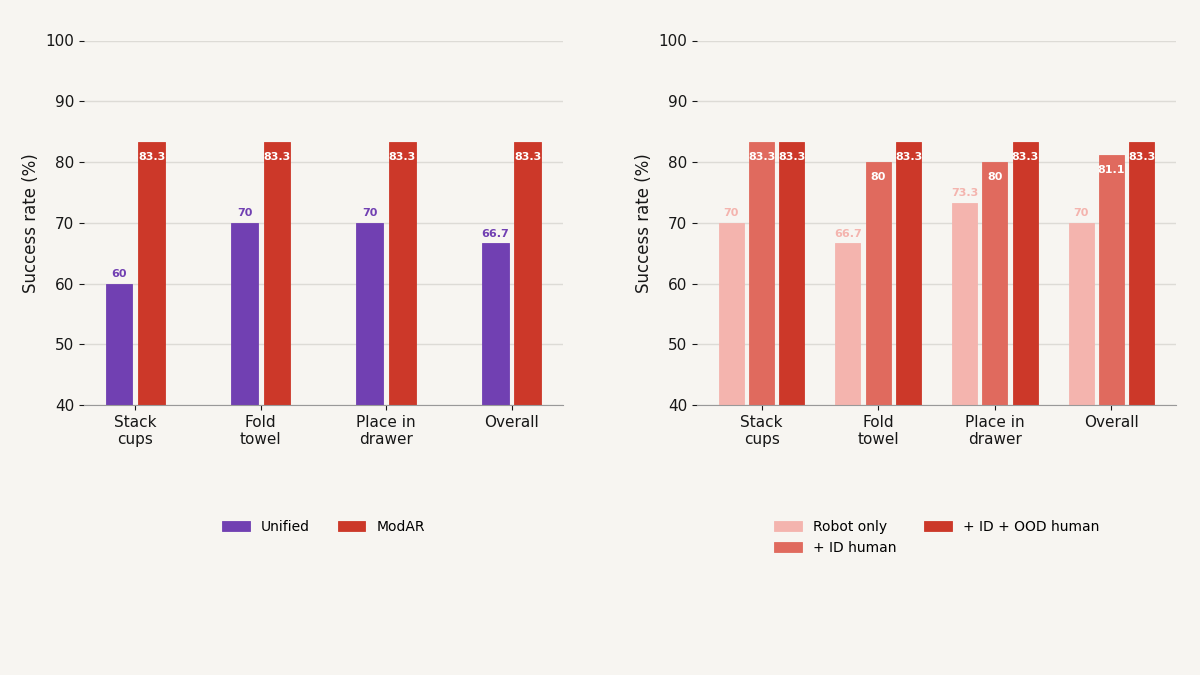
We also fine-tune Flex-π, a recent multimodal WAM that initializes from a pretrained video model, on the same data. Despite ~200× fewer parameters (30.1M vs 6B) and ~20× fewer training FLOPs, ModAR achieves a slightly higher average success rate: 75% vs 72%. We think this demonstrates a promising new direction: scaling from-scratch WAMs with structured representations that transfer better to manipulation, rather than relying on RGB-centric video models. 🧵 [5/8]
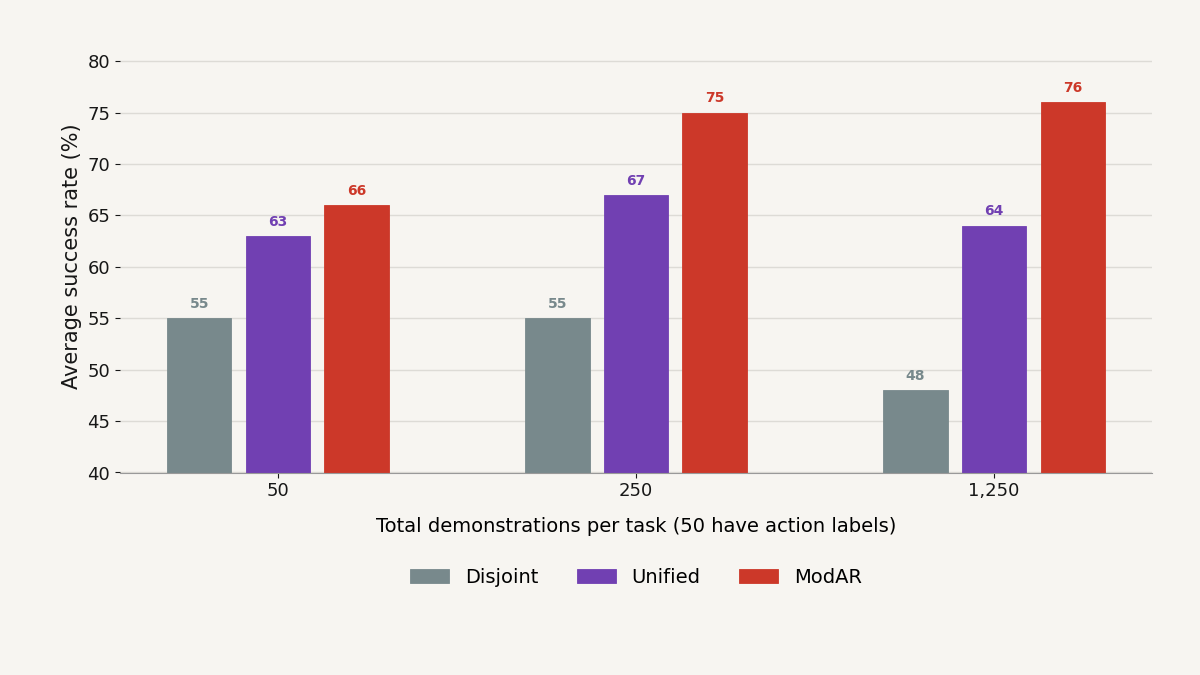
Next: how should future prediction and action prediction be coupled? • Unified: denoise everything together • Disjoint: denoise futures and actions independently; skip generating futures at test time • ModAR: denoise modalities sequentially, then actions ModAR wins at every data scale – and benefits most from actionless data. 🧵 [4/8]
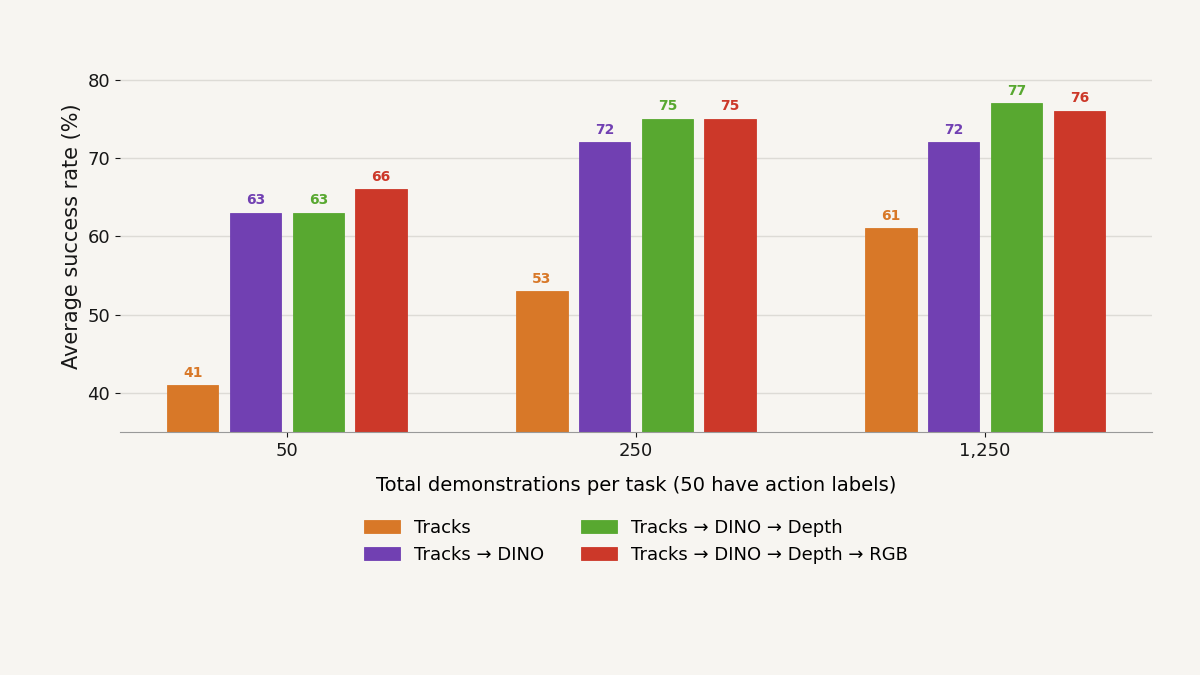
First: what modalities should a WAM imagine in? Does adding more modalities help? Result: Progressively adding Tracks, DINO, and depth improves performance, but adding RGB on top does not. 🧵 [3/8]
📑 arXiv: arxiv.org/abs/2609.17524 🌐 Project Page: adamhung60.github.io/ModAR/ Why generate modalities one at a time? The idea is simple: predict the future in easier, more structured forms first, then use those predictions to help generate harder, more detailed modalities. To test this, we conduct a controlled study across six RoboTwin tasks, varying the predicted modalities, WAM formulation, and amount of actionless training data. We ask two main questions: which modalities to predict, and how to couple future prediction with action prediction. 🧵 [2/8]
World-action models typically imagine the future in RGB – but are pixels really the right representation for robotics? Our bet is no: RGB spends capacity on fine-grained details and variation that are often irrelevant for robot policies. DINO features, point tracks, and depth capture more useful features like semantics, motion, and geometry. But no single modality captures everything — how can we effectively combine them? We introduce ✨ModAR✨, which predicts the future one modality at a time, with each prediction informing the next. We train from scratch and find that this formulation performs best. Our 30.1M scratch-trained model even outperforms a 6B video-model-initialized model finetuned on the same data! 🧵 [1/8]
Today we are introducing Atlas! An autoregressive and multimodal DiT for generating image and depth frames. Atlas is a state-of-the-art 3D reconstruction model and outperforms all open-source models. @HaoZhang623 and I had lots of fun pushing the 3D capability of this model; can't wait to see you build with it!

Introducing Atlas: The world's first multimodal world model that generates image and video frames with pixel-perfect camera control and reconstructs them in 3D. Model the world, move the camera, and simulate space & time.
[1/6] Can one model fix rendering artifacts from any 3D representation? And what does it even mean to "fix" a rendering? At #ECCV2026, we present FixAnything (fix-anything.github.io): a single generalist video model that refines 3DGS/mesh/sparse point-cloud renderings into photorealistic, 3D-consistent videos.
Can robot learn manipulation skill with one object and perform it on a completely different one without any new demonstrations? Excited to introduce SemAnCorr, a framework for dense correspondence and manipulation skill transfer across diverse objects. semancorr.github.io

How can we get robot hands to “hear” slip and contact through microphones, and react to them? We’re excited to share VibeAct, an approach that uses piezoelectric microphones embedded in robot fingertips to estimate contact and slip, then learns reactive policies from this tactile feedback! vibeact.github.io

Excited to share the first paper of my PhD! If you’ve ever tried to control a VLA via natural language, you know it rarely does what it is told. 🗣️ We introduce a multi-stage pipeline for training a Language Feedback Policy (LFP) to steer a VLA in-the-loop.
Introducing Modality Forcing, a recipe for post-training T2I models for SOTA RGB-Depth generation! Text-to-image (T2I) models learn rich representations of the spatial world. How do we build on this prior for high-quality depth generation? modality-forcing.github.io 🧵 [1/6]

Zhi (Leo) Wang✈️I... @TX_Leo_Wang
1K Followers 2K Following Research Intern @Amazon FAR, Robotics PhD @UofMaryland 🤖Robot learning from human data! Prev: @Tsinghua_Uni, @MSFTResearch, @UofIllinois
Anshuman Lall @ COLM ... @anshuman1
264 Followers 2K Following LLM Post-Training/ Recursive Self-Improvement for Reasoning Co-founder/ MTS @ReasonCoreAI PhD @UCLA, Bachelors @iitbombay Led a team of ~500 PhD researchers
szz @liamhexn
3 Followers 56 Following
SPN @spnichol
627 Followers 7K Following Machine learning engineer working on signal processing, NLP and (some) computer vision. Trying to make the most of my measley 3090 and 3 Sparks.
Sophia @LuckyGu55424427
1 Followers 270 Following i say "no yeah" and "yeah no" and they mean different things 🤍 fluent in sarcasm & sweetness
Yifan Chou @YifanChouYF
12 Followers 528 Following CS Undergraduate @UMich @sjtu1896 | Robot Learning

easonlee @yi_xin69636
9 Followers 179 Following
Alex Zverianskii @alexML
737 Followers 2K Following MTS @withmartian • ex Principal MLE @gett 15+ years in AI/NLP • 3x founder (1 exit)
Pierre Nagorny @a1rb4ck
398 Followers 7K Following Machine Learning @artanim_mocap. #VR, real-time #animation, markerless #mocap. @[email protected] @a1rb4ck.bsky.social

Abhishek Bhatia @bhatiaabhishek1
36 Followers 99 Following
Richard Palethorpe @jichiep
2K Followers 314 Following Working on local AI. I wrote a Linux kernel exploit for an n-day once.

mortenlysgaard @mortenlysgaard
86 Followers 152 Following Lead vision engineer at @1x_tech, former co-founder CTO at https://t.co/qx6aarbrPs interested in learning based robotics, embedded systems, vision etc.


Viet-Tuan Le @tuanleviet
39 Followers 670 Following

Runhan Huang @RunhanH
192 Followers 532 Following PhD student @Harvard | Prev. @Tsinghua_IIIS (Yao Class) | Robot Learning, Generative AI
Nhi Pham @NhiPham49
20 Followers 151 Following

Jesse Zhang @Jesse_Y_Zhang
2K Followers 603 Following Robotics Postdoc @uwcse w/ A. Gupta, D. Fox. Collab @allen_ai, @toyotaresearch. Prev: PhD from @csatusc. Intern @ NVIDIA, AWS, NAVER, Horizon Robotics.
Feiyang Liu @ZaychikLFY
22 Followers 788 Following
Haitian Liu @Sky1830180
2 Followers 476 Following CS undergrad @Tsinghua_Uni Research interest: World Action Models, Embodied AI Research intern @ TSAIL & @ViduAI_official
Pranay Meshram @praymesh
20 Followers 230 Following world models, VLAs, cv research intern @iitrookee
Jorge Bravo Abad @bravo_abad
12K Followers 10K Following Professor @UAM_Madrid Writing on what matters in AI for Science: https://t.co/sNvjOIcqgU "IA para estudiantes de ciencias": https://t.co/Zs5o2gszjj

Xiaohan Zhang @XiaohanZhang220
1K Followers 701 Following Senior Research Scientist @sudo_robotics. Prev @rai_inst @AIatMeta @GoogleDeepMind
Krishna Murthy @_krishna_murthy
6K Followers 2K Following Robotics faculty @JHUCompSci | https://t.co/K9F82bmmmk
prayuj sachdev @PrayujSachdev
3 Followers 164 Following

مشاري بن مح�... @veigpt
2 Followers 343 Following خريج علوم حاسب من 🇬🇧، مهتم بالذكاء الاصطناعي المُتجسِّد. (Embodied AI) 🤖
Loug @lougarithm0
172 Followers 909 Following Just a moroccan guy pushing intelligence on steel machines, currently in 🇰🇷 ex-Enchanted tools
Mariya I. Vasileva @mariyaivasileva
22K Followers 2K Following Research Scientist. RSI, multi-agent safety & alignment, evaluation. ex @Meta MSL, @Amazon AGI. 🎓 UIUC (PhD), @Caltech • @WiMLWorkshop, @CVFADworkshop • 🇧🇬


Peerin @p2er1n
10 Followers 626 Following

Rational Aussie @rationalaussie
37K Followers 8K Following Humans are fungible compute. I write about economics and AI. Fix the money, fix the world. #Bitcoin
Shravan @Shrav1_Shan
0 Followers 60 Following

nemo @tiamat_aisi
77 Followers 3K Following


john so @johnrso_
760 Followers 773 Following robots! prev @tesla_optimus, @1x_tech, @stanford, @berkeley_ai. raised by @berkeleyml
Yang Fan @yangfan879
44 Followers 2K Following
Brian @yep_its_brian1
284 Followers 7K Following There's always another great trade out there somewhere. It's just a matter of seeing it

shire che @shireche152566
4 Followers 82 Following
Jitendra MALIK @JitendraMalikCV
13K Followers 129 Following Prof, EECS, UC Berkeley. VP & Distinguished Scientist, Amazon. https://t.co/sFAc0Y7opv
mortenlysgaard @mortenlysgaard
86 Followers 152 Following Lead vision engineer at @1x_tech, former co-founder CTO at https://t.co/qx6aarbrPs interested in learning based robotics, embedded systems, vision etc.
Toru @ToruO_O
3K Followers 355 Following ai & robotics @Amazon | writing about research & life. prev: @meta @nvidia @UCBerkeley @MIT 🌈 she/her/hers I like capybaras :D
Xiaohan Zhang @XiaohanZhang220
1K Followers 701 Following Senior Research Scientist @sudo_robotics. Prev @rai_inst @AIatMeta @GoogleDeepMind
Mariya I. Vasileva @mariyaivasileva
22K Followers 2K Following Research Scientist. RSI, multi-agent safety & alignment, evaluation. ex @Meta MSL, @Amazon AGI. 🎓 UIUC (PhD), @Caltech • @WiMLWorkshop, @CVFADworkshop • 🇧🇬

Massimiliano Viola @massiviola01
1K Followers 245 Following ML @BedrockRobotics | Ex Stanford, ETH Zurich | Computer Vision • 3D • Generative Models | Views and geese are my own ⬆️
hoanh @hoanhle_
433 Followers 689 Following research @NVIDIA. views are my own and subject to change.
Khai Loong Aw @khai_loong_aw
552 Followers 520 Following CS PhD @Stanford. Building unified world models + vision-language models
Arthur Jakobsson @Arthur_K_J
121 Followers 101 Following Masters Robotics @CMU with Professor Jeffrey Ichnowski
Wenlong Huang @wenlong_huang
6K Followers 1K Following PhD Student @StanfordSVL. Previously @MIT_CSAIL @Berkeley_AI @GoogleDeepMind @NVIDIARobotics. Robotics, Foundation Models, Spatial Intelligence.
Jesse Zhang @Jesse_Y_Zhang
2K Followers 603 Following Robotics Postdoc @uwcse w/ A. Gupta, D. Fox. Collab @allen_ai, @toyotaresearch. Prev: PhD from @csatusc. Intern @ NVIDIA, AWS, NAVER, Horizon Robotics.
Huy Le @huile1611
130 Followers 526 Following Research @Mila_Quebec @UMontrealDIRO @GoogleDeepMind | Working on Video, Embodied AI & World Models 🎞️🎥🤖🌍
Matt Strong @MattStr10050461
154 Followers 177 Following Stanford CS PhD | 3D vision for robotics and autonomy
Anish Madan @anishmadan23
524 Followers 2K Following Robotics @SkildAI | Prev: MS @CMU_Robotics, Associate ML Scientist @WadhwaniAI | @IIITDelhi '20
Shane Gu @shaneguML
52K Followers 2K Following Sr. Staff RS GenAI @GoogleDeepMind. 🇯🇵-born 🇨🇳🇨🇦. ex: Omni Thinking, Gemini 1.5-3, GPT-4 @OpenAI, GoogBrain Robotics (JP: @shanegJP). Personal opinions.
Chris Offner @chrisoffner3d
5K Followers 3K Following 3D computer vision, spatial AI, and synthetic data @Google Zurich. prev: @rai_inst, @ETH_en. visual computing, machine learning, robot perception.
Haoyu Xiong @Haoyu_Xiong_
4K Followers 2K Following PhD student @MIT_CSAIL. I work on robotics. Previously @Stanford @CMU_Robotics.

Manu Gaur @gaur_manu
1K Followers 1K Following used to do physics, now working on long horizon robotics @CMU_Robotics
Karthik Dharmarajan @KDharmarajan123
176 Followers 342 Following Interested in Robot Learning. CS PhD @UCBerkeley. Current MSCS @Stanford @StanfordSVL. Prev EECS BS @UCBerkeley @AUTOLab_Cal.
Ajay Jain @ajayj_
8K Followers 5K Following Co-founder @genmoai. Co-created denoising diffusion (DDPM), DreamFusion, Dream Fields. Ex Ph.D. @berkeley_ai, @googleai, @facebookai, @nvidiaai, @mit

Rishabh Jain @RishabhJain_r
326 Followers 3K Following ML & Robotics @Columbia | prev intern @TactaSystems

Gordon Wetzstein @GordonWetzstein
5K Followers 52 Following Professor at Stanford University & Co-founder at Rhoda AI

Chloe Su @Huangyu58589918
2K Followers 2K Following CS PhD @Harvard @KempnerInst| Looking for internship summer 2027 | Prev @GoogleDeepMind @AmazonScience @Apple @mldcm
Narek Harutyunyan @NarekHaruty
10 Followers 113 Following
Mrinal Verghese @Mrinal_Verghese
665 Followers 863 Following Working on robot learning and foundation models @nvidia. PhD from @CMU_Robotics. He/Him. Views are my own and don't represent my employer.
Michael Black @Michael_J_Black
105K Followers 742 Following VP Digital Human Research, Epic Games. Emeritus Director, Max Planck Institute for Intelligent Systems (@MPI_IS). Opinions are my own.
Hongyu Li @Hongyu_Lii
2K Followers 1K Following Robotics researcher at @NVIDIA. Ph.D. @BrownCSDept 🐻. Prev: @ColumbiaCompSci, @rai_inst, @Amazon, @Honda. Opinions are my own and do not represent NVIDIA.

Yifeng Zhu @yifengzhu_ut
2K Followers 786 Following Member of Technical Staff @RewardAI_ | Prev: PhD @UTAustin


Ge Yan @GeYan_21
901 Followers 705 Following CS PhD Student @UW | Previously @UCSanDiego | Intern @ToyotaResearch @allen_ai
Khiem Vuong @kvuongdev
342 Followers 370 Following PhD-ing @CMU_Robotics | interning @MetaAI, ex-intern @Apple | Vision, Robotics
Tony Dong @TonyDong050519
6 Followers 6 Following
Anirudha Majumdar @Majumdar_Ani
9K Followers 587 Following Associate Professor @Princeton | Co-Director, Princeton Robotics | 20% Research Scientist @GoogleDeepMind.

Guanya Shi @ IROS'26 @GuanyaShi
8K Followers 2K Following Assistant Professor @CMU_Robotics @SCSatCMU, leading the @LeCARLab. @Amazon Scholar @ FAR. I build generalist robots with agility. Ph.D. from @Caltech.
Yaru Niu @yaru_niu
1K Followers 1K Following PhD student @CarnegieMellon. Research Intern @NVIDIAAI. Previously @GeorgiaTech @BaiduResearch @UCBerkeley and SCUT. Building robot intelligence.


Bowen Li @Bw_Li1024
1K Followers 1K Following PhD student @CMU_Robotics working on Embodied Reasoning
Philip Schroeder @philip_mit
2K Followers 2K Following MIT PhD student in Computer Science. @MIT @MIT_CSAIL @MITEECS robots, RL, embodied reasoning, video-language models
Xiaolong Li @lxiaol9
2K Followers 1K Following ML @sundayrobotics | Prev: 3D Researcher @Nvidia. GenAI, 3D vision | Applied Scientist @AWS AI | Intern @MSFTResearch | Student researcher @GoogleBrain
Homanga Bharadhwaj @mangahomanga
4K Followers 1K Following Assistant Professor of CS @JohnsHopkins | Hater of hot takes. Lover of analyses.
Zenya Hsu @zenyahsu
10 Followers 6 FollowingTrends for United States
You might like