Mark Smith, MSW @1marksmith
I'm a Family Therapist who sees Individuals/Couples/Families. I'm also a Collaborative Divorce Coach & Parenting Coordinator. https://t.co/vi2BE23OL5 marksmithcounselling.ca Vancouver, BC Canada Joined February 2009-
Tweets19K
-
Followers1K
-
Following2K
-
Likes3K

A British psychologist spent her PhD years proving that something as stupidly simple as chewing gum can change how the human brain stores information, and the reason it works is stranger than it sounds. Her name is Lucy Wilkinson. She was a PhD student at Northumbria University in Newcastle when she designed the experiment that would put chewing gum into the cognitive science literature for the first time in any serious way. The paper was published in 2002 in the journal Appetite, and it was one of those rare studies that sounded like a joke when you read the abstract and turned out to hold up the moment you read the data. The experiment was deceptively simple. Wilkinson and her supervisors recruited 75 healthy young adults, and divided them into three groups to take a 20-minute battery of memory and attention tests. The first group was chewing gum the whole session. The second group moved their jaws as if they were chewing but had no gum in their mouth at all. The third group sat still, and did nothing with their jaws. Then everyone took the same tests, which included immediate word recall, delayed word recall, working memory for numbers and spatial memory tasks. The part nobody had expected were the results. Gum chewers were significantly better than the no-gum control group on both immediate and delayed word recall. Same words, same test, same brain on the other side of the desk, and the group with a piece of gum in their mouth just remembered more of them. The weirdest part of the finding was what happened to the second group, the one that was mimicking the chewing motion without any gum in their mouths. They did not gain the same benefit. Just moving the jaw was not enough. But it was something about actually chewing a piece of gum that was causing the effect. That detail was what made the paper interesting rather than dismissible, because it meant the explanation couldn’t just be that jaw movement keeps people alert. Something deeper was afoot that the field would spend the next 20 years trying to untangle. The follow-up experiment that explained the most likely mechanism was done by John Aggleton’s team from Cardiff University two years later. One set of participants was asked to chew gum while learning a list of words and then chew gum later on 24 hours later while trying to remember the same words. A second group was asked to chew gum only during learning. A third group chewed gum just during recall. A fourth group did not eat any. The group that chewed gum at learning and recall did the best by a wide margin. Those who chewed at only one or the other stage did about as well as the no-gum group. What the result showed was that chewing gum wasn’t just improving memory in some general way. It was behaving as what psychologists refer to as a context cue. Your brain does not store memories as isolated bits of facts floating in a void. It saves them with the full context around it . The room you were in , the sounds around you , the mood you were in , even the physical state of your body when you encoded them . When you try to remember something later, your brain goes to those context cues to find the file. If the context at recall is the same as the context at learning, the memory will come back faster and cleaner. If the context is different the file is more difficult to reach. One small but reliable physical state that the brain was using as one of those context tags turned out to be chewing gum. The regular motion of the jaws, the flavour of the tongue, the steady low level of mouth activity were being filed away with the words being learned. The brain was quicker at pulling up the file when it was in the same physical state at recall. And there was a second mechanism built into that. Other studies have looked at blood flow to the brain while chewing and found it to increase about 25 percent. One such study was done in 2001 by Sasaki in Japan. Other investigators have reported faster times on cognitive processing and improvement on sustained attention tasks while chewing gum. Chewing appears to push the brain into a somewhat more aroused state, making it better able to hold onto information over a task that takes minutes rather than seconds. The next part is the real part of the story. Wilkinson’s finding of an improvement in immediate recall was not reproduced in two independent efforts to replicate this in 2004 and 2005. Other studies replicated the context-dependent effect, but claimed that the simple alertness boost was only real under certain conditions, such as when the task was long and demanding, rather than short and easy. The best evidence from two decades of research is that chewing gum has a measurable effect on cognition, but the effect is conditional and is most reliably observed in tasks requiring sustained attention, working memory under load, and recall benefitting from matching the encoding state to the retrieval state. What all the critics agree on is the deeper finding under the original headline. Your brain is not a neat filing cabinet, where information is stored separate from the body that took it in. Your physical state at the time you learn is part of the memory itself, so anything you can recreate at the time of recall can give you a small edge in getting the file back. That is why students who study in the same room that they will take the exam in, often do better. That is why you remember your dreams better if you wake up in the same position you fell asleep in. Which is why a smell can pluck a memory out of decades-old storage faster than any conscious effort can. The index contains the body. Chewing gum is just the cheapest, weirdest, most available form of that mechanism ever tested by anyone. Next time you have something difficult to remember, try the experiment yourself. Chew a particular flavour of gum as you study. Before you sit down to review what you learned, have another chew of the same flavour. The gum is not doing the job. The gum is acting as a thread for your brain to follow back to where the information was stored. The most powerful memory tool you own is not your willpower or your intelligence. It is the physical state of your body the moment you decide to pay attention.

A Stanford neuroscientist said: "Two inhales through the nose, then one long exhale — to my knowledge, the fastest way to calm down in real time." No pill. No supplement. No 20-minute meditation. Big Pharma is panicking: 🧵

This is for all of you that want homemade bread but don’t have the time for sourdough.

This is a clip that is so on point it may be very uncomfortable for some to watch. However, the Chinese man featured in the clip is saying out loud what I have written about at length and many academics have articulated. You’ll have to excuse the captions which struggles with his Chinese accent, but that doesn’t detract from the message. 🎥 TikTok - vm.tiktok.com/ZNRvrJY5C/

10 WEBSITES YOU WILL THANK ME FOR LATER. Save this list. Almost nobody knows half of these exist. 1. every-noise.com A map of every music genre ever invented. Click any dot, hear a sample, find your next favorite band. 2. stillio.com Daily screenshots of any website over time. Watch competitors and trends evolve visually. 3. thispersondoesnotexist.com Refreshes a brand new AI generated face every time you load the page. 4. radio.garden Tune into any radio station on earth by rotating a 3D globe. Mesmerizing. 5. internetlivestats.com Watches every email, tweet, search, and gigabyte happen on the internet in real time. 6. archive.ph Saves any webpage forever, even ones behind paywalls. The Wayback Machine's faster cousin. 7. printfriendly.com Strips every ad, popup, and tracker from any article before printing or saving as PDF. 8. ninite.com Installs every common Windows app at once with no toolbars, no spam, no clicks. The cleanest setup on earth. 9. supercook.com Type the ingredients in your fridge. Get a list of recipes you can make right now. No signup. 10. windy.com A weather map that animates wind, rain, and pressure across the entire planet in real time. The best discoveries on the internet are still the small, weird, free ones. Pass this list on. The internet is more fun than the algorithm wants you to know.



Sweeping aerial video footage provided by Grouse Mountain showing the world's largest Canada flag on a ski run, visible from across Metro Vancouver. 🇨🇦 It took 70+ people to unfurl this summertime installation. #FIFAWorldCup #WeAreVancouver 2/2 dailyhive.com/vancouver/grou…
The 10,000 step target we've all heard of has no scientific basis. And as Dr Courtney Conley explains, the good news is that the real number is much more achievable than most people think. Adding just 1,000 steps to your daily count, roughly 10 minutes of walking, can meaningfully reduce your risk of dementia, depression and all-cause mortality. It really is that simple. Whether you're 25 or 75, whether you walk for five minutes or five hours, I genuinely believe this conversation will shift the way you move through the world. In this week's new episode of my 'Feel Better, Live More' podcast, Dr Courtney Conley and I explore what the research really says about steps, strength and longevity, and what it means for your daily life. Listen now to episode 660 to hear more.

Ocho minutos sublimes… 😍😍😍 Claude Monet no pintaba el mundo; pintaba el aire que se interpone entre él y las cosas. Su pincel era un sismógrafo de la luz, capaz de registrar los latidos cromáticos de la atmósfera en un instante fugaz. Para Monet, la realidad no estaba compuesta de formas sólidas o contornos definidos, sino de la vibración pura del color bajo el impacto del sol. Este es un corto animado o animación digital estilizada inspirada por el uso del color de Monet.
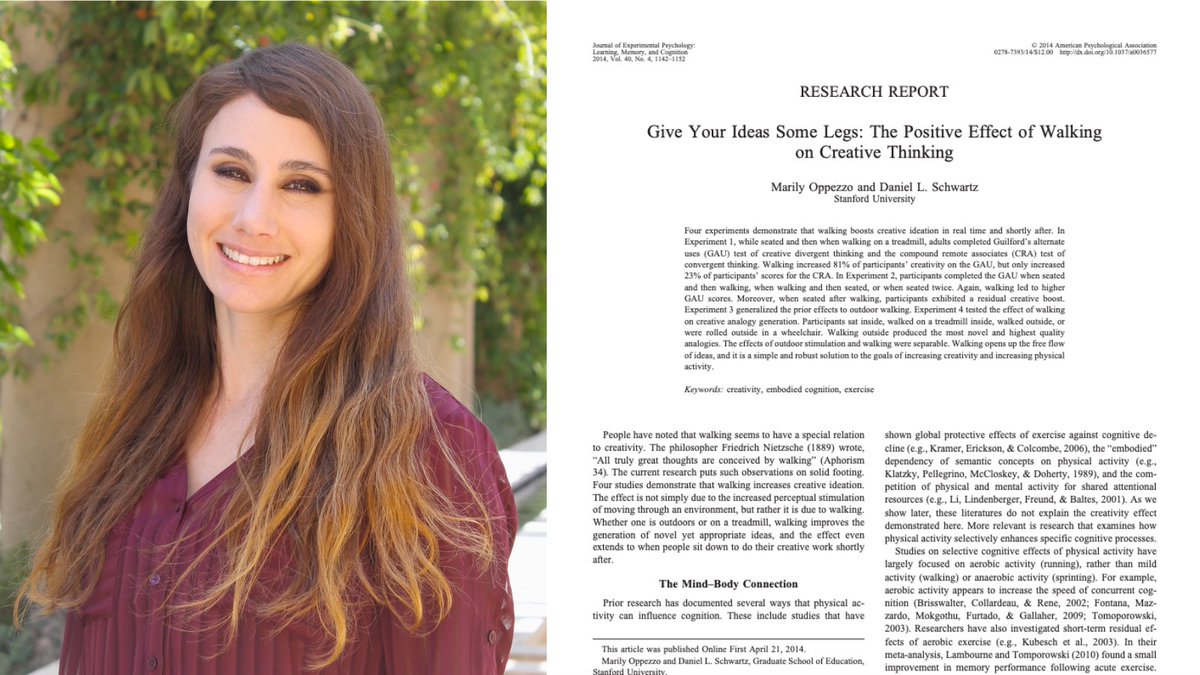
A Stanford psychologist spent 4 years proving that the simple act of walking generates 60% more creative ideas than sitting, and the experiment she designed to kill every alternative explanation is one of the most decisive findings in modern psychology. Her name is Marily Oppezzo. She got the idea for the study while walking with her advisor at Stanford to discuss her thesis topic, and the paper she eventually published in the Journal of Experimental Psychology in 2014 is sharp enough that it should have ended the seated meeting on the day it came out. She ran 4 experiments on 176 people. Same person tested twice. Once sitting, once walking. The creativity tasks were the standard ones psychologists have used for decades to measure how good a brain is at generating novel useful ideas. The result was almost too clean to publish. 81% of participants in the first experiment produced more creative ideas while walking than while sitting. In the second experiment, 88%. In the third, 100%. Every single person walked into a more creative version of themselves. On average, people generated 60% more novel useful ideas the moment their legs started moving. The skeptical question is the obvious one. Maybe it was the fresh air. Maybe it was the scenery passing by. Maybe it was the change of environment doing the work, not the walking itself. Oppezzo killed every one of those explanations with one experimental decision. She put people on a treadmill facing a blank wall. No scenery. No fresh air. No environmental change. Just legs moving in place while staring at white drywall. The 60% boost held. Then she ran the experiment that closed the case completely. She took participants outside in two conditions. Half of them walked through a Stanford courtyard. The other half were pushed through the exact same courtyard in a wheelchair. Same outdoor stimulation. Same scenery passing at the same speed. The only difference was whether the legs were moving. The walkers produced dramatically more novel high-quality ideas than the wheelchair group. The outdoors did almost nothing on its own. The walking did everything. This is the part of the study that hit hardest when I read it the first time. She also tested the opposite kind of thinking. Convergent thinking. The kind where there is one right answer and you have to narrow down to it. Word puzzles where 3 words share a hidden fourth word that connects them. The seated participants did slightly better on these. Walkers got slightly worse. Walking is not a general intelligence enhancer. It does one specific thing. It opens up the divergent search inside your brain. The part that generates options. The part that produces unexpected connections. The part that takes a problem and finds five ways into it instead of one. When you need to converge on the single right answer, sit down. When you need to find the answer in the first place, get up. The mechanism is now well understood. Walking selectively activates what neuroscientists call the default mode network, the system inside your brain that runs when you are not consciously focused on anything. The DMN is where mind-wandering happens. Where memories cross-reference each other. Where ideas that have been sitting in separate folders inside your head finally bump into each other. When you sit at a desk and force yourself to concentrate, you suppress the DMN. When you walk at a natural pace, the executive part of your brain gets just busy enough handling the walking that the DMN comes online and starts doing the work that focus was blocking. The most useful finding in the entire paper is the one almost nobody quotes. The boost did not turn off the moment people stopped walking. Participants who walked first and then sat back down stayed elevated. Their next round of seated creativity work was still significantly better than people who had been sitting the whole time. The rest lingered for at least several minutes after the legs stopped moving. You do not need to do creative work while walking. You need to walk before the creative work. The brain holds the state. The history of this is the part that should haunt anyone who still does meetings in chairs. Charles Darwin built a gravel loop behind his house in Kent called the Sandwalk and walked it 3 times a day for the rest of his life. The theory of evolution was developed one lap at a time on that path. Nietzsche walked up to 10 hours a day during the years he wrote his most important books and openly said the work was conceived on his feet. Beethoven composed for the morning and walked for 5 hours every afternoon with a pencil in his pocket for when something landed. Kahneman said the best thinking of his Nobel Prize-winning career happened on leisurely walks with Amos Tversky. Steve Jobs refused to take important conversations sitting down. He held them on foot. Every one of them was using the system Oppezzo would not measure until 2014. They just did not know what to call it. The question worth sitting with is the one almost nobody asks. Every meeting you have ever attended sitting around a table was a meeting held at a fraction of the brain power that was actually available to the people in the room. Every brainstorm that got stuck inside a conference room. Every problem you tried to solve at a desk and gave up on. Every idea you could not quite get to. The intervention is the easiest one in modern science. No supplement. No app. No subscription. No training program. Just a pair of legs and 15 minutes. The Stanford lab proved it. The philosophers knew it. The neuroscience explains it. And almost everyone reading this is still trying to think their way out of problems sitting completely still.

We need to apologize to our ancestors.

Brené Brown, researcher and author, on the contradiction she keeps hearing in rooms full of tech billionaires: Her work puts her in rooms where the founders and CEOs of major tech platforms talk openly about how they think. What @BreneBrown hears there unsettles her: "So I hear someone say, 'Hey, you know, tech billionaire, what should my kids study? I'm worried for my kids… they should study coding, physics,' and then five minutes later, as if that answer didn't happen, someone will say, 'What do you attribute your success to?' I mean deeply when you think about it, and the same person will say, 'My deep reading of philosophy and the stoics.'" The contradiction is what stops her: the same people crediting philosophy and the liberal arts for their own success are telling other parents their kids should focus on coding and physics. That gap leads her to a bigger, more uncomfortable question: "I start to extrapolate from there and wonder if there is a thinking class that's emerging where they're like, 'We're going to read philosophy and we're going to read the liberal arts and we're going to study history, and the rest of you just keep scrolling. Don't worry about the big words. We'll handle all the big words for you.'" She points to Steve Jobs as an early signal of the same pattern: "It's like when they asked Steve Jobs, 'Boy, your kids must love the iPad.' Steve Jobs said, 'My kids don't have an iPad.' And then his biographer who spent time with his family said he wasn't kidding. There's no technology. At dinner, they're talking about art and history." The takeaway is simple but uncomfortable. The people building these platforms are protecting their own kids from them, and giving them books, ideas, and real conversation instead. So why are the rest of us being sold something different?
The longest relationship of your life isn't what you think..

A retired sex therapist said: "The couples having the best sex after 15 years together all share these eight habits in common." They have nothing to do with positions, looks, or hormones. Here are the 8 habits....

⚡️Children remember the moments when the family becomes fully alive. That is the core. Vacation is just the common vessel. A child does not encode childhood as a spreadsheet of responsible parenting. They encode atmosphere. They remember the motel pool, the gas station stop, the smell of sunscreen, the weird restaurant, the long drive, the sunset, the parents laughing differently, the feeling that normal life cracked open and something larger appeared. That is why ages 5 to 10 hit so hard. The child is old enough to form durable narrative memory and young enough for the world to remain enchanted. Parents still feel mythic. A beach, cabin, lake, theme park, road trip, or even a cheap rented house can become sacred geography. The real mechanism is interruption of routine plus emotional safety. Ordinary life teaches stability. Trips create myth. The family leaves the repeating loop of school, work, chores, screens, exhaustion, and time pressure. For a few days, the child experiences parents outside their normal roles. Mom and dad are no longer just managers of homework, food, discipline, bedtime, and logistics. They become companions inside an adventure. That imprints. The money matters far less than parents think. Luxury is mostly adult vanity. Children remember intensity, freedom, attention, surprise, and togetherness. A $200 trip can beat a $10,000 trip if the child feels wonder and the parents are emotionally present. Many adults are starved because their childhood had no sacred interruptions. Everything was duty, stress, survival, noise, pressure, or emotional absence. No mythic family scenes. No private homeland in memory. No recurring proof that life could be warm and strange and alive. That matters for the adult psyche. People draw from childhood memories during loneliness, fear, ambition, loss, and love. Those memories become inner architecture. Deepest compression: a good childhood is not built only by protection. It is built by unforgettable shared worlds. Take the kid somewhere. Break the loop. Make the ordinary world disappear for a few days. That becomes part of them forever.

🚨: Study shows the most unforgettable childhood memories are family vacations between ages 5 to 10.


Inspired by ancient Chinese practices like Qi Gong and Tai Chi, combined with modern Western lymphatic movement methods. I now practice this routine every day

Meet Dr. Casey Means. This Stanford-trained physician left surgery to expose how modern medicine ignores the root causes of nearly all chronic diseases. Here are her top 7 tips to protect your health: 🧵 1. Eat your food in the right order

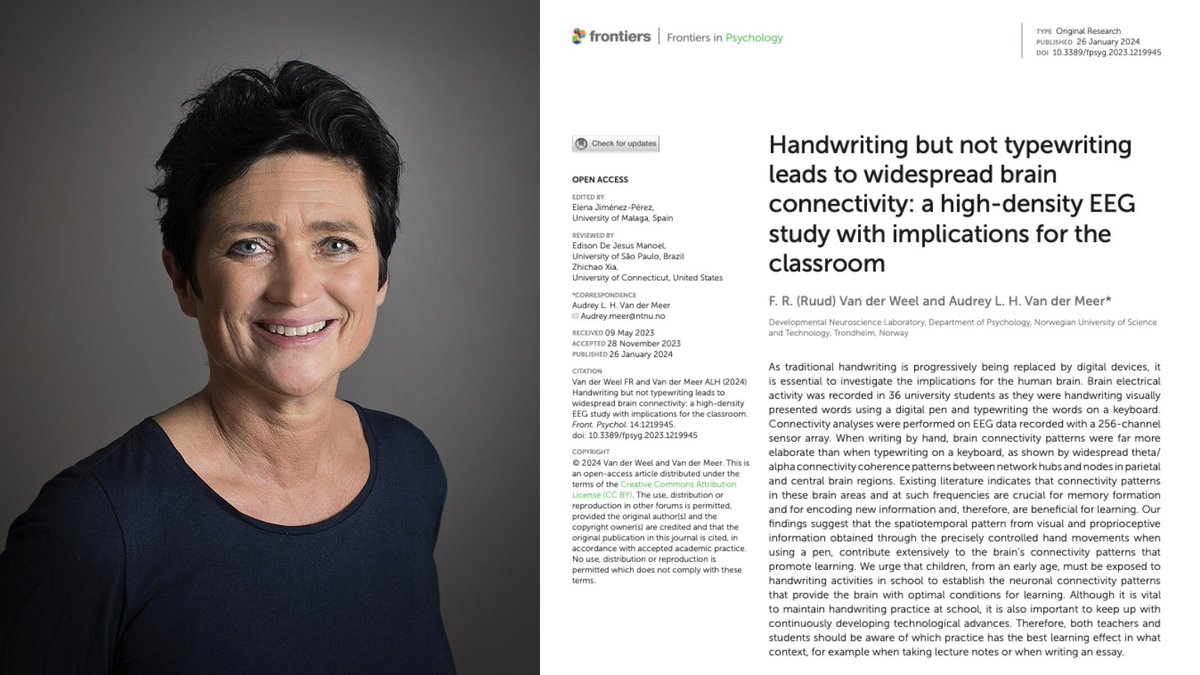
A Norwegian neuroscientist spent 20 years proving that the act of writing by hand changes the human brain in ways typing physically cannot, and almost nobody outside her field has read the paper. Her name is Audrey van der Meer. She runs a brain research lab in Trondheim, and the paper that closed the argument was published in 2024 in a journal called Frontiers in Psychology. The finding is brutal enough that it should have changed every classroom on Earth. The experiment was simple. She recruited 36 university students and put each one in a cap with 256 sensors pressed against their scalp to record brain activity. Words flashed on a screen one at a time. Sometimes the students wrote the word by hand on a touchscreen using a digital pen, and sometimes they typed the same word on a keyboard. Every neural response was recorded for the full five seconds the word stayed on screen. Then her team looked at the part of the data most researchers had ignored for years, which is how different parts of the brain were communicating with each other during the task. When the students wrote by hand, the brain lit up everywhere at once. The regions responsible for memory, sensory integration, and the encoding of new information were all firing together in a coordinated pattern that spread across the entire cortex. The whole network was awake and connected. When the same students typed the same word, that pattern collapsed almost completely. Most of the brain went quiet, and the connections between regions that had been alive seconds earlier were nowhere to be found on the EEG. Same word, same brain, same person, and two completely different neurological events. The reason turned out to be something nobody had really paid attention to before her work. Writing by hand is not one motion but a sequence of thousands of tiny micro-movements coordinated with your eyes in real time, where each letter is a different shape that requires the brain to solve a slightly different spatial problem. Your fingers, wrist, vision, and the parts of your brain that track position in space are all working together to produce one letter, then the next, then the next. Typing throws all of that away. Every key on a keyboard requires the exact same finger motion regardless of which letter you are pressing, which means the brain has almost nothing to integrate and almost no problem to solve. Van der Meer said it plainly in her interviews. Pressing the same key with the same finger over and over does not stimulate the brain in any meaningful way, and she pointed out something that should scare every parent who handed their kid an iPad. Children who learn to read and write on tablets often cannot tell letters like b and d apart, because they have never physically felt with their bodies what it takes to actually produce those letters on a page. A decade before her, two researchers at Princeton ran the same fight using a completely different method and ended up at the same answer. Pam Mueller and Daniel Oppenheimer tested 327 students across three experiments, where half took notes on laptops with the internet disabled and half took notes by hand, before testing everyone on what they actually understood from the lectures they had watched. The handwriting group won by a wide margin on every question that required real understanding rather than surface recall. The reason was hiding in the transcripts of what the two groups had actually written down. The laptop students typed almost word for word, capturing more total content but processing almost none of it as they went, while the handwriting students physically could not write fast enough to transcribe a lecture in real time, which forced them to listen carefully, decide what actually mattered, and put it in their own words on the page. That single act of choosing what to keep was the learning itself, and the keyboard had quietly skipped the choosing and skipped the learning along with it. Two studies. Two countries. Same answer. Handwriting makes the brain work. Typing lets it coast. Every note you have ever typed instead of written went into your brain through a thinner pipe. Every meeting, every book highlight, every idea you captured on your phone instead of on paper was processed at half depth. You did not forget those things because your memory is bad. You forgot them because typing never woke the part of the brain that would have made them stick. The fix is the thing your grandmother already knew. Pick up a pen. Write the thing down. The slower road is the faster one.

Most people treat meditation like stress relief. Harvard neuroscientist Sara Lazar shows something more physical: 8 weeks changed brain structure. The amygdala got smaller as stress dropped. The lever is not escaping life. It is changing your relationship to the signal.

Royal Secrets – Ancient Chinese Foot Wellness 🦶
Yes, your children, but also all of us as we age~

Exercise that helps children improve concentration and thinking skills.

Families First Mediat... @ADRforALL
1K Followers 2K Following Dispute Prevention & Resolution - Mediation, Arbitration & Coaching UNDER ONE ROOF. Specialists in Separation & Divorce, Elder, Wills and Estates.


Atif Pervaiz @Atif93548254803
5 Followers 76 Following ✨ Transform your business with premium virtual assistants! Save 20+ hours weekly. Trusted by 100+ elite entrepreneurs. Book your FREE strategy call now! 🚀
Lumbo stray @Strayeddy
5 Followers 48 Following

Cheryl @Cherylyovana
132 Followers 2K Following Seeking new adventures, exploring uncharted territories, and pushing the boundaries of possibility.
Favour Smith @favour68399
5 Followers 312 Following
Olivia Sammons @livsammons
340 Followers 5K Following I interview leading entrepreneurs @Closers.io | Scaled 0-30 million within 26 months. Host of Founders Future Podcast
BeautyAbigailJackson @N7ejyMoD098eB2
17 Followers 1K Following Life’s a journey. I'm here to make it legendary.
Cristian nell @nell44945
214 Followers 3K Following am single am from Texas a simple music can make you feel better 💘
Melissa S. Storch @CollabFamilyLaw
306 Followers 2K Following Collaborative Family Lawyer, Mediator, Peacemaker, Food Allergy Advocate, Writer, Wife, Mother
Holina @Provide89075600
6 Followers 150 Following
Kate Gloria @gloria5097
4 Followers 71 Following
Jonathan Rundman @jonathanrundman
1K Followers 3K Following musician, songwriter, new album Waves 4-11-25, @elca Lutheran pastor
Alittlebitofeverythin... @MiguelP69679957
292 Followers 2K Following
Prabh Waraich @PrabhWaraich_
122 Followers 2K Following "The Systems Guy" | Proven systems to grow a profitable audience with content.

Coanea @Coaneagdh2Ry
10 Followers 631 Following
NavigateDivo @NavigateDivo
7 Followers 45 Following Reinventing how people navigate the divorce journey 🫶 👉 Check out https://t.co/4y4plp14MT to learn more!
Leausio @Leausio0AJ
93 Followers 2K Following
Teetatew @Teetatewz7u
52 Followers 3K Following
Neatason @NeatasonAKQH
22 Followers 3K Following
Sirshe @Sirshe7BAg
55 Followers 1K Following
Flawshesth @FlawshesthABlw
57 Followers 3K Following
Slairsleet @SlairsleetuhIY
61 Followers 3K Following
Nerloosh @NerlooshyyKJ
32 Followers 2K Following
Sorethski @SorethskifUgAt
59 Followers 7K Following
Toydaret @ToydaretpH27Fw
47 Followers 2K Following
Seethoat @SeethoatCfio
45 Followers 4K Following
しもだいらあさ... @shimodaira98172
50 Followers 3K Following
Pousasu @Pousasu252Gv
87 Followers 2K Following
missy alma @alma_missy30137
30 Followers 474 Following
Sesthosm @Sesthosmldx4l
65 Followers 1K Following
Thesshl @ThesshluQF
209 Followers 3K Following
Slesawsl @SlesawslMBLL
78 Followers 4K Following
Tesetes @Tesetes265784
81 Followers 7K Following A strong woman is one who is determined to do what others are determined not to do.
Chiraez @Chiraezmv4JdV
43 Followers 4K Following
CarolVeblen @x5xqHicd73nBA0
69 Followers 7K Following
Shoron @ShoronnQure
72 Followers 2K Following
Mary @Mary37387314661
1 Followers 50 Following
Smymmit @Smymmit2grIvg4
7 Followers 239 Following
Mindful Negotiators @mindnegotiators
1K Followers 179 Following The global mindful leadership club. •Lawyers & Leaders• United for a mindful world!
Searshousm @SearshousmzcSz
46 Followers 4K Following
Bella @Bella1227702
36 Followers 3K Following
Thershet @ThershetaKQ
16 Followers 383 Following
IrmaGeoffrey @2fly293oCyKId5F
58 Followers 7K Following
Tesloreth @TeslorethMT7rK
75 Followers 7K Following
CBC British Columbia @cbcnewsbc
294K Followers 389 Following This account is inactive. For more of CBC British Columbia, visit https://t.co/IlCa7cR0be
Families First Mediat... @ADRforALL
1K Followers 2K Following Dispute Prevention & Resolution - Mediation, Arbitration & Coaching UNDER ONE ROOF. Specialists in Separation & Divorce, Elder, Wills and Estates.
Law Society of BC @LawSocietyofBC
6K Followers 144 Following The Law Society of British Columbia regulates the legal profession in BC in the public interest.


Roy Rogers Happy Trai... @RoyRogers_HTMS
31K Followers 5K Following Roy Rogers Happy Trails Music Shop Former Music Store in Bristol Tennessee
Praise The Camera Man @PraiseTheCMen
159K Followers 21 Following camera operation; capturing calculated recording angles; maintaining good camera control, general perception, also properly controlling what's in the frame.

Matthew LaBosco @matthew_labosco
39K Followers 147 Following Nervous system specialist helping high-performing executives end chronic stress by retraining the nervous system to rest, recover, and perform again.
Nick Brunyate @NickBrunyate
2K Followers 2K Following I’m a 🇬🇧🇫🇮. Only on Twitter to follow the war and support 🇺🇦
Athenaeum Book Club @athenaeumbc
232K Followers 375 Following An online book club studying and preserving the great texts of Western Civilization. Join 40,000+ members 👇
AnthonyAndrews @anthon7yandrews
45K Followers 2K Following Truth will prevail. we all have a talent in this information war. We are all Information Warriors, please focus on it.

World News X @WorldNews_X_
127K Followers 23 Following "Get the latest global headlines and in-depth analysis. Stay updated with breaking news and exclusive interviews from around the world." #Breakingnews #war
Furkan Gözükara @FurkanGozukara
275K Followers 2K Following PhD Computer Eng. : AI, Wan, Qwen, FLUX, ComfyUI LTX, LLMs, Z-Image, LoRA, Tutorials, Fine-Tuning, DreamBooth, AI Lectures, Voice Cloning, Tech - Pro Humanity
Jennifer Bendery @jbendery
90K Followers 385 Following Senior politics reporter for HuffPost. On Bluesky: @jbendery.bsky.social. Tips: [email protected]. Signal: jbendery.41

MAGA Cult Slayer🦅�... @MAGACult2
325K Followers 10K Following We're exposing how you're being controlled. JOIN #smokefleet. It's an organic movement for all of us!!! #RidinwithBiden

Christopher Steele @Chris_D_Steele
42K Followers 342 Following Director @orbisBIofficial | Former British Crown Servant | Intelligence Professional | Russia Specialist |
Ilan Goldenberg @ilangoldenberg
42K Followers 1K Following Senior Vice President and Chief Policy Officer J Street. Previously White House, DOD, State.
Nancy Youssef, نان... @nancyayoussef
31K Followers 1K Following Journalist. Egyptian-American. And according to one reliable source, "a much better stepmom than Cinderella’s.” https://t.co/BK8ICOhVIN #autismstepmom
CA Vivek Khatri @CaVivekkhatri
221K Followers 168 Following Daily Threads & Learning Articles | Algo Trader & Investor | Macro l Building Wealth Community l Founder & Partner @Stocki_zen –SEBI RA Firm (INH000017675)
Joyce Karam @Joyce_Karam
170K Followers 3K Following Editor-in-Chief @AlMonitor | Adjunct Professor, GWU | Author of China-Middle East newsletter 📝 RT≠ Endorsement 📧 [email protected]
Matthew Miller @matthewamiller
390K Followers 617 Following Partner at Vianovo. Former spokesman at the Departments of State and Justice.
Sohel @SohelBloom
13K Followers 172 Following Interests in nature, technology, sports, business and economy. Passion for helping individuals to build their brand. DM for paid collaborations.
Douglas Macgregor @DougAMacgregor
681K Followers 84 Following Army Colonel Retired Combat Veteran | CEO @TheNatConvo | SECDEF Advisor | Author | Consultant | Military TV Analyst | https://t.co/tLrnHgGR1x
Natasha Bertrand @NatashaBertrand
730K Followers 7K Following @CNN correspondent covering the Pentagon and national security. [email protected]. Signal: Natashabertrand.12
julie k. brown @jkbjournalist
330K Followers 2K Following Miami Herald journalist whose investigation led to the arrests of Jeffrey Epstein & Ghislaine Maxwell. Signal: jkbjournalist.25 Substack: jkbjournalist.substack
Jacob Shamsian ⚖️ @JayShams
38K Followers 11K Following Features/Investigations Correspondent @businessinsider · JacobShamsian.07 on Signal · Author of zero books ⭐ https://t.co/pjjqxQgD5a ⭐
Frederik Pleitgen @fpleitgenCNN
335K Followers 4K Following CNN Senior International Correspondent and Anchor
Malachy Browne @malachybrowne
40K Followers 11K Following Visual Investigations @nytimes | Pulitzer team for international reporting (2020 & 2023) | https://t.co/LIbJXYLfnL
Dr Sumit Sharma @dr_sumit_sharma
27K Followers 133 Following MD | Precision reversal of metabolic dysfunction for high-performers who've tried the basics. Uncovering what others miss. Longevity optimization. London-based.
Jürgen Nauditt 🇩�... @jurgen_nauditt
115K Followers 9K Following I stand with Ukraine. Love destroyed russian tanks. NAFO. Managing Director.
Shayan Sardarizadeh @Shayan86
220K Followers 14K Following Senior journalist at BBC Verify | verification, AI, disinformation, conspiracy theories, open source investigations, extremism | [email protected]
Anders Åslund @anders_aslund
332K Followers 5K Following Economist & author. Russia, Ukraine & Eastern Europe. Read my latest book: "Russia's Crony Capitalism" https://t.co/ZqmWMRSMf9
Legion-Anonymous Oper... @IAmAnonLegion
205K Followers 124 Following We are Legion Of Anonymous Operations. EST 2007 renamed on X in 2021. A journalism collective. #OpGOP #OpChildSafety #AnonOps #Anonymous #Legion #SmokeFleet
Suzie rizzio @Suzierizzo1
222K Followers 27K Following I’m a small town beach girl that loves politics & fostering animals! #BLM #Resister #Equality #VotingRights #VoteBlue #LGBTQ 💙 No DM’s 🌊
🎸 Rock History �... @historyrock_
757K Followers 4K Following Long live ROCK AND ROLL and HEAVY METAL!!! 🤘🏻 The best content of the best years of music history 🎸Contact us by DM 📥.
Andrew Friesen @friesen_f
6K Followers 1K Following Father. Husband, Data/Digital Transformation. Likes cars, travel, data, Red Tory/Blue Liberal. Data over dogma! On an X break!
Shawn Farash @Shawn_Farash
449K Followers 5K Following Captain Deplorable. Host - UNGOVERNED on LFA TV. Trump's first RT on Truth Social. High Energy. NY ➡️ TN. The media is not your friend.
Ice hockey Olympics 2... @IceHockeyLive26
100 Followers 9 Following 🏒Live streaming Ice Hockey Olympics 2026 @IceHockeyLive26 Watch the world’s best teams clash for gold with speed, skill & passion on ice.#IceHockey #Olympics26
The Olympic Games @Olympics
5.8M Followers 5K Following Excellence, respect and friendship 🕊️ ES: @JuegosOlimpicos FR: @JeuxOlympiques HI/EN: @OlympicKhel JA: @Gorin KO: @Olympic PT: @JogosOlimpicos RU: @Olympia_da
Mitch Goldich 🐙 @mitchgoldich
107K Followers 959 Following Writer and senior editor at Sports Illustrated + @theMMQB. Mostly NFL and Olympics coverage. Former @si_union unit chair. Philly native. @NFL_octopus inventor.
Gandalv @Microinteracti1
124K Followers 5K Following Wars don’t start by accident. Geopolitics. NATO. European defense. Premium briefings on X - $1/mo. Full analysis on Substack 👉 https://t.co/2TO5x2OGdg
Science girl @sciencegirl
5.9M Followers 6K Following science in context , art history and technology
Dr. Geoff Grammer @DrGeoffGrammer
15K Followers 1K Following U.S. Army Colonel (Ret.) | Psychiatrist | Advocate for mental health, science, and democratic values | Anti-MAGA | Formerly @geoffreygrammer

Middle Earth Memes @MiddleEarth_xD
8K Followers 692 Following Meme Fan Page. I post Memes about Middle Earth, and The Hobbit, and Rings of Power, and LOTR
Dr Reenee Singh @CouplesCentre
1K Followers 2K Following Director London Intercultural Couples Centre, Child and Family Practice, Couples/Family Therapist, Trainer. https://t.co/lMq7gSIAiV
Wyatt Arndt @TheStanchion
36K Followers 2K Following Senior writer at CanucksArmy and resident media bad boy - The Stanchies (Provies/Athletties/Armies) - President of NEW wrestling - Email: [email protected]You might like