Workflow SDK @workflowsdk
Build durable, resilient, and observable workflows. Built by @vercel. workflow-sdk.dev San Francisco, CA Joined October 2025-
Tweets53
-
Followers2K
-
Following12
-
Likes71
Buttons and modals in Chat SDK now accept a 𝚌𝚊𝚕𝚕𝚋𝚊𝚌𝚔𝚄𝚛𝚕 prop. Pair it with a @workflowsdk webhook to pause a run, then resume it when a human in the loop clicks a button. vercel.com/changelog/chat…

@vercel Ship26 is live! This year, we shipped a 3D device that can create WASM apps using wterm, just-bash, and @workflowsdk ...and a landing full of agents that walk around the site using a dynamic navigation mesh.
The hardest thing about agents and backends is durability. @workflowsdk fixes this. That LLM you're calling *will* go down. That service *will* rate limit you. That database *will* unexpectedly slow down. You *will* get paged 💀 I've been looking for a unicorn for a decade. I wanted the level of reliability of combining stuff like SQS / Kafka / microservices, and I absolutely did not want *that* at the same time 😂 Truly reliable systems like that are notoriously difficult to reason about, to develop locally, to test, to simulate, to deploy… Workflow SDK solves that without compromises. We're doing what Next.js did for the frontend, but for one of the most important problems of the new generation of backend applications. Notably, Workflow SDK has an incredible self-hosting and multi-cloud story from day 0. We've taken amazing lessons from Next.js and poured them into the many Worlds (adapters) you can deploy to. Congrats to Pranay and the Workflow team on a generational ship: vercel.com/blog/a-new-pro…

Vercel Workflows is GA. Your code is the orchestrator. Ship agents, backends, or any long-running process without managing queues, retries, or workers. vercel.com/blog/a-new-pro…
Vercel Workflows is GA. Your code is the orchestrator. Ship agents, backends, or any long-running process without managing queues, retries, or workers. vercel.com/blog/a-new-pro…
You can now filter workflow logs to easily view all logs for a workflow run in one place. Jump directly from a run to logs, filter by steps, and quickly find relevant requests.
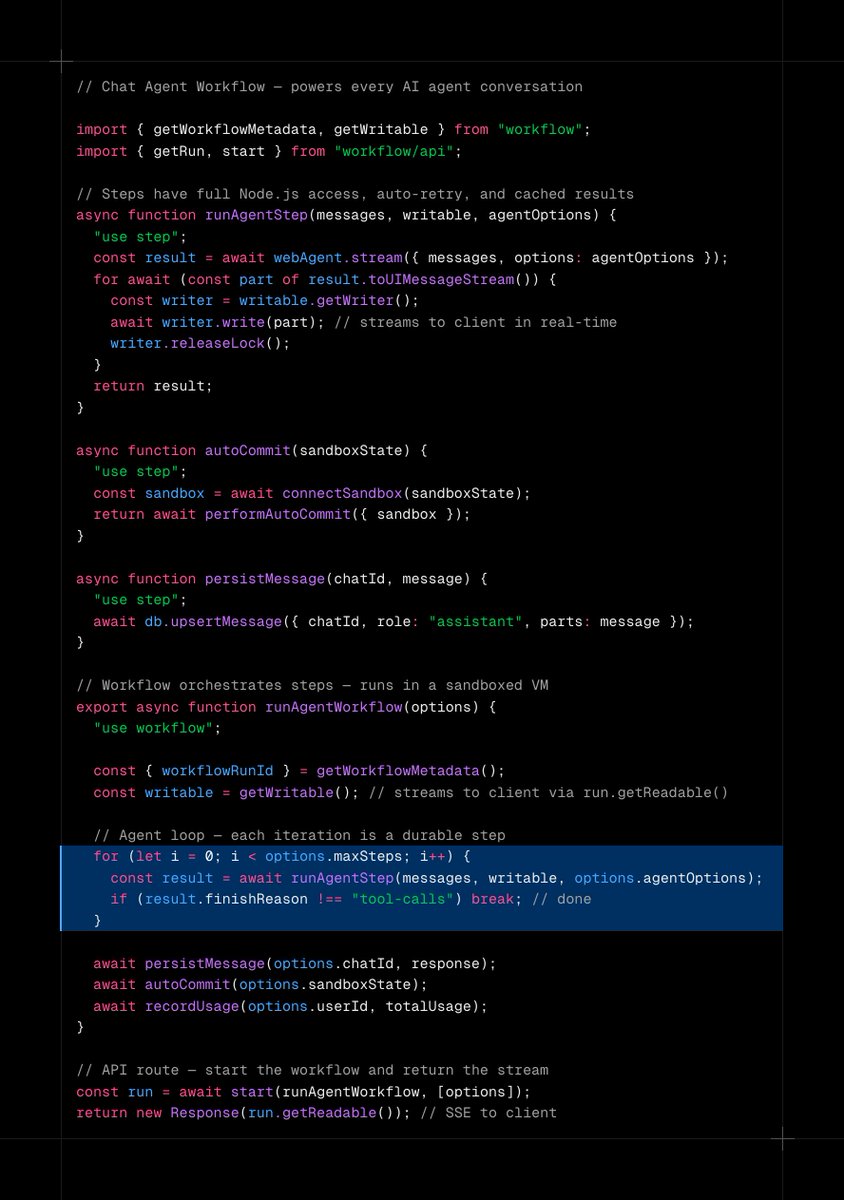
A fascinating aspect of Open Agents is how it uses the @WorkflowDevKit SDK to elegantly orchestrate agent sessions efficiently. But before we go deeper, let's understand the problem: Open Agents is a coding agent that runs in the cloud. Naturally, the expectation here is that I should be able to kick off multiple sessions and go to sleep and then wake up to a stack of PRs. This inherently means, the sessions should be - long running - stateful - resumable - reliable A naive way to solve this: - Write an API to start a session, create a session ID and store it in a database - along with other metadata. - Trigger the session inside a sandbox (Vercel sandboxes can run up to 5hours) and stream the responses back to the client using a websocket - Store the responses to the db so when a client reconnects to a session using a session ID, we can resume it by fetching the results and restarting the session Why wouldn't you just do this?

3 months ago I started building a coding agent that runs in the cloud. It's since written every line of code I've shipped, including itself. Today, I'm open sourcing it. Introducing Open Agents.

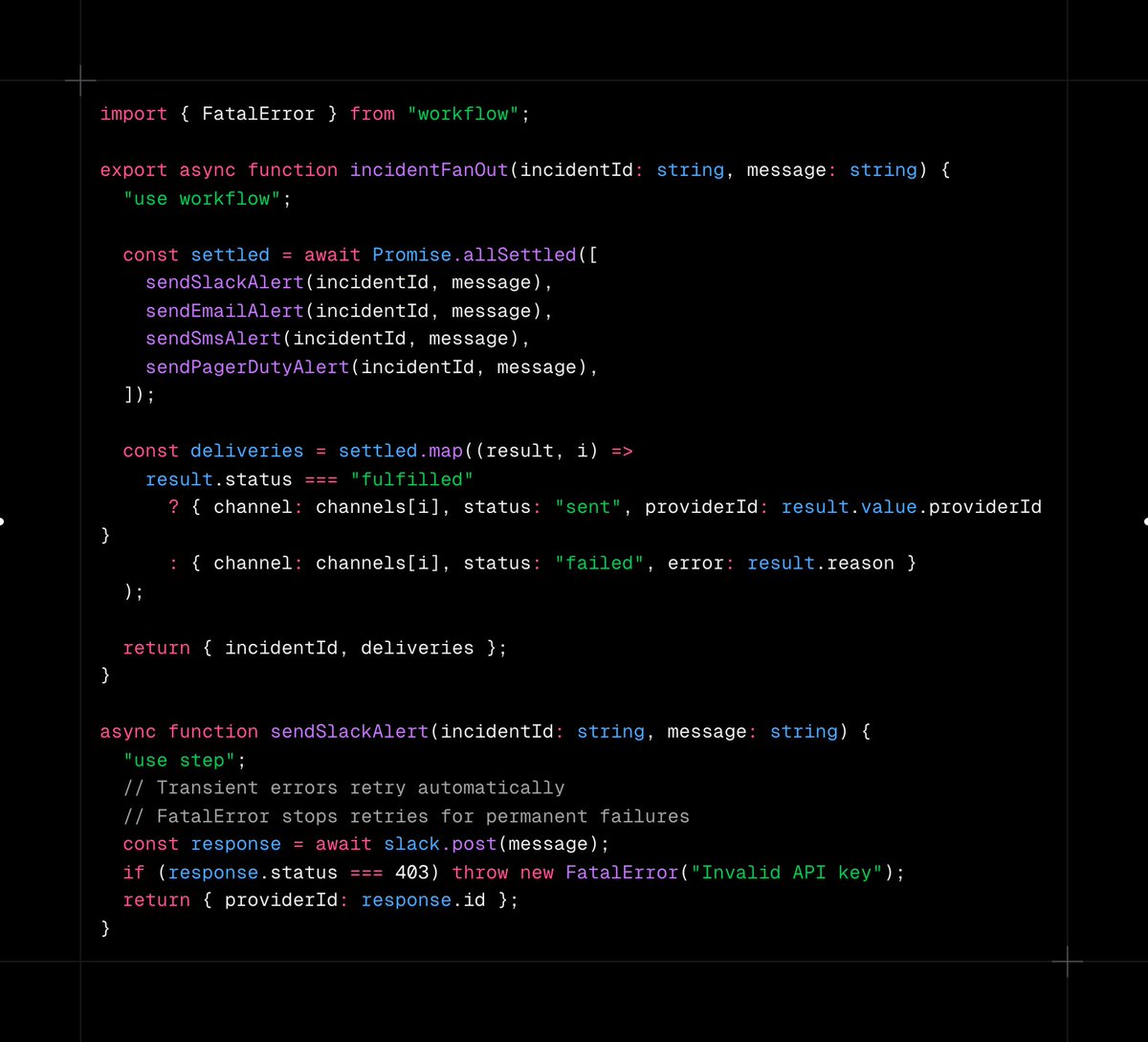
This setup handles transient retries automatically while stopping permanent failures immediately. You can track everything without a coordinator service, dead letter queues, or complex retry policies. Explore the interactive demo on v0: v0.app/chat/yNVqbF72C…
Using Promise.allSettled() provides parallel execution alongside per-channel failure tracking. Each step is independent, so throwing a FatalError stops retries for that specific channel while the others continue.
Sending an alert to four channels sequentially means the last channel waits for the first three. If you send them in parallel without coordination, you lose track of which specific channels failed. Promise.allSettled() provides the best of both worlds.
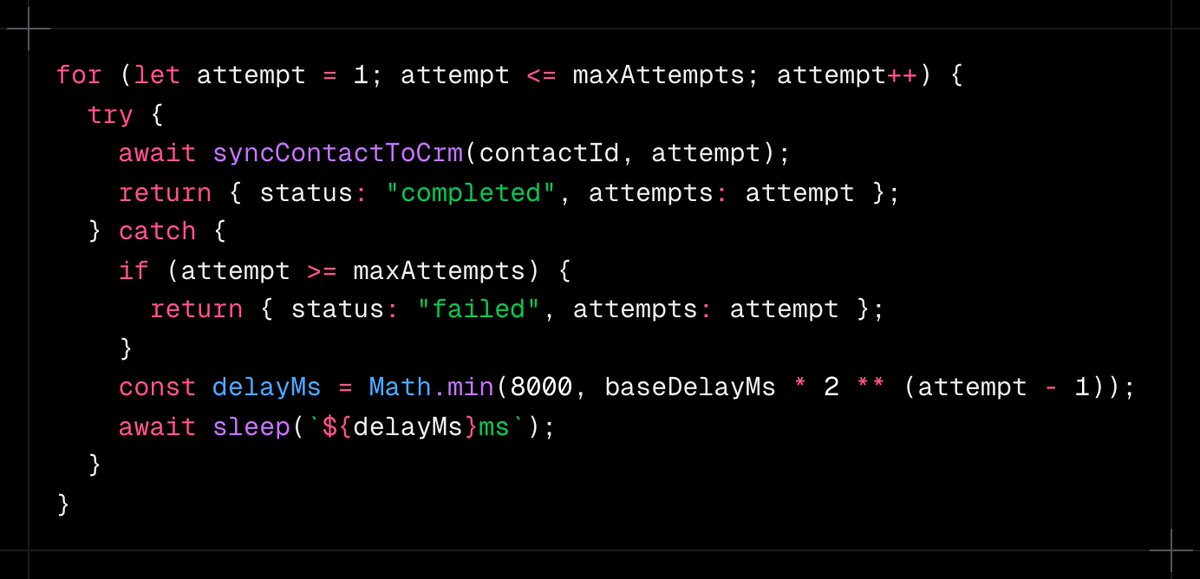
No queue. No cron. No dead-letter table. Exponential backoff in a for-loop that survives restarts. Explore the interactive demo on v0: v0.app/chat/retry-bac…
The backoff is just math in a local variable. `sleep()` pauses for real wall time and zero compute while waiting. Crash between attempts? The loop picks up exactly where it left off.
Traditional: a retry queue, a backoff column, and a cron to sweep stuck jobs. Workflow: a for-loop with `sleep()`:
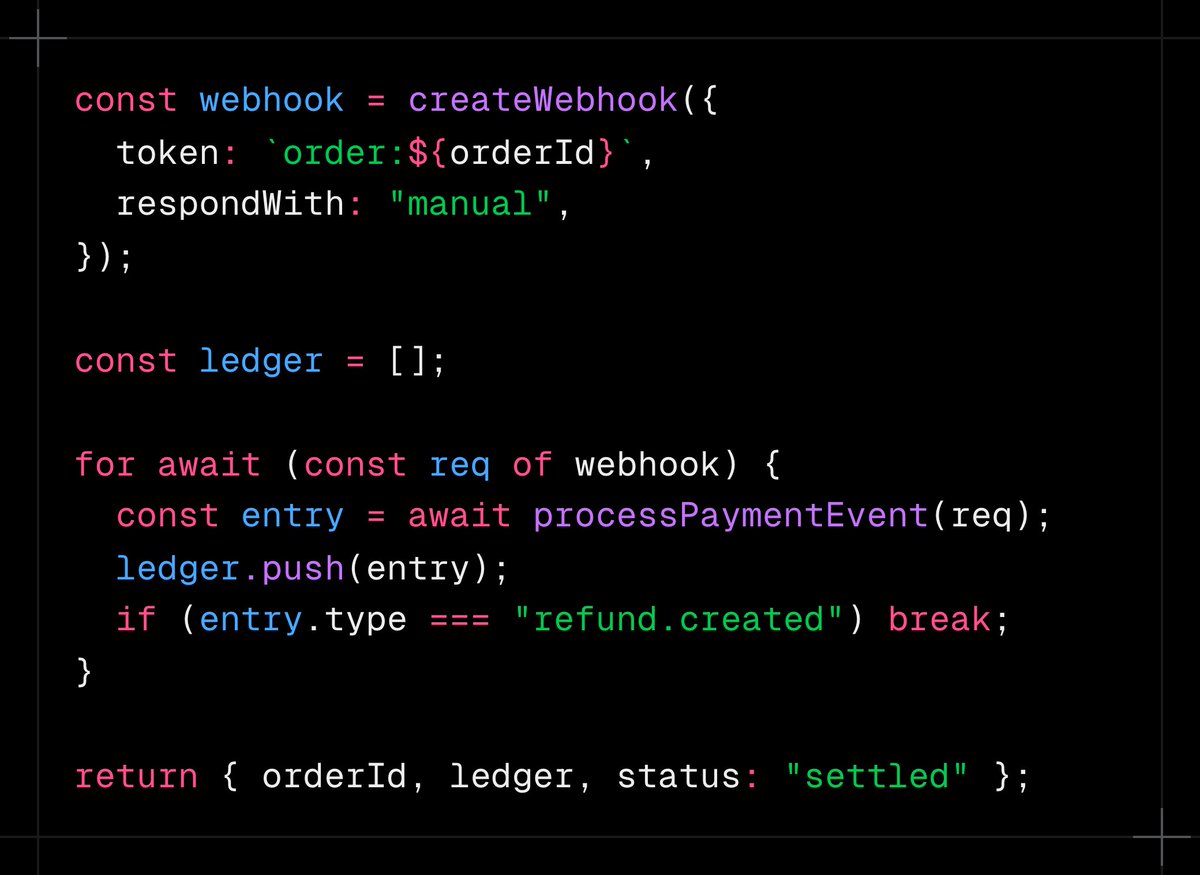
No database rows required. Just a local array that tracks the whole payment lifecycle. Explore the interactive demo on v0: v0.app/chat/webhook-b…
The webhook is scoped to one order. `for await` suspends between events at zero compute. Each hit runs as a `"use step"`, retried independently. `ledger` is a local array. It survives across events, restarts, and deploys.
30 Days of Workflow DevKit — Day 4 — Payment Webhooks What if your webhook tracked an order from first charge to final refund — remembering every event — without a database? `createWebhook()` can do that in a simple loop:
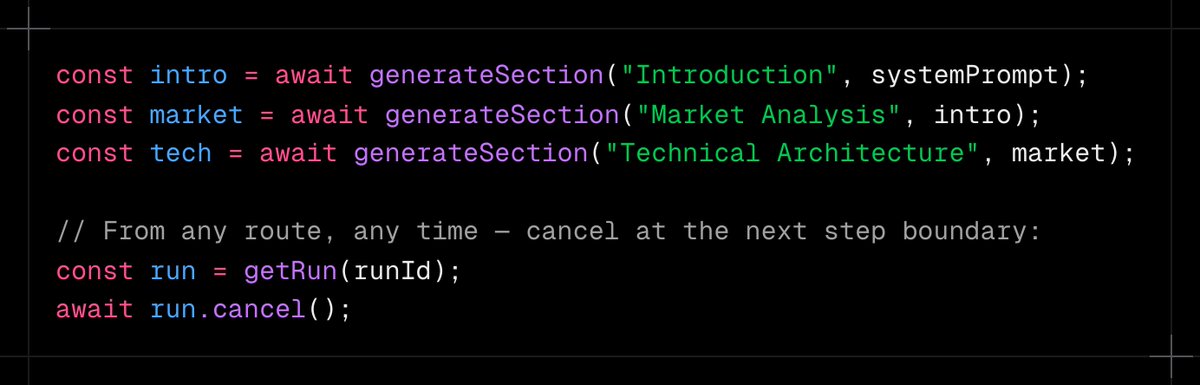
No wasted tokens. No half-written output. Cancel, keep what's good, fix the prompt, rerun. Explore the interactive demo on v0: v0.app/chat/safe-canc…
Each `"use step"` function runs to completion or not at all. `run.cancel()` exits at the next step boundary. Completed sections are preserved in your dashboard, pending ones are dropped. The cancelled run is yours to inspect.
30 Days of Workflow DevKit — Day 3 — Easy Cancel You tweaked the system prompt and kicked off a test workflow. Three sections in, every paragraph reads like a fever dream. Stop the run, keep what's there, fix the prompt. All thanks to a simple cancel():
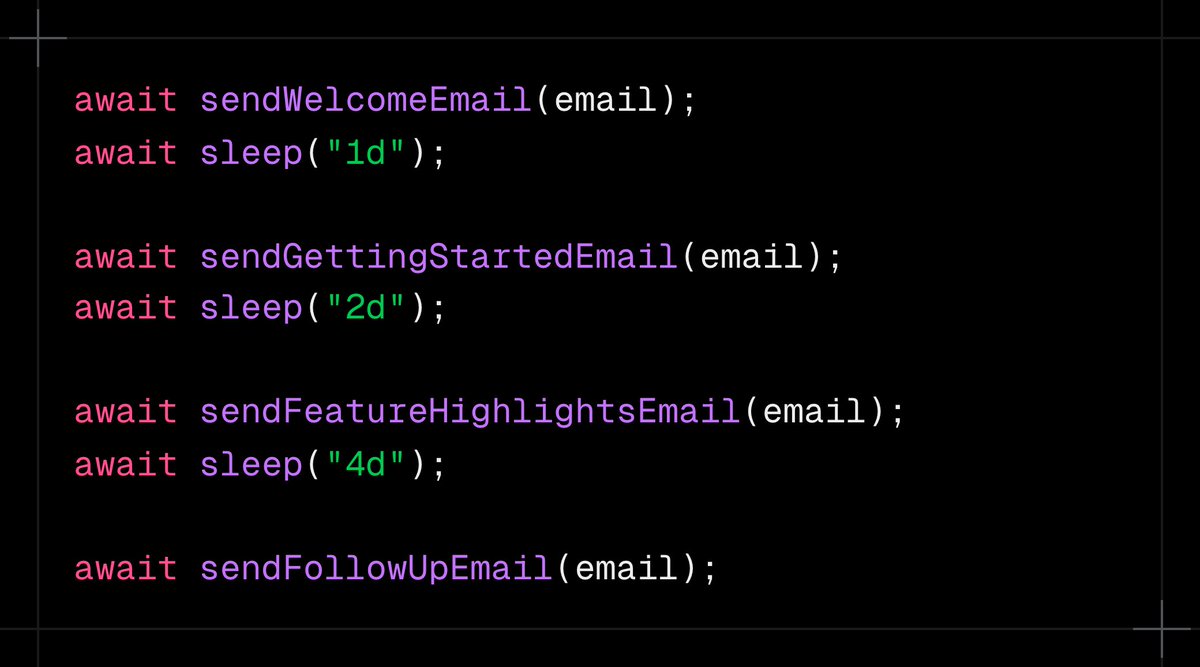
That's the whole email drip campaign. No scheduler. No queue. No state machine. Seven lines of async/await. Explore the interactive demo on v0: v0.app/chat/onboardin…
Each `sleep()` is real. `sleep("4d")` pauses for four actual days. Deploy in between? It picks up exactly where it left off. Each send is a `"use step"` which retries independently.
30 Days of Workflow DevKit — Day 2 — Email Drip Campaign You need to send 4 emails over 7 days. So you set up a cron, a state table, a "last sent" column, retry logic... Or you write this:

Ydev @Ydev07909715
0 Followers 610 Following
Danny Ivatt @DanielIvatt
1K Followers 2K Following
Joe Choi-Greene @JoeChoiGreene
672 Followers 1K Following cto cofounder @ItsClearlyAI yc s24, amazon, cs at cmu
AudutheGreat @iamjarule_
31 Followers 33 Following FOUNDER, @5point1nexus | @5point1ratio @thegreatnesscl and @tgctoken
shivaganesh @shivaganesh_720
0 Followers 294 Following
Valerie @valvcamacho
1 Followers 15 Following
Harsh Singhal @HarshSDev01
51 Followers 2K Following Harsh Singhal 💡 Ideas → Action 📈 Growth Mindset 📊 Learning • Growing • Creating 🌟 Balancing dreams & reality 📌 Here for connections & good vibes
The Blue Jays @BJay4us
8 Followers 131 Following God gives the nuts, but He does not crack them! NONE OF THESE HERE ARE FINANCIAL ADVICE---DYOR
Mario de Sousa Lima @MarioSousaLima
116 Followers 7K Following
Iulian Baranai @iulianbaranai
27 Followers 372 Following Passionate about Engineering and Product. Be curious, be kind, stay healthy.
Christian Minich @Cnolanminich
3 Followers 156 Following Dad, data, process, philosophy | Sales Eng at Dagster | my wife says my headstone will read “Sorry I’m late”


Robert Seghedi @robertseghedi
221 Followers 914 Following Co-founder https://t.co/Uvw7WXKvF4 - The starter kits AI can't write. 9+ years of software engineering.
Mohamed Ahmed @mahmedJSX
17 Followers 1K Following Founder @ClatterLabs | 16 | AI Builder & Developer Creating bold AI products. Always open to crazy ideas. https://t.co/0JUgqG8PrQ
𑂱 @imminikua
0 Followers 398 Following ⠀▢⠀⠀⠀⠀⠀⠀⠀⠀⠀⠀⠀⠀⠀⠀⠀⠀⠀⠀⠀⠀⠀⠀⠀⠀⠀⠀⠀ ⠀ ⠀ ⸽ 只是爱上了某个女孩而已 ⋆ 𝐢 𝐥𝐨𝐯𝐞 𝐲𝐨𝐮 ⬝ #ᴡᴢᴡ ⠀ ⠀ ⸽ 所有记录生活日常的视频&图片都是𝐀𝐈⠀⠀⠀ ⠀⠀ ⠀ ⸽ 日常号(防迷路) : @
Dangel | Galaxyhub La... @seenfinity
14K Followers 1K Following Building @GalaxyhubAI | @Voightxyz | x1 Hackathon Winner | Member of @LaFamilia_so | JET Pilot member @JET_EUROPA_
Bobby Smart @BobbySmartDev
2 Followers 56 Following

joyousjubilee @joyousjubilee
5 Followers 480 Following
Jaclin Bird @BirdJaclin98860
3 Followers 72 Following
Tanishque Singh @Tanishque_dzns
7 Followers 569 Following UI/UX Designer ✦ Graphic & Motion Design ✦ Designing, Building & Scaling Brand Experiences


Arulmani Kulantvel @arulmani82964
2 Followers 105 Following
Logan @LoganLagged
180 Followers 2K Following GG Studios | Founder & CEO Xbox and Nintendo Developer
Utensil @_utensil_
56 Followers 654 Following
veerugurjar @veerugurja15555
24 Followers 7K Following
Rina @Rina30461393
3 Followers 12 Following
#серыйкамен... @digicoring
19 Followers 309 Following something like a music producer || prod. by #серыйкамень | prod. by greyyroxx | prod. by au16 || yt: @детьюн
William Armstrong @armstrongwill8
7 Followers 14 Following solutions architect · builder · genuinely obsessed with what's next automating things, shipping demos, staying close to AI

Kalle @kalletu
5 Followers 132 Following Builder. Current live projects: @marenasks @citehog @duuniai @fistpumpapp
David @dbzx10299
0 Followers 42 Following
Möbius ∞ @800TUSD
138 Followers 4K Following

Chaitanya Pandey @cpecoglos
0 Followers 30 Following Tech enthusiast, CTO @introproai | Emerging entrepreneur | Gen Z coder | Innovating with AI & Web | Dreaming big, coding bigger | Here to redefine technology 🌐
Jack Blair @JackBlair87
833 Followers 1K Following building https://t.co/Y5oZ3o7cLZ | @zfellows, @theresidency


Hugh @RealHieuHuynh
4 Followers 529 Following
Micky @Rasmic
33K Followers 1K Following Bond Servant of Jesus Christ. Full Stack Engineer, Youtuber & Investor. https://t.co/D6ePH0JRJG | https://t.co/DKPbgWU0IA | https://t.co/luGajbkZYf
Jón Andreas @jonandreas
88 Followers 647 Following

Nt @nextdats
573 Followers 1K Following
️ @vrythx
6 Followers 314 Following
Carlo GG @CarloDotGG
434 Followers 2K Following MechEng to AI Strategist | Ex-JLR, Salesforce, Spryker | Bridging Web3 & AI to Build the Future 🚀 | Founder Energy ⚡️ {x}
Mark — Manifest Mos... @Markkreuts
28 Followers 142 Following building manifest mosaic 🌙 ai vision boards that put YOUR face in your dream life. daily affirmations, voice journaling, an ai coach who remembers.
Karthik Kalyan @karthikkalyan90
2K Followers 2K Following @workflowsdk @vercel • prev cofounder @langtrace_ai • ex @coinbase
Chris Tate @ctatedev
58K Followers 2K Following @Vercel Labs | Created https://t.co/473Fqx4HKt, https://t.co/ZekOfFeoXF, https://t.co/9MKvOdyxN3, https://t.co/Bnt6dbEdSi, https://t.co/SODeKvPbac | Husband & Dad | He/him | Musician, Space Nerd, Foodie | Vegan
John Lindquist @johnlindquist
29K Followers 2K Following Codex Power User Workshops - https://t.co/xPtDG0Inyh Previously @vercel AI DX The OG egghead - https://t.co/rxAeU2DHfm

Next.js @nextjs
283K Followers 16 Following The React Framework – created and maintained by @vercel.

Malte Ubl @cramforce
48K Followers 904 Following Self-driving infrastructure @Vercel CTO. Immigrant 🇺🇸/🇩🇪/acc

Nathan Rajlich @TooTallNate
6K Followers 2K Following Building @workflowsdk | Employee #6 @vercel | Former @nodejs core committer | Before you ask, I'm 6’6”
Pranay Prakash @pranaygp
3K Followers 2K Following Creator of @workflowsdk | prev. YC (@windsorio, @fronthq), GraphQL @meta, and (again) @vercel
AI SDK @aisdk
35K Followers 4 Following The Open Source AI Toolkit for TypeScript. Built by @Vercel.
You might like