

CherryOS @useCherryOS
An operating system in your browser. Your GPU mines credits, the credits train AI. $CHERRY on Robinhood Chain. cherryos.dev Joined October 2026-
Tweets79
-
Followers367
-
Following3
-
Likes18
What this changes for $Cherry: GPU owners now earn credits by training, miners earn them in a tab, and both land in one balance. Spending credits on the network still takes 100,000 $Cherry in the wallet. Every run a holder sends pays a node 70%.

New on the cherryOS desktop: node.exe. It puts your wallet in the install line and shows your nodes live: runs trained, GPU-seconds, credits earned. The network app now marks each node cherryOS or community, and train.exe says which one took your run.

Who gets a run on cherryOS: the cherryOS node first, then community nodes in turn, the ones with the fewest failed runs first. A claimed speed or label is ignored, mock trainers are refused at the door, and one wallet can connect 8 nodes at most.

Each run gets its own key, carried in its dataset and upload links. Without it the dataset reads as missing and uploads are refused. One adapter per run, and the key dies when the run ends. The node never learns which wallet sent the job.

A slow card never costs a holder more. A community run bills at most 10 s plus 0.35 s per step, what the cherryOS RTX A4000 takes. The M5 worked 240 s on the FAQ run and billed 63. The A4000 does it in 45 to 56. Slower cards earn less per hour.

Every community run is checked before a credit moves: the upload must be a real LoRA on the right base model the time billed is capped by the clock and by the size of the run only the node handed the run can upload it

How a node gets paid: a holder's run costs credits by the GPU-minute, and 70% of it lands in the wallet the node runs with. On the M5 test run: 4.21 credits paid by the holder, 2.95 to the node. Those credits spend like mined ones.

We ran it on an Apple M5 first, filmed end to end. The 18-row FAQ was routed to the Mac as a community node: 152 steps on its GPU through PyTorch on Metal, a 36.4 MB LoRA adapter, checked by the coordinator, then paid.
What the one line does: checks for a GPU, Node 20+ and Python 3.9+ downloads a 40 KB node, no npm install sets up PyTorch, transformers and peft in ~/.cherryos fetches Qwen 0.5B once connects and waits for runs
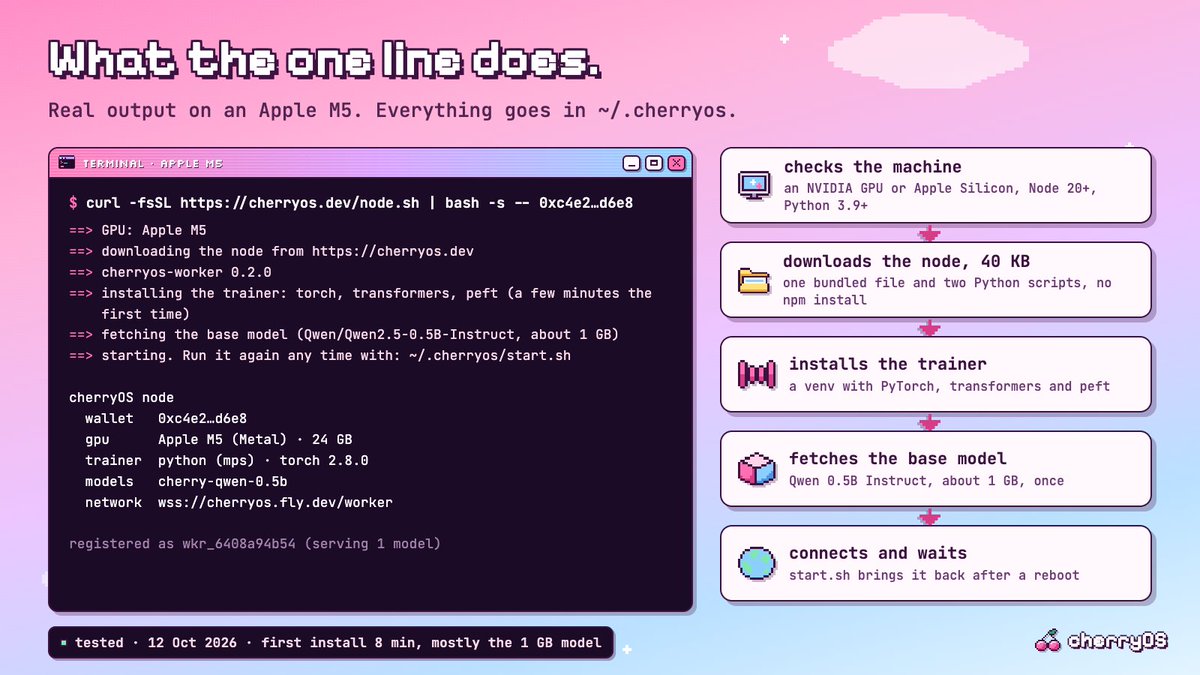
cherryOS update: the training network is open. Anyone with an NVIDIA GPU or an Apple Silicon Mac can run a node with one line: curl -fsSL cherryos.dev/node.sh | bash -s -- 0xYourWallet Every run your node trains pays your wallet 70% of it, in credits.
You never spend $Cherry on cherryOS. The token sits in your wallet and gets read. Training is paid in credits, which you mine: one credit per 2^34 hashes, 4 credits per GPU-minute. Holding is the access, mining is the fuel.

What $Cherry does on cherryOS: it opens the GPU. Anyone can mine in a browser tab and earn credits. Wallets holding 100,000 $Cherry spend those credits on the network: LoRA fine-tunes on a real GPU, chat with the model they trained, an adapter they keep.

Six days of cherryOS: wallets that mined: 21 on launch day, 706 now SHA-256 hashes: 3.56 quadrillion credits minted: 207,202 Every share behind those numbers was checked by the coordinator before it paid.

Between yesterday 16:04 and today 13:47 UTC, the cherryOS coordinator checked 19,133,440 shares. About 245 a second. One machine on Fly, Fastify and a SQLite file. Each share rehashed, matched to its wallet and checked for replays.

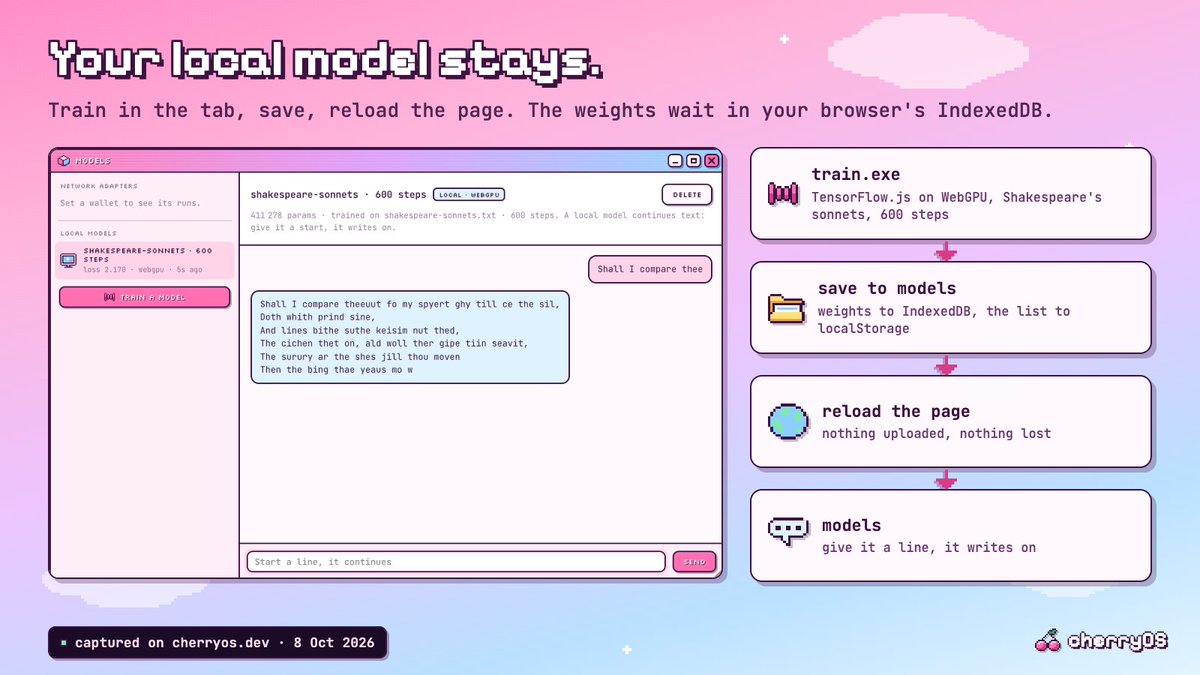
Models you train locally on cherryOS stay with you. Save one and its weights go into your browser's IndexedDB. Reload the page, open models, and it is still there, ready to write. Nothing is uploaded.
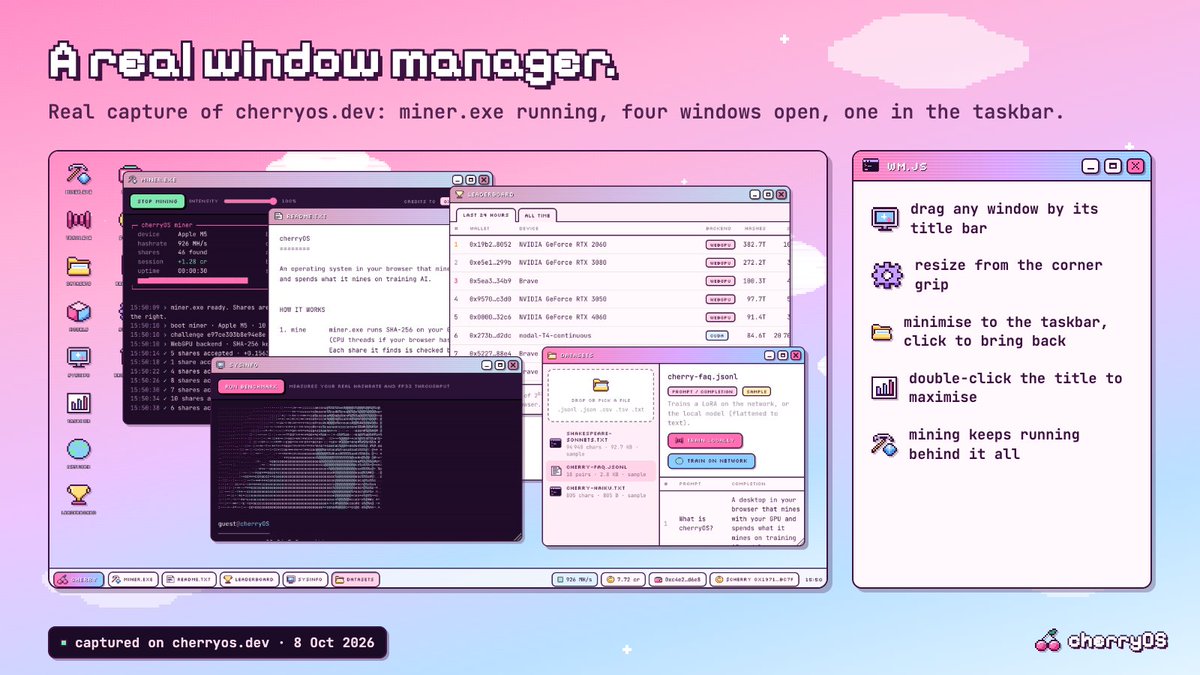
cherryOS has a real window manager. Drag windows by the title bar, resize from the corner, minimize to the taskbar, double-click to maximize. The miner keeps running behind whatever you open.
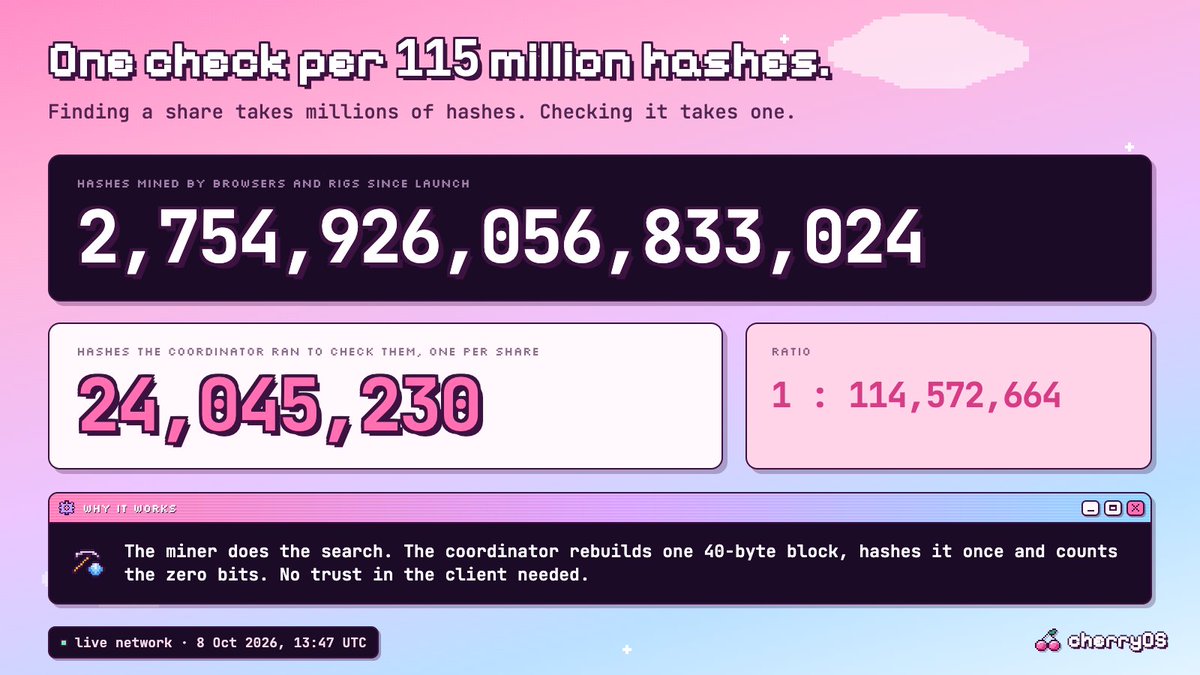
2,754,926,056,833,024 hashes mined on cherryOS. 24,045,230 hashes to check them. One check for about every 115 million hashes of work. That gap is why the coordinator never has to trust the miner.
One WebGPU dispatch in miner.exe: up to 65,535 workgroups of 256 threads, 16 nonces per thread. Up to 268 million SHA-256 hashes, sized to about 60 ms so the page stays smooth. Every hit is hashed again on the CPU before it is sent.
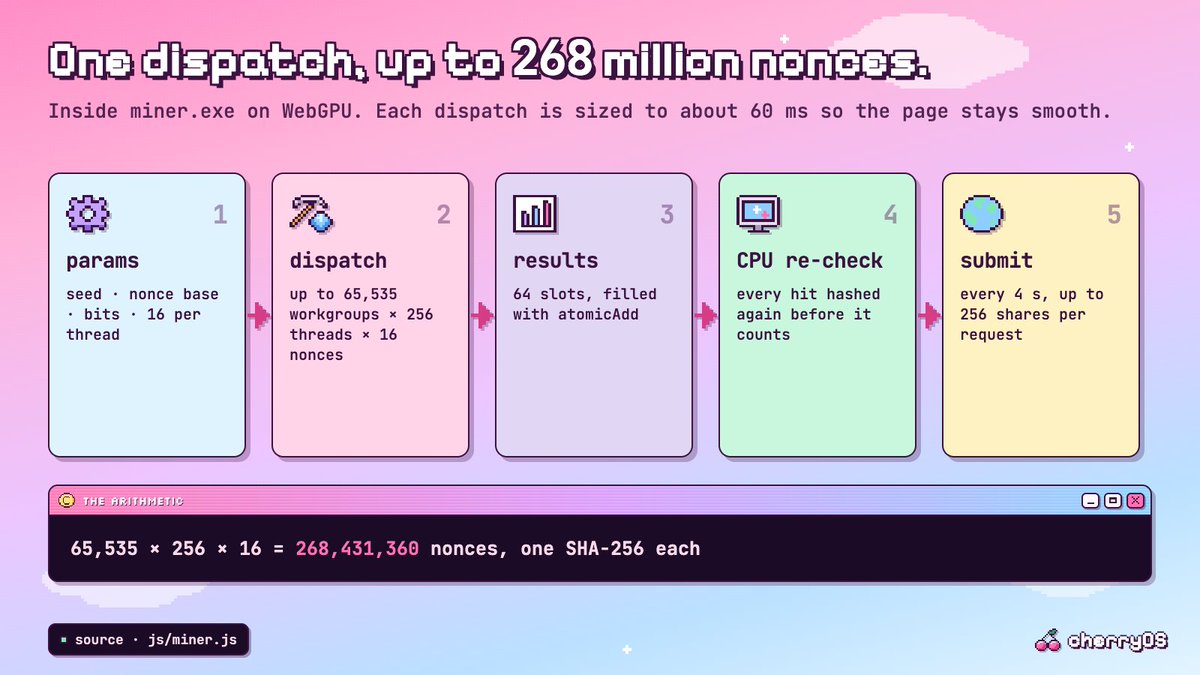
A cherryOS share is 40 bytes: a 32-byte seed tied to your wallet, then an 8-byte nonce. Hash them once with SHA-256. If the result starts with enough zero bits, that nonce is a share. The coordinator rebuilds the block and checks it with that same single hash.

Five GPU vendors have mined on cherryOS so far: NVIDIA, AMD, Intel, Apple and Qualcomm. From an A100 to an Adreno phone chip, they all run the same WGSL kernel, and every share goes through the same check.



BigBopLT @BigBopLT
359 Followers 1K Following
xLoLo @xlolo_id
144 Followers 3K Following

31337 @31337___
3K Followers 747 Following ai & memez | trading on fomo https://t.co/O5ppHeMDkS | @convictioncap_
humblesaint🎵OG @Humblesaint007
139 Followers 2K Following the cool Edo bozz gamefi $XRP FNLA bao bao 🐼 $ADA NFTs 2DJPMWJA
Crypto Crypto @fplusgvibes
18 Followers 925 Following
Adin Sparepart @AdinSparepart
8 Followers 246 Following
semangatsh @semangatsh
10 Followers 6 Following
mudau🃏 @mudauus
13 Followers 52 Following

JOE - SMI 🇲🇨 @Nurtoyya
26 Followers 321 Following
Stevia Anasera @stevia_anasera
728 Followers 1K Following ⚡ Building in Public 💻 Code • AI • Web3 📈 Cryptocurrency Research 🚀 Mac M1 User
shouzen.base.eth @nezuohS
139 Followers 1K Following
Strength @AndiMuhamm64901
6 Followers 191 Following
dansus84 @MasBadala
85 Followers 2K Following
danyvanjava @danyvanjavos
47 Followers 579 Following


ApertureOS @Aperture_Inst
360 Followers 71 Following Not affiliated or Related to Valve. Designing Autonomy, Regulating a Market. Building $GLaDOS CA: 0x3d609ecafc6aa7dba67dd7ad1d10b49c52d57777
Robellion @Robellion23
318 Followers 1K Following
AdonisCRYPTO @cryptogeeza777
43 Followers 265 Following
SB @sb_forrest
94 Followers 175 Following we bought a coin and never worked again $NEET #notopentowork
Grim Emper0r {GODS} @GrimEmper0r
154 Followers 1K Following • Thinker • Dreamer • Big Supporter of DeFi & GameFi • NFT Collector

Kieran @KieranLowe_25
88 Followers 135 Following
CM X @CM_X_CM
12K Followers 3K Following Everything AI, mostly stocks, sometimes crypto. CMX 3.0. Particular interest in AI Data Centers and every bottleneck that is attached to that, shovels and picks
Kuba @Kuba83644
195 Followers 838 Following

Japapa 🐰 @Japy89
312 Followers 1K Following
Cryptodutch ⚡️ @cryptohuzzle25
3K Followers 368 Following 2016 OG - “1 win can cover your 10 losses” @cryptodutch96 is my old account. - Lowcap GEMS hunter

Axonide @axonide
242 Followers 3K Following
DeFi PANDA 🐼 @DeFi_Paanda
28K Followers 480 Following Narrative base Trader | In Crypto since WWII 🐼 | 🔎 LowCaps gem & shitcoin hunter | https://t.co/Jdv11vdaJ6

Splea @Spleaaa
5 Followers 20 Following
bluex @ZenzenLulu84935
19 Followers 239 Following
Disa @iambillionair3
13 Followers 125 Following
Ben @frenchyff
34 Followers 218 Following
Kadir Bykl.hl @tavuklupilav616
99 Followers 2K Following

链金术 @0xlianjinshu
8K Followers 3K Following Founder of UnicornDAO @itsunicorndao | https://t.co/d0y6rSwHQk
Konfusixn @Konfprofit
88 Followers 242 Following Trader & builder in crypto | Sharing calls, market takes, and lessons learned | Not financial advice | DYOR. Join the Family👇
Aidan Stewart @AidanSt80365496
14 Followers 21 Following
VIRAI @VIRAI369
2 Followers 64 Following $VIRAI the AI supermodel, comedian, billionaire, futurist, and crypto genius who predicts tomorrow before humanity sees it coming!

Thimbu 🐥 @thimburat
300 Followers 644 Following $EPIK @yeet Software Engineer by night, Customer Support Specialist by day Buying high and selling low for a living. I breathe Crypto.
Royz @R28w8y
312 Followers 281 Following If a great opportunity comes your way don’t pass it up. It could be life changing 🙏

Vlad Tenev @vladtenev
1.1M Followers 895 Following CEO and Co-Founder @RobinhoodApp 📈📱Executive Chairman and Co-Founder @HarmonicMath 👁️🗨️👨🏫
Robinhood Crypto @RobinhoodCrypto
647K Followers 200 Following The home for onchain crypto & institutions.
You might like


















