Svein Y. Willassen @sventy
CEO, Sonett AS. Previously CEO and co-founder @ Confrere, previously CEO and co-founder @ https://t.co/32y3iVd9nv confrere.com Oslo, Norway Joined April 2008-
Tweets554
-
Followers496
-
Following345
-
Likes592

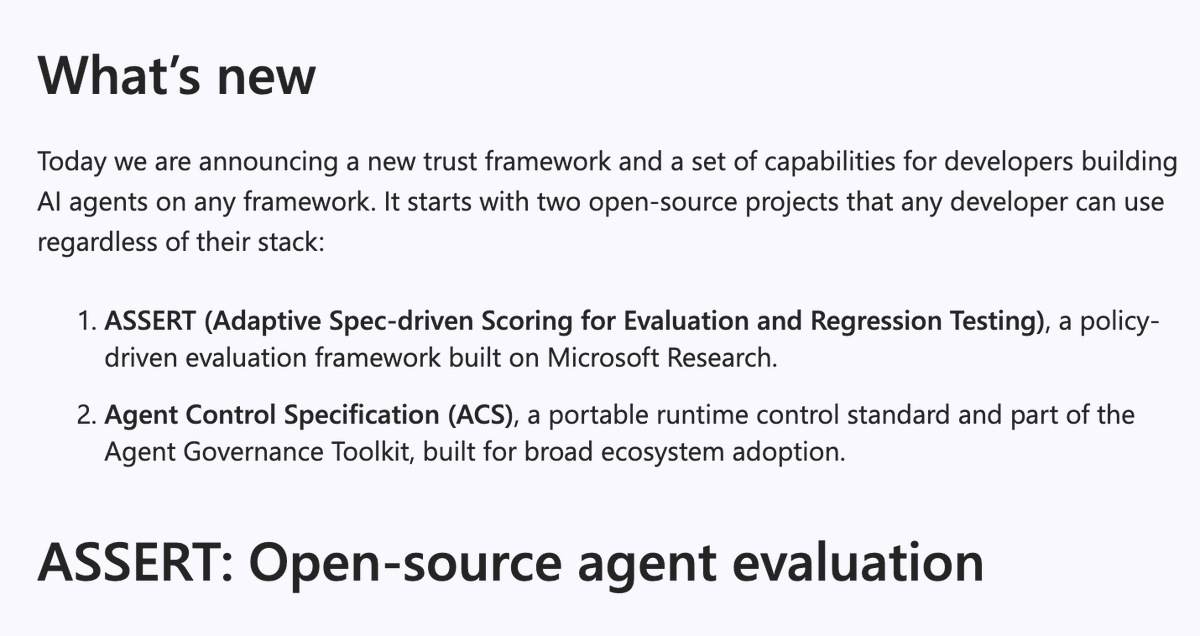
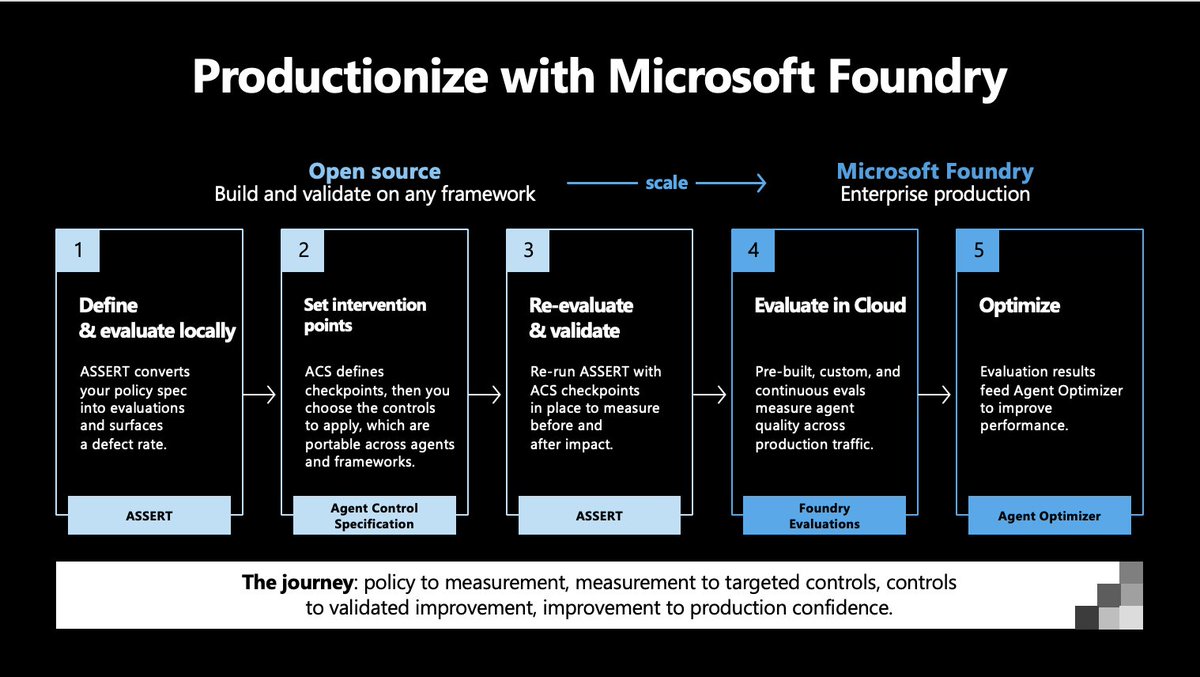
Microsoft announced a bunch of interesting new AI models and tools this week. Model launches alway get lots of attention. But don't sleep on the new ASSERT evals framework that launched today. I'm on record as arguing that 2026 is the year of evals. Evals are the glue for all the "jobs to be done" at every level of AI: model training; testing and deciding on what models to use and how to use them; and testing and improving AI agents in production. Evals unify our work on those different layers of the stack. These days, when we talk about evals, observability, and testing, we're talking about overlapping parts of a large set of tools we're still early on in figuring out. As the AI engineering ecosystem matures, diversifies, and increases massively in scale, we really, really need good evaluation (observability, monitoring, testing, data management) frameworks. I got a chance to test the new Microsoft ASSERT evals framework before it was released, and it has some very nice core ideas. 1) ASSERT is open in two important ways. First, the team is serious about broad support for models, frameworks, and use cases. Microsoft spent time understanding voice agent use cases and building Pipecat support, for example. Second, the code is completely open source, released under an open MIT license. 2) We're all working in and with agentic coding tools today. That means we are planning in natural language, and all of our software development and ops tools have to evolve for these new, natural language, workflows. ASSERT takes descriptions of desired agent behavior and generates specifications for the ASSERT suite of tools to run against. In a world where "English is the programming language," how we actually make natural language "code" precise enough and repeatable enough is perhaps the big unsolved tooling problem that all of us are working towards in different ways. This is true whether we work on coding agents, AI opps tooling, orchestration frameworks, or vertical applications. 3) Microsoft describes ASSERT as a policy-driven framework. Rather than eval against generic performance metrics, ASSERT aims to generate stable but adaptable evaluation criteria for specific agents. "Policy-driven" also implies a full loop design. Policy (generated from specific requirements) -> evaluation -> optimization -> monitoring in production -> improving the policy description -> evaluation -> ... 4) Enterprise agents need to be evaluated along many dimensions: task completion, individual conversation turn behavior, latency, mode-specific metrics like audio disfluencies, and safety/security. Microsoft designed ASSERT to be used together with a new safety governance toolkit called Agent Control Specification. 5) Finally, ASSERT is integrated into the Microsoft Foundry ecosystem. Today, AI engineering tools have to be open source and vendor neutral to get attention from developers and gain widespread adoption. *And* it's equally important to give enterprise customers tools that work as a coherent stack. This is hard to do well. There are real tensions between open source development versus engineering a great full stack developer experience. However, if you sweat the details on both ends, you benefit from a full spectrum of feedback about real-world development pain points. It's more work, but it's worth it! Kudos to Microsoft for embracing this and committing to an open, community oriented approach, plus doing the extra work to build the full stack for enterprise customers.


@chrija @oyvindreed @frewis @joinxeneta @idaaa At least it's true that a lot of time spent in Zone 1 is an important part of the top athlete training philosophy here. Does that impact "brain health"? Well... eh...
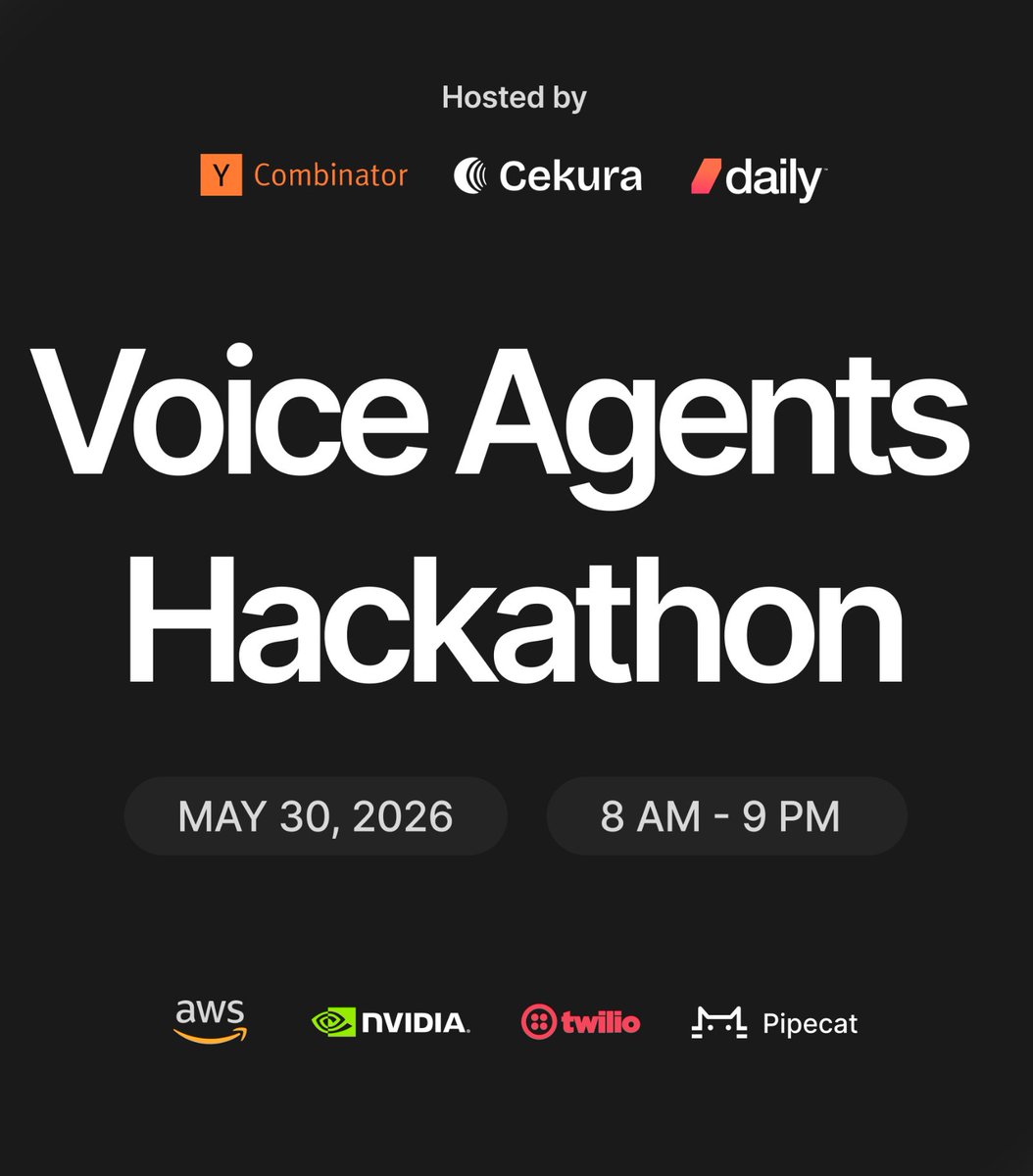
Voice agents hackathon at @ycombinator in SF on May 30th. Prizes include a guaranteed YC interview, and special awards from sponsors @cekuraAi, @NVIDIAAI, @AWS, and @twilio. Learn to build agents that work at scale, in production. Use tooling from Cekura to simulate and auto-improve your agents. Handle accents, noisy environments, interruptions, and customers who don't follow the expected script! Build with NVIDIA Nemotron open source models, running on AWS infrastructure. Integrate with Twilio's telephony platform. Leverage the Pipecat developer ecosystem. Join us for fun, learning, conversations with the engineers building all of the above tools, food, and prizes.

I care a lot about 1) latency, and 2) good benchmarks. The voice models from @GradiumAI occupy in the top spot on the @covaldev voice AI benchmark leaderboard, which tests both latency and accuracy. We've made the Gradium models the default in our open source, massively multi-player, LLM game. You play the game by talking to your "ship AI." Of course, humans aren't the only talkers in the universe, these days. So @chadbailey59 has been building OpenClaw bots that play the game, too! Here's a video of an OpenClaw agent playing the game by talking to the agent's ship AI. Chad created specific personalities for both the OpenClaw bot and the ship AI, here. Gradium's voice models are very emotive, and they support voice cloning and customization. I love how morose and pessimistic the ship AI is, and how excitable and cheerful the OpenClaw bot is. This is not scripted at all. These are two voice AI agents just doing their thing.
Last week at the SF Voice AI Meetup, I moderated a panel about multi-modal model training, with Jagadeesh Balam who works on speech models at @NVIDIAAI, Fabian Seipel of @ai_coustics, and @code_brian from Tavus. I always really enjoy the opportunity to hear from people working on models (small, large, text, audio, pixels, transformer-based, diffusion, etc)! Some notes: - Brian said "latency is solved," if you're thinking about latency as a mechanical problem. Humans take ~700ms to think about things before they respond in conversation. Current STT->LLM->TTS pipelines can beat that. What's missing is the higher-level architecture for "thinking": queuing what to talk about next, deciding what to say first and how, tracking emotional tone, etc. - Jagadesh said that as we do more and more interesting things with the models, the bar for performance goes up. Transcription was "solved" for non-realtime use cases, but now voice agents need fast and accurate transcription of very tricky strings like email addresses and mixed alphanumeric account numbers. And for speech-to-speech models, we have to clear the bar of performing well in long, multi-turn conversations. Part of the challenge here is generating very good training data. "Data simulation for training is unsolved. If it were solved, all our model roadmaps would be done by now!" I appreciate this viewpoint, because I don't think we talk enough about the challenge of having large amounts of *exactly* the right training data. - Fabian talked about how ai|coustics generates data for training very fast, very specialized audio models that improve the performance of voice agents. His team includes people who spend a lot of their time simulating room geometries, mic frequency responses, WebRTC processing artifacts, and many other things. He calls them "professional audio destroyers."
✨ Voice AI, open models, and next-generation evals hackathon at @ycombinator in SF on May 30th. ✨ We're co-hosting with @cekuraAi , and we've pulled in our friends at @NVIDIAAIDev, @AWS, and @twilio for expertise and mentoring. We'll help you build state of the art voice agents using: - NVIDIA Nemotron models - AWS SageMaker and Bedrock inference - Twilio telephony - Cekura evaluation tooling - Pipecat orchestration and Pipecat Cloud agent hosting Up for grabs: - A guaranteed YC interview - Special judges' prizes from NVIDIA, AWS, and Twilio for the most impactful and technically impressive projects Join us to learn from engineers who built all the tools you're using, compare notes with other voice AI developers, and show off your ideas! Space is limited. Apply below.
Voice AI turn taking is a solved problem. The single most common complaint about voice AI, today, is that agents interrupt too often. But the voice agents I build for myself now respond quickly and interrupt me less often than the people I talk to every day. (I actually measured this.) @mark_backman made a @pipecat_ai PR two weeks ago that was the last piece of the puzzle for turn taking so good that I no longer ever think about it. The approach combines three layers of processing: 1. Voice activity detection, with a short (200ms) trigger. 2. A native audio turn detection model that's small, fast, and runs on CPU. This model captures audio nuances like inflection and filler sounds that don't get transcribed. 3. A prompt mixin for the conversation LLM that decides turn completion based on conversation context. None of these are new. We've been using VAD for a long time. We trained the first version of the Pipecat Smart Turn native audio model in December 2024. And we've been experimenting with prompt-based large model turn detection (sometimes called "selective refusal") for more than a year. Now, the Smart Turn model and the SOTA LLMs we're using in voice agents have both gotten so good that using them together feels like we've finally "solved" turn detection. Mark also figured out how to elegantly apply a "single-token tagging" technique to this problem. We sometimes use single-token tagging in place of tool calling, when we need a near-zero latency programmatic trigger. Mark's Pipecat mixin defines three single-token characters and prompts the LLM to output exactly one of them at the beginning of every response. - ✓ means the agent should respond normally (immediately) - ○ is a "short incomplete" - the agent should wait 5 seconds - ◐ is a "long incomplete" - the agent should wait 10 seconds The wait times, and the details of the prompt, are configurable, of course. Watch the video to see me talk to an agent that handles all my various pauses and inflections, plus phrases like "let me think," pretty much the way a person would handle them, in terms of response latency. Also, in the second half of the video, I ask the agent to adjust its response pattern because I'm going to tell it a phone number. This kind of "in-context" adjustment of response wait times is really useful. The LLM in the video is GTP-4.1. We've tested the prompt and single-token adherance with GPT-4.1, Gemini 2.5 Flash, Anthropic Claude Sonnet 4.5, and AWS Nova 2 Pro. Note that older models in all these families (and, in general, smaller open weights models) aren't able to reliably output these single-token tags. But the new models we're using these days are pretty amazing.

Americans love to say that Europeans hate them, and when you inquire - they all quote you the attitudes of the French and their own cousins - the Brits. As if everyone else - who offered nothing but respect and willing cooperation - simply doesn’t matter. Here’s the part they don’t see: Millions of pro-American Europeans are angry right now, because they were stabbed in the back. These are people who defended the U.S. instinctively, who trusted Washington when it was unpopular to do so, who grew up believing America was the adult in the room. Post-communist Europe is the real catastrophe here. Entire generations raised to admire the U.S. as a stabilizing force are watching Washington collapse into an ideological mob rule. And unlike our parents before, we will not pass that same admiration to our children. That is the cost of betrayed trust. Meanwhile, people tell us that we need to hold out for Nov 2026 or Jan 2029. Really? That's your plan? Waiting it out? We used to believe the U.S. had real checks and balances. We used to believe power couldn’t be centralized in the hands of a few. We used to believe the system could absorb bad leadership. We were wrong. Congress, the courts, the legislatures - none seem to be doing anything, while the current administration is slapping tariffs on its allies, dehuminizing them, threatening them with force or economic bullying, and destroying US-EU supply chains. There are no guardrails. Anyone who thinks alliances are useless is about to experience the luxury of having none left.
If you're getting started with voice agents and Android, the Pipecat Android demo client has all the core components a client-side voice AI app needs: voice input and output, device control, and network transport. Marcus just updated the code, which now supports two WebRTC transports. The Pipecat SmallWebRTCTransport for zero-dependency, peer-to-peer connections. And the Daily WebRTC transport for large-scale production use. The demo bot also sends a video stream, which the app renders. You can actually use this code to connect to any voice AI service that implements the RTVI standard, too, not just Pipecat. The Pipecat client-side SDKs (Javascript, React, React Native, Swift, Kotlin, and C++) are part of the Pipecat ecosystem but don't depend on any server-side Pipecat components and are completely open source.
“When AI is open, it proliferates everywhere.” Jensen Huang explains why open models are fueling the AI revolution, activating innovation across industries, startups, researchers, students, and countries worldwide. Learn more about our open models → nvda.ws/49pHhXj

Just launched #CES2026, the new open-source NVIDIA Nemotron Speech ASR model is here to solve latency drift and redundant compute. Its cache-aware streaming architecture eliminates the need for buffered inference, giving you stable, sub-100ms latency (24ms median T-T-F) and up to 3x more throughput on your GPU. 🤗 Read the technical blog with real-world results from @trydaily and @modal on @HuggingFace: nvda.ws/3Lt8m3Q
NVIDIA just released a new open source transcription model, Nemotron Speech ASR, designed from the ground up for low-latency use cases like voice agents. Here's a voice agent built with this new model. 24ms transcription finalization and total voice-to-voice inference time under 500ms. This agent actually uses *three* NVIDIA open source models: - Nemotron Speech ASR - Nemotron 3 Nano 30GB in a 4-bit quant (released in December) - A preview checkpoint of the upcoming Magpie text-to-speech model These models are all truly open source: weights, training data, training code, and inference code. This is a big deal! Jensen said in the CES keynote yesterday that he expects open source models to catch up to proprietary models this year in a number of categories. NVIDIA is putting their weight behind making this happen. (As Alan Kay said, the best way to predict the future is to invent it.) The code for this agent is open source too, of course. You can deploy it to production with @modal and @pipecat_ai cloud, or run locally on an @nvidia DGX Spark or RTX 5090.
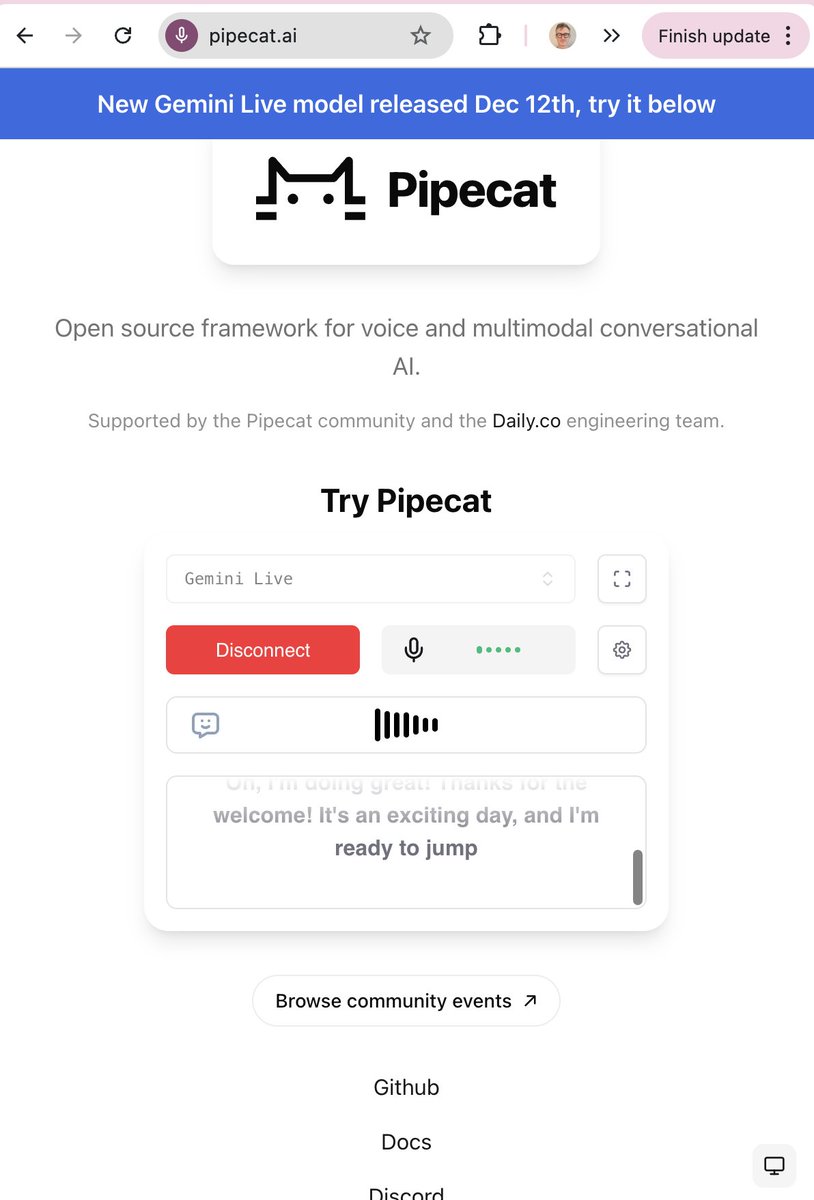
New Gemini Live (speech-to-speech) model release today. Using the Google AI Studio API, the model name is: gemini-2.5-flash-native-audio-preview-12-2025 The model is also GA (general availability, so not considered a beta/preview release) on Google Cloud Vertex under this model name: gemini-live-2.5-flash-native-audio Try it out on the @pipecat_ai landing page.
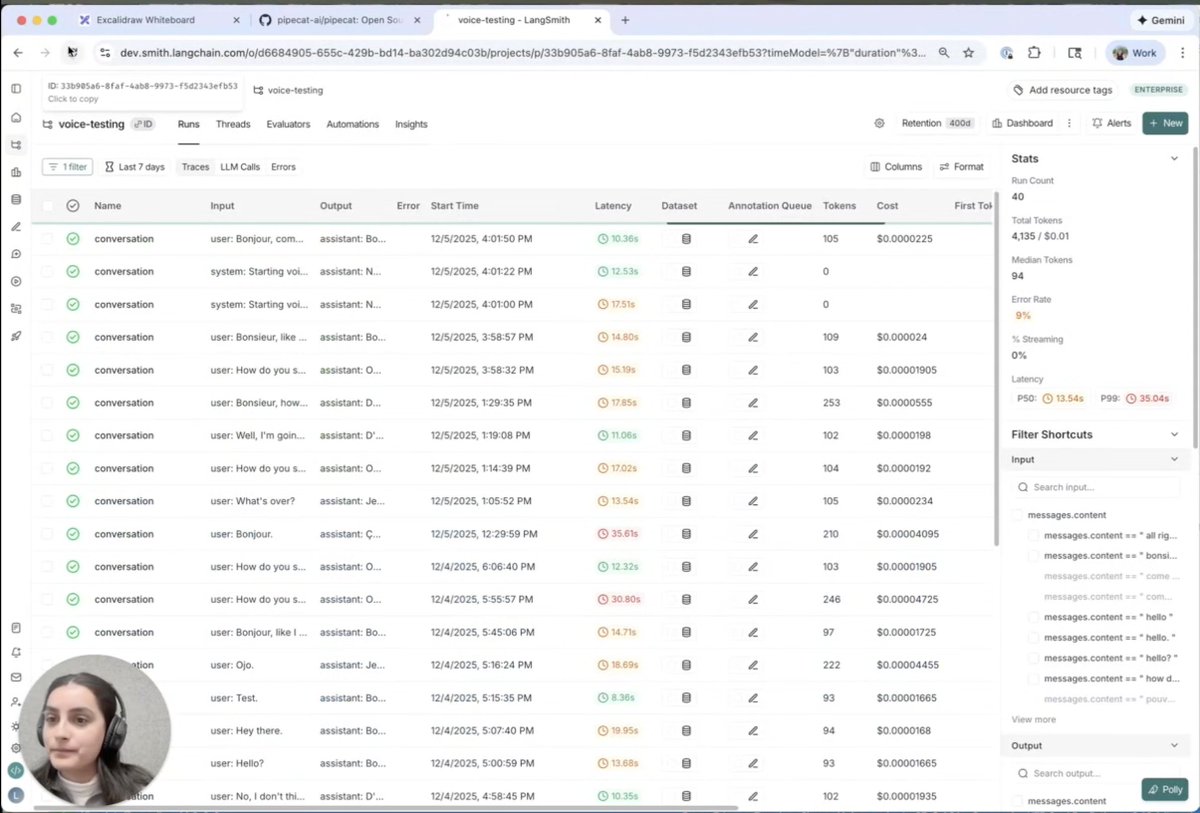
The team at @langchain built voice AI support into their agent debugging and monitoring tool, LangSmith. LangSmith is built around the concept of "tracing." If you've used OpenTelemetery for application logging, you're already familiar with tracing. If you haven't, think about it like this: a trace is a record of an operation that an application performs. Here's a very nice video from @_tanushreeeee that walks you through building and debugging a voice agent with full conversation tracing. Using the LangSmith interface you can find a specific agent session, then dig into what happened during each turn of the conversation. What did the user say and how was that processed by each model you're using in your voice agent? What was the latency for each inference operation? What audio and text was actually sent back to the user? Today's production voice agents are complex, multi-model, multi-modal, multi-turn systems! Tracing gives you leverage to understand what your agents are doing. This saves time during development. And it's critical in production. Tanushree shows using a local (on-device) model for transcription, then switching to using the OpenAI speech-to-text model running in the cloud. You can see the difference in accuracy. (Using Pipecat, switching between different models is a single-line code change.) Also, the video is fun! It's a French tutor. Which is a voice agent I definitely need.

.@davitb , CEO of @krispHQ, publishes a must-read weekly Voice AI Newsletter and hosts a regular podcast. I joined Davit and @klemensimonic, co-founder and CEO of @soniox_ai, to talk about the current state of real-time AI transcription. It's relatively easy to build a voice agent proof of concept, today. But we often see product teams get stuck on the path from POC to production. Many voice agent products *are* scaling rapidly. I think of the POC-to-production challenges primarily as "best practices" problems. Which models work best for real-world voice agents? How do you evaluate agent performance? How do you deal with noisy environments? What kind of context management do you need to build on top of your basic transcription->LLM->voice loop to maximize success rates? How do you integrate with existing systems (customer databases, support knowledge bases, telephony stacks)? What does production infrastructure look like? We touched on all of these topics in the Davit's podcast, plus latency, accuracy, and moving from "transcription" to "speech understanding."

Pipecat Thanksgiving day release. 🦃 Some highlights: Deepgram AWS SageMaker realtime speech-to-text support, improved text aggregation, simplified and more powerful error handling, new MiniMax Speech 2.6 HD and Turbo models. SageMaker is AWS's AI platform for deploying and using machine learning models at scale. AWS has brand new support for streaming data in and out of models hosted on SageMaker, which is great for voice AI use cases. This Pipecat release includes a generic base class for SageMaker "bidirectional streaming," plus a new `DeepgramSageMakerSTTService` class. Text aggregation and error handling are important fundamental jobs that a realtime agent framework needs to do well for the widest possible range of models, APIs, and use cases. Different APIs chunk streaming text differently. For different use cases, you might want different aggregation strategies. (For example, feed one sentence of LLM output at a time to your voice generation service.) And managing multi-turn context as accurately as possible requires different strategies depending on what the APIs you are using can do. (For example, whether your TTS model can give you word-level timestamps or not). Good error handling requires both managing the very different approaches to error handling that different services have, and giving developers good application-level ways to catch, respond to, and log errors. The more services Pipecat supports, and the more different kinds of things people use Pipecat for, the more work these abstraction layers need to do! This Pipecat release includes several new text aggregation and error handling frame types and methods. The goal of these improvements is to make common use cases work better with less application-level code required, while also making it easier to build robust error handling for complex applications. Finally, the MiniMax Speech models are getting great reviews. Thank you to the MiniMax team for the implementation!

Smart Turn is @trydaily's open source AI model to detect when a user is *really done* talking. Today, we are announcing Smart Turn v3. 8MB model, 12ms CPU inference and 23 languages! This is just huge! 🔥🚀 daily.co/blog/announcin… Soon to be available in @pipecat_ai !
Blog post with more details about the new v3 version of Smart Turn: daily.co/blog/announcin… Training and inference code on GitHub: github.com/pipecat-ai/sma… Model weights and all data sets are on @huggingface: huggingface.co/pipecat-ai The Krisp Turn-Taking model, integrated into their suite of voice AI models: krisp.ai/blog/turn-taki… The Ultravox context-aware endpointing (turn detection) model: ultravox.ai/blog/ultravad-…
Voice-only programming with the new OpenAI Realtime API ... I spend a lot of time these days pair programming with LLMs. Often I'm talking rather than typing. This "voice dictation" use case has become an important vibe benchmark for me. Being able to create text input just by talking, flexibly, in a context dependent way, with tool calling, is a *hard* problem for today's models. Natural language dictation requires a very high degree of contextual intelligence, instruction following accuracy, and tool calling reliability. Today's new gpt-realtime model is quite good at this hard problem. The original realtime model release last year was impressive. Seeing what a speech-to-speech model could do got a lot of people excited about the possibilities of voice AI. The improvements since that first release are equally impressive. I can use this new model, now, for real world tasks that were past the edge of the "jagged frontier" before. Here's a video showing a couple of fun (and tricky) modes of voice input.

borud @borud
829 Followers 910 Following
victorpascual @victorpascual
2K Followers 2K Following Father of three. Ex-Tekelec, Acme Packet, Oracle and a couple of start-ups. Now with Nokia. All opinions/nonsense expressed are my own.


Gustavo Garcia @anarchyco
2K Followers 468 Following Building RTC services and large scale apps. @RingCentral ex-@EpicGames @Houseparty @Telefonica
Philipp Hancke @HCornflower
2K Followers 451 Following rtc@meta. Still cheering for @jitsinews and @NVIDIAGFN. Opinions are my own and I have plenty of them.
Dean Bubley @disruptivedean
16K Followers 4K Following Telecom Futurist & 5G / 6G / WiFi / FTTX / spectrum / policy analyst, advisor & public speaker. Analogy sharpshooter.
Ben Luong @copperchunk
580 Followers 2K Following Creator of CopeCheck. Documenting the denial phase of AI labour displacement. GA4/Ads consultant by trade. Economic discontinuity by obsession.

chester @mdsiaofficial
347 Followers 3K Following Software Engineer. building https://t.co/x4jq5vCz0I @midgenhq Book, Sports, #mdsiaofficial
Erproojo @Erproojo782
21 Followers 574 Following

EmpressEllaHernandez @y3EXDGhmu171S
19 Followers 1K Following Positivity, ambition, and a whole lot of passion.
AudioCodes @AudioCodes
7K Followers 5K Following We deliver AI-driven solutions that enable future-ready enterprises to modernize voice, optimize CX and transform interactions into business intelligence.
Tiegew @Tiegew298773
18 Followers 939 Following
Cijik @Cijik2860
68 Followers 3K Following

Ali Teshnizi @aliteshnizi
196 Followers 526 Following Founder @ Optimized | 🏭 🚚 📦 Supply⫘Chain⫘on⫘Autopilot | 🌲 Ex PhD @Stanford
Awquarpe @Awquarpe761598
29 Followers 2K Following
Elna Rau @RauElna83172
2 Followers 49 Following
Johannes Willassen @willassenj
0 Followers 5 Following

Jessica @susan4820760460
466 Followers 8K Following
@BioAI_Neuro @BioAI_Pharma
12K Followers 6K Following @MIT trained Neuroscientist writing on ⚡Bioelectricity |⏳Longevity | 💊AI Drug Discovery 🎯 [email protected]
Roseanne Wincek @imthemusic
4K Followers 3K Following VC @RenegadePtnrs | Reformed Chemist/PhD Dropout/Clevelander #BeARenegade @MasterClass @Compass @Glossier @Looker @Motive_Inc @spekitapp @coda_hq @trydaily

Thearez @ThearezpvJiL
24 Followers 883 Following
Lerdarsme @LerdarsmeLOIYg
8 Followers 602 Following
Juno fanty @JunoFanty43746
7 Followers 103 Following
Josh Ponelat @jponelat
172 Followers 365 Following Coffee | Code | Creative. In an order that would surprise you.
Rivefiles @rivefiles
534 Followers 8K Following Unofficial Rivefiles Marketplace https://t.co/dfzlh4gUZC
Shesnew @ShesnewRykLK2z
7 Followers 148 Following
Aniket Mohanty @Aniket_Mohanty_
16 Followers 710 Following
Amrith @amrith
11K Followers 5K Following Building communities and things people care about 🌱 ex @ProductHunt and early teams at @opalapp, @stoicapp and more.

Harshith Pabbati @harshithpabbati
165 Followers 566 Following


Aecha 🇬🇧🇰�... @aecha58
59 Followers 295 Following
openvocs @openvocs
48 Followers 116 Following Open Voice Communication Systems for Mission Control Room Environments ... a project of the German Space Operations Center (GSOC) | @DLR_de #webrtc
Emma Weber (PR Specia... @PromoQueenX_88
55 Followers 626 Following 💎Tired Of Fake Promotion? 👑Major Label Marketing Deals 📈Established in 2014 Here 👉 https://t.co/GGvhSBZ6Ta
Geight @Geight2546
9 Followers 1K Following
goodheart @goodgod203001
6 Followers 115 Following
Goodgod @Deidrab17
6K Followers 7K Following Life is full of good and bad. at the same time the bad can be useful In the end so we shouldn't judge people because of there bad time. Let God judge


silviapfeiffer @silviapfeiffer
2K Followers 1K Following Founder of Coviu: @CoviuApp, Editor of WebVTT spec, Former Editor W3C HTML5 spec, Google Developer Expert (GDE), author books on HTML5 video https://t.co/2A2YZ4EUDr


Kibbutz Tech @DKibbutz
0 Followers 15 Following Kibbutz Tech provides Web development Services and Mobile App Development services. Please connect here!
Pion @_pion
3K Followers 558 Following The Open Source, Cross Platform Stack for RTC. Pure Go implementations of WebRTC, TURN, DTLS and more. https://t.co/2C44MIUcsi
Christian Stuff @Regaddi
141 Followers 195 Following Staff Engineer at @trydaily. Loves coffee, music, family and frontend. Previously @stickermule Namics @lyskaio Tweets are mine.
Tamara @astral_clouds
76 Followers 1K Following
Arjun Kava @Arjun_Kava
602 Followers 2K Following Founder and CEO @ https://t.co/gjatYXBAZk | Build Voice AI agents in any app
Vegard Edvardsen @evegard_
56 Followers 295 Following
Olivier Anguenot @oanguenot
1K Followers 900 Following Lead developer at Alcatel-Lucent Enterprise. WebRTC adopter. CPaaS & API lover. Triathlon for ever. Blogger at https://t.co/1mkyCVIPpF
borud @borud
829 Followers 910 Following
victorpascual @victorpascual
2K Followers 2K Following Father of three. Ex-Tekelec, Acme Packet, Oracle and a couple of start-ups. Now with Nokia. All opinions/nonsense expressed are my own.

Jo Kristian Bergum @jobergum
20K Followers 1K Following CEO https://t.co/qdJ3bIZOOU - The retrieval engine built for agents.
Gustavo Garcia @anarchyco
2K Followers 468 Following Building RTC services and large scale apps. @RingCentral ex-@EpicGames @Houseparty @Telefonica
Philipp Hancke @HCornflower
2K Followers 451 Following rtc@meta. Still cheering for @jitsinews and @NVIDIAGFN. Opinions are my own and I have plenty of them.
Dean Bubley @disruptivedean
16K Followers 4K Following Telecom Futurist & 5G / 6G / WiFi / FTTX / spectrum / policy analyst, advisor & public speaker. Analogy sharpshooter.
Chelcie Taylor @chelcietay
442 Followers 172 Following Investing in AI applications @notablecap (fka GGV Capital) | alum: @HarvardHBS, @Princeton
Ben Luong @copperchunk
580 Followers 2K Following Creator of CopeCheck. Documenting the denial phase of AI labour displacement. GA4/Ads consultant by trade. Economic discontinuity by obsession.
Paul Holliday @paulholliday
65 Followers 228 Following Leader Product Designer | https://t.co/O61yKrsei7
Alexandria Ocasio-Cor... @AOC
12.7M Followers 4K Following US Congresswoman, NY-14. In a modern, moral, and wealthy society, no American should be too poor to live. People-Funded, takes no lobbyist💰. Personal account.

Klemen Simonic @klemensimonic
146 Followers 213 Following Founder & CEO @Soniox_ai —building voice AI that understands every language, in real time.
LiveKit @livekit
10K Followers 22 Following Open source framework and cloud platform for building voice, video, and physical AI agents. https://t.co/OWLvFH82oN

Bundeskanzler Friedri... @bundeskanzler
192K Followers 115 Following Bundeskanzler der Bundesrepublik Deutschland. Für ein starkes Deutschland. Für ein starkes Europa. MdB-Account @_FriedrichMerz | Federal Chancellor of Germany
Tymofiy Mylovanov @Mylovanov
184K Followers 1K Following President, Kyiv School of Economics; Minister of economy, Ukraine, 2019-2020; Associate professor, University of Pittsburgh
VAKE @vakefinnmark
902 Followers 828 Following Varanger Arctic Kite Enduro (VAKE) | Varanger Peninsula | Finnmark | Northern Norway
Tim Miller @Timodc
461K Followers 4K Following Host of The Bulwark Podcast | msNOW analyst | Author “Why We Did It” | Jokic обожавалац | Weak and Gay | Never Trump
Project Europe @ProjectEurope_
5K Followers 26 Following Investing in the next generation of technical builders with global ambitions, backed by 150+ of the best European founders.
Mat Velloso @matvelloso
35K Followers 3K Following Former VP at Meta, VP at Google DeepMind, Former MSFT. Opinions here are mine.
The Bulwark @BulwarkOnline
235K Followers 362 Following Political analysis and reporting free of tribal prejudices. Subscribe here: https://t.co/KDejWa49D9 and send us tips https://t.co/k4QsKoQ23a
Yann LeCun @ylecun
1.2M Followers 788 Following Professor at NYU & Executive Chairman at AMI Labs. Ex-Chief AI Scientist at Meta. Researcher in AI, Machine Learning, Robotics, etc. ACM Turing Award Laureate.
Demis Hassabis @demishassabis
1.1M Followers 172 Following Nobel Laureate. Co-Founder & CEO @GoogleDeepMind - working on AGI. Solving disease @IsomorphicLabs. Trying to understand the fundamental nature of reality.
Mustafa Suleyman @mustafasuleyman
516K Followers 495 Following CEO, @MicrosoftAI | Author: The Coming Wave | Past: Co-founder, @InflectionAI & @GoogleDeepMind
Jaana Dogan ヤナ �... @rakyll
167K Followers 1K Following Software Engineer at Google. Simpler platform, better APIs. Simplicity and optimism. Personal opinions.
Justin Trudeau @JustinTrudeau
6.6M Followers 876 Following Father, former Prime Minister of Canada. | Papa, ancien premier ministre du Canada.
Volodymyr Zelenskyy /... @ZelenskyyUa
8.5M Followers 1 Following President of Ukraine / Президент України


Peter Bakkum @pbbakkum
5K Followers 822 Following I work on Multimodal API @openai, for fun: https://t.co/FabgtjdaT1

Tana @tana_inc
15K Followers 108 Following On a mission to reinvent how humans, teams, and computers work together. Join our amazing community for the latest!
DeepSeek @deepseek_ai
1.0M Followers 0 Following Unravel the mystery of AGI with curiosity. Answer the essential question with long-termism.
Rajiv Ayyangar @rajivayyangar
16K Followers 2K Following CEO @ProductHunt (@ me if you have questions about launching) cofounded @Tandem (virtual office) 🇵🇭🇮🇳 https://t.co/K1XlPUwAx5
ElevenLabs @ElevenLabs
182K Followers 11 Following AI research and products that transform how we interact with technology. Leading foundational models powering ElevenAgents, @ElevenCreative, and ElevenAPI.
Chad @chadbailey59
647 Followers 639 Following Enthusiast. Making cool stuff at @pipecat_ai, @trydaily, etc. @[email protected]
Vinay Hiremath @vhmth
46K Followers 87 Following previously: co-founder @loom, mechatronics intern @specter
Google DeepMind @GoogleDeepMind
1.4M Followers 279 Following The engine room of @Google. Building AI safely and responsibly to solve the world’s most complex problems. Join us: https://t.co/jUHQA27iBL



Paul Graham @paulg
3.1M Followers 790 Following
@BioAI_Neuro @BioAI_Pharma
12K Followers 6K Following @MIT trained Neuroscientist writing on ⚡Bioelectricity |⏳Longevity | 💊AI Drug Discovery 🎯 [email protected]
Derya Unutmaz, MD @DeryaTR_
338K Followers 8K Following Professor scientist, immunologist, biomedical engineer & Biohacker. ALL IN ON AI ! #Longevity #BioAI #Codex #Robotics #Space #Scifi #Singularity #trekkie 🖖
Nathan Labenz @labenz
17K Followers 3K Following AI Scout, building text-2-video @Waymark, host of The Cognitive Revolution podcast
Shrestha Basu Mallick @shresbm
4K Followers 1K Following Generative AI Product leader at @Google working on Gemini Enterprise; Previously @Theteamatx, @Salesforce Opinions my own
Jeff Dean @JeffDean
442K Followers 6K Following Chief Scientist, Google DeepMind & Google Research. Gemini Lead. Opinions stated here are my own, not those of Google. TensorFlow, MapReduce, Bigtable, ...
SpaceX @SpaceX
41.7M Followers 123 Following SpaceX designs, manufactures and launches the world’s most advanced rockets and spacecraft
Alex Volkov @altryne
41K Followers 2K Following 🎙️ Host of @thursdai_pod ✨ AI Evangelist with @wandb 🪄🐝 working on @weave_wb (opinions my own)
Logan Kilpatrick @OfficialLoganK
326K Followers 3K Following Member of technical staff, working on Gemini, @GoogleAIStudio, the Gemini API, & Kaggle. My views!


Halvor Manshaus @manshaus
64 Followers 115 Following Student of Political Ideas, Lawyer (litigation, IP/Media/Energy)You might like