seclee @seclee3
Phd student@SDU | CloudNative, Network, LLMs, GPU system | #seclee seclee.com Joined November 2021-
Tweets52
-
Followers7
-
Following220
-
Likes251
@deepseek_ai @OpenAI @opencode with DeepSeek V4, no special adaptation needed, compatibility is seamless. This model is way smarter than Qwen3.6.
Just tested DeepSeek V4 Pro + OpenCode, already better than 5.3-Codex in engineering design, performance advice, and code quality. High KV cache hit rate also cuts costs significantly. @deepseek_ai @OpenAI

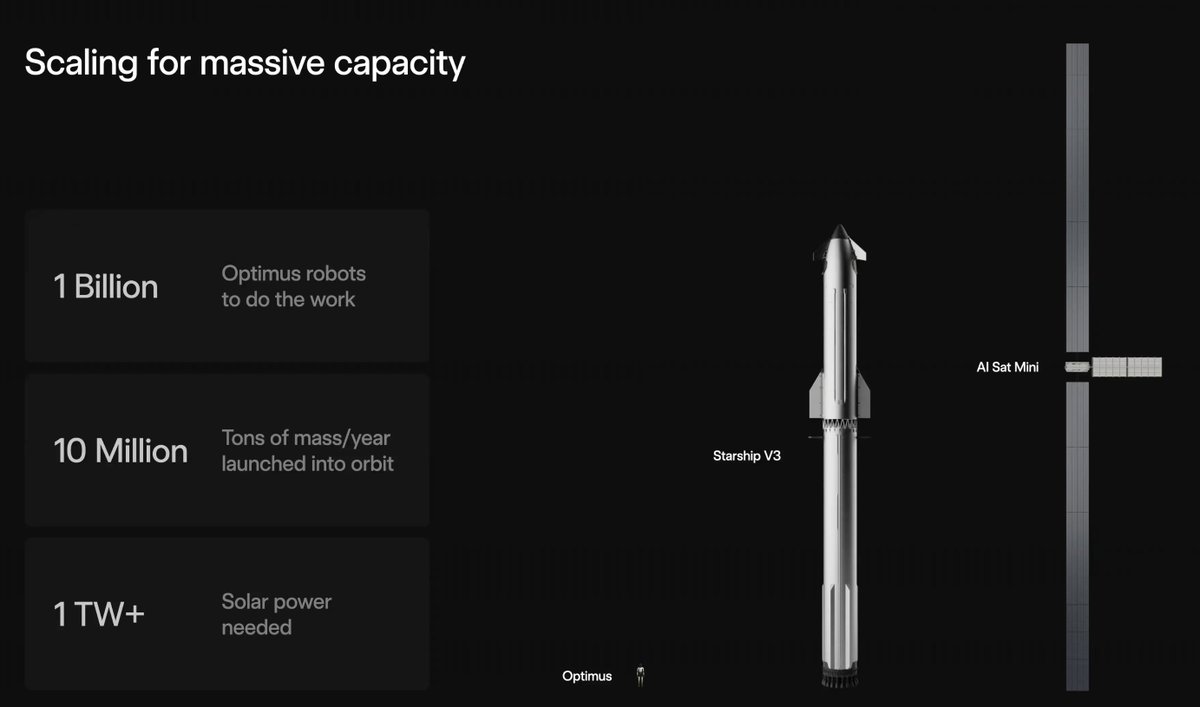
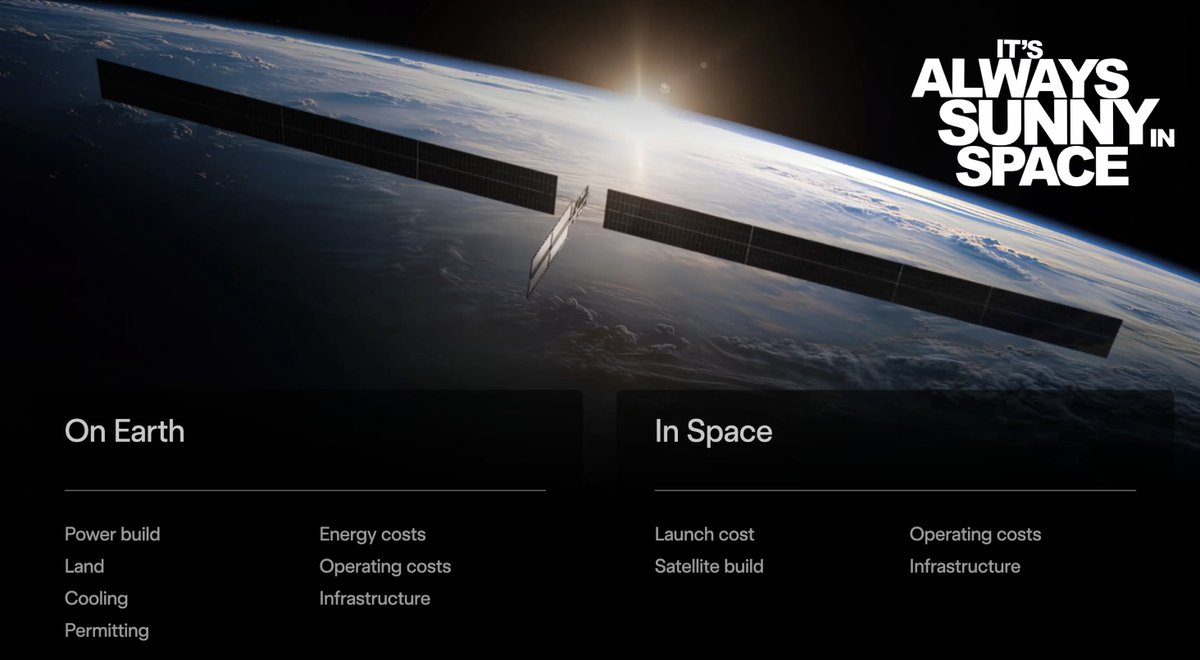
There's an underrated part of the AI Sat Mini design that nobody seems to have picked up on. Up until now, the 2 major critiques to Orbital Datacenters have fundamentally been: 1. The Solar Irradiance hitting the satellite in a Dawn-Dusk SSO will make running GPUs on it thermally impractical 2. The Earth Albedo hitting the radiators will make it challenging to dissipate heat The AI Sat Mini config takes care of both. - The Flatsat Bus is pointed perpendicular to the sun load edge-first, minimizing Solar Load. - The Radiator is pointed perpendicular to both the Earth and the Sun Loads, able to dissipate heat to free space on both sides - The Solar Array mounting seems to be fairly thermally isolated, and the massive span allows for a ton of radiative dissipation from the dark rear-face (as is often the case with space SPAs, they don't store that much) These are fairly clever orbit & conops driven geometry choices that become apparent once you start mission design, and de-constrain the design quite simply. Your flatellite + radiator is almost permanently shaded, and the only incentive becomes to run your compute as hot as possible to leverage the Eb = σ• T⁴ scaling. Passive heatpipes conducting heat from the chip pedestal to the radiator may be sufficient, without engaging in the insane exercise of mass producing 0g coolant pumps. Now there seem to be 2 variants here between the images posted, but that may just be render inaccuracy. Vertical Config: Image 1 (with the Starship for scale) shows the solar arrays along the edge of the flatellite. Horizontal Config: Image 4 (the on-orbit render) shows the solar arrays perpendicular to the face of the flatellite. Either scenario supports the earlier observations, as the solar array plane is free to rotate. However as others have noted, the Vertical config may offer a fair degree of gravity gradient stabilization. This is another interesting bit - Orbital Compute will require very little pointing accuracy, compared to most other space applications like EO or Comms that track a target (Imaging AOI or Receivers). As long as the satellite points roughly at the sun, and the gimbaled ISL terminals can maintain a stable connection to Starlink, the pointing requirement is negligibly coarse. You could probably forgo reaction wheels and control this whole thing with magnetorquer pulses. SpaceX has a habit of eliminating broad constraints at architecture level quite cleverly, and I was looking forward to how they think about Orbital Compute. Safe to say I was quite delighted by this design.


First view of the 100kw AI Mini Sat with solar panels and heat radiator to scale. “And that’s just the Mini version. We expect future versions to go to the megawatt range.” — Elon The key missing ingredient is a terawatt of AI compute. Fully integrated fab with recursive

ModelGate An OpenAI-compatible API Gateway for local LLM deployment. Multi-backend. Quota control. Rate limiting. Hybrid routing. Open source ↓ github.com/derekwin/Model…
8/ 📉 Log noise reduction: Info level now focuses on exceptions only for cleaner logs and better debugging.
7/ 💡 Quota deduction is now atomic to prevent over-deductions—more precise control. ✅
1/ 🚀 Merged 7 small PRs into ModelGate today! Major improvements on security, stability, and maintainability. Let's dive in! 🎉 #Go #LLM #APIGateway #OpenSource
Local LLMs are easy. Production LLM infrastructure is not. If you’re serious about AI infra, you need a model-aware gateway layer. Open source ↓ github.com/derekwin/Model… Would love feedback from infra builders.
This unlocks 3 powerful patterns: 1️⃣ Enterprise internal AI governance 2️⃣ SaaS tiered AI monetization 3️⃣ Vertical model API productization Without rebuilding auth + billing every time.
Most people think running a local LLM = docker run ollama. That’s cute. Running it in production — with multiple users, quotas, routing, and hybrid cloud — is a completely different architecture problem. Let’s break it down 👇
Tom Huang @tuturetom
38K Followers 7K Following Co-founder & CEO @OpenDesignHQ — building Open Design, the open-source Claude Design alternative. → https://t.co/J2erf2l0vF
Di_Grape @GrapeDi36025
12 Followers 37 Following
qizhe cai @CaiQizhe
225 Followers 157 Following Incoming Assistant Professor at UVA. I am building network stack/protocols/hardware for Terabit Ethernet.
云微 @yunwei37
1K Followers 2K Following Stupid, but try to keep Learning, curiosity and Courage | Creator https://t.co/UWe3rFdsqC | eBPF & AI | Bring new orders and chaos! | 🐟好吃
Maggie @mahaelsadig
19 Followers 344 Following
Albert Gran Alcoz @albertgran
246 Followers 546 Following Senior Performance Research Engineer @ NVIDIA | PhD ETH Zürich | High-Performance Networking, AI Infrastructure, Cloud, Network Security 🇨🇭
Dave Vescio @DaveVescio
499K Followers 544K Following Spiritography — a fine art practice discovering embedded presences within rusted metal and weathered glass.
Lucy L. @LucyBuilding
36K Followers 197 Following 👩前 Web3 工程师|浙大 CS 硕士 ✍️Writing about US/HK equities, AI infra, semis & crypto 📈 拆解普通人真正能执行的投资路径 Sharing tools, frameworks and real portfolio notes
DeepSeek @deepseek_ai
1.0M Followers 0 Following Unravel the mystery of AGI with curiosity. Answer the essential question with long-termism.

X Daily News @xDaily
333K Followers 5K Following Your #1 News source on everything X + xAI and now SpaceX | Contributors: @HXMnCK, @xUpdatesRadar and @swak_12 I | Hit Follow and sign up for notifications! 🔔
Mega Ran @MegaRan
69K Followers 7K Following GRAMMY® Nominated EMMY Winning World Record Holding musician/teacher/hubby/f̶o̶s̶t̶e̶r̶ parent🥰 TXT me at +1 (858) 758-2493 🎶album: Buddy's Magic Tree House

Jianyang Gao @gaoj0017
3K Followers 909 Following Author of the RaBitQ quantization algorithm; Postdoc at @ETH on AI; ICPC World Final;

The AI Timeline @TheAITimeline
26K Followers 1 Following covering the latest trending AI & LLM research, see "highlights" for all weekly threads, ran by @bycloudai

SpaceX @SpaceX
41.8M Followers 123 Following SpaceX designs, manufactures and launches the world’s most advanced rockets and spacecraft


Onur Mutlu @_onurmutlu_
9K Followers 138 Following Professor at ETH Zurich and Carnegie Mellon University; Scientist, Educator, Researcher, Computer Architect @ETH_en @ETH @CarnegieMellon Group: @SAFARI_ETH_CMU
张小珺 Xiaojun Zha... @zhang_benita
39K Followers 118 Following Award-winning tech journalist · Host of Zhang Xiaojun Podcast
Saining Xie @sainingxie
40K Followers 2K Following cofounder & chief science officer at @amilabs | faculty @nyu_courant | prev: @googledeepmind @meta (fair) @ucsandiego | ynwa
alex zhang @a1zhang
35K Followers 929 Following phd student @mit_csail @nlp_mit, previously undergrad @princeton 🫵🏻 go participate in the @GPU_MODE kernel competitions!

Sisyphus Labs @justsisyphus
8K Followers 325 Following Just typing ultrawork to make oh-my-opencode / Managed by Q's friend
Figure @Figure_robot
206K Followers 3 Following Figure is an AI Robotics company building the world's first commercially viable autonomous humanoid robot.
No Priors @NoPriorsPod
11K Followers 118 Following @saranormous and @eladgil host your podcast guide to the AI revolution. weekly interviews with the builders (on Apple, Spotify and YouTube)
sarah guo @saranormous
145K Followers 3K Following startup investor/helper, founder @conviction. accelerating AI adoption, interested in progress. tech podcast: @nopriorspod
David Khachaturov @davidobot_
154 Followers 254 Following PhD CompSci at @cambridge_uni doing security research. Maintain the web version of @obey_love. Publish games to mobiles/switch under @mazette_games
masato_ka @masato_ka
1K Followers 517 Following HRIからソフトウェア工学をやって、またロボットとかセンサーとかそんな世界に帰ってきました。 共著;Jenkins実践入門 3版まで(技術評論社); その他IoT系書籍など。このアカウントの発言は個人的な内容です。所属する組織団体とは一切関係ありません。青空の方はmasato-kaです。
Robotic Systems Lab @leggedrobotics
29K Followers 172 Following The Robotic Systems Lab designs machines, creates actuation principles, and builds up control technologies for autonomous operation in challenging environments.
Tony Zhao @tonyzzhao
73K Followers 956 Following Co-founder and CEO @sundayrobotics. Stanford PhD dropout, ex Deepmind, Tesla, GoogleX
Tim Qian @Tim_Qian
4K Followers 2K Following Building transparent startups at https://t.co/gRbPzPfZgV Work with me: $3000 to build a startup with you for one week $10000 to build a startup with you for one month

Ion Stoica @istoica05
8K Followers 20 Following Professor at UC Berkeley, co-founder of Databricks, Anyscale, LMArena, Conviva.
LinkedIn Help @LinkedInHelp
328K Followers 5K Following We are the LinkedIn Social Support Team and avail 7 days a week! If you need help with your LI account, DM us your email address that is listed on your profile.
LinkedIn @LinkedIn
1.8M Followers 14 Following Welcome to a world of career opportunities, advice, inspiration and community. | Support → @LinkedInHelp
Pavan Jayasinha @pavanjayasinha
3K Followers 469 Following ECE @UWaterloo // prev: quant research @citsecurities, gpu perf @Modular, ASICs @extropic_ai + @UntetherAI, neutral atom QC @QuantumIQC

Yuxuan Jiang @_MattJiang_
943 Followers 1K Following CSE PhDing @UMich | Scaling Trust in ML Infrastructure Alongside Compute | @ZJU_China @UofIllinois @MSFTResearch
LMSYS Org @lmsysorg
16K Followers 199 Following Large Model Systems Organization: Join our Slack: https://t.co/vzYOTP4w6C. We developed SGLang https://t.co/OjwQadINKU, Chatbot Arena (now @arena), and Vicuna!
Association for Compu... @TheOfficialACM
73K Followers 3K Following The world's largest professional organization advancing #computing as a science and profession. Also @mastodon.acm.org Likes & shares ≠endorsement
Unsloth AI @UnslothAI
69K Followers 464 Following Train and run models locally! 🦥 https://t.co/2kXqhhvLsb

Joon Sung Park @joon_s_pk
20K Followers 1K Following CEO @simile_ai. Building simulations of society. CS PhD @stanfordhci + @stanfordnlp. Oil painter.

Jeff Clune @jeffclune
32K Followers 442 Following Co-founder, Recursive. Professor, CS, U. British Columbia. CIFAR AI Chair, Vector Institute. | ML, AI, deep RL, deep learning, AI-Generating Algorithms (AI-GAs)
SNIA @SNIA
3K Followers 438 Following SNIA is an industry organization that develops global standards and delivers education on all technologies related to data. We are the experts on data.



Bill Yuchen Lin @billyuchenlin
27K Followers 3K Following RL for coding @xAI @SpaceX Affiliate Assistant Prof @UW. Ex: @allen_ai; Google, Meta FAIR.

Kickstarter @Kickstarter
901K Followers 1K Following Here to make the world a more creative place💡 Discover new projects to back — or launch your own: https://t.co/dun4Iay1RUYou might like