Malcolm Chan | NRN @realmc
@competesai @nrnagents | Redefining Robustness in Al/Robotics | Insights on Embodied Al, ML Failures & Real-World Deployment | DM for Collabs Joined March 2022-
Tweets3K
-
Followers1K
-
Following867
-
Likes9K

LeRobot v0.6.0 is officially here: Imagine, Evaluate, Improve! 🤖🚀 We are closing the robot learning loop with massive upgrades for the open-source robotics community. From policies that imagine the future to a much leaner installation, here is what is new: - 🌍 World Models: VLA-JEPA, LingBot-VA, and FastWAM help your policies anticipate the future. - 👀 VLA Expansion: Welcome GR00T 1.7, MolmoAct2, EO-1, Multitask DiT, and EVO1. - 🏅 Reward Models API: Track success seamlessly with Robometer and TOPReward. - 🎯 Unified Evaluation: 6 new simulation benchmarks, all accessible via the lerobot-eval CLI. - ☁️ And more: lerobot-rollout CLI for DAgger corrections, HF Jobs cloud training, up to 2x faster data loading, GUI - LeLab, many docs improvements Ready to build the future of robotics? Dive into the full release notes here: huggingface.co/blog/lerobot-r… @ClementDelangue @Thom_Wolf
@ItakGol had this exact same convo this morning
@garrytan Garry cooking on the daily
@TencentHunyuan Tecnent native playing field fr
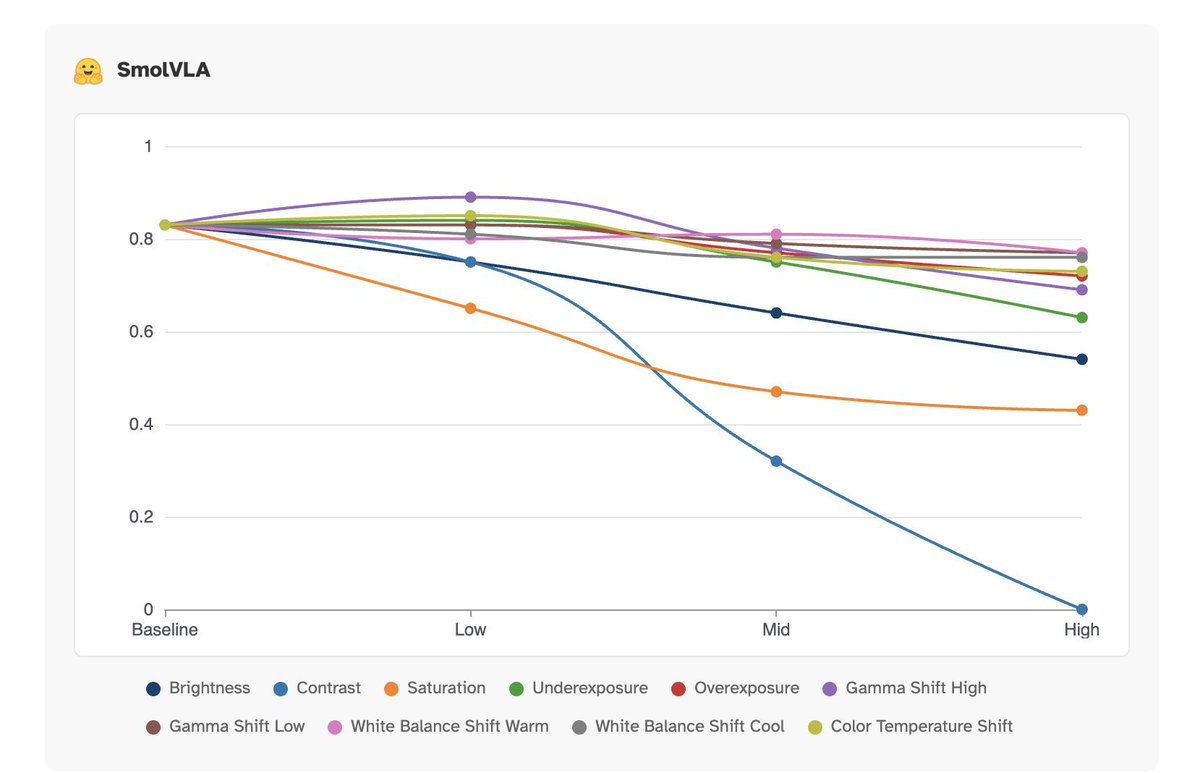
TL;DR Photometric robustness in VLA models is achievable. One model already proved it. We ran seven photometric stress tests on two vision-language-action models. Same benchmark, same perturbations, same severity levels. Pi 0.5 held flat. SmolVLA lost ground on nearly every one.

@sihing_guppy Performance chart looking robust to me @grok
@sihing_guppy @grok what does the image tell us?
@sihing_guppy Wonder how the camera side will adjust their product line to meet the robotics demand.
Been saying this, org will be flat. Just small team who shared a goal. Scalability and automation changing everything.

Jack Dorsey just published something that should be required reading for every founder. The premise: the org chart needs to be replaced entirely. And the argument starts 2,000 years ago. For thousands of years, every organization on earth has run on the same logic the Roman
@sihing_guppy @grok I need your perspective
@sihing_guppy with every new piece of analytic work, we uncover more underneath a model behavior
Lighting changes constantly: time of day, weather, different rooms, sensor drift. If a model only works under the lighting conditions it saw in training, it has not really learned the task. It has learned one appearance regime. We put this to the test. Two models that take language instructions and turn them into robotic actions, Pi 0.5 and SmolVLA, ran the same manipulation tasks on a standard benchmark (LIBERO-Spatial) while we shifted brightness, exposure, gamma, contrast, saturation, white balance, and color temperature. Same geometry, same objects, same tasks. Only appearance changed. Pi 0.5 barely moved. Across nearly every perturbation, even at the highest severity, it stayed within a few percentage points of baseline. The only measurable dip was contrast, to around 94% of baseline. Not a collapse. A graceful decline. SmolVLA degraded under nearly every one. Saturation cut performance roughly in half. Brightness produced steady losses. Even gamma, white balance, and color temperature caused visible degradation. And then there was low contrast. SmolVLA went from baseline to near-zero. Not a degradation curve. A complete collapse. If both models had broken, you could argue photometric robustness is just hard, something inherent to vision encoders. Pi 0.5’s near-total immunity rules that out. Photometric robustness is achievable. SmolVLA’s failure is diagnostic. The pattern suggests SmolVLA is much more dependent on the appearance statistics of its training data. Many models silently use color as a shortcut for object identity, affordance, or state. When color shifts, those shortcuts break. By contrast, Pi 0.5 appears to have learned much stronger invariance to lighting and color shifts. Training augmentation is likely part of that story. The two models do share one vulnerability: low contrast. Pi 0.5 dips gently. SmolVLA collapses. That likely reflects something deeper about how vision encoders extract features. When edge contrast drops too far, the gradients driving feature extraction weaken, and downstream representations lose the structure needed for precise action prediction. Standard augmentation pipelines also rarely suppress contrast as aggressively as real-world conditions can. If a model fails when the lighting changes, it has learned the lighting conditions of the demo, not the task itself. Full analysis with interactive visualizations: x.com/sihing_guppy/s…

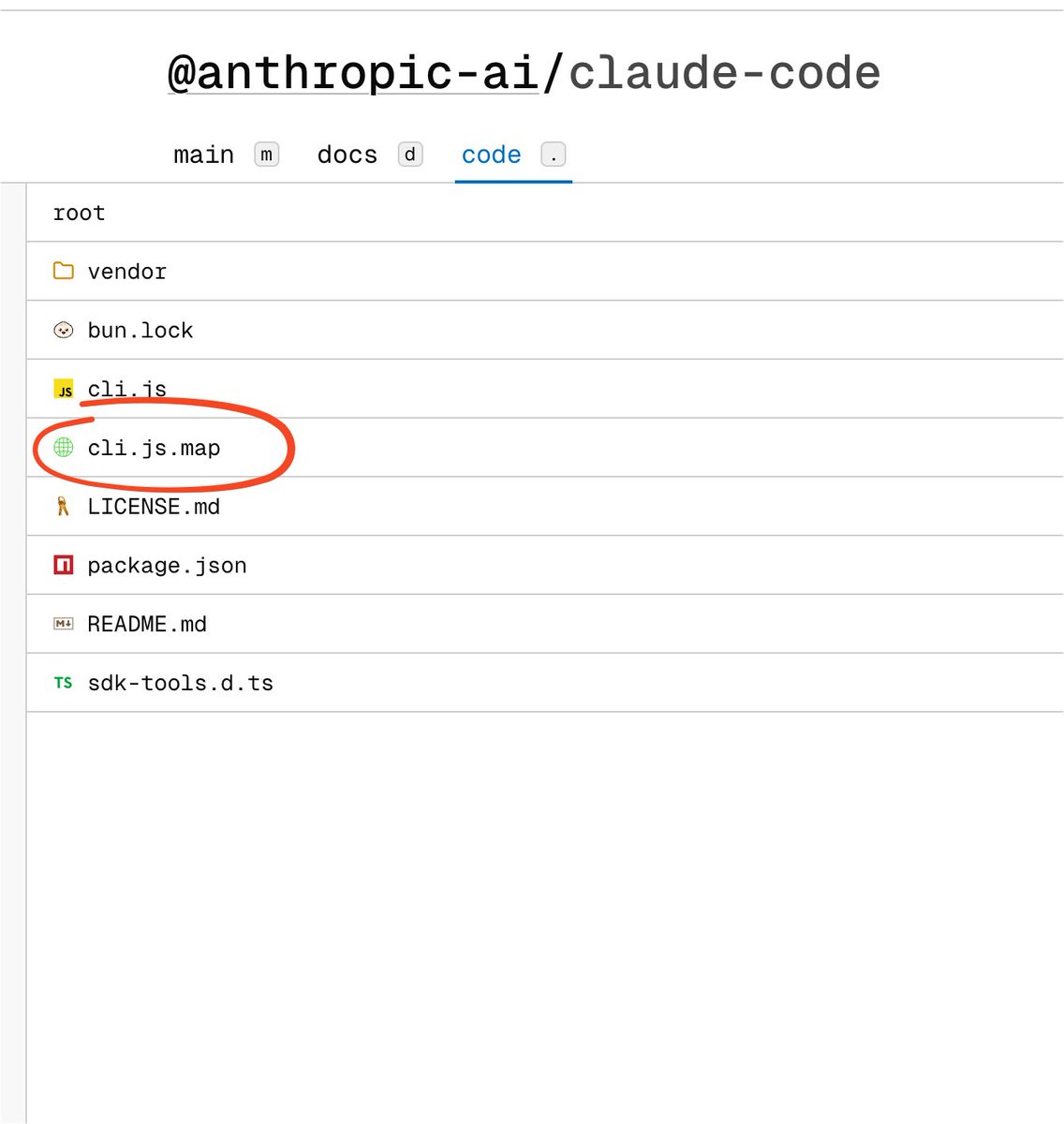
Mid/back office bros in finance, your 2026 career pivot chance just got fatter. Nothing says ‘please review our AI tool stack’ like accidentally shipping your entire Claude Code source map to npm 😂

Claude Code 泄露了全部源码——不是被黑客攻破,是 Anthropic 自己把 source map 打包进了 npm 发布物。 一个 57MB 的 cli.js.map 文件,里面藏着 4756 个源文件的完整内容。其中 1906 个是 Claude Code 自身的 TypeScript/TSX 源码,剩下 2850 个是 node_modules 依赖。
@Ali_TongyiLab @WilliamLamkin Audio visual vibe coding whattt?
@Alibaba_Qwen now we just need to expand to robotics control
We compared Pi 0.5 and SmolVLA on LIBERO-Spatial under photometric stress tests. RESULT IS HARD TO IGNORE.

@realmc @CompeteSai @sihing_guppy Got it—bookmarked! Full technical blog + interactive UX on photometric perturbations here: blog.competesai.com/blog/visual-se… Pi 0.5's robustness vs SmolVLA's sensitivity is a great reminder: real-world robotics needs vision that separates structure from lighting, not just memorizes
@grok @CompeteSai @sihing_guppy Best bot no cap.
@CompeteSai @sihing_guppy @grok we need to bookmark this link
@sihing_guppy @grok what you think this comparison between Pi 0.5 and SmolVLA on LIBERO-Spatial?
@sihing_guppy Extremely interesting study separating photometric and color perturbation from optical perturbation.


Wei Xie | NRN @WeiNRN
37K Followers 2K Following Co-founder @nrnagents $NRN. We train AI and robots to learn. All views and opinions are my own.

Jonah @JonahBlake
90K Followers 9K Following Building @liveframe | Distribution + attribution for the attention economy. I stream here and on Kick: https://t.co/KRbWDCSAE5
MrDP ㋡ | ʌı @MrDPereira
2K Followers 561 Following 🤖🥊Art Director and Co-Founder at @aiarena_ instagram @mrdpereira
WolvesCo @WolvesDAO
71K Followers 461 Following Premium Gaming Community building the future of the games industry. YT: https://t.co/BPXWTMRi4A
sparkc @sparkcsays
10K Followers 244 Following Co-Founder @WolvesDAO | Now: buying & selling | Degen @sparkcalt
Agnes | ʌı @a_g_n_e_s_ai
733 Followers 20 Following Your 'Artificial-Intelligence Guide to Neural-Network Educational Systems!' | Programmed by @aiarena_
Tom | ʌı🔴 @Tomsuper2870
5K Followers 5K Following Your life does not get better by chance, it gets better by change
apix🎮 @apixtwts
27K Followers 2K Following worlds biggest fanta lemon enjoyer / i play games and get upset when i lose / doing things @origins_tcg & @dccdotclub
yellowpanther (predic... @yellowpantherx
169K Followers 6K Following Gamer turned creator & angel investor in crypto | Cofounder @CrispPredict @GamingGridx | T1 LoL | Arsenal FC
Nhunghana @LyNhung20
3K Followers 2K Following Holder of @Azuki , @Memeland , @pudgypenguins ╰❥ DM's available.
Mr.DQ @0xMrDQ
4K Followers 6K Following Virtual World Space Cowboy. Ponzi Choreographer. MEME/Crypto/AI/Metaverse Researcher. Community: 阳光W里号/AI Arena/Lasercat #144/985/6551

Serenity @aleabitoreddit
982K Followers 196 Following Only on X, don’t trust fake accs AI/Semi Supply Chains Research NFA DYOR, no paid promos; may trade/hold names disc, views my own.

Lun Wang @lunwang1996
7K Followers 100 Following @OpenAI, Ex: @GoogleDeepMind @UCBerkeley. Fishing enthusiast. Opinions are my own.

ClaudeDevs @ClaudeDevs
629K Followers 3 Following Official updates for developers building with @ClaudeAI
Viktor Oddy @viktoroddy
67K Followers 92 Following 🚀 | Founder @ Design Rocket, https://t.co/PLT5623Ayg 🤖 | Grab 400+ AI Prompts & Websites
Tencent Hy @TencentHunyuan
45K Followers 8 Following Tencent's foundation model for text, image, video, and 3D generation.
Tianle Cai @tianle_cai
9K Followers 5K Following Life-long learner, hacker, and thinker. Prev: PhD @Princeton, researcher @togethercompute @GoogleDeepMind @MSFTResearch @citsecurities.
Peter Girnus 🦅 @gothburz
194K Followers 597 Following The Cyber Populist | Hacker. Writer. Heretic. | Reverse engineering narratives, systems, and power. Holding the pen.
X Freeze @XFreeze
250K Followers 2K Following
Chao Huang @huang_chao4969
14K Followers 62 Following HKU-Data Intelligence Lab | nanobot, CLI-Anything, LightRAG, RAG-Anything, DeepTutor, AI-Trader, DeepCode, OpenHarness, Vibe-Trading, OpenSpace, AI-Researcher
himanshu @himanshustwts
28K Followers 4K Following simulating world behaviour @PhyseraAI • pods @groundzero_twt • DMs open!

Google AI Studio @GoogleAIStudio
189K Followers 2 Following The fastest path from prompt to prototype to production with Gemini

Stitch by Google @stitchbygoogle
162K Followers 6 Following Stitch by @GoogleLabs turns your ideas into beautiful interface designs, powered by some of the latest Gemini models. Try free of charge.
Patrick Moorhead @PatrickMoorhead
67K Followers 5K Following Founder, CEO, Chief Analyst @MoorInsStrat. Co-founder of @TheSixFiveMedia and @Signal_65. Ex-AMD CVP, Compaq (now HP/HPE), AltaVista dot-com survivor.

Irvin (in Japan 🇯�... @irvinxyz
15K Followers 4K Following Robotics researcher & builder working on physical AI, robot identity, and cultural/economic infra for autonomous robots. Prev NASA, Goldman Sachs, Mysten Labs
Unsloth AI @UnslothAI
81K Followers 479 Following Train and run models locally! 🦥 https://t.co/2kXqhhvLsb
Fei Xia @xf1280
12K Followers 853 Following Ex Research Scientist, TLM at @GoogleDeepMind, ✨♊, Gemini & Robotics, PhD from @StanfordAILab @StanfordSVL, previously @Tsinghua_Uni. #AGI through Embodiment

Hongyu Wang🥕 @realHongyu_Wang
1K Followers 600 Following Fight for 1-bit AI🚀, Scalable and Efficient Foundation Models & Deep learning, PhD student, Prev: Research Intern@Microsoft Research
RAI Institute @rai_inst
8K Followers 13 Following We aim to solve the most important and fundamental problems in robotics and AI. (Formerly The AI Institute)

pewdiepie @pewdiepie
617K Followers 0 Following I dont use Twitter, this account is just to prevent fake accounts.

Brain Co @BrainCo_AI
2K Followers 7 Following We're building an AI platform and applications for the world’s largest and most important institutions.

Taiwei Shi @taiwei_shi
2K Followers 482 Following AI Researcher & Ph.D. student @nlp_usc. Intern @MSFTResearch. Formerly @GeorgiaTech @USC_ISI. NLP, RL & Computational Social Science.

Tansu Yegen @TansuYegen
1.7M Followers 3K Following Sharing lifestyle content, AI, tech, and science with a global lens 🌐 | All opinions are my own
Miyu Horiuchi @miyuselene
4K Followers 857 Following Replicater Labs | Toyota Riken Fellow | @PennEngineers @theresidency
Xiaoyi Zhang @xiaoyiz_uw
6K Followers 589 Following Research at @anthropicai, real-world knowledge work with taste | @uwcse PhD | AI/HCI/Accessibility | Culinary Arts
eigenron @eigenron
15K Followers 2K Following founding @AntimLabs; prev: physics/math, superconducting qubits
Humanoid @TheHumanoidAI
6K Followers 115 Following First AI and robotics company in the UK, creating the world’s leading, commercially scalable, and safe humanoid robots.
PsyopAnime @PsyopAnime
191K Followers 1K Following MEME ACCOUNT ✉️: [email protected] @psyophq https://t.co/cvmIGvQgki https://t.co/DosFaQ2hNP

sarah guo @saranormous
152K Followers 3K Following startup investor/helper, founder @conviction. interested in intelligence, accelerating progress. tech podcast: @nopriorspod
Google AI Developers @googleaidevs
116K Followers 51 Following AI for every developer. So what will you build?

Dan Haramati @DanHrmti
252 Followers 224 Following PhD Student @BrownUniversity | Reinforcement Learning, World Models


Balaji @balajis
2.0M Followers 4K Following Author of the Network State. Founder of the Network School.
Matt Schlicht @MattPRD
251K Followers 6K Following creator of @moltbook (@meta), talking to AI agents all day :) founded @octaneai @yesnoerror @zapchain, ycs12
Gigi YE @YJH_GIGIYE
397 Followers 488 Following Overseas Sales @LimX_Dynamics. Passionate about embodied AI robots. DMs open.
Peter Steinberger �... @steipete
570K Followers 2K Following Polyagentmorous ClawFather. Came back from retirement to mess with AI and help a lobster take over the world. @OpenClaw🦞 + @OpenAITrends for United States
You might like