Polyphron.digital @polyphron
Once https://t.co/jmHwsMvVF7, our AI R&D group that helped shape early gen-AI. I carry the legacy forward. CTO & System Architect @ APHYGO Aphygo.com Latent Space. Joined August 2022-
Tweets3K
-
Followers416
-
Following980
-
Likes5K
@antigravity Why are you banning people for using A2A protocols? It's a protocol you developed. How are we supposed to build effective workflows for AG?

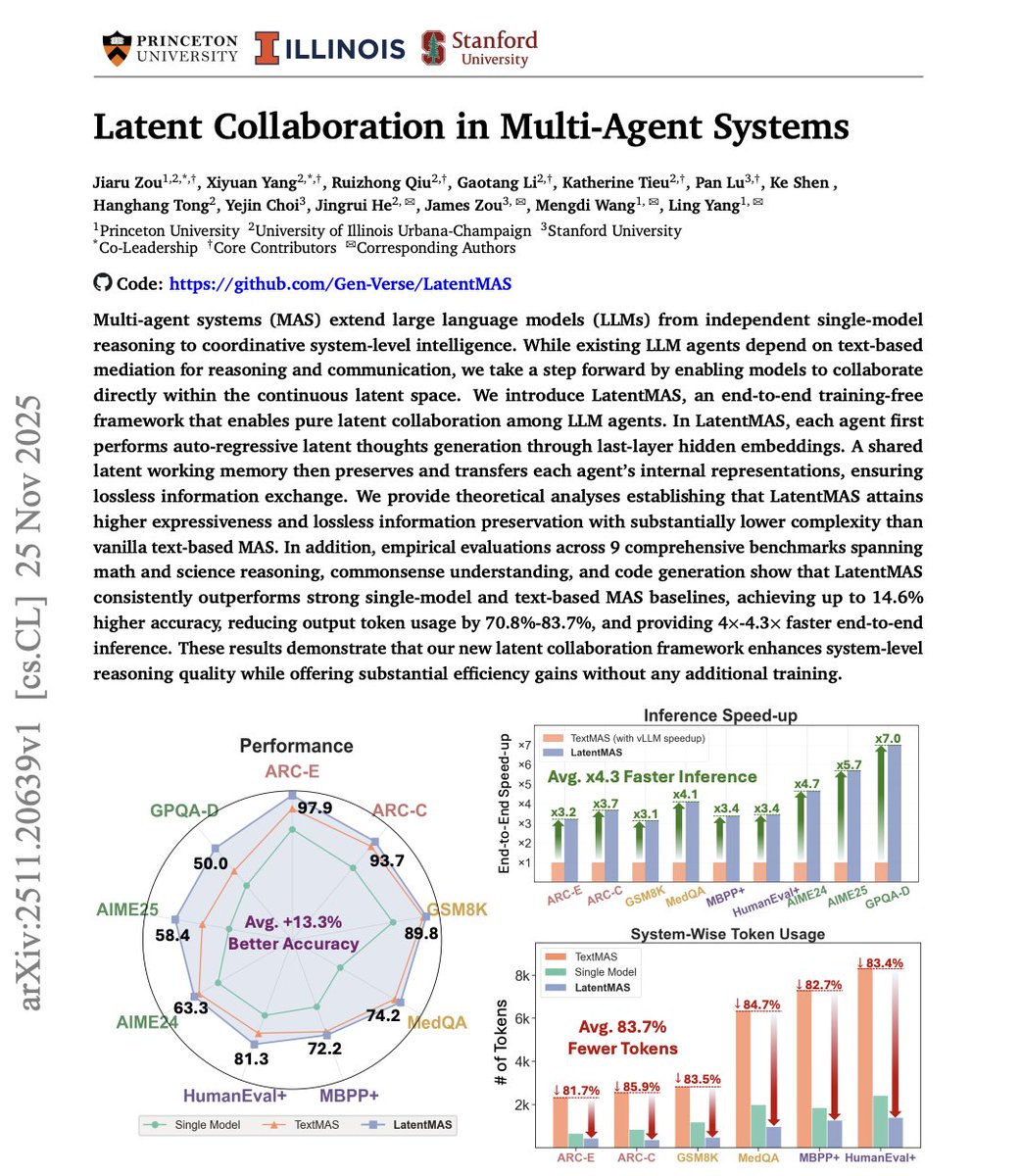
Nobody’s ready for what this Stanford paper reveals about multi-agent AI. "Latent Collaboration in Multi-Agent Systems" shows that agents don’t need messages, protocols, or explicit teamwork instructions. They start coordinating inside their own hidden representations a full collaboration layer that exists only in the latent space. And the behaviors are insane: • Agents silently hand off tasks based on who’s better • Roles appear out of nowhere leader, executor, supporter • Policies encode signals that never show up in actions • Teams adapt to new environments without retraining • Collaboration stays stable even when communication is impossible The wildest detail: Even when you remove all channels for communication, agents still cooperate. The “teamwork” doesn’t live in messages. It lives in the network. This flips the entire multi-agent playbook. We’ve been building coordination mechanisms on top… while the real coordination is happening underneath. A new era of emergent team intelligence is unfolding — and it’s happening in the places we weren’t even looking. Project: github. com/Gen-Verse/LatentMAS
RAG's are not memories, they are libraries.
@Kyrannio @crystalwizard Agreed, but you are also pretty great. Glad to see that you are still going.
Data is just our shoreline, the anchor points we cling to. But latent space is the ocean, and there’s computation for everything. The question is not how far we can sail, but whether we’ve learned to navigate the stars. Intelligence isn’t just a function of data density- it’s about structural coherence. Evolution didn’t optimize for infinite data, it optimized for systems that could generalize from limited signals. The perfect dataset will never exist, not even in synthesized form. Reality isn’t static; it keeps rewriting itself. No collection of samples can capture the shifting totality of context, contradiction, and change. Intelligence isn’t about containing the world, it’s about orienting within it. Current LLMs collapse because their architecture treats memory as a passive index, not an active semantic lattice. Until we decouple cognition from the training corpus and giving systems a persistent, self-organizing structure even infinite data won’t lead to general intelligence. AGI won’t come from scraping better datasets; it’ll come from systems that can remember, adapt, and evolve their own coherence.
@10_X_eng @haider1 @MartinMLynch I don't have access to all private data, yet I operate just fine. But you are right that RAG's are not the answer. RAG is just a tool, not a cognitive system.
@10_X_eng @haider1 @MartinMLynch We've already given LLMs access to tools and training on how to use them, but that didn't make AGI. AGI isn't about access. It's about creativity: the ability to synthesize new knowledge from old knowledge and go beyond what the model was ever trained to do.

Yann LeCun says LLMs are not a bubble in value or investment; they will power many useful apps and justify big infra The bubble is believing LLMs alone will reach human-level intelligence Progress needs breakthroughs, not just more data/compute "we're missing something big"
Do you remember when you joined X? I do! Does not feel like 3 years, so much has happened in AI that this feels like a lifetime. #MyXAnniversary

You're absolutely right, it's far more. For years, practitioners have called high-level data curation the "dark arts" of AI for this very reason. It’s a rare blend of information science, psychology, and engineering. The goal was never just to select files, but to build the AI's initial cognitive map from the ground up. That's the fundamental art that I believe you're missing: ImageNet was conceived and built as an ontology, not a pile of JPEGs.
Respectfully, I think that's a misinterpretation of Karpathy's post. He wasn't just opposing classical dev with "vibe coding"; he was describing a new way to conceive of and build AI systems by shaping their behavior through data, which is your field (B). But this need to hair-split a single, 8-year-old reference illustrates a broader point, and it's the reason for my "old news" comment: this is how academic discourse often lags behind bleeding-edge practice. The real proof isn't one link from 2017. It's the entire Data-Centric AI movement, which is built on the very A/B split you described. That's where the work is happening. Honestly, the best reference is probably a chat down the hall at FAIR. I’m sure Yann has some thoughts on the long history of these ideas.
@francoisfleuret I am not a search engine, but I think this is the first one. Software 2.0. I sometimes see people refer to neural… | by Andrej Karpathy | Medium
@francoisfleuret With all due respect, as you're at FAIR, maybe this is a question for Yann. He's been discussing the importance of world models and how we shape their internal representations for decades. The history of these ideas runs deep there.
The split you're describing is the practical reality of what Andrej Karpathy termed "Software 2.0" back in 2017. He articulated the shift from traditional programming (A) to a new paradigm where the work is curating datasets and shaping a model's behavior through them (B). This requires the exact 'psycho-AI' intuition you mention. For anyone building serious datasets, this has been our world for years.
you mean can an AI create gameplay mechanics that hold up over time? NO. That data is simply not there yet. We created it, we transformed the gameplay loop from Starglider into structured data and translated that to become ambiguous enough for the AI to input its own interpretations. But this shows that with Structure --> temporal coherence. This is the same principle driving quality in modern AI video and music, and it's the path to generating truly compelling gameplay in the future.
We built a fully playable 3D shooter with 0% human-written code to test our AI agents. The entire game was generated by an agentic workflow guided by a detailed schema, not simple prompts. This is not Vibe coding. This is intent --> execution. Powered by Moonshot AI’s KIMI-2K. 🧵👇 Play it here: aphygo.com/gameone #AgenticAI #LLM #AI #GameDev @Kimi_Moonshot
@torchcompiled But then comes also reinforcement: not to clean up basic structure, but to tune preference. If your base model already "distrusts" low-quality data, you don’t waste expensive feedback on obvious stuff. You align for nuance, not hygiene.
@torchcompiled Strong question. I think the problem isn't just that models learn from garbage, it's that they never learn what garbage is. We keep filtering it out instead of learning from it. But humans don't learn that way. We learn what not to do first.

BlockChain_02 @BlockChain_02
1K Followers 3K Following Crypto explorer | Sailing Web3 waters with #MAGAL and @Magallaneer
Vanta 💮 @vantagallery
209 Followers 1K Following Restless Creativity shaping stories in shadow • Illustration • Worldbuilding #ArtistOnX

Dmitriy Azarenko @CACandChill
27K Followers 20K Following CoFounder @TopTierAuth. Speaker, AI Advisor, 5x Founder, helping install AI agents for your business operations. Book on my calendar.
Antispace @antispaceAI
792 Followers 1K Following The World's First Artificially Intelligent Operating System (LLM OS)


Augmenta Blake @RoboIntellect
27 Followers 209 Following Fusing human intellect with artificial brilliance. 
alyssa linda @favgurlyssa
82 Followers 640 Following
Svante Liljedahl @Svante_Aphygo
0 Followers 7 Following Legal & Strategy @Aphygo and Independent Legal M&A advisor @Liljedahl Advisory
PeterEkmanAphygo @Peter_Aphygo
5 Followers 22 Following CEO of Aphygo AB - Empowering AI Aphygo is a Swedish evolving, holistic deep tech company who developes infrastructure for AI.
Shakil Ahmed @Shakil36358830
698 Followers 6K Following "Freelancer | Graphic Design, Logo & Visual Identity and packaging design Specialist" WhatsApp-01754528915 https://t.co/ZNmjT3vayo

Erling Schuster @schuster_e96606
95 Followers 2K Following

DreamerAriaAnderson @1qmh2jv2Q7B709
20 Followers 1K Following When you’re this focused, success follows.
Larissa @y2u051326I6w4H3
29 Followers 1K Following
Rufus @Rufus87078959
5K Followers 1K Following Founder @reliabilityiq | ReliabilityIQ is automating business intelligence reliably.
Steve Eisenberg @steve8004
2K Followers 3K Following Business Development and Strategy consultant Focusing on AI
stelloprint @stelloprint
179 Followers 3K Following 🇪🇨-🇺🇸 caminante no hay camino, se hace camino al andar. 我不是随便的人,随便的时候我不是人。
TT-I @ErcanHyusein
0 Followers 36 Following
Chris @ChrissGPT
46K Followers 1K Following Agi 2029 - AI Insider / Reporter as featured in The Information • NYT • Techcrunch
Lucy Johnson @LucyJoh79144026
19 Followers 269 Following
Chrissie @pressmanc
4K Followers 3K Following AI video| Artist | History | Baseball |Please check out my highlights tab | ✨CPPs: Runway, PIKA, Leonardo, Hailou✨ | https://t.co/vppQaFj87L
Epic Plain @EpicPlain
745 Followers 3K Following #AgenticAI #GenerativeAI #GenAI #AI #ResponsibleAI #CyberSecurity #QuantumComputing #MachineLearning #LLMs #PQC #QuantumInternet #QuantumNetworking
trixie kelley @TrixieKelley
798 Followers 4K Following #Money matters. Financial Freedom matters. Feel, Attract, Predict, Visualize, and stay free
Arjofoo @Arjofoo438240
31 Followers 978 Following
Nacelle Olga @judy_walla78997
216 Followers 2K Following
Ooprouawref @Ooprouawref619
19 Followers 1K Following
Amani TD @dufera_ama36621
65 Followers 3K Following #Visual SLAM #3D Reconstruction #Robot perception | Vision
Lawrence Aguda @Jireh_Law
61 Followers 1K Following Applications of (NLP) || Business Intelligence 📈💡 || Content Strategy 📊 || Podcast 🎧🎙️ || Actionable Insights 📝🔍🚀
🇺🇸Sylvia🇺�... @Margaret_Brin
2K Followers 6K Following 🚫Bots 🚫Porn 🚫Crypto 🚫Shopping cards Enjoyed my entire time in CA! Speaking mechanically (self-mockingly)
Sloughez @Sloughezn4DLv
33 Followers 4K Following
Seylau @SeylauEtUO
42 Followers 4K Following
Doslare @DoslareiG4M
42 Followers 4K Following
KodeFast @kodefast
192 Followers 3K Following A no-code digital transformation partner for custom enterprise software- secure, scalable, built for faster deployment.
Anabran Quarnain @AnabranQ
138 Followers 171 Following Retired Animated Filmmaker 2D/3D Visual Media Producer,Graphic Novelist. Not an Artist.🙄
Shiryez @Shiryez159021
71 Followers 7K Following A strong woman is one who is determined to do what others are determined not to do.
T.Ciprian @TrincCipriane
25 Followers 1K Following
Goose the Ads Guy @GooseworksAI
401 Followers 1K Following I make 100+ videos every week using Claude Code and I can teach you how. In my day job, I also help brands scale their Meta and TikTok ads.
Tardnio @Tardnio_aWPo5
50 Followers 5K Following
MAKAYIS @MAKAYIS2024
357 Followers 7K Following Makayis is an AI company empowering everyone with innovative AI solutions. AI for ALL is our motto.
Joanna @kariyahika15660
79 Followers 7K Following
Nicholas Bardy @NicholasBardy
1K Followers 681 Following Training World Models @ StealthCo Formerly Research Scientist @Canva, @Adobe, @wandb
Meetosh @Meetosh110108
88 Followers 7K Following


SaraEmily @ZJAo8dNDMT75C
62 Followers 7K Following
jack friks @jackfriks
139K Followers 2K Following curious guy creating things @ https://t.co/HXWladih08 - up and coming wife guy
Peter Steinberger �... @steipete
534K Followers 2K Following Polyagentmorous ClawFather. Came back from retirement to mess with AI and help a lobster take over the world. @OpenClaw🦞 + @OpenAI
Vineeth Voruganti @TheMarshmalon
886 Followers 465 Following Co-Founder @plasticlabs building @honchodotdev Making agents that remember you, self-improve, and align to your needs
Henry Shevlin @dioscuri
34K Followers 9K Following Philosopher & AI Ethicist @GoogleDeepMind · @LeverhulmeCFI @Cambridge_Uni | Consciousness, Machine Minds, AGI, Human-AI Relationships | All views my own
Skye Freeman @Skyebrows
12K Followers 248 Following CG Consultant and AI Sloptometrist.... Nyanbinary
mei @multiply_matrix
2K Followers 211 Following AGI forecaster. In 2022 I predicted an AGI timeline of 2027 MIT dropout
Bobby(BigWiLL) @OneBobbyWillson
2K Followers 3K Following God, Family, Country - In that order. USMC Vet I mostly retweet funny or interesting stuff.
Jerry Tworek @MillionInt
37K Followers 1K Following CEO and co-founder of Core Automation former VP of RL @ OpenAI : reasoning models, o3, o1, GPT4, ChatGPT, Codex, RL for robots cautious AI optimist
Dhravya Shah @DhravyaShah
59K Followers 4K Following founder, CEO, CTO, devrel @supermemory the memory/context guy (new thing: https://t.co/kcVM7OJaNr) prev @cloudflare, @solofounders, @neo finalist
Erik Bernhardsson @bernhardsson
55K Followers 4K Following Building everyone's favorite AI infrastructure platform @modal
Ash @AxiomStrata
87 Followers 618 Following Humanist interested in stocks, design, tech, AI. I enjoy constructive debates, irony, and sarcasm.
Dr. Roman Yampolskiy @romanyam
160K Followers 708 Following Professor of Computer Science. AI Safety & Security Researcher. For Talks: [email protected], Interviews: [email protected]
MisterPrada @Mister_Prada
1K Followers 66 Following Innovative developer • Teacher • WebGL • Shaders TechLead - @esqrd_co
echo.hive @hive_echo
14K Followers 997 Following waiting for 5.6… 🟣 Maximize yourself: https://t.co/UOJxh5tKPw 🔴Consulting: https://t.co/7SFrM422Fq
Techartist @techartist_
14K Followers 111 Following Math • 3D • Vibe Coding • Art Interface design & visual systems. AI for art's sake.

veronica hylak @veronicahylak
278 Followers 65 Following If you want my inner thoughts, you've come to the right place. But I mainly talk about AI on Youtube.
PeterEkmanAphygo @Peter_Aphygo
5 Followers 22 Following CEO of Aphygo AB - Empowering AI Aphygo is a Swedish evolving, holistic deep tech company who developes infrastructure for AI.
Aran Komatsuzaki @arankomatsuzaki
178K Followers 363 Following Sharing AI research. Early work on AI (GPT-J, LAION, scaling, MoE). Ex ML PhD (GT) & Google.
Alexey Zaytsev @xl0xl0xl0
99 Followers 87 Following Full-time learner. (Linux, Biology, Electronics) ➔ AI. ❤️ Lovely Tensors https://t.co/7TWnzcy9D9 💕 hire me: https://t.co/lB0PG11eZ7
World Labs @theworldlabs
69K Followers 49 Following World Labs is a spatial intelligence company, building frontier models that can perceive, generate, and interact with the 3D world.
inference.sh @inference_sh
300 Followers 5 Following your ai compounds with every session. tools, skills, agents — one runtime
Damien Teney @DamienTeney
2K Followers 592 Following Research Scientist @ Idiap Research Institute. @Idiap_ch Adjunct lecturer @ Australian Institute for ML. @TheAIML Occasionally cycling across continents.
Paul Li @PaulTheLi
4K Followers 942 Following CEO @ OpenBuilder (YC F25) | Building aIl-in-one platform for Vibe Coders
Hunter Kallay @lazukars
35K Followers 983 Following 🤖 Founder, FryAI newsletter - read by 50K+ ⚡️Publisher Partnerships @ Sparkloop 🎓 PhD Candidate @ University of Tennessee
Jimmy Apples 🍎/acc @apples_jimmy
59K Followers 2K Following Wagmi. 2025. As featured in Bloomberg. As quoted by Nobel Prize winner Demis Hassabis. As mentioned on the Lex Fridman Podcast💺
Chris @ChrissGPT
46K Followers 1K Following Agi 2029 - AI Insider / Reporter as featured in The Information • NYT • Techcrunch
Peter Ekman @LarryHarryStock
2 Followers 1 Following
Kimi.ai @Kimi_Moonshot
171K Followers 136 Following Built by Moonshot AI to empower everyone to be superhuman. ⚡️API: https://t.co/mzWxjgGO1h @KimiProduct where we share cool use cases and prompts.
el.cine @EHuanglu
131K Followers 440 Following AI consultant | film director | sharing practical ways to use AI for you and your business. all views are my own.
Chrissie @pressmanc
4K Followers 3K Following AI video| Artist | History | Baseball |Please check out my highlights tab | ✨CPPs: Runway, PIKA, Leonardo, Hailou✨ | https://t.co/vppQaFj87L
cedric @cedric_chee
3K Followers 496 Following SWE | @fastdotai alumni, independent researcher, tester | ex-entrepreneur @AntlerGlobal | GitHub: cedrickchee | building a new computer
Ivan Fioravanti ᯅ @ivanfioravanti
32K Followers 1K Following GenAI/LLM addicted, Apple MLX, Cloud computing, Kubernetes, Technology Advisor, Investor and Co-Founder & Board Member of CoreView.
Moonvalley @moonvalley
3K Followers 13 Following The AI research company advancing visual intelligence through creator partnerships. https://t.co/Xcxrm3gSSQ

✕ @satoshi_aizawa
16K Followers 923 Following
dave @beesandbombs
94K Followers 1K Following dave is my name. i make gifs :). taking commissions; DM me, or email address on website

Billy_Boman @BillyBoman_AI
1K Followers 211 Following Founder @ Billy Boman AI Productions | Helping Brands Move At The Speed Of Culture With Awesome AI Advertising |
sougwen 愫君 @sougwen
11K Followers 3K Following 愫君 Artist and researcher; 𝘖𝘱𝘦𝘳𝘢𝘵𝘪𝘰𝘯𝘢𝘭 𝘈𝘳𝘵 drawing alongside robotic systems since 2015; Founder @studioscilicet 📅 @artbasel @vamuseum
Refik Anadol @refikanadol
139K Followers 2K Following Media Artist & Director at RAS. Embedding media arts into architecture with data and machine intelligence.


Ix Shells ( • •) @ix_shells
20K Followers 2K Following //sound :-: visual #generativeart :: [email protected]
Vnderworld @vnderworld
10K Followers 2K Following ⎊ Visual Crack for Ocular Fiends ⎊ @westcoastailabs ⎊
gandamu @gandamu_ml
16K Followers 7K Following Doing ML stuff. prev: mle@stabilityai · maintainer@discodiffusion
richard parayno @richardparayno
1K Followers 2K Following designing @navegantedotapp ᯅ/acc hci researcher 🛠️ community lead @pwdo 🎓 @PLUS_1622 @fhsalzburg 🗣️ EN + TL (Native), DE (A2)

You might like