-
Tweets64
-
Followers770
-
Following49
-
Likes238
More explorations can be done for diffusion in the spectral domain. What if directly training a diffusion model in the spectral domain? We can use a causal transformer where only high-freq tokens attend to low-freq ones? It is also more natural for super-resolution tasks?
High-fidelity generation is hitting a scaling crisis as DiT compute grows with image resolution and video length. But do we need high-resolution denoising at every step? We introduce Spectral Progressive Diffusion, a plug-and-play framework for efficient image and video
Introducing Omni, one unified model can support any-to-any multimodal modeling, including multimodal understanding, image/video generation and editing, world modeling and 3D reconstruction. All in one that adopts standard mixture-of-experts arch with only 3B activations.
The discriminator is also trained on ImageNet (initialized from a pretrained SiT/JiT and later trained jointly with the generator), but it does not cause any metric hacking. If you are referring to this prior research (arxiv.org/abs/2203.06026), it shows that training a FFHQ/LSUN GAN with an ImageNet feature network as the discriminator can lead to leakage and artificially improved FID scores. However, when both training and evaluation are conducted on ImageNet, there is no such leakage. Then the question becomes whether using a discriminator in general helps exploit the null space of the FID metric. We do not believe so, as the improvement in FID is clearly reflected in improved human perceptual preference. We present uncurated ImageNet comparison results in the appendix of the paper. The method also works well with guidance; full metrics are provided in the paper.
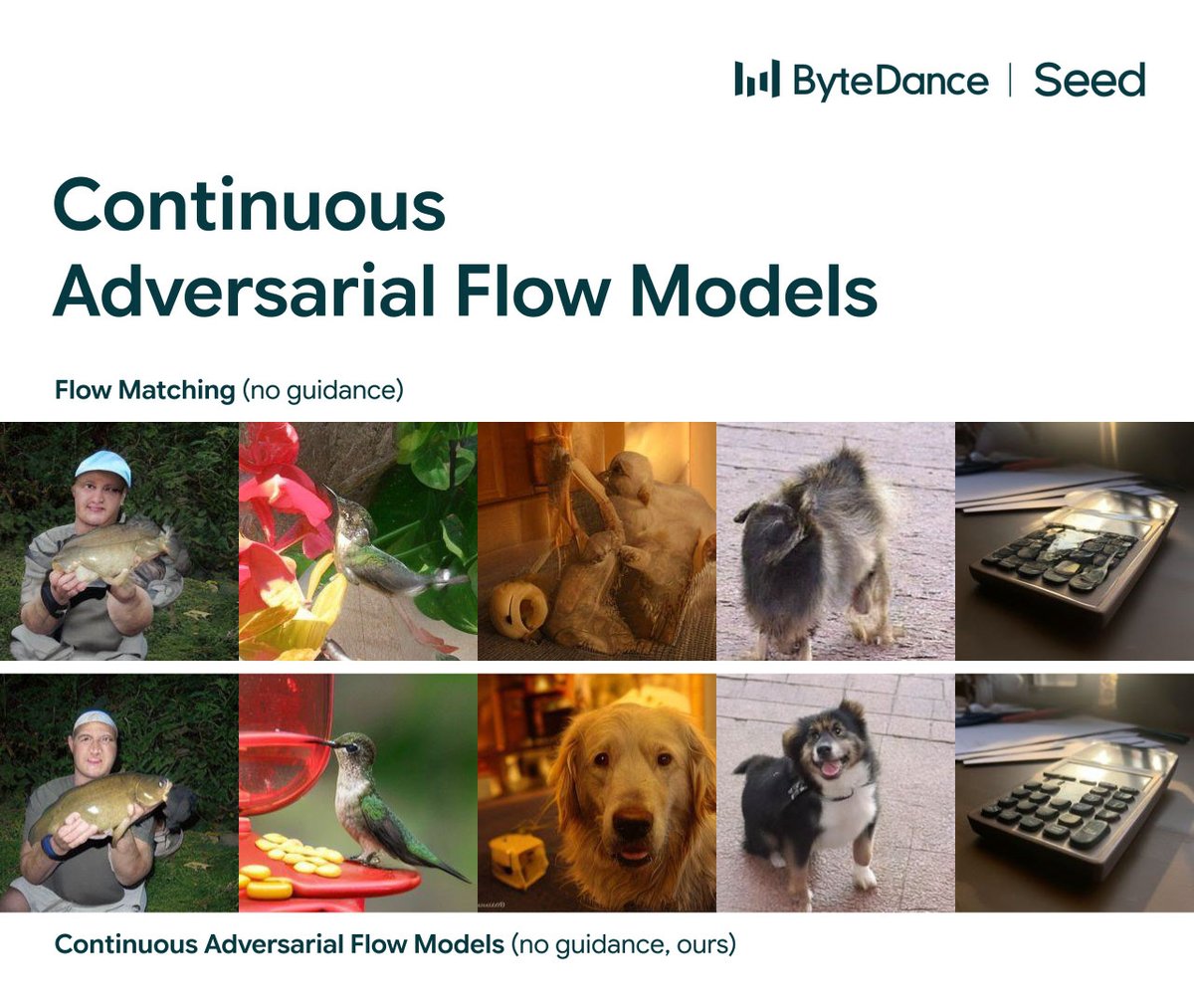
Continuous Adversarial Flow Models (CAFMs) Paper: arxiv.org/abs/2604.11521 Flow matching generates poor samples without guidance because the MSE loss induces incorrect generalization. Instead of an isotropic Euclidean distance, we need a manifold-aware criterion—but how can we obtain it? CAFMs bring adversarial training to continuous time. Learning velocity with a discriminator induces better generalization because the discriminator as a criterion can learn the manifold! Also unlike flow matching’s forward KL objective, adversarial training allows optimizing different divergences. CAFMs can generate sharper and higher-quality samples. Adversarial training in continuous time also avoids the vanishing gradient problem, leading to stable training. CAFMs can be trained from scratch or used to post-train existing flow models. Post-training SiT/JiT for just 10 epochs yields large FID improvements. We also observe significant GenEval and DPG improvements when post-training text-to-image models. More details in this thread!
@Haotianxue_GT Not at all. The model is a continuous-time flow model. It doesn't do few-step inference.
@Jacoed @YouJiacheng Not quite the same. Discriminator projects high dimensional input to a scalar output, and the loss is applied on the scalar, but the transformation is learned and can capture the manifold. This is the key difference compared to fixed isotopic Euclidean distance
The intuition is that, regardless of the method, we need a criterion metric. Most work just use Euclidean distance, but this induces incorrect generalization. We want to switch to some kind of perceptual metric, but this needs to be learned and generalized by another network. If we use a fixed perceptual network, then the generator may exploit the null space, so we have to adversarial train the criterion network too. This becomes GAN-like. Maybe there are better approaches in the future but this was my intuition for researching adversarial methods.
@drscotthawley Thank you! Hope it enables whatever you were trying to explore.
Guidance is not faithful to the original data distribution. CFG can literally drop modes! It can also generate out-of-distribution samples (overly canonical, over exposure, AI synthetic-like instead of photorealistic images) Today we are using guidance to compensate the flaw in the original flow matching objective. CAFMs are trying to "fix" the problem in the first place. Guidance can still be applied on top. We can achieve even better performance with both combined.
I actually have wrote a paper called "Diffusion Model with Perceptual Loss" (arxiv.org/abs/2401.00110) two years ago. The problem of using a fixed perceptual network is that the generator will try to exploit the null space, creating artifacts. CAFMs is my solution to that. With an adversarial approach, the criterion is updated in the loop so the generator cannot exploit the null space.
@junmingong Flow matching is indeed very efficient and scalable for pre-training. But the problem of flow matching is the use of MSE loss, which induces the wrong generalization. CAFMs can be used as a post-training approach. This combines the best of both worlds.
Seedance 2.0 Model Card is out! arxiv.org/pdf/2604.14148

@BryanThornbury The resulting model is more similar to diffusion/flow-matching. The model still predicts velocity and you need ODE/SDE samplers.
@_akhaliq Thanks for sharing! Continuous Adversarial Flow Models brings adversarial training to continuous time. Instead of learning velocity with MSE criterion as in flow matching, we use a learned criterion that captures data manifold. Quick post-training. Better generation!

5. Conclusion and thoughts Our Adversarial Flow line of research explores ways to integrate adversarial modeling and flow modeling, two of the most influential paradigms in generative modeling. Adversarial Flow Models (AFMs) bring adversarial training to discrete-time flow modeling. Now, Continuous Adversarial Flow Models (CAFMs) further extend this idea to continuous time. I think being able to do adversarial training in continuous time will unlock many more interesting explorations! Our method is also different from guidance. Both CAFM and FM ensure convergence to the empirical distribution (i.e., the overfitted ground-truth distribution). They differ only in their finite-capacity generalization, while still remaining faithful to the original distribution. In contrast, guidance does not guarantee faithfulness to the original distribution. Guidance can lead to out-of-distribution (OOD) samples, canonical samples, and other distortions. Accurately and faithfully generating the original data distribution remains an important area of research. We do not claim that CAFMs can always generate high-quality samples without guidance. When training samples are sparse or contain outliers, the manifold learned by the discriminator is not guaranteed to be correct. Guidance can still be applied orthogonally to achieve low-temperature sampling. Recently, representational latent spaces (RAE) have become a popular research direction. These methods change the data space in which flow matching operates and therefore implicitly affect the model’s generalization. However, they do not directly address the problem of MSE and require operating in latent space. CAFMs directly modify the loss objective to induce different generalization and work effectively even in pixel space. Other representation-alignment approaches (REPA), may also have implicit connections to our work. We hope our work inspires further insights in the research community.

JC "Jack" Chen @thejackchan
171 Followers 1K Following Ph.D. @maxplanckpress Informatik @VIACenterSB RoboMaster @CMU_Robotics Ex-intern @RealityLabs @GoogleARVR
Yifan Lu @YifanLu17525599
53 Followers 95 Following Researcher @ NVIDIA Spatial Intelligence Lab PhD Student @ University of Toronto

Zhaoyi Jiang @zhaoyijiang9
1 Followers 62 Following
Haojun Qiu @haojun_qiu
8 Followers 132 Following
deliciousSandwich @mrsirrisrm
130 Followers 6K Following
Shaheer jafri @Shaheerjaf15542
9 Followers 663 Following SIEM | SOAR |Threat Hunting| Malware Analysis | DFIR | DETECTION ENGINEERING
汪志斌 @Wangzhibin1126
0 Followers 66 Following
Kairun Wen @KairunWen
183 Followers 595 Following Incoming PHD Student @ CUHK-MMLAB || Spatial Intelligence & Embodied AI🤖.
frankwang @yuwang719073
0 Followers 146 Following
Karthik Ram @KRAM398
45 Followers 2K Following Here to learn| Optimist | Product Manager @TikTok_Us | Ex- @PayPal, and @Razorpay | Grad@ @CarnegieMellon

Ailing Zeng @AilingZeng81332
524 Followers 161 Following AI Researcher @Anuttacon_ Building multimodal video generation and interactive human-centric systems
Honglin Chen @HonglinChen_
687 Followers 1K Following PhD student in computer graphics @Columbia; previously MSc student @UofT and undergrad @ZJU_China. She/her
eigenome @eigenome
10 Followers 1K Following
Peter Potaptchik @PPotaptchik
359 Followers 439 Following DPhil student at Oxford https://t.co/JH0l4u7wHv


Haojun Chen @chenhaojun001
0 Followers 123 Following

Yulia Rubanova @YuliaRubanova
986 Followers 565 Following I build video models that understand objects, physics, and action. Staff Research Scientist @GoogleDeepMind, Veo Ingredients-to-Video. Co-author Neural ODEs
Niko Zeldenthuis @NZeldenthuis
0 Followers 2 Following
Chaorui Deng @CCCCCCCD01
36 Followers 146 Following
D Yang @DanqingYang99
1 Followers 193 Following



Yong-Hyun Park @hagsaeng_bag
491 Followers 1K Following 1st year PhD. student @CIS_Penn. Prev) MS, BS @SNU Physics Education, Research intern @SonyAI_global, @NAVER_AI_Lab.

He Zhang @zhanghesprinter
482 Followers 281 Following Foundation Model @ Adobe. MLLM for image/video generation/editing. “old” student athlete for 100&200M
Junho @junhoBTC
13K Followers 2K Following 🌎 ECDO Research: https://t.co/dcNHi9OdF1 • ⚡Antigravity/Unified Field Research: https://t.co/Vbaajitby2 • 🟠 ₿

avonaly @avonaly1
8 Followers 288 Following
Xiao Yang @YangZuoshi
306 Followers 404 Following Pricinple research scientist @Canva, focusing on Generative AI. Past @ByteDance @Meta
ryan @ryan8890901185
0 Followers 29 Following
Yongqi Chen @BrianChen112900
193 Followers 659 Following Building real-time interactive video world models prev: Founding Engineer at Morpheus AI(acq. by Roblox) intern @haoailab building FastVideo
g @g9665926721001
71 Followers 3K Following
Andrew Luck @Andrlluuk
0 Followers 2K Following
Felix Krause @felix_m_krause
272 Followers 226 Following PhD Student @LMU_Muenchen (CompVis) | Generative AI

John Twipraham Debbar... @twipraham
0 Followers 16 Following

friday fang @FangFriday
11 Followers 910 Following


Zizu @ZizuResearch
12 Followers 353 Following computer vision | applied research | PhD student | creator of locale |
Bingchen Zhao @BingchenZhao
645 Followers 904 Following PhD student at the University of Edinburgh @ancAtEd @EdinburghVision. https://t.co/WDUG64sGBu
こじま @mmkkey_
86 Followers 294 Following 東京科学大M2/学術バーQ/機械学習研究(三次元領域) Ex-Internship:@TOSHIBA_GroupJP, @DENSO_Corp
Jonathan Ho @hojonathanho
5K Followers 233 Following
Alexandr Wang @alexandr_wang
492K Followers 858 Following chief ai officer @meta, founder @scale_ai. rational in the fullness of time
Alec Radford @AlecRad
71K Followers 302 Following
Chaorui Deng @CCCCCCCD01
36 Followers 146 Following

Di Chang @DiChang10
1K Followers 1K Following PhD @CSatUSC|VSR @Stanford | Intern @MetaAI|Prev. ByteDance Seed @TikTok_US @EPFL @TU_Muenchen| Working on Multimodal Generative Models|
Jack Parker-Holder @jparkerholder
12K Followers 845 Following Research Director scaling world models @GoogleDeepMind, Honorary Associate Professor @UCL_DARK. Dad (🧒👶🐶), CFC fan, BJJ. Views are my own :)
Saining Xie @sainingxie
40K Followers 2K Following cofounder & chief science officer at @amilabs | faculty @nyu_courant | prev: @googledeepmind @meta (fair) @ucsandiego | ynwa
Prime (Shengqu) Cai @prime_cai
2K Followers 617 Following cs phd @stanford | prev. @eth | I work on long context, generative models, and large-scale training infra
Robin Rombach @robrombach
13K Followers 564 Following Krawallkrümel. Generative Models at https://t.co/1xqMb617gc, made with ❤️
AlphaSignal AI @AlphaSignalAI
15K Followers 331 Following The latest news from the top 100 companies in AI. Over 300,000 devs read our newsletter.
Ben Poole @poolio
22K Followers 1K Following research scientist at google brain. phd in neural nonsense from stanford.
Tri Dao @tri_dao
42K Followers 656 Following Asst. Prof @PrincetonCS, Chief Scientist @togethercompute. Machine learning & systems.

Luming Tang @lt453_
2K Followers 3K Following Senior Research Scientist @GoogleDeepMind, core contributor of Gemini Pretraining and Omni Post-training; Prev: PhD @CornellCIS, BS @Tsinghua_Uni
David @DavidSHolz
103K Followers 10K Following founder @midjourney, previously founded leap motion, before that was at nasa and max planck - vibeposting @davidvibesonly
Zeqi Xiao @zeqi_xiao
550 Followers 435 Following Ph.D. student@MMLab, Nanyang Technological University .
Albert Pumarola @AlbertPumarola
1K Followers 591 Following Researcher & Manager @Meta Superintelligence Labs
Daniel Geng @dangengdg
2K Followers 966 Following Research @OpenAI, Sora videogen. Previously @UmichCSE, @GoogleDeepMind, @MetaAI, @berkeley_ai
Sander Dieleman @sedielem
68K Followers 2K Following Research Scientist at Google DeepMind (WaveNet, Imagen, Veo). I tweet about deep learning (research + software), music, generative models (personal account).
Jiatao Gu @thoma_gu
6K Followers 2K Following Assistant Prof @CIS_Penn and Staff ML Researcher at @Apple (MLR) | ex-FAIR | PhD @HKUniversity | Research on Generative AI & World Models. また、日本語もできます。
Jun-Yan Zhu @junyanz89
13K Followers 681 Following Assistant Professor at Generative Intelligence Lab @CMU_Robotics @CarnegieMellon. Understanding and creating pixels.
Doyup @ CVPR @doyup_lee
497 Followers 503 Following Exploring toward the next level of visual content creation. Ex @runwayml as a Foundational Contributor of Gen-3 alpha, Frames, and Gen-4. Opinions are my own.

Minguk_Kang @minguk_kang
694 Followers 1K Following Founding Research Scientist @pika_labs, PhD at POSTECH, First Author of GigaGAN | Built PikaStream1.0
Jianwen Jiang @unseenvie
344 Followers 60 Following

DailyPapers @HuggingPapers
19K Followers 4 Following Tweeting interesting papers submitted at https://t.co/rXX8x0HzXV. Submit your own at https://t.co/QhbJKXBd4Q, and link models/datasets/demos to it!
Xun Huang @xxunhuang
6K Followers 578 Following Technical Director @Roblox. Founder of Morpheus AI (acquired by @Roblox). ex-Adobe/CMU/NVIDIA/Cornell. Video world models.
Michael Saylor @saylor
5.1M Followers 816 Following Bitcoin is https://t.co/KbbYe74DgB | Largest $BTC Hodler | @Strategy Founder & Chairman | bio https://t.co/9Zlq0oHYnP | free education https://t.co/4L1s0ix7FE | $MSTR $STRC
Jianyi Wang @Iceclearwjy
431 Followers 208 Following Researcher @Apple | PhD @MMLabNTU | Ex-intern @ ByteDance Seed | BS/MEng @beihang1952
Jon Barron @jon_barron
34K Followers 1K Following Principal research scientist at Google DeepMind. Synthesized views are my own.
Rohan Choudhury @rchoudhury997
832 Followers 618 Following model training @cognition https://t.co/pjU847PL2f
Andrew Carr 🤸 @andrew_n_carr
26K Followers 5K Following co-founder leading science @getcartwheel co-founder advisor @arcade_ai Past: Codex @OpenAI, Brain @GoogleAI, world ranked Tetris player

OpenAI @OpenAI
4.9M Followers 4 Following OpenAI’s mission is to ensure that artificial general intelligence benefits all of humanity. We’re hiring: https://t.co/dJGr6LgzPA
Marques Brownlee @MKBHD
6.1M Followers 483 Following Web Video Producer | ⋈ | Pro Ultimate Frisbee Player | Host of @WVFRM @TheStudio
Xiao Yang @YangZuoshi
306 Followers 404 Following Pricinple research scientist @Canva, focusing on Generative AI. Past @ByteDance @Meta
BingchenLiu @ResearcherBruce
21 Followers 167 Following AI Researcher @ https://t.co/OFfW7i7yWp | ex Researcher @ Playground AI & Bytedance | Ph.D. @ Rutgers University
AK @_akhaliq
504K Followers 3K Following AI research paper tweets, ML @Gradio (acq. by @HuggingFace 🤗) dm for promo ,submit papers here: https://t.co/UzmYN5XOCi
Roni Sengupta @SenguptRoni
3K Followers 932 Following Asst. Professor @unccs, Prev. postdoc @uwcse (UW), Ph.D. @umiacs (Univ. of Maryland). Computer Vision & Graphics (she/her)Trends for United States
You might like