Fystack @fystack
Fystack helps Web3 projects, fintechs & stablecoin issuers automate digital asset workflows across multiple chains at scale — secure, compliant, self-hosted. fystack.io github.com/fystack Joined March 2025-
Tweets898
-
Followers261
-
Following79
-
Likes442
Unlike the US or Europe, Singapore doesn't need crypto cards to replace banks. Its payment infrastructure already works. So why are crypto cards still growing? Because in Singapore, they're becoming an income and treasury tool, not just a payment tool. In our latest research, we compared the leading crypto cards available in Singapore by: • FX fees • Cashback (advertised vs. realized) • MAS licensing • Custody model • Tax treatment • Best card for different user profiles One takeaway stood out: For many Singapore users, FX fees matter more than cashback. Frequent travel across Southeast Asia can easily save more than chasing reward rates tied to volatile tokens. Read the full guide here: fystack.io/blog/best-cryp… #Stablecoins #CryptoCards #Singapore #Payments #Fintech #Web3 #USDC #DigitalAssets #Fystack

Will your competitive advantage still exist in five years? Launching a stablecoin is getting easier. Building merchant distribution, payment orchestration, network effects, and switching costs isn't. That's why Stripe's reported bid for PayPal isn't just another M&A story. It's a reminder that the next phase of competition won't be about who issues another stablecoin. It'll be about who owns the layers between the infrastructure and the customer. In this article, we break down the four layers of the modern stablecoin payment stack and explain why they matter for banks, fintechs, payment providers, and infrastructure teams planning their long-term strategy. Read the full analysis: fystack.io/blog/stripe-vs… #Stablecoins #Payments #Fintech #DigitalAssets #PaymentInfrastructure

𝗪𝗵𝗮𝘁 𝗩𝗶𝘀𝗮'𝘀 𝗦𝘁𝗮𝗯𝗹𝗲𝗰𝗼𝗶𝗻 𝗣𝗹𝗮𝘁𝗳𝗼𝗿𝗺 𝘀𝘂𝗽𝗽𝗼𝗿𝘁𝘀 𝘁𝗼𝗱𝗮𝘆. Launched in beta on July 16. Open USD only, no other stablecoin supported. Live on Ethereum, Solana, and Tempo. Access requires an existing Visa Access ID and Business Identification number. No public sign-up yet. API access is listed as "coming soon." Pricing is not disclosed. Full details below 👇

𝗩𝗶𝘀𝗮 𝗷𝘂𝘀𝘁 𝗹𝗮𝘂𝗻𝗰𝗵𝗲𝗱 𝗮 𝘀𝘁𝗮𝗯𝗹𝗲𝗰𝗼𝗶𝗻 𝗽𝗹𝗮𝘁𝗳𝗼𝗿𝗺. 𝗜𝘁 𝗱𝗼𝗲𝘀𝗻'𝘁 𝗿𝗲𝗽𝗹𝗮𝗰𝗲 𝘆𝗼𝘂𝗿 𝗰𝘂𝘀𝘁𝗼𝗱𝘆. Visa opened its Stablecoin Platform in beta, offering Open USD to its existing enterprise clients. Under one path, Visa moves the fiat. Your existing custody provider still holds the keys. That's exactly the model Fystack runs on: self-hosted custody that stays yours, on any stablecoin, any chain, no platform lock-in. One asset platform. Full-stack custody. Read the full breakdown: fystack.io/blog/visa-stab…

A blockchain outage doesn't always mean lost funds. But it can still become an operational nightmare. For exchanges handling USDC on Base, there are two risks to prepare for: - A sequencer halt stops transactions for everyone, while funds stay safe. - A USDC freeze locks one specific address, while the chain keeps running. Neither MPC nor self-hosted custody removes these risks. The real question is different for each one. A sequencer halt hits every user at the same time, regardless of architecture. A freeze does not have to. ↳ With a shared hot wallet, one frozen address can lock funds for thousands of users. ↳ With dedicated, isolated addresses, a freeze stays contained to one customer relationship. Custody is not only about protecting keys. It's about designing infrastructure that limits how far one failure spreads, where that's actually possible. Read our breakdown of Base sequencer risks, USDC freeze mechanics, and what exchanges should consider when scaling custody: fystack.io/blog/base-usdc… #Stablecoins #CryptoCustody #BlockchainInfrastructure

Most teams entering Asia use one go-to-market playbook for six different markets. That's why most of them stall. Vietnam runs on licensed exchanges. Philippines runs on trust inside apps people already use. Indonesia runs through one consortium. Singapore runs on licensing. Hong Kong runs through banks. South Korea runs through exchanges first, banks second. 𝐖𝐡𝐚𝐭 𝐚𝐜𝐭𝐮𝐚𝐥𝐥𝐲 𝐰𝐨𝐫𝐤𝐬 ↳ Vietnam: partner with one of five licensed exchanges, don't compete with them ↳ Philippines: become the infrastructure behind Maya or GCash, not a new wallet ↳ Indonesia: join the ICEx consortium instead of building standalone ↳ Singapore: get an MAS license, or build on rails that already have one ↳ Hong Kong: the door is banks, not consumer apps ↳ South Korea: exchanges get you in, banks are where you stay Translating your product into six languages is easy. Matching six different entry points is the actual work. We broke down the real data and entry paths for each market fystack.io/blog/why-stabl…
We mapped the AML and Travel Rule requirements across Singapore, Vietnam, Indonesia, Thailand, and the Philippines as of mid-2026. The gap between the strictest regime and the most closed market in the region is enormous, and it's not just about capital. 𝗪𝗛𝗬 𝗧𝗛𝗜𝗦 𝗠𝗔𝗧𝗧𝗘𝗥𝗦 A custody architecture built for Singapore doesn't automatically clear Vietnam's capital bar or Indonesia's custodian mandate. Every market sets its own cold storage ratio, its own reporting threshold, its own cost of entry. Institutions expanding across SEA aren't solving one compliance problem. They're solving five, at the same time. Full breakdown in the chart below 👇 #RegTech #DigitalAssets #SoutheastAsia #Compliance #Custody #Stablecoins

95% isn't just a security best practice. In Japan, it's a legal requirement for crypto exchanges. Japan's stablecoin framework doesn't apply the same custody rules to every participant. Crypto exchanges, stablecoin distributors, and trust issuers each operate under different regulatory obligations. In our latest guide, we explain: - The 95% cold storage rule - How foreign stablecoins like USDC enter the Japanese market - Common misconceptions about Japan's Travel Rule - What changed under the 2026 regulatory updates If Japan is on your expansion roadmap, this guide is a good place to start. fystack.io/blog/japan-sta…

Getting licensed is only the beginning. Keeping your custody infrastructure compliant across multiple Southeast Asian markets is the harder challenge. Our latest guide compares licensing, AML, Travel Rule, and data residency requirements across five jurisdictions. Read more: fystack.io/blog/southeast…

Many fintechs see compliance as something to add later. That decision becomes more expensive as the business grows. Every new regulation can mean another integration, another vendor, and another layer of operational complexity. The teams that scale successfully don't treat compliance as an add-on. They build it into their infrastructure from day one. As APAC regulations continue to evolve, that approach is becoming less of a competitive advantage and more of a business requirement. Read more → fystack.io/blog/apac-fint…

Many fintechs think the biggest cost of compliance is buying another KYT solution. It usually isn't. The hidden costs often appear later: • More vendors to manage • More systems to integrate • More operational complexity as regulations evolve Our latest blog explores why compliance becomes much harder when it's added after the product has already scaled. Read more → fystack.io/blog/apac-fint…

Stablecoin isn't just changing payments. It's changing how fintech teams think about infrastructure. #Visa and #Mastercard arrived at two completely different answers. One bought the stack. The other scaled through partners. Neither strategy is universally right. It depends on what you're optimizing for: speed, control, capital, or compliance. We put together a simple infographic breaking down the trade-offs and a deeper article explaining when to build, partner, or buy stablecoin infrastructure. Full analysis: fystack.io/blog/visa-vs-m… #Stablecoin #Fintech #Payments #Infrastructure #DigitalAssets #Fystack
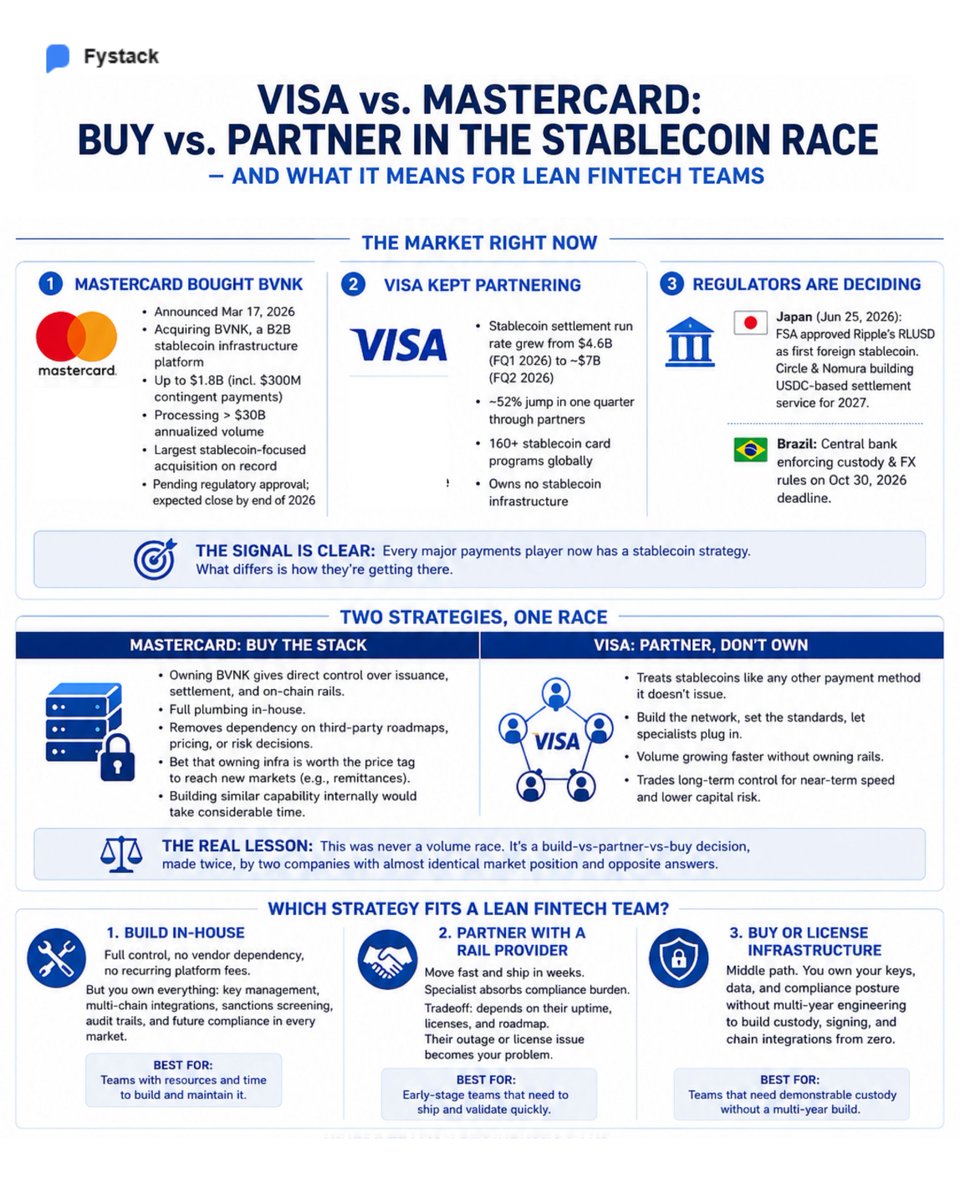
Mastercard spent 1.8B USD to buy stablecoin infra. Visa spent almost nothing and still grew faster. Same market. Same opportunity. Two opposite strategies. Build vs buy vs partner is not theory anymore. It is happening at global scale. Full breakdown 👇 fystack.io/blog/visa-vs-m…

If you're building a stablecoin business in Southeast Asia, here's one mistake that can quietly kill your expansion plans: Treating Southeast Asia as a single market. Vietnam, Singapore, Indonesia, Thailand, Malaysia, and the Philippines all have completely different rules around stablecoins, licensing, Travel Rule implementation, data localization, and foreign operator access. The challenge isn't understanding six regulations. It's making one cross-border payment that complies with all six. In this guide, we break down: • The stablecoin framework in each major SEA market • Vietnam's new pilot regime and what it means for foreign companies • Where the FATF Travel Rule creates operational friction • Why data localization is changing custody architecture • The infrastructure decisions businesses should make before entering the region If Southeast Asia is part of your expansion roadmap, this should save you weeks of research. Read here: fystack.io/blog/one-regio…
A lot of crypto teams make the same mistake: They answer trust questions with technical answers. User: "What happens if your company disappears?" Team: "We use MPC with threshold signatures..." Wrong conversation. This guide covers the 7 custody questions users actually ask, what each question is really probing for, and how to answer in plain English. fystack.io/blog/the-7-cus…

Fystack’s open source policy engine sits right at the signing layer to evaluate rules independently, blocking unauthorized transactions. Read the full guide: dub.sh/ai-agent-guard…
Fintechs are standardizing six layers of defense to secure these wallets: 1. Spending limits 2. Allowlists 3. Approval workflows 4. Policy engine enforcement 5. On-chain rules 6. Virtual cards. Together, they ensure an agent never gets unlimited signing power
By 2028, 1 in 4 enterprise breaches are projected to come from AI agent exploitation. It is time for agent payment infrastructure to get a serious upgrade. 🧵


Alex Vu @alexvu05
0 Followers 24 Following

M.Namvar @mhdnamvar
74 Followers 241 Following Software engineer, currently deep in crypto custody, DKG, MPC and threshold signing.
Trương Thảo Nhi @t_nhii_
5 Followers 91 Following Hub Admin @sqrDAO | FinTech Student at DUE. Passionate about Web3 & digital assets. DMs always open
barkira.eth @rafaelescrich
243 Followers 3K Following Writing @ https://t.co/FNUtqIhUKv CTO @ https://t.co/dRZae8SCbr Founder @ https://t.co/wb7dr9J5g9 Founder @ https://t.co/7ArnmUlB3t
OUTLAW STAR @StrangerMontana
457 Followers 3K Following EVM Enjoyer, Security Researcher, former intern @ KannAudits, Rektoff cohort 5
𝗗𝗔𝗩𝗜𝗗 ... @BiggieCryptoo
818 Followers 499 Following Video Creator / Editor All video repost here are my work
Rami @0x18a6
788 Followers 5K Following
Adevar Labs - Securit... @AdevarLabs
1K Followers 75 Following Blockchain Security Firm | Rust, Solidity, Move, and beyond. Vulnerability discovery, practical remediation, and complete audit reports | Ship Safely. 🚀
Andrew Mocol | Founde... @TheMocolicious
27 Followers 181 Following building @altudeso wallet infrastructure that doesn’t suck | professional 🐐 herder

Unni U @UnniU12
5 Followers 139 Following
Mahesh_-_ Singh @MaheshS71380887
29 Followers 212 Following
Suralal @lalsuralals
113 Followers 397 Following
Parveen Kumar @PawanKumar33593
74 Followers 1K Following
Magicyang @yangyu365
394 Followers 8K Following
Bartosz @lllbarteklll
87 Followers 265 Following


Walker 🐂🀄 @skywalker0x1
77 Followers 755 Following
Matt Sim @RVAClassic
9K Followers 6K Following curr-@operatoruplift @superteamtalent @superteammy @kastxyz @ourbit @nansen_ai @nomadzxyz | ex-@xset @sbusinessgaming @velocity_usa @otfgaming @ooblestudio
Danki 🐴 ( Tin Eris... @0xDankiii
665 Followers 1K Following cryptographic agility | ethereum philippines | devrel / devex | web3 ux | random photos https://t.co/CAjZJIUdyE
Gian Alarcon @gianmalarcon
420 Followers 1K Following CTO & Cofounder @0xQash Previous @TheMarquisOnX
Lisk SEA @LiskSEA
846 Followers 68 Following Growing @Lisk in Southeast Asia – the growth platform for Founders. Bootcamps, Hackathons, Incubators, and a $15M fund to accelerate and grow startups.
NatWeb3 @National_Web3
5K Followers 3K Following Passionate about the future of Web3. Building the decentralized world, one tweet at a time. #NFTs #DAO


Tuan Pham Minh @tuanpmhd
929 Followers 943 Following Product Engineering | Digital Assets | Technical Consulting | DevRel | Prev: @ShagaLabs @SuperteamVN @KrystalDeFi | building @solana_devs_vn
samlaf @samlafer
2K Followers 2K Following @SeismicSys doing TEE stuff | Prev @Eigenlayer @eigen_da | https://t.co/A6wyWF0iwh


0x7Jay⚡️ @0x7Jay
736 Followers 532 Following @ForbesWeb3 | Solar Member 🟣 Venture | Web3 Chaplain | Advocate @Tiny__Vikings | Lead @CW3UK | @SuperTeamUK | Customer Service @Bitcoin__Angels
Michael @buochanlangle
14 Followers 67 Following

Liam @Liam_1701
1K Followers 2K Following 989898.atm | Research Analyst at @HouseofChimera | Council member at @Contra_HUB
Yann @0xYann_
2K Followers 3K Following Powering trading desks on Solana with @polarislabxyz & @rpcedge


Đức Châu - BBO | ... @DucChauB
367 Followers 693 Following - Community Manager at: https://t.co/YSeau49GUw - BBO - Tre Viet Bamboo Pool - ENO WMT 140 - VietEn - Leader : Tre Việt Team
Bamboo Labs @BambooLabsXYZ
439 Followers 387 Following Cardano Stake Pool Operator "BBO" https://t.co/VVsnCmv6BO
Annie @minhlaPhuongne
640 Followers 955 Following Content Creator | From @BambooLabsXYZ 🇻🇳 | Blockchain | SPO: BBO | Midnight ambassador
Coin Interest Rate @cointerestrate
163 Followers 521 Following Earn more crypto. Tracking 80+ earn, stablecoin, lending and staking platforms.
ddadybayo @ddadybayo
2K Followers 3K Following research & strategy - @unstoppablebyhs | freedom maximalist | 🇰🇬
Begin App @BeginWallet
6K Followers 863 Following Your money, onchain. Lightning fast, super secure & easy to use! Available for $ADA, $BTC & $SOL. Download now. Also building @AgentWalletHQ and @BlockSign_io
xfajarr @fajarr0x
2K Followers 7K Following dev @monklabsio | prompt engineer @octora_xyz | maintain https://t.co/N2YeVwmE81 | @dev3pack fellow
Halifa Aminu salihu @Halifaaminu2001
281 Followers 7K Following BELIEVE IN ALLAH !!! AND HIS PROHPHET MUHAMMAD S. A. W THIS IS MY SIGN 🕋🏰💒⏲️🌃🇳🇬 @nexchain_ai
0xKMG base.eth .ink �... @kmgrizvo
255 Followers 3K Following Exploring the wild side of web3 | NFT enthusiast & blockchain adventurer | Building dreams onchain. $ANITA Army @ANITAONINKCTO All in crypto .
facai579 @youzi579
68 Followers 832 Following
Philip Martin @SecurityGuyPhil
6K Followers 329 Following CISO @ Uber. Army Veteran. Maker of delicious smoked meats and baked goods.
Unchained Summit @UnchainedSummit
506 Followers 482 Following #1 Web3 events for High-impact Networking & Deal-flow. An event series by @AeternumInc. Up next: Dubai & India
Cris D. 🐲 @Cris7ran
1K Followers 477 Following 1️⃣ Builder fr 2016 2️⃣ Core Contributor @Opencampus_xyz APAC @Bleeep_xyz 3️⃣ Founding Board @MoneyFiHub 4️⃣ Proud SMU Mustangs & Dallas Cowboys

Rork @rork
59K Followers 12 Following Build your mobile app, publish to App Store in 2 clicks, and start monetizing at https://t.co/OyihjiOtUz

Adi | Resolved Market... @AdiFlips
7K Followers 2K Following backtest your polymarket strategies https://t.co/H28pRsYDoY • undergrad @iitguwahati

DeFi Warhol @Defi_Warhol
44K Followers 2K Following Tiering everything in crypto 5k MMR in research 15k MMR based tier list enjoyer Contributor https://t.co/1tdubpIzwr KOL fren @GREEND0TS
Founders Inc @fdotinc
88K Followers 320 Following Where the world’s most ambitious founders start. https://t.co/A2T3O6Vilb Apply to join & get funded: https://t.co/538DrnALuR
Fizen @fizenapp
90K Followers 627 Following The crypto neobank where USDT actually spends: QR payments, eSIMs, remittances, US stocks. Backed by Tether. 📲 App: https://t.co/4nsiNNlGU7
Colosseum @colosseum
61K Followers 113 Following Crypto’s premier hackathon, accelerator, and venture fund | https://t.co/WWP873LOWX
Tonik @TonikBank
2K Followers 9 Following The Ph’s first digital bank on a mission to revolutionize banking in SEA. Experience best-in-class 24/7 neobanking on a highly secure app.
WorldFirst @WorldFirstLtd
3K Followers 2K Following Global payment platform for entrepreneurs. 40+ currencies. 200+ countries. Trusted by 1.6M+ businesses.
nibel.base.eth @Nibel_eth
36K Followers 3K Following APAC Regional Lead @baseapac | Markets Content @base
Max Kaplan @maxekaplan
7K Followers 1K Following Investor | Exited Founder | fmr @solstrategies @orangefincrypto (acq) @krakenfx

Polkadot Devs @PolkadotDevs
40K Followers 154 Following Welcome to the @Polkadot Developer community. Stay updated with tools, events, and pioneering ideas 💡 Build. Collaborate. Innovate. 🌐

Squads @multisig
38K Followers 418 Following Building the next generation of financial services. Home to @altitude, @fusewallet and Solana’s leading multisig solution.
Wormhole Vietnam @WH_Vietnam
309 Followers 179 Following Tài khoản vận hành bởi Wormhole Việt Nam mang đến những cập nhật mới nhất về Wormhole. Tham gia kênh chat tiếng Việt ở Discord: https://t.co/DaqAI7a6HG
ChatterPay @chatterpay
2K Followers 50 Following ChatterPay allows anyone to use crypto with just WhatsApp messages.


pratikbin.node @pratikbin
2K Followers 4K Following Building CreateOS by @NodeOpsHQ | Contributor @BuildOnNodeOps | slyly outsmarting infra chaos with cloud wizardry | 👨
Phuc Source 🐉🔥 @phucsource
144 Followers 1K Following Build @wannaplayglobal, empowered by @superteamvn | ex-Community Builder @theayacommunity
Monad @monad
1.2M Followers 246 Following Layer 1 blockchain bringing parallel execution to the EVM || 10,000 TPS || account by Monad Foundation || https://t.co/oM9xT93LGf
Boring Security @BoringSecurity
23K Followers 215 Following Powered by ApeCoin - Security Awareness Public Good for Web3/NFTs and beyond We provide free classes, security awareness, and track scam/hack trends in Web3.
catapulta @catapulta_sh
517 Followers 345 Following


Decal — Stablecoin ... @useDecal
4K Followers 77 Following Stablecoin payments, stored value, & loyalty for merchants. Powered by @Solana. App: https://t.co/J0yHJzubnq

Aptos AlphaTeam @AlphaTeamAptos
4K Followers 150 Following An open community for Vietnamese builders, influencers, grantees, and anyone making moves on @Aptos. No token. No treasury. Just vibes and action
David @david_in_web3
2K Followers 929 Following Just build things! Cooking at @lpagent_io Prev @PolyquestSOL | @mattlefun | @fdn_labs | @fizenapp | @tradedotfun_sol From @Superteamvn @SuperteamKorea
valens @suppvalen
8K Followers 2K Following applied cryptography • AEO • security research • technical advisory building https://t.co/nqwIs9h4L7 AI agents & post-quantum systems views my own

Metasal aus/acc 🦘 @metasal
12K Followers 9K Following nonCMO @solana | Builder | 40+ tools, apps & experiments shipped | founder @solanaANZ | prev @squadslabs @exodus | creator @soldotnew @devrelsxyz @programwatch
Pablo Sabbatella @PabloSabbatella
83K Followers 4K Following Web3 Operational Security researcher 🥷 @opsek_io founder 🕵 @_SEAL_Org member 🦭 @SecuritySeries host 🎙️ We train and audit teams so they don't get hacked 🥷
Thanh Nguyen @redragonvn
3K Followers 615 Following Founder at @Verichains and @vnsec, ex-CPU hacker/security architect at @Intel, hacker at @hackerschoice
Thorsten Ball @thorstenball
50K Followers 1K Following Author of https://t.co/arW0hnWcIy and https://t.co/RN9xXOzPEl. Working on @ampcode. Writing https://t.co/0SZD6dcj40.
Simon @realsimon
10K Followers 886 Following Head of Growth @alliance | prev @valiucom @ycombinator | Creator of the 1st stablecoin fintech in LatAm and BTC-backed stablecoin.
Solana Pay @solanapay
18K Followers 144 Following Powering digital payments across Solana and beyond! Account managed by @MoonPayCommerce
Vishal Kankani @kankanivishal
7K Followers 892 Following Investing in enhancing human & machine coordination, prev: @multicoin

Haun Ventures @HaunVentures
24K Followers 23 Following Backing the founders building the future of finance.
TuongVy Le @TuongvyLe12
8K Followers 1K Following General Counsel @veda_labs, nerding out @DEXintheCityPod

Patrick Collins @PatrickAlphaC
113K Followers 5K Following Co-founder of 🛡️@cyfrin | 🟪 @soloditofficial | 🦅 @codehawks | 🎓 @cyfrinupdraft | ⚔️ @battlechain
Mad Squad @MadSquadGame
2K Followers 480 Following MAD SQUAD is the first and one of the most exciting shooter games using blockchain technology where heroes and robots compete in futuristic arenas.Trends for United States
You might like