RJ @c2bsolution
Founder of @FundiProtocol | Building apps onchain for public good starting with Funds for Humanity 🌱🌎 Views are my own linktr.ee/FundiLabs Joined May 2022-
Tweets1K
-
Followers2K
-
Following513
-
Likes7K

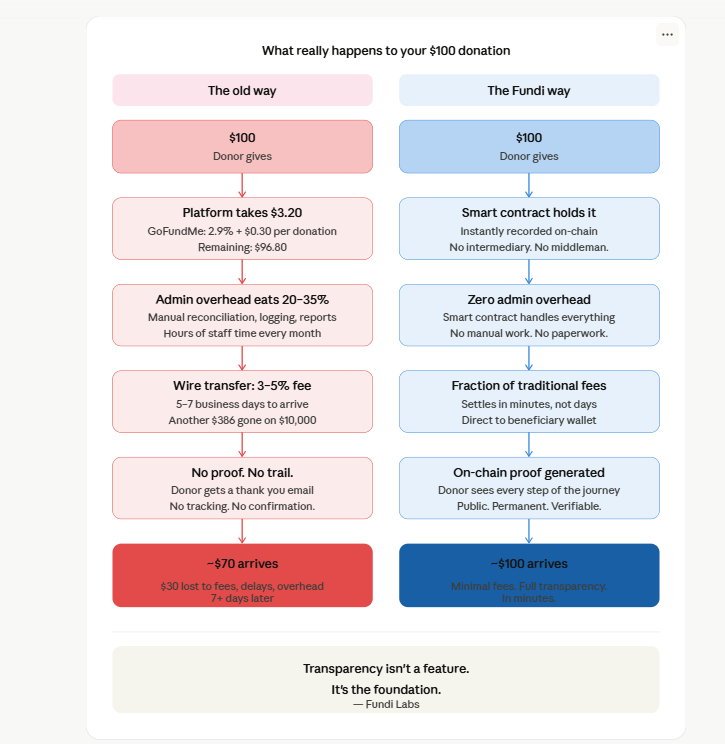
And here is the number that should make every impact organisation stop scrolling. $736. That is how much disappears from a $10,000 campaign before a single beneficiary receives anything. Platform fees, wire transfer costs, & admin overhead. All of it quietly extracted by a system that was never designed to protect the mission. Not in one dramatic moment. In small, invisible cuts that nobody talks about because everybody assumed this was how fundraising works. This isn't how it needs to work. The family in Uganda waiting for flood relief is not concerned with correspondent banks or quarterly reconciliation cycles. They care whether the money arrived when it arrived. And whether anyone can prove it did. That is the only metric that matters. Everything we are building at Fundi Labs starts and ends there.
The infrastructure that moves charitable money around the world was not built for the people receiving it. It was built for banks, platforms, & intermediaries who sit between a donor's generosity and a beneficiary's need, and collect their fee at every step of the journey. Here
EPISODE 2 Nine years ago, a group of nonprofit leaders, fraud experts, and government officials had to gather in a room just to convince the sector that charity fraud was real. The idea was met with disbelief. Nine years later, 42% of charities were victims of fraud in 2024. And half of every fraud detected was committed by people already inside the organization - Staff, volunteers, & trustees. The people donors trusted most with their money. I want you to sit with that for a moment because this is not a story about scammers in basements posing as charities. This is a story about the finance manager who has been with the organization for eight years, the volunteer coordinator everyone loves, and the trustee who sat on three boards and stole from all of them. One fraud expert put it plainly: "People don't stop committing fraud in just one instance. If the charity does not report the behavior out of fear of attention, the fraud will be repeated at the next nonprofit that hires the person." A sad, recurring theme. His words, not ours. And then there is the case that stopped me cold when I first read it. Women's Cancer Fund collected over $18 million from donors who believed they were helping women undergoing cancer treatment. Only about one cent out of every dollar donated actually reached those women. The rest went to the charity's operator, to fundraisers, to people who had nothing to do with cancer and everything to do with the money. One cent out of every dollar. And for years, nobody knew. This is the part that keeps us up at night. Not that the fraud happened. Fraud happens everywhere there is money and insufficient oversight. What keeps me up is the donors. The person who skipped lunch to donate $20. The diaspora family that sent $100 to help someone going through what their mother went through. They had no way to know; the system was never built to show them. But we are not in that era anymore. The technology exists today to make trust unnecessary, not because people are bad, but because proof is better than faith when someone's survival depends on it. That is what Fundi Labs is built on. Every donation is recorded onchain the moment it is made. Smart contracts that hold funds and release them automatically based on conditions set before the first dollar arrives. A trail that is public, permanent, and impossible to alter at 11 pm on a Tuesday quietly. Not an audit that arrives six months later. Or a report that includes a summary of what has already happened. Real-time, verifiable proof for every dollar, every step, every time. We are not building Fundi because we think impact organizations are dishonest. We are building it because the honest deserve a system that proves it - automatically, continuously, without anyone having to take their word for it. And the donors who give deserve to know their one cent became one dollar. Every single time. Follow us to stay in the know. fundilabs.io
EPISODE 1 In 2024, international humanitarian assistance fell by nearly $5 billion, the largest single drop ever recorded. X By mid-2025, less than 17% of the $46 billion needed to meet global humanitarian needs had been received. Facebook The UN's own Emergency Relief


There's a reason donor retention rates in the nonprofit sector average just 43%. People give once, wait for proof their money did something, and when that proof never comes, they move on. It's not that donors are stingy. It's that most fundraising platforms were never designed to close the loop between giving and impact. @FundiProtocol was built around one simple idea: every donor deserves to see the full journey of their gift. From the moment it leaves their hands to the moment it changes someone's life. When donors can see that, they don't just give again. They give more. They tell their friends. They become advocates for your cause. Transparent fundraising isn't just an ethical choice. It's the smartest growth strategy an impact organization can have right now.
Most nonprofits ask their donors to simply trust that the money arrived. No real proof, just a thank you email and maybe an annual report months later. But donor trust is getting harder to earn, and easier to lose. The organizations winning right now are the ones who can show their donors exactly where every dollar went, who received it, and when. Not as a promise, but a verifiable proof. That's what tokenized fundraising makes possible. Every donation recorded onchain, visible in real time, impossible to dispute. @FundiProtocol was built for impact organizations who are ready to stop asking for trust, and start earning it.
A lot of people hear “smart contracts” and immediately think about automation. But automation by itself doesn’t solve much if the incentives inside the system are still misaligned. You can automate a broken workflow and still end up with delays, uncertainty, and coordination problems. That’s why we think the bigger opportunity isn’t just smart contracts individually. It’s what happens when contracts operate as part of a connected system. Where: ~ execution doesn’t depend on constant follow-ups ~ incentives are aligned across participants ~ outcomes can be verified without extra coordination ~ and every action strengthens the reliability of the network itself That changes the role of infrastructure completely. Instead of systems being held together by trust and manual oversight, they start operating more like environments with built-in logic and accountability. That’s the direction we’re moving toward at Fundi Labs. Not just programmable contracts, but programmable coordination.
The goal isn’t just to move capital. It’s to know where it is at any moment, what it’s been used for, and what’s actually been completed, without having to ask anyone. Because moving money is easy. What’s hard is everything that comes after. Following up, waiting for updates, trying to match what was supposed to happen with what actually did. That’s where most of the friction lives. And it usually doesn’t show up at the start. It shows up as things grow. ~ More transactions. ~ More people involved. ~ More expectations around reporting and accountability. Now every answer takes a bit longer to get. Not because the team isn’t working, but because the system doesn’t give you that visibility directly. So everything becomes a process of checking and confirming. And over time, that becomes the real work. Not moving capital, just keeping track of it. That’s the gap. The difference between a system that can send funds, and one that lets you see, clearly and immediately, what’s happening with them. Because at scale, you don’t just need movement. You need clarity that doesn’t depend on coordination.
Trust is not a system, but a risk decision. We talk about trust like it’s a foundation. But most of the time, it’s just what we fall back on when there’s no clean way to verify what’s happening. And early on, that’s fine. When things are small, you don’t need much structure. You can ask questions, get answers quickly, and move on. So trust feels natural. It starts to break when the system grows. More money moving, people get involved, & more steps between where something starts and where it ends. That’s when you notice something subtle. You’re no longer seeing things directly; you’re hearing about them. Through updates, reports, or someone confirming that “it’s been handled.” And most of the time, it has. But the gap remains because the system doesn’t give you visibility by default. It’s asking you to accept a level of uncertainty and move forward anyway. Not certainty, just a willingness to proceed without it. The problem is that it works right up until you need a clear answer. When something doesn’t line up, timing matters, & someone asks a question that shouldn’t take long to answer, but does. That’s when the cost shows up. Because the system was never built to make things obvious in the first place, everything has to be checked after the fact. That’s the shift happening now. Less focus on whom you trust and more focus on whether the system itself makes things visible and verifiable as they happen. Not as a feature, but the default way it works. Because over time, that gap between “we trust it” and “we can see it” gets harder to justify. Curious, do you think trust still holds up at scale, or does it eventually need to be replaced by something more concrete? Follow Fundi Labs for more
Why More Funding Often Creates More Complexity, Not Clarity There’s a common assumption in impact funding and capital allocation: more funding should lead to more clarity, better execution, and stronger outcomes. In practice, that’s not always what happens. What we often see instead is that complexity outpaces the systems designed to manage it. At an early stage, operations are relatively straightforward. Funding sources are limited, programs are easier to track, and reporting can be handled with a combination of internal coordination and basic tools. As funding grows, the environment changes. Organizations are managing: * multiple funding sources with different requirements * a wider range of programs and allocations * increased expectations from donors, partners, and stakeholders * more frequent and detailed reporting cycles Without corresponding improvements in infrastructure, this creates pressure on existing systems. A few patterns tend to emerge: 1. Infrastructure lag: Processes that worked at a smaller scale begin to break down as volume increases. Reporting becomes slower, and visibility into financial flows becomes less immediate. 2. Fragmented data: Information starts to live across multiple systems, teams, and formats. Different stakeholders may be working with different versions of the same data, making alignment more difficult. 3. Compliance burden: Additional funding often brings additional requirements. New grants introduce reporting standards and operational constraints that can conflict with existing workflows. 4. Visibility illusion: Activity increases, and from the outside, things appear to be progressing. Internally, however, teams may be spending more time coordinating, verifying, and reconciling than actually advancing initiatives. The result is a system that becomes more reactive over time. Not because the organization lacks capability, but because the structure supporting it hasn’t evolved at the same pace as the capital flowing through it. This is why more funding doesn’t automatically create clarity. Without the right systems in place, it can introduce layers of operational friction, making it harder to understand what is happening in real time. The shift that’s starting to happen is subtle but important. Organizations are moving from: managing funding and reconciling activity after the fact to: designing systems where flows, allocations, and outcomes are structured in a way that remains clear and verifiable as complexity increases Because at scale, clarity isn’t a byproduct of growth. It’s a function of how well the system was designed to handle it. If you’re working in impact funding or managing growing capital flows, it’s worth asking: As funding increases, does your system make decision-making easier or more difficult? Follow @FundiProtocol for more

Most systems don’t fail suddenly, they fail through small inefficiencies that compound over time. In impact funding and capital flows, the difference between “working” and “scaling” is often whether your processes can hold up without constant manual coordination. That’s where the real work is. Let’s build for systems that don’t depend on constant supervision to stay reliable. GM!
In many impact organizations, reconciliation is still a manual process. Donations come in from multiple sources, and funds are allocated across different programs. Updates are tracked in spreadsheets, emails, and internal systems. At a small scale, this works. But as funding grows and more stakeholders get involved, manual reconciliation becomes a bottleneck. ~ Data needs to be cross-checked across systems ~ Transactions are matched after the fact ~ Reporting depends on internal coordination ~ Errors and delays become more frequent Over time, this creates a gap between what happened and what can be confidently proven. And in impact funding, that gap matters. Donors want clarity, partners expect accountability, organizations need reliable systems to operate efficiently... Manual reconciliation introduces friction into all three. The challenge isn’t a lack of effort. It’s that the system itself depends on human coordination to confirm what has already occurred. This is where the shift begins. Instead of reconciling transactions after they happen, the next generation of systems ensures that transactions, allocations, and outcomes are structured to be verifiable from the start. That’s the difference between managing records and building infrastructure. Tokenization, when applied correctly, isn’t just about digitizing assets. It’s about designing systems where ownership, flows, and impact can be tracked and verified in real time, without relying on manual reconciliation. For impact organizations, this changes everything: i. Less time spent validating data ii. More confidence in reporting iii. Clear visibility across all stakeholders The question is no longer whether reconciliation is necessary. It’s whether it should still be manual. If you’re operating or supporting impact funding systems, it’s worth considering how your current processes scale, and whether they’re built for verification or just coordination. Follow @FundiProtocol to see how we’re building infrastructure that makes impact measurable, transparent, and verifiable by default.

In our last discussion last month, we highlighted the costs of poor contract design, delays, disputes, operational fragility, and reputational risk. But here’s the reality: most capital structures don’t fail because of the assets, they fail because agreements weren’t built for scale. Consider this: ~ A revenue-share agreement works smoothly with 10 participants, but at 100, manual reconciliations, approval bottlenecks, and reporting inconsistencies explode. ~ A token representing ownership functions in a small pilot, but enforcement still relies on offchain approvals. ~ A fund with multiple stakeholders can operate efficiently, until an unexpected event hits and no system enforces the rules automatically. The common thread is that execution doesn’t match intention. Legal agreements exist, but operational reality isn’t aligned. This is where programmable enforceability changes the game: ~ Rights and obligations are encoded into the system ~ Payouts, distributions, and approvals happen automatically ~ Audit trails are transparent and verifiable ~ Operational processes reflect the legal contract in real-time When your capital structure is built this way, risk drops, trust increases, and growth scales naturally. The next wave in capital infrastructure won’t come from more spreadsheets, dashboards, or tokenized assets, it will come from systems that execute agreements reliably under all conditions. If you’re designing funds, tokenized assets, or revenue-sharing models, ask yourself: i. Will this system work when participation grows tenfold? ii. Will enforcement fail if humans make errors or delay approvals? iii. Is operational reality aligned with legal intent? The organizations that answer yes consistently are the ones investors, partners, and communities trust, and they are the ones building lasting capital infrastructure. Follow us for more insights on structuring capital that scales, and join our community on Telegram (t.me/+zz9hAIl4TwhhO…) to explore how enforceable infrastructure transforms real-world capital flows.
The Cost of Poor Contract Design in Real Capital Flows In capital markets, risk is often discussed in terms of volatility, liquidity, or counterparty exposure. But one of the most underestimated risks sits elsewhere: Contract design. Not whether a contract exists, but how it

Tokenization isn’t just about putting assets onchain. It’s about rethinking trust in every step of a transaction. Today, most ownership transfers rely on emails, approvals, reconciliations, and manual processes. These systems function, until they don’t. A delayed approval, a missing document, or a miscommunication can stall capital, trigger disputes, or undermine confidence in your operations. At Fundi, we design systems where ownership, rights, and impact are verifiable, auditable, and enforceable, even when human error occurs. By embedding operational proof into every process, we make sure that: - Every transfer is traceable - Every right is enforceable - Every outcome is measurable This isn’t just about automation. It’s about reducing reliance on memory, trust, and chance, and creating infrastructure that works reliably, no matter what. Ask yourself, how much of your current system depends on someone remembering to send a PDF, approve a transaction, or reconcile data manually? The organizations that get this right don’t just reduce risk, they unlock confidence, transparency, and scale in the way capital and impact are managed. Follow us to see how operational proof is transforming the way organizations manage capital and impact.
Building real infrastructure doesn’t move at the speed of hype cycles. It moves at the speed of clarity, iteration, and consistency. In fast markets, almost everything looks like it’s working. Ideas get attention, products get traction, and momentum hides a lot of underlying gaps. But over time, you start to see where the real work is. The hardest part isn’t launching something new. It’s building systems that continue to function when activity slows down, when markets shift, and when attention moves elsewhere. That’s where most projects struggle. Processes that depend on manual coordination start to break. Reporting becomes inconsistent. Ownership and agreements become harder to verify. And suddenly, what looked like progress turns into friction. This is why we focus on building systems that are designed to hold up under pressure, not just perform when things are easy. Systems where ownership, transactions, and outcomes remain clear, verifiable, and enforceable regardless of market conditions. Because in the long run, reliability always outlasts hype. Follow us to learn how we’re building infrastructure that supports real ownership, real capital, and real impact. 👇 check the comment to join our Telegram community to stay close to what we’re building.
Over 3+ years ago, we started with a very clear vision of what we wanted to build. We believed that ownership, agreements, and financial contributions should not depend on emails, screenshots, or manual confirmation between parties. They should be verifiable by default, enforced by systems, and transparent to everyone involved. At the time, most of the conversation in the space was focused on speculation and short-term trends, but we were more interested in the infrastructure that would still matter years later. Since then, the vision itself has not changed, but the amount of work behind it has grown significantly. Over the past few years we have focused on building the foundation step by step. We have grown a strong community of supporters who understand why verifiable systems matter. We have worked with different projects and brands, helped structure campaigns through Funds for Humanity, and continued developing Fundi as a framework for handling ownership, contributions, and agreements in a way that remains transparent and enforceable even when multiple parties are involved. This kind of progress is not always visible from the outside. Real infrastructure does not move at the same speed as hype cycles. It takes time to design contracts properly, to test workflows, to coordinate with partners, and to make sure the systems we build can actually handle real use cases, not just demos. There have been periods where growth felt slow, but every step added more stability to what we are building. One thing that has stayed constant through all of this is the direction. The goal has always been to create a future where ownership can be verified without debate, where agreements do not break under pressure, and where impact can be measured without relying on trust alone. That is what continues to guide the work today. Looking back, it is clear that the community has grown stronger, the technology has matured, and the vision has become more practical with every iteration. What started as an idea is now a system that continues to expand, with more people building on it and more use cases being explored. We are still moving forward the same way we started, one contract at a time, one workflow at a time, one collaboration at a time. Slow progress is still progress, and we are still building.
Looking back this was the low before a 10% swing up but on the htf this was still near the top. Right now we are in a middle of range where I think if we go just 10% lower we will probably see new lows for our actual bottom. If Bitcoin manages to set another high in this range between 78k-85k, I think the bottom is in for most majors but we will still see a retest close to the lows of this range before we see ATHs again either way. Im waiting to see what happens between these 2 scenarios for confirmation.
The timing of this news being registered as an “all alt coins are in jeopardy” event is screaming alt coin liquidity grab and gives me bottom signal vibes.🙏🏽🚀 Hold tight everyone #WAGMI #HODL

JUST IN: Ledger CTO warns of "large-scale" crypto hack in the JavaScript ecosystem and advises against making on-chain transactions for now.
One thing we’ve learned while working with real assets and real capital is this: Disputes rarely happen because there was no agreement. They happen because the agreement can’t be verified fast enough when it matters. When value increases, everyone wants clarity. When value drops, everyone wants protection. When participants change, everyone wants proof. In traditional systems, that proof is often scattered across documents, emails, internal records, and different versions of the same file. Finding the truth becomes a process instead of a fact. And the more parties involved, the harder it gets to maintain a single, trusted source of record. This is why onchain infrastructure is becoming important for real-world assets, funds, and shared ownership structures. Not because blockchain is new. Not because tokenization sounds better. But because a system where ownership, rights, and transactions can be independently verified removes a huge amount of friction when decisions need to be made. It reduces the time spent arguing about what happened and increases the time spent moving forward. As more capital moves into tokenized structures, the projects that last will be the ones where agreements don’t depend on memory, reputation, or manual coordination. They depend on records that stay consistent, even when people don’t. That shift, from trust-based workflows to verifiable systems, is where the real value of tokenization starts to show.
Tokenization is growing fast. Every week, new assets are being brought onchain, new platforms are launching, and more organizations are exploring how digital ownership can improve the way capital, agreements, and assets are managed. With that growth, we often hear the same question: “If the asset already exists in the real world, why do we need onchain records?” On the surface, it sounds reasonable. If a property exists, a fund exists, or an agreement is already signed, why add another layer? Because problems rarely appear when everything is going well. They appear when value changes, when pressure increases, or when participants no longer agree. As long as everyone is aligned, emails work. PDFs work. Spreadsheets work. Internal records work. But the moment money is involved, memory becomes unreliable. Different versions of the same document appear. Approvals get questioned. Ownership needs to be proven. Past decisions need to be verified. This is where traditional systems start to slow down, and trust alone is no longer enough. Onchain records are not about replacing the real-world asset. They are about creating a shared, verifiable source of truth that does not depend on any single party to maintain it. When ownership, transactions, and obligations are recorded in a system that cannot be altered after the fact, disputes become easier to resolve, audits become simpler, and participants can operate with more confidence. For organizations managing funds, real-world assets, donations, or shared ownership structures, this becomes critical as scale increases. More participants means more coordination. More coordination means more risk if the system relies on manual processes. The real value of tokenization is not visibility. It is provability. When value changes, proof becomes everything. That is the layer we are focused on building at Fundi - infrastructure where ownership, rights, and history remain verifiable, enforceable, and transparent, even when conditions change and stakes are high. Because the systems that survive long term are not the ones that look good when things are easy. They are the ones that keep working when trust alone is no longer enough.
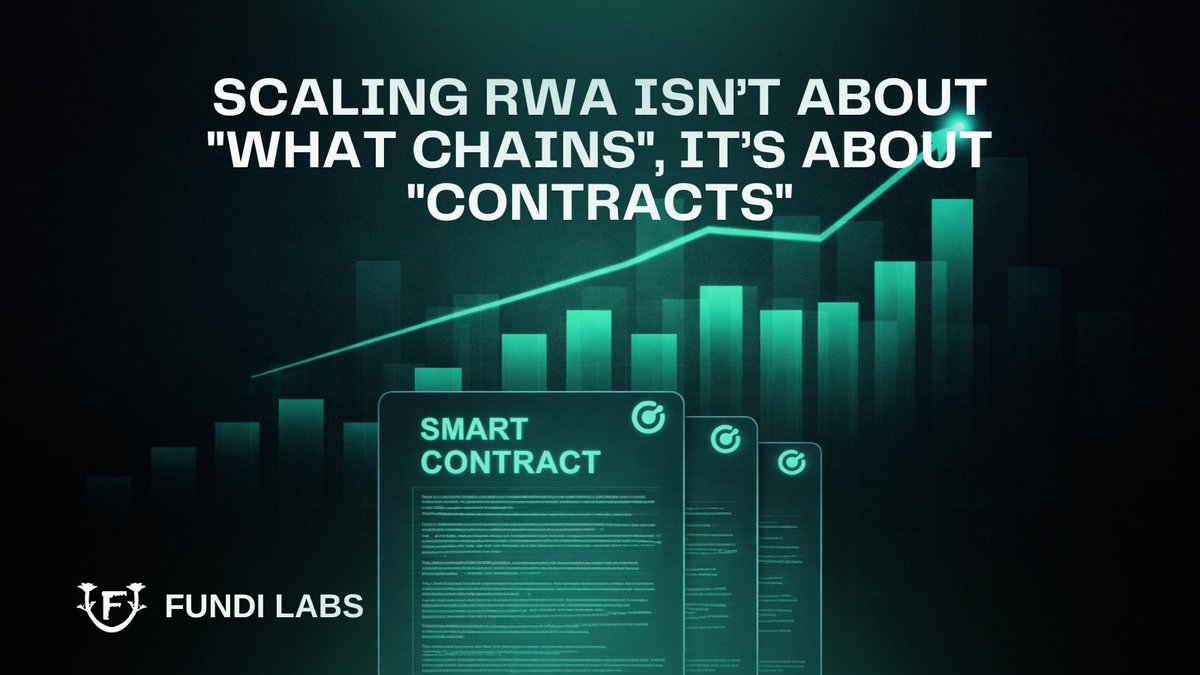
Scaling RWAs isn’t primarily a “which chain” problem. It’s a contract design problem. A lot of energy in the tokenization space goes into debating infrastructure. @ethereum or @solana? @base or another L2? Which chain is cheaper, faster, or has better liquidity? Those questions matter. The underlying chain affects transaction costs, accessibility, and ecosystem reach. Ignoring that would be a mistake. But once real assets and real capital are involved, the conversation shifts quickly. The real challenge becomes how the asset itself is structured. Tokenization can record ownership and automate transfers. What it doesn’t automatically solve are the deeper questions investors and institutions care about: • What legal rights does the token actually represent? • Who controls the underlying asset? • How are payouts calculated and distributed? • What happens if obligations aren’t met? • How are disputes resolved or terms updated? These are contract architecture questions, not blockchain questions. You can move a token across chains instantly. But if the agreement behind that token relies on manual processes, unclear enforcement, or poorly defined rights, the structure will struggle to scale. This is why sophisticated participants don’t evaluate tokenized assets based solely on the chain they’re built on. They examine whether the contracts, governance rules, and operational workflows are designed to handle real-world conditions. In practice, the most resilient RWA platforms treat tokenization as part of a broader system, one where legal structure, contract logic, and operational processes are designed to work together. Infrastructure matters. But infrastructure alone doesn’t create reliability. The projects that will scale real-world assets successfully are the ones that design contracts that hold up when capital moves, incentives change, and markets tighten. Because blockchains move tokens. Contracts move capital.
Tokenization isn’t just slapping an asset onchain. The real question: Can you prove it works at scale? Legal, technical, operational, economic… diligence in tokenized assets covers it all. Read how pros do it ⬇️
What Diligence Really Looks Like in Tokenized Assets Today Tokenization promises efficiency, transparency, and liquidity. But anyone who’s raised capital or invested in tokenized assets knows this: not all tokens are created equal. Diligence in tokenized assets goes far beyond

What Diligence Really Looks Like in Tokenized Assets Today Tokenization promises efficiency, transparency, and liquidity. But anyone who’s raised capital or invested in tokenized assets knows this: not all tokens are created equal. Diligence in tokenized assets goes far beyond a simple legal review. It’s about understanding whether the asset, its contracts, and its ecosystem can reliably deliver what they promise, today and at scale. Here’s what professional due diligence looks like: 1. Legal & Compliance Verification - Is the token backed by a verifiable real-world asset? - Are ownership rights enforceable across jurisdictions? - Are contracts structured to protect all stakeholders, not just the issuer? 2. Technical & Smart Contract Audit - Are contracts secure, audited, and free from exploitable vulnerabilities? - Does the contract logic correctly handle payouts, governance, and ownership transfers? - Are there fail-safes or upgrade mechanisms if issues arise? 3. Transparency & Traceability - Can all token holders independently verify ownership and transaction history? - Is the asset’s lifecycle fully auditable and tamper-proof? 4. Economic & Risk Assessment - How is the token’s value derived and maintained? - Are liquidity and incentive structures robust under market stress? - Is the model resilient to downturns or rapid scaling? 5. Operational Due Diligence - Are reporting, distributions, and governance processes automated and reliable? - Are outcomes measurable, auditable, and aligned with stakeholders’ expectations? 6. Ecosystem & Stakeholder Alignment - Who are the participants, and are incentives aligned for long-term collaboration? - Is there a clear path for growth, adoption, and liquidity management? The takeaway from this is: tokenization alone doesn’t guarantee confidence or risk reduction. Proper diligence evaluates legal, technical, operational, and economic dimensions. Organizations that bake verifiability, enforceability, and transparency into their assets gain trust, reduce risk, and attract serious participation. At @FundiProtocol, we help organizations structure tokenized assets in ways that are auditable, enforceable, and investor-ready, so that value isn’t just promised, it’s provable. Follow for more


Nancy L @Seda59093503
11 Followers 832 Following emotional damage, aesthetic healing 🌷 follow back always
Johnmiracle Ejikeme @johnmiracleweb3
120 Followers 72 Following Web3 Growth and Marketing Lead |Ex - @swisscheese_fn | chief believer @tuitiononchain | inventor @topratedclubco
UFAKII 😎 @ahmufakii
1K Followers 1K Following Everything about WEB3 ll Educator II Gate Snr. Affiliate & Guardian ll Ambassador
hailey doll 💕 @turgayberk81
24 Followers 708 Following omg i’m into random conversations kinda vibey tbh xD
hailey 💄 @cami_7928
2 Followers 47 Following Flowers grow in my loneliness, dreams in whimsical silence 🕯️


Blessed Jimmy @BlessedJim86233
29 Followers 142 Following
Edidiong Jonah @JonahEdidi25453
36 Followers 136 Following
Jackson Jack (💜,�... @JacksonJac25198
41 Followers 268 Following

Christopher Walter @ChristWalter121
47 Followers 19 Following Realtor 🇺🇸🇬🇧🇸🇬 🌍🌏🗺️ Husband and Father. #Btc #Eth #SP500. Hodl and disappear
Houseofdrey @Houseofdrey001
120 Followers 436 Following Deeply rooted in humanitarian service || Content writer || Community manager || Moderator || Meme Creator

Prince_Lingo_CLONE @PrinceECLONE
42 Followers 699 Following
Benjamin Agada @BenjaminAg69093
0 Followers 31 Following
Uchechukwu Godson Ume... @UmeloGodso36795
23 Followers 397 Following
Richmond @Richmondndys
193 Followers 589 Following
azaztrader (福莫) @azaztrader01
3K Followers 5K Following The information shared on this page is not investment advice. Strategic Advisory | DM for collab | @MondayTrade_

Suhyeon | RWAs & Toke... @_sam_jung
2K Followers 2K Following Bridging TradFi & Web3 | RWA/Tokenization Insights | Korea Perspective 🇰🇷
Otto Sedy @OttoSedy30566
18 Followers 357 Following
Juan A. Lleó @Juan_A_Lleo
3K Followers 7K Following Arte digital y electroacústica / Digital art & Electroacoustic Music | FID 11782 and @jalleo on https://t.co/UCcdyCZjeT

Eun @ththththyth
2K Followers 2K Following Art Collector & Creator | AI Digital Art with Midjourney 🌟no DM
samoda.eth @samodasixib
2K Followers 3K Following Web3 investing & research 🔍 @Chain_GPT Diamond Club 💎 $CGPT @AIVM_Network (AI-first L1) 🚀 Alpha is not advice. NFA/DYOR
Erbeaaugee @Erbeaaugee0220
16 Followers 571 Following

5W Foundation @5WFoundation
252 Followers 191 Following - next generation #conservation - Helping preserve and protect #biodiversity and #threatened #wildlife. https://t.co/ct3wRsSfxQ

naing soe @AA21cen
0 Followers 18 Following

drew @drewlivanos
21K Followers 4K Following founder & investor. nyc. helping startups ship w/ @syntaxfullstack. roll blue hens @udelaware
Leo Lanza | ETHisDigi... @itl3olanza
82 Followers 2K Following https://t.co/JD9gg7qoNv contributor | Building wealth through crypto, DeFi, & smart investing strategies. YouTube https://t.co/veE7XzZmaW

Koko @kokebsolomon
3K Followers 2K Following building crypto community in Africa | @Web3Clubs @ETHSafari @AfricanOnChainC | 🫶🏿 @WIEPteam @Kernel0x


Alabi Segun (💜,�... @alabi_segu24062
44 Followers 576 Following
Williams @dinma_wills
1K Followers 2K Following Relationship takes || motivational/educational insights || medical healthcare|| Feminine || Being myself 💞
The Stuart Alderoty @The_s_alderoty
630 Followers 7K Following Chief Legal Officer @Ripple and President @NatCryptoAssoc . Over 35 years of legal experience with expertise in regulatory affairs and complex litigation.

Kabeerdefi 👾 @basedkabeer
1K Followers 1K Following building & creating onchain || contributing to @Based_Africa || Ex. Intern @uglycash 
Yoyo @docengineer8
0 Followers 26 Following
Ogbonna Geoffrey @GeoffreyOg69640
0 Followers 110 Following
Elara @HoneyBee152250
103 Followers 246 Following 📈 Market watcher | 💬 Vibes curator | 🛠 Grinding like a living legend | 🌊 Riding waves, no panic

Olatunji Olatunji ||T... @TheGreatOla123
303 Followers 1K Following #cryptolover #noob BitcoinOS Bridgade
Hey Arnold Perfect Sh... @heyarnoldshots
35K Followers 495 Following Daily Hey Arnold shots 🏈🇦🇷 No Kids, Pets OK Same person behind @ el.arnoldo on IG
Rushi @rushicrypto
38K Followers 4K Following Bitcoin, crypto, real estate, geopolitics. Analyzing markets, trends, and global moves that matter.
Shibo @GodsBurnt
130K Followers 12K Following Financial News & Commentary | @doginaldogs | God First
Zoom Afrika @zoomafrika1
817K Followers 0 Following 24/7 on Beautiful Animals, Places, People, Tribes, Life Styles, News and Fact Historical stories in Africa. DM for Promotions.
PSE @PrivacyEthereum
14K Followers 30 Following PSE is a research and development lab delivering privacy to the Ethereum ecosystem.
Ryan Gittleson @RyanGittleson
7K Followers 508 Following @Base Start-up Growth, Base Batches Lead: helping the next wave of founders, Co-founder of @Virtue_Poker, Prev: @Consensys

Motif @TraderMotif
64K Followers 193 Following Over a decade in the game ♠️ Trading what the market gives. Up or down. THIS IS MY ONLY SOCIAL MEDIA ACCOUNT.
Julian Kwan @julian2kwan
4K Followers 340 Following CEO @IXSfinance RWA Vaults for Agents | Delivering BTC Real Yields | Building in RWA since 2018
More Perfect Union @MorePerfectUS
352K Followers 2K Following Media that builds power for working people. Emmy-winning nonprofit newsroom. Reach out: [email protected] Voicemail/text: 202-505-4556
MASTR @MastrXYZ
31K Followers 5K Following $MASTR : OG Crypto Watchdog 🚨 Rug Insurance | Anti -scam Mission Knowledge | Exposing Frauds | Protect Web3 Mobile Apps | TG Token Scanner | Web3 AI BOT
Max Alend @colnft
11K Followers 349 Following NFTs before they were PFPs. Seen the hype, stayed for the art. 3650-day NFT challenge
Houseofdrey @Houseofdrey001
120 Followers 436 Following Deeply rooted in humanitarian service || Content writer || Community manager || Moderator || Meme Creator
Nick Gerli @nickgerli1
147K Followers 306 Following CEO of Reventure App. Home price forecasts and valuation rates for every ZIP code in the U.S.
azaztrader (福莫) @azaztrader01
3K Followers 5K Following The information shared on this page is not investment advice. Strategic Advisory | DM for collab | @MondayTrade_
Auza @_Auza_
6K Followers 1K Following Building on Base | Earning on Base 💙 | 18 y/o from 🇳🇵 | Content Creator | Collabs & DMs Open | TG: @Auza_Alpha

charles (csl) ᛋ @CharlieStLouis
4K Followers 488 Following DeFi @ethereumfndn | prev. @delv_tech (ceo) @makerdao (gov architect) | Maker Mafia 🌹🦇🔊
Suhyeon | RWAs & Toke... @_sam_jung
2K Followers 2K Following Bridging TradFi & Web3 | RWA/Tokenization Insights | Korea Perspective 🇰🇷
Paul Mit @pmitu
23K Followers 2K Following 🌿 3х Founder → building @flowmapp ⚡️⚡️⚡️ @FoundbaseHQ + @aaplyHQ: bootstrap, $600k ARR, no VC, $0 marketing, and 💵 3 exits
JK 🛡️ @jonathankingvc
8K Followers 2K Following Investor @cbventures | Advisor @atlantachain @404DAO | #WhoDat⚜️ | @GATechScheller | @GSUPanthers | @PBS_1914 | ex-@microsoft
Eun @ththththyth
2K Followers 2K Following Art Collector & Creator | AI Digital Art with Midjourney 🌟no DM


Custodiy @Custodiy1
30K Followers 411 Following Custodiy as a Service | #Custodiy | $CTY | Tokenization, RWA & Digital Assets | Create, Trade & Manage Digital Assets support: | [email protected]
Tom Capital @Tom__Capital
29K Followers 130 Following Posts are for informational purposes only and not financial advice. Always DYOR.

Doctor Profit 🇨�... @DrProfitCrypto
486K Followers 802 Following Elite trader, I trade psychology, $BTC and Stocks| Educational content only. NO FINANCIAL ADVICE Join Premium: https://t.co/TvHxOtKhHj
Wolf 🐺 @IamCryptoWolf
112K Followers 1K Following Engineer. Analyst. Wolf's VIP Telegram: https://t.co/6mH4mFG4sC
BENNY THE BUTCHER @BennyBsf
226K Followers 490 Following "Summertime Butch 2" in stores now https://t.co/78uIoemTCi IG @ Getbenny [email protected]
Ted @TedPillows
305K Followers 17K Following Survived 2 cycles, still here turning on-chain and macro economics signals into trades.

North Texas Food Bank @ntfb
23K Followers 4K Following Remember, one meal makes a difference. Serving Dallas, Collin, Fannin, Rockwall, Hunt, Grayson, Kaufman, Ellis, Navarro, Lamar, Delta & Hopkins Counties
Base App @baseapp
431K Followers 64 Following Trade, earn, predict, and chat with friends or agents.
Clemente @Chilearmy123
67K Followers 4K Following Your favorite trader’s favorite trader Board Member @K9Strategy For partnerships: https://t.co/TWD45Pl5Fh
5W Foundation @5WFoundation
252 Followers 191 Following - next generation #conservation - Helping preserve and protect #biodiversity and #threatened #wildlife. https://t.co/ct3wRsSfxQ
Koko @kokebsolomon
3K Followers 2K Following building crypto community in Africa | @Web3Clubs @ETHSafari @AfricanOnChainC | 🫶🏿 @WIEPteam @Kernel0x
African Onchain Colle... @AfricanOnchainC
400 Followers 88 Following Connecting African communities to build and innovate on the blockchain. Empowering developers, creators, and visionaries.
Collably Network @CollablyNetwork
59K Followers 599 Following Global Web3 partnership marketplace. Match your project with investors, exchanges, launchpads, service providers, and ecosystem partners.
Kabeerdefi 👾 @basedkabeer
1K Followers 1K Following building & creating onchain || contributing to @Based_Africa || Ex. Intern @uglycash 

EliZ @eliz883
606K Followers 253 Following Italian Crypto Trader & Investor ✍️ Contact / Assistant: @CryptoTyborg Discord: @WealthGroup
Emilia Stephen @0xEmiliaS
4K Followers 2K Following Web3 Content Creator || Helping Projects grow visibility and reach the right audience || ex-amb. @FundiProtocol
Nebraskangooner @Nebraskangooner
408K Followers 85 Following 🚨 Daily #Bitcoin and Equity Updates More content👉 | https://t.co/ovtThm6sVi |
Olivia Moore @omooretweets
105K Followers 921 Following Partner @a16z and twin to @venturetwins | Investor in @gammaapp, @happyrobot_ai, @krea_ai, @tomaauto, @partiful, Salient, @scribenoteinc, @lassieai, @meetarcYou might like