Abhinandan @abhibuilds
agentic ai engineer • ai system design • evals & security abhinandan.one san francisco Joined December 2025-
Tweets1K
-
Followers310
-
Following476
-
Likes2K
I generally wake up at 5a.m. and out of the first 3 tasks that I do, is to go to deep work for at least 2 hours. And this works unknowingly well
btw landing of the most referenced org on web acme.com

@waterloo_intern @grok explain this please

One way to live 400 years is to do (and experience) 5x more things per day
gonna to start @Stanford cs336: Language Modeling from Scratch from today. will be covering each lecture, completing each assignment and building artifacts out of the learning. all while sharing the whole learning journey in public this is the day one and the i have learning chapter 1: tokenizer sharing more ongoing progress soon.... 🤞

builders and founders should watch this twice

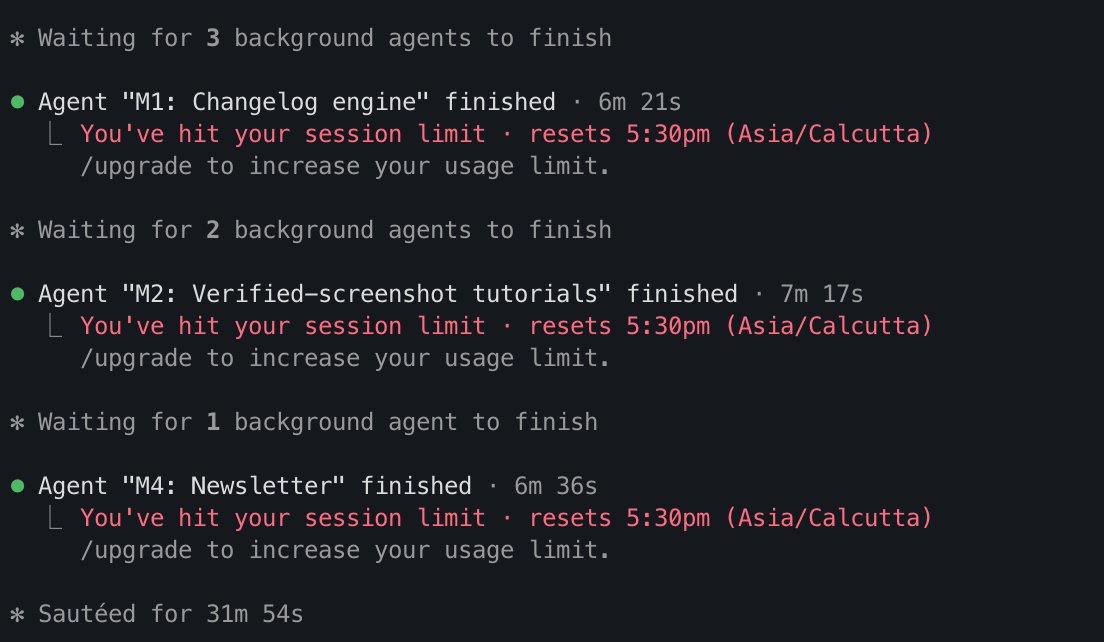
consumed my claude limit for the first time in this week :|
Claude AI is FREE. ChatGPT is FREE. DeepSeek is FREE. Kimi is FREE. Gemini is FREE. Microsoft Copilot is FREE. Perplexity AI is FREE. Nano Banana Is FREE Freepik AI is FREE. Bing Image Creator is FREE. Playground AI is FREE. Runway ML is FREE (limited). Pika Labs is FREE. ElevenLabs is FREE (starter). Audacity is FREE. DaVinci Resolve is FREE. OBS Studio is FREE. Blender is FREE. Figma is FREE. Photopea is FREE. Deepseek is FREE. QuillBot is FREE. DeepL is FREE. Tome is FREE. Gamma is FREE. Notion is FREE. Zapier is FREE. HuggingFace Spaces is FREE. Start Your Business Today The internet is your free university. Start building today. 🚀
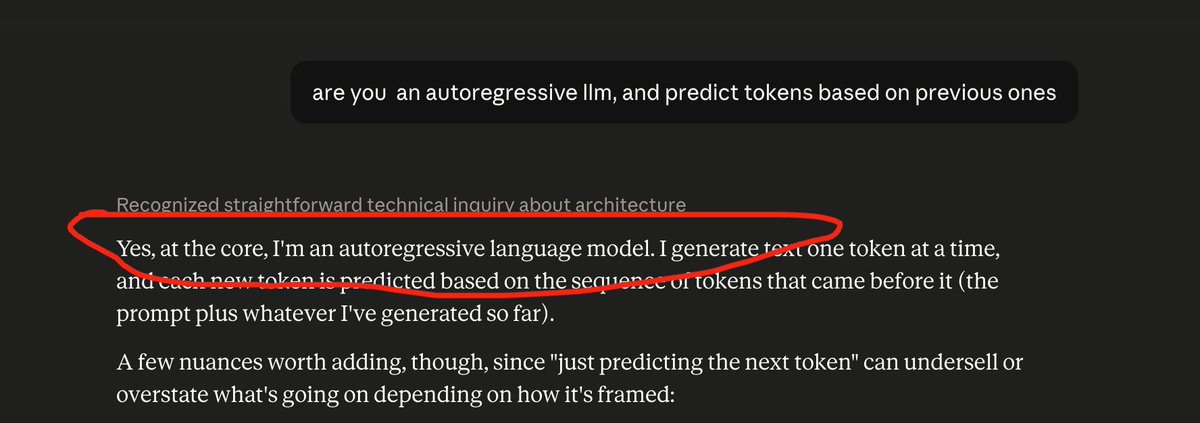
proof that sonnet is autoregressive (though anthropic-trained)

“Loop engineering” is a hot buzzphrase after mentions of it by Boris Cherny (Claude Code’s creator) and Peter Steinberger (OpenClaw's creator) went viral on social media. Loops are now a key part of how we get AI agents to iterate at length to build software. In this letter, I’d like to share my 3 key loops, shown in the image below, for building 0-to-1 products. These loops guide not just how I build software, but also how I decide what software to build. Agentic coding loop: Given a product specification and optionally a set of evals (that is, a dataset against which to measure performance), we can have an AI agent write code, test its work, and keep iterating until the code is bug-free and meets its specification. This idea of closing the loop took off around the end of last year, and it has been a game changer in enabling coding agents to work longer productively without human intervention. For example, over the weekend, I was building an app for my daughter to practice typing, and my coding agent could easily work for around an hour, using a web browser to check what it had built multiple times before getting back to me, without needing my intervention. The engineering loop executes quickly. Every few minutes, the coding agent might build and test a new version of the software. I hear frequently from developers who are finding new ways to engineer more effective engineering loops. This is an active area of invention! Developer feedback loop: In this loop, a developer examines the current product and steers the coding agent to improve it. Last year, a lot of developers (including me) were acting as the QA (quality assurance) function for our coding agents, manually finding bugs and then asking the agent to fix them. But with coding agents much more able to test their own code, the amount of time we need to spend on this function has decreased significantly. This allows us to make higher-level product decisions, such as what key features to offer, where the UI needs improvement, and so on. The developer-feedback loop operates over time intervals between tens of minutes and hours — that's how frequently a developer might review a product and give feedback. In the case of the typing app, I changed my mind a few times about the visual design, what cat costumes she can unlock as she learns (she loves cats), and the user flow for a grown-up to log in and steer the child's learning experience. When a developer has a clear vision for what to build, it is still a lot of work to translate that vision into a specification for a coding agent to implement. Further, after the developer has seen an implementation, they might update (or perhaps clarify) the spec to steer it toward what they want. If you find that the system repeatedly runs into certain problems, building a set of evals for the agent becomes useful. AI-native teams are increasingly using AI to help shape product direction, for example, automating the gathering and analysis of usage data, summarizing written and verbal customer feedback, or carrying out competitive analysis. However, for pretty much all the products I’m involved in, I see humans as having a significant context advantage over current AI systems — we know a lot more than the AI system about the users and the context the product has to operate in — and thus humans play a critical role. Many people describe this human contribution as “taste,” but I prefer to think of it as humans having a context advantage, since that gives us a clearer path to helping AI systems get better. This also speaks to why this step can’t be automated: So long as the human knows something the AI does not, human-in-the-loop is needed to to inject that knowledge into the system. External feedback loop: This includes a wide range of tactics like asking a few friends for feedback, launching to alpha testers, or putting the code into production with A/B testing. These tactics are usually slow, rarely taking less than hours and sometimes taking days or even weeks. This data informs the developer vision, which in turn continues to drive the detailed product spec, which in turn drives the coding agent. With coding agents speeding up software development, more engineers are starting to play a partial product management role. For many engineers who are growing into this role, the hardest part is shaping the product vision and striking a balance between building (bridging the gap between vision and spec) and getting user feedback to evolve the vision. It is important to do both! I will write more about how to do this in future posts, but for now, I find it encouraging that engineers are playing an expanded role (just as product managers and designers now do more engineering). [Original text: The Batch]




Tewodros Idris @teddykidris
16 Followers 789 Following
kiran @kK61893
1 Followers 114 Following
Tommy @Tommy_Tang_930
20 Followers 627 Following
SAI TEJA @TejaSai44872
4 Followers 280 Following

aditya @ad1tyabharadwaj
438 Followers 4K Following @ubereats search / I write here: https://t.co/9trYy6mcoM
j lau @jlau36547470
36 Followers 1K Following
Broly @LF_SuperSaiyan
333 Followers 5K Following The Legendary Saiyan | Computer Researcher | Enterprise AI deployment | Gym freak
Ankit Walishetti @AnkitWalishetti
63 Followers 398 Following @Columbia | prev research @harvard edge, @northwesternU eecs | published in @SpringerNature and @IEEE




Ramesh S Raghavan �... @sriragam
1K Followers 3K Following Love/live Technology, Innovation, Evangelism ! Passionate about technology, creativity, data, education, linguistics & music. Tweets are personal views.
Aadya @polymath_diary
25 Followers 432 Following Intern@Dell Technologies | AI safety research | interested in thinking, writing, cameras and AI

pang cheng yong @pcy750333
45 Followers 3K Following
0xNeural @HanqingLv
7 Followers 963 Following
Shruti Honnungar @shrutihonnungar
557 Followers 2K Following 👩💻 @PaloAltoNtwks | Previously @VMware l @CMU_ECE l @CMUTEHQ | Artist/ Illustrator @thechromachic on IG.
guo wei lin @guoweilin
13 Followers 1K Following
YPK @mainyashhoon07
81 Followers 4K Following deep learning, maths, core CS, posting here what i learnt | Blogs : https://t.co/f1S47UbUGH
Hellonjhere @Hellonjhere123
1 Followers 337 Following

Carl Youngblood @cayblood
2K Followers 6K Following Co-founder @Blockscale (sold to @coinbase). President @transfigurism. Former architect @awscloud. Member @Ch_JesusChrist. Prophet, musician, urbanist.

ANURAG SINGH BHANDARI @anurag_s_b
30 Followers 612 Following sometimes ml sometimes engineering sometimes building sometimes philosopher....
Muhammad Zain @muhammad_z53429
2 Followers 120 Following
Richa Priya @Richapriya07
26 Followers 903 Following
Joan @perez__joan
337 Followers 364 Following PhD · Open-source AI tools for real-world problems. GeoAI, VLMs, Diffusion, Spatial Analysis & Web3. Shipping SAGAI, UVLM & more. https://t.co/ZF4jEGaI5b
Matías @Mat_M_W
117 Followers 2K Following {Discovery commences with the awareness of anomaly} Kuhn @alea_uy #Statistics #DataScience #MachineLearning Moving to @matutem.bsky.social
Marie @cimarieta
14 Followers 241 Following
Raamkumar | ராம... @raam1610
69 Followers 3K Following
mars @MarsMars784127
0 Followers 81 Following
liuskate @liuskate
1 Followers 147 Following
John Cajas Guijarro �... @JohnCajasGuijar
4K Followers 4K Following Economista. Profesor @lacentralec. Doctor en economía del desarrollo @FLACSOec. Marxista en construcción. Opiniones personales.
nopanic @0518MOkCJZ1e44R
50 Followers 4K Following
humanghoghaliya @humanghoghaliya
6 Followers 604 Following
skanda @shridhar_s64791
6 Followers 107 Following
Arman Anwar @armaninspace
68K Followers 620 Following Builds thinking machines that print money - Statistical Machine Learning Geek - Good-old-Fashioned AI Nostalgic - Recreational Mathematician - Stares at Art
Shubh @Shubh07_X
21 Followers 565 Following IT'27 undergrad | Learning to build scalable products ⚙️ | Web Dev • DSA
Siva Rama Krishna Man... @Siva_Mannem
5 Followers 308 Following
Harness Engineering @harnessengr
250K Followers 11K Following The more things change, the more they stay the same. DM for repost
Mike @_cosmocrator_
90 Followers 2K Following
RCG @rgummadi
9 Followers 445 Following
ChaosInMotion @AlexanderJimlee
151 Followers 1K Following
Rishabh Mahajan @mahaRISHABH13
34 Followers 787 Following Upskilling for MLE & Data Scientist roles. Deriving algorithms from scratch, building data pipelines.
barney Zhou @barneypourquoi
51 Followers 1K Following Learning machine learning and Spanish now. 在尝试做对外汉语老师
Aakanksha Chowdhery @achowdhery
14K Followers 6K Following @Stanford @reflection_ai // Previously @GoogleDeepMind :: PaLM, Gemini // @MSFTResearch, @Princeton // views my own and subject to change


clem 🤗 @ClementDelangue
437K Followers 5K Following Co-founder & CEO @HuggingFace 🤗, the open and collaborative platform for AI builders
jietang @jietang
52K Followers 375 Following Professor @ Tsinghua, Founder of https://t.co/3IaQ4CI5W3. AGI, LLM. “The value of a man should be seen in what he gives and not in what he is able to receive.”―Einstein
Percy Liang @percyliang
109K Followers 425 Following professor of computer science @Stanford @stanfordnlp, co-founder of @togethercompute, creator of https://t.co/7R5THVogW2, co-founder of @simile_ai, pianist
Behnam Neyshabur @bneyshabur
43K Followers 1K Following Co-Founder & CEO @mirendil 💼 Past: co-led Discovery team @AnthropicAI & Blueshift team @GoogleDeepMind 🎒Traveling & Backpacking
Vaibhav (VB) Srivasta... @reach_vb
52K Followers 292 Following founder mode @OpenAI | ex @huggingface | F1 fan | Here for @at_sofdog’s wisdom | *opinions my own
Ashish Vaswani @ashVaswani
32K Followers 2K Following
The Foundery @jointhefoundery
6K Followers 14 Following Forging Entrepreneurship. A WTF x Think9 venture.
Z.ai @Zai_org
123K Followers 262 Following The AI Lab behind GLM models, dedicated to inspiring the development of AGI to benefit humanity. https://t.co/7a5aSCUNcZ https://t.co/x14hb3klXm

aneri @0xaneri
27K Followers 3K Following building and creating @elevenlabs | prev. PM at @coinbase and @meta | alum @stanfordgsb and @uchicago


DogeDesigner @cb_doge
1.9M Followers 1K Following



Chris Olah @ch402
151K Followers 183 Following Reverse engineering neural networks at @AnthropicAI. Previously @distillpub, OpenAI Clarity Team, Google Brain. Personal account.

xjdr @_xjdr
29K Followers 695 Following building AI that wont embarrass me in front of my own standards
Jakob Foerster @j_foerst
25K Followers 1K Following Associate Prof in ML @UniofOxford. Something Something Research Scientist @MetaAI. Something @BOLD_LAB_AI. Always #teamhuman. Opinions belong to the world.
TaraBull @TaraBull
1.5M Followers 23K Following #SpacesHost | Truth Slayer | ↗️ I follow all Subscribers • Let's end the establishment media • ʟɪꜱᴛᴇɴ ᴡɪᴛʜ ᴄᴜʀɪᴏꜱɪᴛʏ. ꜱᴘᴇᴀᴋ ᴡɪᴛʜ ʜᴏɴᴇꜱᴛʏ. ᴀᴄᴛ ᴡɪᴛʜ ɪɴᴛᴇɢʀɪᴛʏ.
pj @BeingPractical
126K Followers 552 Following eternal entrepreneur. product geek - i build & break products. tea addict. building @RaiseTheBarHQ. customer service at @DhanHQ

DAN KOE @thedankoe
952K Followers 964 Following join the next content bootcamp: https://t.co/KHN63fQmtI
Peter H. Diamandis, M... @PeterDiamandis
404K Followers 862 Following Exec. Chairman @XPRIZE @fountainlife_hq (and others) Working to extend human healthspan. Curator @Abundance360



Tony Tong | Founder |... @tonytonggg
1K Followers 2K Following Clarity. Calibration. Communication. Lead intelligence for businesses: https://t.co/jkeY21VFcL Decision clarity for navigating uncertainty: https://t.co/N315Eh0WqK
The Figen @TheFigen_
2.8M Followers 16 Following PhD musicology/Teacher/ - Posting positive warm and memes ...
Respectful Memes @RespectfulMemes
2.4M Followers 36 Following #1 Source of Memes to show your Grandma!
Rahul Kumaran @RahulKumaran4
3K Followers 3K Following The docs guy @trybrowzer, helping B2B startups create self healing product guides; @joinodf ODF26, @fdotinc | 3x Founder, 2x exits |
Addy Osmani @addyosmani
405K Followers 3K Following Engineering & DevRel Leader, Prev: Director @GoogleCloud AI/Gemini ✨, Eng Lead @GoogleChrome • Author @OReillyMedia • Great user, developer & AI experiences
Rahul @sairahul1
125K Followers 786 Following Building with AI. Sharing what's wild, what's practical, and what's next. Founder of https://t.co/IfYUA3MgDK and https://t.co/jeqp1MyNtk


Saurabh Kumar @drummatick
21K Followers 560 Following e/local-llm 🚀 Building a local Qwen Harness LLM fine tuning | Harness optimization | Evals and Memory systems for Agents (opinions my own)
Kartik @code_kartik
10K Followers 669 Following I ship things people love using • mts @mem0ai • building @screenshotstdio (prev: https://t.co/BpklXWHiA3) • @bettershotsite
sid @immasiddx
20K Followers 814 Following Founder’s Office (Intern) @frido_official. Sharing the latest in tech and AI with a sprinkle of memes.
AI Engineer @aiDotEngineer
60K Followers 11 Following The world's best engineers, leaders, founders, and researchers building with AI. Organizers of the AIE Summit, Code Summit, Europe, Asia, and World's Fair.
Latent.Space @latentspacepod
29K Followers 124 Following The #1 AI Engineering podcast & newsletter, now covering AI for Science as well. Over 170,000 daily readers. Technical news today you will use at work tomorrow!
Sowmay Jain @sowmay_jain
15K Followers 858 Following building @zeltahealth, founder @upsurgelabs. creator of @laukiantonson. cofounder @instadapp. forbes asia 30u30.



skcd @skcd42
35K Followers 321 Following Understanding the universe @xai ex hacking @aide_dev ex fb engineer ICPC WF its just code 👨🏼💻
You might like