Penrose @UsePenrose
create beautiful diagrams just by typing mathematical notation in plain text penrose.cs.cmu.edu Pittsburgh Joined April 2021-
Tweets51
-
Followers2K
-
Following14
-
Likes47
@OpenAI's new 4o image generation is pretty amazing. It also fails on some utterly basic tasks. Maybe a good metaphor for how easily we can be misled by algorithms based largely on fitting empirical data (i.e., machine learning) rather than deductive reasoning. @UsePenrose

talked about diagrams and defended my thing today 🎓 thanks for friends who joined in person & on zoom!

video of the defense talk is up! youtu.be/gVZJc7_0T14?si…
took the idea of “run the layout optimizer again when interacting with the diagram” pretty far this summer. Bloom is a React library for interactive diagrams. It lets you reuse the diagram styling just like Penrose, but in a general-purpose programming language.
Great work by the @UsePenrose team building Bloom: a lightweight way to make interactive diagrams: penrose.cs.cmu.edu/blog/bloom All coordinates are automatically figured out by the Penrose layout engine, and diagram specifications can be re-used for different content (like HTML/CSS).
A standard way to draw planar graphs is to draw nodes as dots and edges as line segments. But the Koebe–Andreev–Thurston theorem also shows that any planar graph can be visualized by drawing nodes as circular disks, which are tangent if they share an edge:

@Tinkerandthink @TivadarDanka Also pretty easy to make with Penrose!
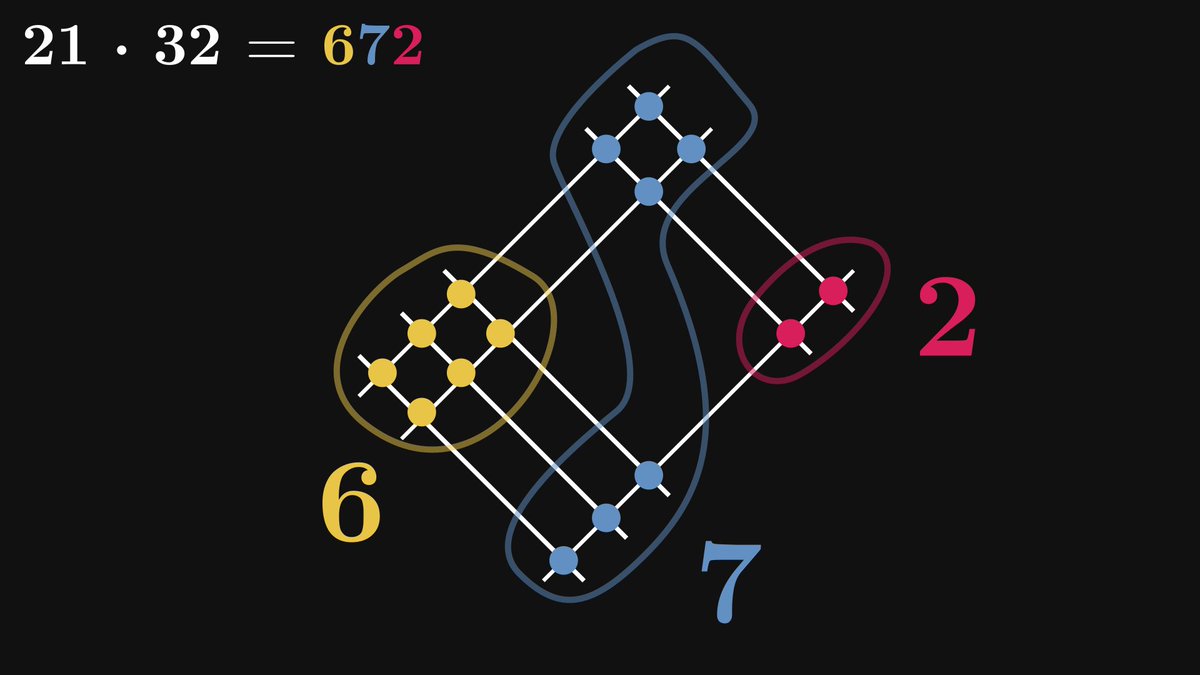
Q: How do you quickly multiply multi-digit numbers? A: Draw a diagram! Just draw a line for each 10's and 1's digit of the two factors, and count the number of crossings to get the 100's (yellow), 10's (blue), and 1's (red) digits of the product! Drawn here using @UsePenrose.
Q: How do you quickly multiply multi-digit numbers? A: Draw a diagram! Just draw a line for each 10's and 1's digit of the two factors, and count the number of crossings to get the 100's (yellow), 10's (blue), and 1's (red) digits of the product! Drawn here using @UsePenrose.

The Japanese multiplication method makes everybody feel "I wish they taught math like this in school." It's not just a cute visual tool: it illuminates how and why long multiplication works. Here is the full story.
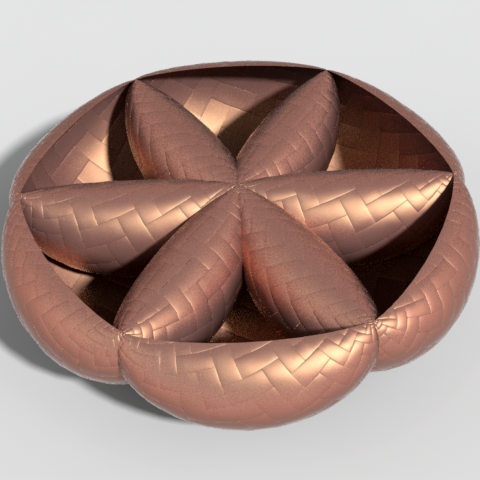
In a moment nobody was waiting for, I've released meshes from Mark Kilgard's classic OpenGL / GLUT demo "dinoshade.c": cs.cmu.edu/~kmcrane/Proje… The image below re-imagines this example as a vectorized SVG generated in @UsePenrose—read how it was done here! github.com/penrose/penros…


penrose.cs.cmu.edu Penrose (now released) is promising looking domain-specific language for scientific figures that isn't bogged down by decades of tech-debt (cf Tikz/tex) Esp like the .style/.substance/.domain division, makes iteration easy (e.g. shape in 2, 'Pipe' in 3)
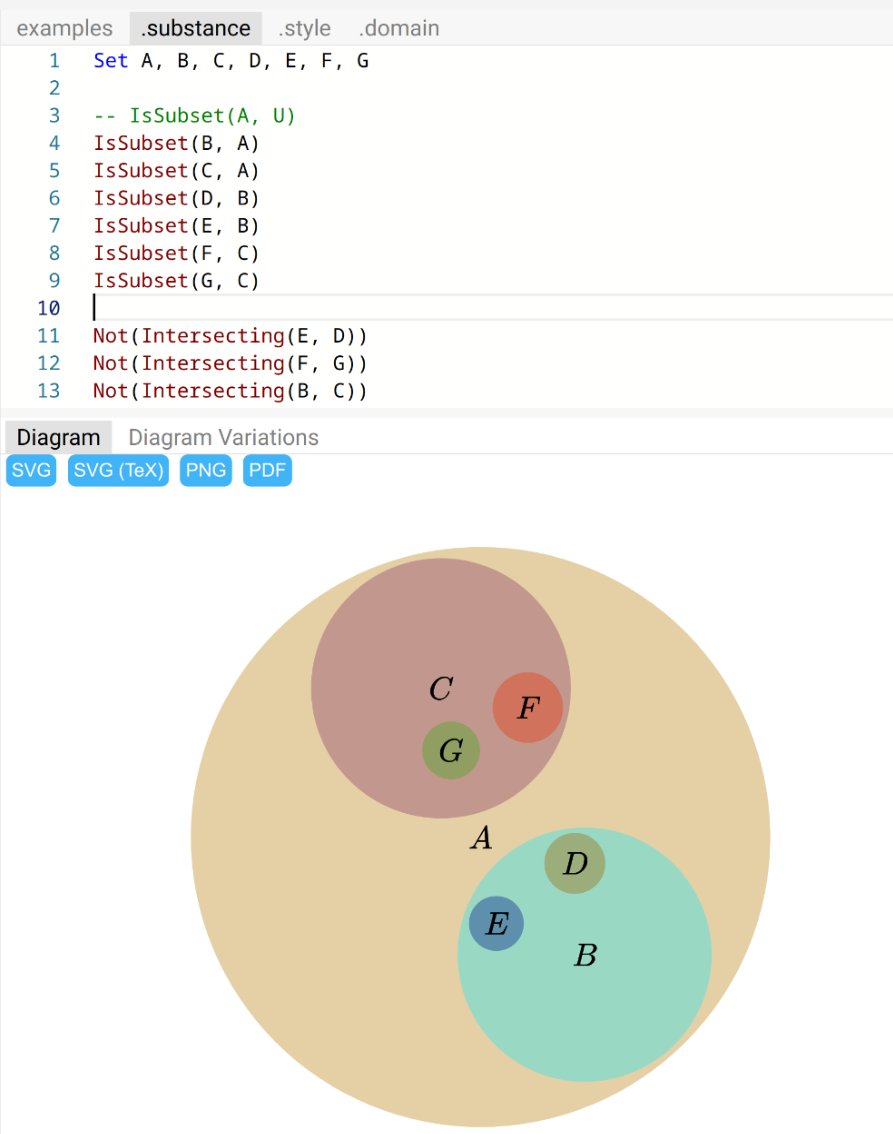
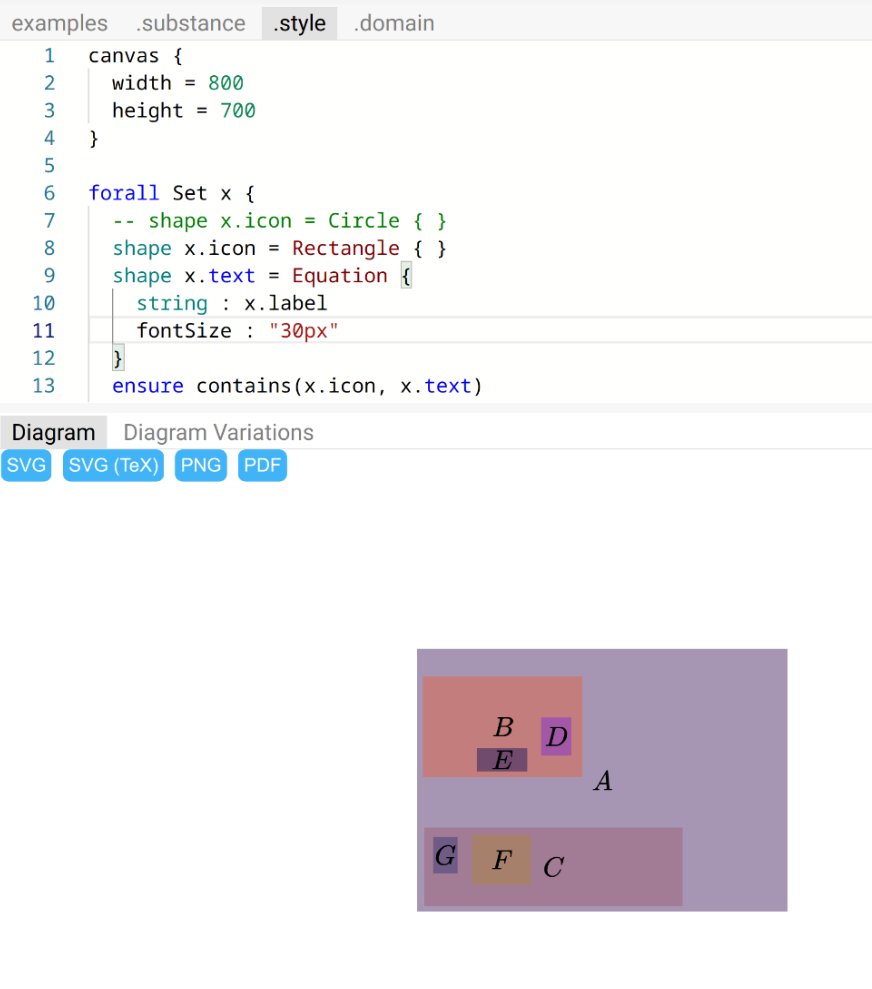

Tired of making the same kind of diagrams over and over by hand (e.g., in PowerPoint)? The @UsePenrose team has been working away on Penrose 3.0, an automated notation-to-diagram tool, finally released today! Check it out here: penrose.cs.cmu.edu/blog/v3

The winding number of a polygon is, quite literally, the number of times a polygon "winds" around a given point x. It can be used for inside/outside tests by just summing the angles made by each (oriented) edge: zero if x is outside, ±2π if x is inside. [Made with @UsePenrose.]

Animation of how the winding number changes as the center point x moves inside/outside a shape. Notice how the signed angle of an edge suddenly jumps from +π to -π (or vice versa) as x crosses an edge, changing the total signed angle by ±2π. [Made with @UsePenrose]
The winding number of a polygon is, quite literally, the number of times a polygon "winds" around a given point x. It can be used for inside/outside tests by just summing the angles made by each (oriented) edge: zero if x is outside, ±2π if x is inside. [Made with @UsePenrose.]
Thanks to @sgestep, we squashed a 4+ year old bug in @UsePenrose that makes it *asymptotically* faster! 🪲 Pro tip: if you're using L-BFGS to avoid building a dense matrix… don't build the dense matrix!! Try the new, way faster version of Penrose here: penrose.cs.cmu.edu/try/
What's the best way to pack N circles into a square? Using less than 20 lines of code in @UsePenrose, we can reproduce the best-known solutions ever found: en.wikipedia.org/wiki/Circle_pa… Try it out for yourself! penrose.cs.cmu.edu/try/?gist=7587…
You can perfectly pack 16 unit squares into a larger 4x4 square. But what’s the smallest square that can contain 17 squares? Check out this thread for an interactive exploration, via @UsePenrose!
[19/n] And keep on going—how low can we go? Warning: if you make it too small, the optimization may go on forever and freeze your tab! Sorry about that. You can also slow down the optimization to a step size of 1 to see how it works:
[1/n] There's been a lot of hubbub lately about the best known packing of 17 unit squares into a larger square, owing to this post: I realized this can be coded up in < 5 minutes in the browser via @UsePenrose, and gave it a try. Pretty darn close! 🧵


The optimal known packing of 17 equal squares into a larger square - i.e. the arrangement which minimises the size of the large square.


Happy birthday to Don Knuth! Knuth received the 1974 #ACMTuringAward for his major contributions to the analysis of #algorithms and the design of #programming languages. Watch this video where Knuth discusses the origins & motivations of the TeX project: bit.ly/3IVls6D

A pool player who works on @UsePenrose must do Made with Penrose™ pool diagrams. Gave a talk about pool yesterday in the @S3DatCMU weekly seminar to show how a pool player plans their shots.

Keenan Crane @keenanisalive
39K Followers 507 Following Digital Geometer, Assoc. Prof. of Computer Science & Robotics @CarnegieMellon @SCSatCMU and member of the @GeomCollective. There are four lights.
andrew blinn @disconcision
8K Followers 2K Following progaming 🗨️ languages eboy and mousefeel 🖱️ epicure, working on Nintendo® 🎮 Excel™ for the 📱 vpriPhone
Eleonora Svanberg @EleonoraSberg
17K Followers 520 Following Researching quantum gravity black holes. 🌌 PhD student in mathematical physics @OxUniMaths & applied maths grad @Cambridge_Uni ☕️ author, speaker & founder
Jonathan Aldrich @JAldrichPL
5K Followers 1K Following Professor of PL/SE at CMU. Coauthor, Programming Language Pragmatics (vids: https://t.co/eqZUam3iMJ). ACM Publications Board. CTO of https://t.co/ilgx6i6eL1 He/him.
prof-g @prof_g
24K Followers 2K Following Robert Ghrist = mathematician; engineer; educator; assoc. dean of undergraduate education Penn Engineering; illustrator; animator; acta non verba


Rafal Bernaut @RBernaut
7 Followers 272 Following

Dongyeop Lee @dongyeop_lee2
38 Followers 265 Following Master's student at the Graduate School of Artificial Intelligence in @postech2020. Previously: student researcher at @google
aiden @akenny430
0 Followers 156 Following
Rado Kirov @radokirov
1K Followers 1K Following Engineering at stripe. Recovering academic. Do you want to have a VC chat with me - https://t.co/6eeyYBVWe3
Peter Rudenko 🇺�... @peter_rud
511 Followers 2K Following Software engineer interested in system engineering, hpc, machine learning, big data processing, distributed systems.
fura @fura_alpha
2 Followers 39 Following 日常のことを書きます。 Interests: math, art, puzzle, card games, 漢字, 言語, 言葉遊び, 植物, etc. Competitive programming: @fura_2

Ajit C Balram @cbajit
94 Followers 1K Following
Martin Karlsson @martingkarlsson
80 Followers 2K Following Patriot, philantropist and a pillar of society.
Gilad @giladturok
1K Followers 5K Following CS PhD student @cornell | diffusion language models | Prev: @Uber, @FlatironInst, @Columbia
Akihiko Oharazawa @akihiko0427
279 Followers 275 Following Kao corporation (Researcher) | Now: Carnegie Mellon University (Robotics Institute, Visiting researcher). Opinions expressed are my own.
Alexander Perepechko @kotokel
21 Followers 16 Following
Javad Karimi @JavadKAbadchi
186 Followers 2K Following
Wyatt Meldman-Floch @wyatt_noise
5K Followers 1K Following Creator of objective Reality and $NET. CEO @RealityNetw0rk. Opinions expressed here are yours; this account is your subconscious
mohajer @rejahom
12 Followers 3K Following


Mio @Mio1722729
52 Followers 564 Following
Nana Quame @Foro1GH
13 Followers 53 Following I model systems for a living, and live for the mystery beyond them.
yurko @yurko_turskiy
243 Followers 465 Following AI-driven Video & Creative Tech • Engineer • Designer • 👨🚀 @MadeWithCapsule
J. Collin Williams @jcollinwilliams
43 Followers 2K Following
actual hog @actualhog
793 Followers 1K Following
Bernardo Subercaseaux... @b_subercaseaux
842 Followers 1K Following Chilean PhD student @CarnegieMellon. Passionate about Theoretical Computer Science, writing, monkeys, beer, lemon pie, and old Shakira's songs.
Mengyi sun @SunMengyi
256 Followers 3K Following
Jiwon (🤔 한패닉... @JiwonMe
136 Followers 258 Following
風間エユブイ @kazama_auv
10 Followers 339 Following
Yongxiang Lei @YongxiangLei
0 Followers 77 Following I am now a phd at University of Warwick and majoring in Engineering.
Sreekar Sai R @sreekarsr
14 Followers 140 Following Computational Imaging PhD student, Carnegie Mellon University
Santiago Lambrisca @SLambrisca
170 Followers 1K Following
oeohomos @joeohomos
34 Followers 3K Following
Kaustubh @datamanthan
35 Followers 777 Following Research @ BR&T. Computation, stats, and visualization. Private accnt.
Dona Bayesiana @donabayesiana
73 Followers 2K Following Computação, Teoria do Caos, música pesada. Acho que meu hobby é ter filhos, pois tenho 3.
Sicheng Li @JasonLsc22
197 Followers 1K Following SteerNeRF, NeRFCodec, GSCodec_Studio. PhD student @ ZJU
zder @zderredz
8 Followers 324 Following
Jhin @JhinZerg
1 Followers 2K Following


Mazen Amria @MazenAmria
0 Followers 69 Following M.Sc. in Computer Science @ Albert-Ludwigs-Universität Freiburg
Markus Strasser @mkstra
872 Followers 358 Following biophysics and hci prev: emergent ventures, @nanopore 🔬, Barcelona Academy of Art, mathematics
Tommy @Tommy21080808
0 Followers 4K Following 🤖 AI Enthusiast | 💻 Developer | 🌱 Lifelong Learner Building the future with code & curiosity.
!.! @xypyth
44 Followers 7K Following
Ricardo Casado @Richardd203
136 Followers 303 Following Temas de interés: ingeniería, mates y algo de finanzas.

M.Idrees.321 @idrees_321
0 Followers 28 Following
やん @snowztail
2 Followers 1K Following
Pedro L. C. Rodrigues @plc_rodrigues
382 Followers 1K Following Researcher at the Statify team from Inria Grenoble (@InriaStatify). Previously post-doc at Inria Saclay and PhD at GIPSA-lab. He/him/his
Keenan Crane @keenanisalive
39K Followers 507 Following Digital Geometer, Assoc. Prof. of Computer Science & Robotics @CarnegieMellon @SCSatCMU and member of the @GeomCollective. There are four lights.
Jonathan Aldrich @JAldrichPL
5K Followers 1K Following Professor of PL/SE at CMU. Coauthor, Programming Language Pragmatics (vids: https://t.co/eqZUam3iMJ). ACM Publications Board. CTO of https://t.co/ilgx6i6eL1 He/him.
Zixin Wen @Zixin_Wen
674 Followers 878 Following PhD student @mldcmu, I prove statements about neural networks.

Matt Davis @infinimatt
95 Followers 127 Following Software Engineer. PhD student at CMU SCS. I like software that works that humans can use. SE, HCI, PL. Not a movie star (sorry). @[email protected]
Hwei-Shin @wayshiz1
33 Followers 76 Following she/her🙆♀️ software engineer 👩💻 I also do art and design sometimes🎨
𝕨𝕚𝕝 @c_robo_
174 Followers 192 Following
Mia Tang @Miamiamia0103
4K Followers 206 Following CS PhD student @Stanford / Prev: CS + Design @CarnegieMellon
jcenzo.bsky.social @wise_jenna
704 Followers 470 Following Assistant Professor in @PurdueECE, @purdue_pl. PhD in Software Engineering from @S3DatCMU, @CarnegieMellon. She/her. https://t.co/P6YWIgpbb9.
Dor Ma'ayan @dorma10
48 Followers 184 Following
Josh Pollock @joshmpollock
897 Followers 630 Following CS PhD Student @MIT_CSAIL @mitvis. Using PL, HCI, and Vis to build better systems. https://t.co/xulVbZqIsS 🐟

Wode "Nimo" Ni @wodenimoni
457 Followers 268 Following diagramming @brilliantorg 👁️ Ph.D. @ CMU 🎓 pool player 🎱 working on @UsePenrose
Joshua Sunshine @joshsunshine
700 Followers 321 Following Assistant Professor @SCSatCMU. Projects: https://t.co/8hZpAqeFig, https://t.co/Q77K2rMxK4, https://t.co/ykdzjx0jwy, and https://t.co/CRExybHPdyYou might like