
Theo | web developer @Tiocode_
Frontend Engineer | TypeScript, React.js, & Next.js | Passionate About Building Scalable, Exceptional User Interfaces theophilusnk.vercel.app nigeria Joined August 2019-
Tweets3K
-
Followers699
-
Following2K
-
Likes9K

The more they come out, the better the chances of Tinubu. The more they increase in number coming out to contest, the better the chances. -Abdulmumin Jibrin, member of the House of Representatives, speaking on the opposition’s challenge to Tinubu ahead of the 2027 elections. #PoliticsToday
@judasdaine20175 @studyeurope123 Which country are you looking into

At church but don’t have strength to type? You can simply snap the account and transfer your offering ❤️ Use Beamer today! @beamerbank Proud to be a cook
@ojoolawa @realFemiOtedola 😂😂😂😂😂

I am going to call this “The project of my life” and I need your help with it, kindly repost and drop a comment thank you! 👏🏾✨
Another hard part about building something by yourself is your don’t know what the right or wrong step is, so you just have to keep taking steps hoping you get it right one day 😶
@UiSavior That’s what I am currently doing

She called me and was screaming. she said "I won!" "There were so many people but I was among the winners!". It was a proud sister moment for me, I was sooo happy!! But looking at her right now, it feels like she's leaving me slowly, my girl needs help and I can't do it alone.

Marycynthia Okoro - 2nd prize winner


@Adikastakes You are ashamed of him not Liverpool fans please Get it right please 🌚
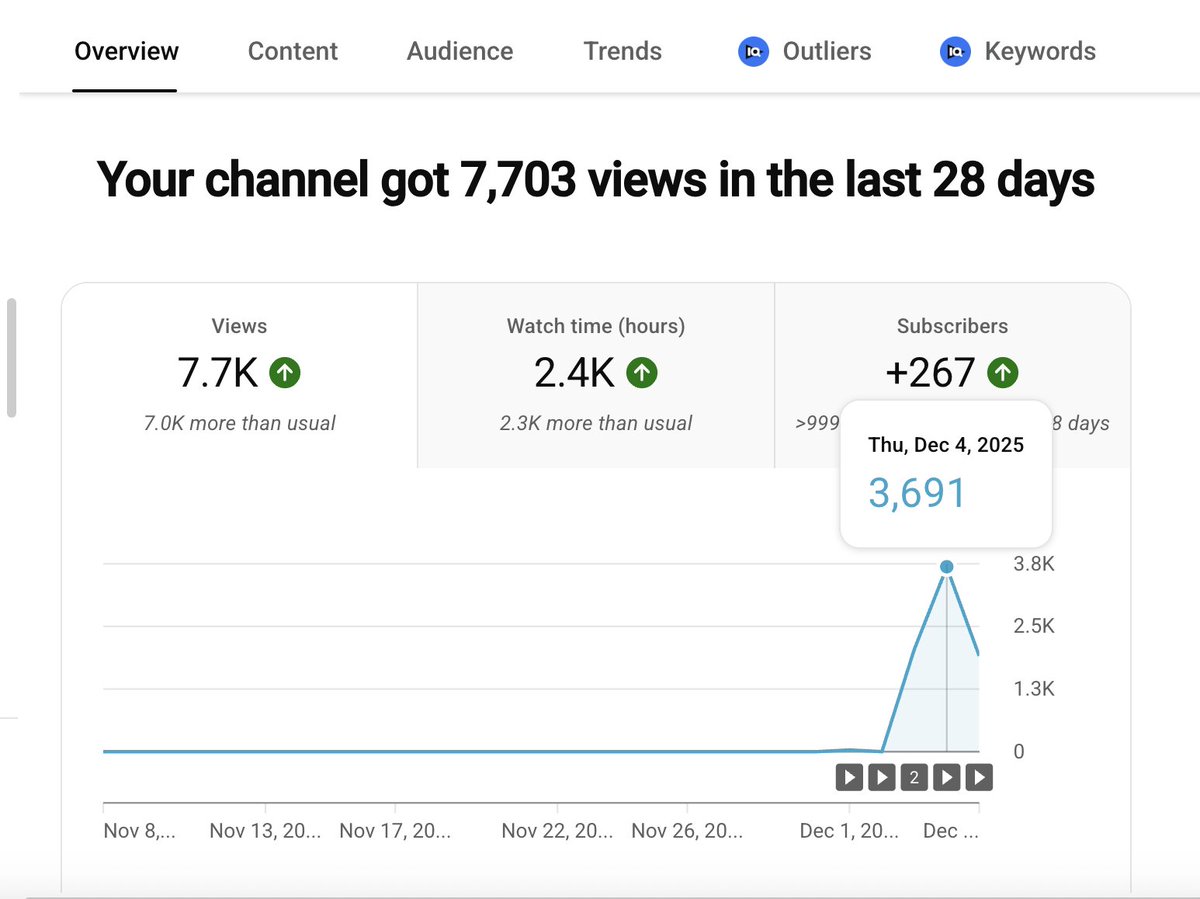
4 days ago, I did something crazy. I picked a channel that already had 88 subscribers, privated all 80 videos that had little to no traction, renamed the channel, set it up, and started posting in a new niche. A suggestion kicked in and boom, everywhere stew. I’m still on a streak of posting one video per day and might increase the upload rate later. I now have full confidence to pick up all my stubborn channels and switch them to another niche. I might even get this one monetized in two weeks if the traction continues like this. That said, my programs are currently open for enrollment. I don’t teach anything theoretical, it's 100% practical. I show you how to navigate, create quality content, and figure out what your audience truly wants to see. 2026 is around the corner. You can still end 2025 on a very, very good note.

Finally made a personal site that feels just right :)) Check it out here: fashikun.com Designed by me, built by @iPariola

This is more than an event. It’s connection. It’s opportunity. It’s people coming together to grow, learn, build, and dream. Do not miss out on this! RSVP now: bit.ly/devfestph2025

When people are suffering because the cost of living is too high, and you (as a policymaker) intend to spend public money to fix this, there are two main routes: - subsidize demand, or - subsidize supply Subsidizing demand is "give people money to pay for the expensive thing." Subsidizing supply is "give producers money to build out capacity to make more of the expensive thing." These routes represent a difference between (to use coarse-grained terms) current Western liberal thinking and Chinese socialist thinking. Subsidizing demand causes inflation if the expensive thing is expensive due to insufficient supply. The number of people who will have access to this thing will not go up, because the actual amount of supply stays the same. Prices eventually rise to reflect the inflation (speed depends on implementation of the subsidy). Subsidizing supply increases the amount of the expensive thing being produced, reducing its price and increasing availability. More people are likely to have access to it because now there's more of it and it costs less to buy. There are probably broader considerations involved that professional economists take into account but these dynamics seem relevant for our current economic situation. A few weird things seem to be involved in this situation in our present cultural moment: 1) Western liberal elites don't like subsidizing supply because subsidies for producers often feels like giving money to owners, or capitalists, or rich people. Why would you give money to the capitalist owner of the factory instead of to the common man? 2) American elite thinking tends to focus on "virtualized" things (like prices) while Chinese elites think more about "real atoms" (actual goods). Hence, viewing the prices of things as being too high leads to favoring virtualized solutions like helping with the price (give more virtualized money to bring down the virtualized price). Thinking about the amount of physical goods leads to thinking about how to make more of the physical good (build more factories). 3) There is this idea that you don't want to "crash prices" through "overproduction." In the West, classical micro-economic incentives lead producers to make a profit-maximizing amount and that it's bad to disturb that; only occasionally disruptive exogenous events result in large changes to supply and deflationary drops in pricing. There isn't much thought given to the idea that "price collapse" also lowers the cost of the good as an input into other things, as well as (in the case of widely-consumed goods) effectively lowering a tax burden on the population. China seems to think this way, and so subsidizes massive "overcapacity" which results in both everything that uses that good as an input becoming more economically viable, and people who consume it having more money for other things. The above idea is not obvious so I will give three examples: 1) The idea of asteroid mining and bringing back billions of tons of some valuable metal (nickel or gold or platinum), worth "trillions of dollars." Someone always points out that it'll "crash the price" (it will); this statement shows an inability to separate the virtualized idea of a price from how it represents the cost [to produce/acquire] - in fact it would be bringing trillions of dollars of value to the entire economy, as now there's a lot more of the metal to use, and everyone who uses it to produce something useful has lower cost of production and more downstream products (value) can be made. 2) In my own industry (global reforestation) I hear a similar objection to the idea of enabling much larger scales of sustainable timber: wouldn't it collapse the price of timber? Yes, and that's a good thing: now there's more timber for everyone to use and it's cheaper so more products become economical to make. 3) Finally, the "peace dividend" over the past 30 years where the proliferation of mobile phones made cameras, gyroscopes, and batteries far smaller and cheaper due to forcing producers to scale up production: this is what enabled the drone industry to develop as an economically viable product. The difference is that the West (to the extent that it remains laissez-faire) only allows these exogenous shocks or market trends to periodically drive down prices by expanding supply - the cause is unpredictable, whether it's discovery of a new source, business model, production methods, etc. Even the phrase "price collapse" sounds horribly negative and conversation-ending. But if you want to "lower taxes" on your citizenry you can either a) lower taxes revenues, or b) find a way to make something that everyone buys cost a lot less Examples of things that would essentially be a massive tax break for the citizenry if they went through a "price collapse": - housing - health care - education - fuel - ... you get the idea Current Chinese socialism is focused on increasing material wealth for its citizens, and so uses industrial policy to greatly increase production capacity - not just through subsidies, but also via competition: producers are given money to build more factories, but also forced to compete so that they innovate on efficiency and cost. If you give every producer money but tell them only a couple will win, you get a lot more stuff made and it gets better-cheaper-faster.... sooner. They are essentially accelerating the long-term deflationary effects of capitalism through socialist planning. But this is not a post about socialism! That's just the name for it, because the big idea that everyone has missed is that "Chinese socialism" is nothing like what it took from the West - the common moniker is "socialism with Chinese characteristics - but I prefer to think that the degree of distortion from having to translate between such alien cultures and language resulted in so much leeway for re-interpretation that what China ended up with was nothing like what Western socialists had in mind, it's like a Panda Express version of socialism: unrecognizable to people familiar with the authentic original, but optimized for its local conditions. After all, western conservatives - although apt to implement subsidies for producers ("giveaways to the rich") - still stop short at telling the producers to produce more than the profit-maximizing amount - they assume that the profit-maximizing amount is the "right amount" to be produced for the market. There is not as much thought given to "what are the downstream effects if 10x as much is produced and the price trends towards zero?" Bringing up "it would collapse the price for X" is enough to end most discussions. (Of course, you do see some modern tech barons thinking this way, and it's part of the galaxy-brain/megolomanical thinking where one company might intend to dominate or reshape an entire ecosystem, but we are mostly talking about non-technocratic Western policymakers right now) So instead the West contents itself with incremental reduction of prices (cost) through piecemeal innovation and competition, rather than targeted identification of areas where driving down a cost deliberately as close to zero as possible might have some kind of macro effect on society, and then implementation of industrial policy intended to achieve this effect. This is not socialism, because if it were really socialism (as the West understands it), at least some branch of the extreme Left in the US or EU would be advocating for it. And the Right won't brook quite that much market intervention: it prefers to just deregulate to accelerate the incremental price reductions - you know, regular ol' capitalism. Here is the point: the argument about whether China is socialist (communist) or capitalist is wrong. It is not either of those things - they are both Western ideas. It is a secret third thing. Now I am not sure exactly what it is - because I am steeped in American culture while having cultural access via my Chinese ethnicity - I can only tell you that it's not one of those things. It has something to do with a practical materialism, where "materialism" is not the word with the connotations of "shallow and liking money" (though Chinese people do love money), but rather a concern with real atoms, real things, the real physical world. It is not as though China has no art or culture or life of the mind, but that there is a profound recognition (perhaps even an overcorrection from being humiliated by "culturally inferior" barbarians) that if you haven't mastered the physical world, nothing else matters. And so it's not about the price, and thus virtualized measures like "GDP" - it's about how much real physical stuff you're making. For the tech people, it's a bit like counting productivity by Lines of Code (LOC). Writing more code means more productivity, right? Whereupon great programmers turn out to improve functionality by deleting Lines of Code, and so have "negative productivity." The same glitch exists in GDP, because with Mississippi having a GDP per Capita of $53k and Chongqing having a GDP per Capita of $14k... Well, you can increase GDP by making incrementally more stuff And you can increase GDP by giving out subsidies so everyone pays more for the same stuff But if you figure out a way to make the same stuff for way way cheaper super fast, you'll crater nominal GDP even while real economic welfare rises. Statistical agencies typically try to correct for quality/price changes like this and can account for it incrementally, but if you simply don't care about GDP as a measurement at all and are using some secret third thing to guide your policymaking towards the idea of "make as much stuff for as many people as possible" I guess you might even end up driving GDP towards zero along with your prices while your people mysteriously get rich. Anyhow, you might think this is a critique of American policy or something but really it's just a message for the new socialist government of New York City: if you want to drive down cost of living for New Yorkers, don't spend precious public dollars subsidizing goods. Figure out a way to spend it on increasing production capacity so that you can "collapse prices" because then everyone can afford it and have more. Remember: secret third thing.

Do you think GDP is an accurate Econ stat in 2025? Mississippi GDP per Capita: $53k Chongqing GDP Per Capita: $14k Mississippi Econ Backbone: Eggs farms and food stamps Chongjing Econ Background: Automotive, Electronics, Defense, semiconductors, high tech, tourism

@cyber_razz Cisco catalyst 2960 switch
@LFC Arne slot is fucking clueless How are you playing second 11 when your first team is not even something to write about 😩💔 You are playing with one of your strongest opponents and you’re just wasting resources It’s better you leave the club before you reduce lfc to nothing

Darcy DeClute | Scrum... @scrumtuous
255K Followers 3K Following I wrote a book! 🥳Not a Gumroad eBook scam but a real book! 📕 https://t.co/ttVHSuusdr Buy the hardcover, now on Amazon!📚 https://t.co/VqLLzaE5Ds
Ose✨ @MudinTY
4K Followers 3K Following Technical/Content Writer || Model || Virtual Assistant || Digital Marketer || Alumni @alx_africa || Building @mudinatx || Lead @scaportharcourt ✨Introvert✨
VICTOR ßAMS @Veek_Bams
1K Followers 2K Following |♉| here to share my 1% on what I find interesting or inspiring. UI designer | Brand identity designer
Valma @Valma79301
5 Followers 87 Following
G AAA³🧢 @ahmadadisa006
40 Followers 127 Following 🧬 It's 🧬 game 🧬 time 🧬 30BG for 🧬 life 🧬 @davido @hiitsgame

Ilupeju @ilupeju51150
15 Followers 275 Following
Bad Bunny @BadBunny125475
0 Followers 16 Following
ahsan ghauri @ahsan06993500
7 Followers 76 Following
Haven🥶🖇️ @havendigitals
25 Followers 305 Following I design brands & build websites Founder — Haven Digital Services Helping businesses grow online DM for projects
SovyLearn @SovyLearn
2 Followers 29 Following 🚀 Fondateur de SovyLearn ✨ Rendre l’apprentissage simple, clair et accessible. 💻 Développeur web 🧠 Vision logique 🎯 résultats concrets
Abdul Khabeer @FramewrkDev
1 Followers 41 Following Building the web, one site at a time 🛠️ Cairo-based dev • React & TypeScript Helping local businesses get online properly ↓ See my work https://t.co/RRgGAKwJ0t
Engr. Amarachi @AREAL_Recruitmt
2 Followers 21 Following AREAL Recruitment is a remote-first recruitment agency connecting global employers with carefully screened and trustworthy African professionals.

Onyeodinaka @OUmoke62674
99 Followers 342 Following

WholelifeTech @WholeLifeTech
15 Followers 563 Following We provide custom development services for websites, mobile apps, and software. We bring a modern touch and provide the right technology to pursue and accomplis
Obaro-Etugbo Samuel @samuelhector123
0 Followers 7 Following
CHUKWU DANIEL @dchukwu591
3 Followers 39 Following
MiraéEssence @MiraeEssence
1 Followers 19 Following
Melorex @Melorex47
5 Followers 8 Following
QUEEN MOOMOO @QUEEN__MOOMOO
78 Followers 157 Following SIMPLE GIRL MODEL DANCER VIDEO VIXEN ACTRESS DRAMA QUEEN LOVE💟PLAYING STUBBORN BT RESPECTFUL

Brown🍁👑 @_Web3newbie
1K Followers 1K Following Web3 Chad 🥷 || Structural Engineer 👷🏽♂️ || @Chelsea FC 💙 || Chess Boy ♟️ || Everything You Can Imagine Is Real.
ROIC_KING🇺🇸 @Gaahie8942805
50 Followers 2K Following 15-30% Monthly | 2 High-Conviction Stocks.Short-Term Gains: 15-20% in Days/Weeks.DM "JOIN" for WhatsApp Alerts. Live Trade Signals • Market Analysis

Olumzy @Olumzy125753
2 Followers 104 Following Motivational Enthusiast | Helping you unlock your potential and unleash your inner strength.,And believe in yourself,take action and make it happen
kirkgfx @kirkgfx
64 Followers 301 Following I design fitness/wellbeing apps that users actually stick with 📱 | UI/UX that boosts retention & results | DMs open
Cynthia 💕 @Ceey001
4K Followers 4K Following Ambivert| Catholic | Exploring the world through books 📚 | Proud Igbo woman and Libra ♎️ |Virtual Assistant |
atf. @atfdoesitbetter
3K Followers 940 Following
Collins Idoko | Faceb... @Cbmex1
1 Followers 9 Following
Oluwasegun @excel_concepts1
267 Followers 2K Following Brand & Product Designer https://t.co/1faqUFop5p

Florence Kelvin @FlorenceK77309
4 Followers 72 Following
Candle 👨🏼�... @PaschalUzoh
812 Followers 2K Following AI | Product Designer | Framer Dev. | Designing High-Impact Digital Products | Helping Brands Build Capacity @usebaseconnect @eldnacstudio
Madisen Grant @GrantMadis63556
88 Followers 2K Following "She wasn't looking for a knight. She was looking for a sword."

•Buike | the FrontE... @DevBuike
875 Followers 1K Following learning FrontEnd | NextJS. FullStack in view..

Adefemi Adeoye @_opeolluwa
1K Followers 2K Following Open Source Rust Developer 🦀 | Software Engineer 👨🏻💻 exploring OCaml 🐫 Editor @thisWeekInRust

Yobrain @Yobrain566428
3 Followers 38 Following

Princedede ♔ @iknowWassup
3K Followers 4K Following Building in AI, Web2 and Web3.. Tech Enthusiast. Culture & Truth.
Tobiloba @Thorbyloba
204 Followers 561 Following
rolex.dev @rolex_devv
744 Followers 2K Following Frontend Engineer (React, Next.js, Tailwind expert) | Member — @CH_JesusChrist
Americanah @ifeanyiTchima
988 Followers 1K Following
Andria digital @OTinafine2
13 Followers 120 Following Affiliate marketer| Graphic designer I teach people how to make money online. If $20 is not a small amount to you, DM me now
Isaiah Tochukwu @Tochizy001
22 Followers 163 Following
Sathish @sathishheroic
12 Followers 40 Following You can change what to do but, you can't change what you want.
Șanya11🗿 @Sanyaa011
18K Followers 6K Following Relatable videos≠Fashion Tweets ≠ DM for Pr ≠ Everyday VADDICT + AG Baby.

Davido @davido
17.3M Followers 1K Following 5IVE OUT NOW! 5️⃣ Listen now ⬇️ | 📧 inquiries: [email protected]
Peter Obi @PeterObi
5.6M Followers 81 Following Former Governor, Anambra State. LP Presidential Candidate, 2023. NDC Presidential Candidate, 2027. Tweets by him are signed -PO.
Àgbà Akin @Kynsofficial
195K Followers 262 Following Tech, Politics, MUFC, CEO @swiftspeedapp. Lead contributor @echovaultsapp
Name cannot be blank @hackSultan
293K Followers 2K Following Building a learning institution with a better experience at @altschoolafrica @hacksultan_ea
Àgbà John Doe @jon_d_doe
479K Followers 9K Following Man, Husband, Father, Uncle. C-in-C of Àgbàfians. Insult=Block. Click & subscribe to the page, for ads & others. T&C apply. DM @jon_d_doee
Mr Psquare @PeterPsquare
4.6M Followers 3K Following Musician/Entertainer/Businessman/Dr&CEO. Bookings: [email protected] +2348121110000

Solomon Eseme @Kaperskyguru
38K Followers 218 Following Helping you become a great AI Backend Engineer Founder @master_backend [email protected] Join my AI Backend Engineering Bootcamp https://t.co/7pNyR6k2oj
Aproko Doctor Global @aproko_doctor
2.5M Followers 11K Following Executive Director @AD__Foundation. Building @AskAwaDoc & Aproko Doctor Global. Storyteller. Watch our YouTube videos 👇



Punch Newspapers @MobilePunch
7.0M Followers 2K Following This is the official X (formerly Twitter) handle of PUNCH Newspapers, the most widely read newspaper in Nigeria.

Mr Bayo @mrbayoa1
1.5M Followers 238 Following Gaming Lifestyle, Sport lover and a serial winner in Football Betting. Don’t play games you don’t understand. TG: https://t.co/6w0Ab7fPOE

‘Tunde Omotoye @TundeTASH
605K Followers 2K Following 2X G20 YEA Canadian Delegate | HR, Policy, Tech, Immigration, Study Abroad | Licensed Consultant by CICC 🇨🇦| building @SchooliplyHQ | Follow @TravoolyHQ
Chisom Nwokwu🌟 @tech_queen
86K Followers 635 Following God’s Special Princess✨• Multi-Published Author • ex-@Microsoft • MSc AI @GeorgiaTech • Building @joincohorts_
Darcy DeClute | Scrum... @scrumtuous
255K Followers 3K Following I wrote a book! 🥳Not a Gumroad eBook scam but a real book! 📕 https://t.co/ttVHSuusdr Buy the hardcover, now on Amazon!📚 https://t.co/VqLLzaE5Ds
Dev.tobs || MDsc. EMC... @DevTobs
134K Followers 2K Following “Tenured COO ~ https://t.co/tQ8GlYFtTi |📥: [email protected]
HR Beno II @BenoStudios
1K Followers 154 Following Remote & Onsite Roles • Digital Assets • CV/Resume Revamp • Global Talent Sourcing.

Asalu Adegboyega Yink... @yinkarianstocks
12K Followers 48 Following Experienced Stock Trader | Investment Educator & Consultant | Strategic Leader
Nigerian Stocks on Ba... @ngnstx
35K Followers 112 Following For GenZs stashing on the Nigerian Stock Exchange and foreign markets. Crisp media content through the week. Not affiliated with Nigerian Stock Exchange.
Moments & memories @momentmemori
176K Followers 880 Following Feel calm in the chaos. Follow for the content I love, you love.
Fanta_de_joker @fanta_de_joker
15K Followers 5 Following Amarachukwu emegom endorsed Nwoke Mbano ,Mr nahuuu
Bremen @Rxbremen
11K Followers 845 Following Licensed Pharmacist|| Capitalist|| Individualist|| Dubito Ergo Cogito Ergo sum|| Polymath ||JW||Lone wolf

Rufybaba @Rufyb
30K Followers 891 Following Investment Management | Economics | Finance | Strategy | Tweets Catalogue on the 'Highlights' Tab
★ 𐚁 Morgane 𐚁... @VittoreMorgane
8K Followers 3K Following I TOLD YOU I’M A F*CKING PROBLEM🐝 𐚁 BEYONCÉ STAN ACCOUNT #TeamOL
Ellie Sleightholm @elsleightholm
39K Followers 241 Following 🚀 Mathematician showing others the beauty in Mathematics, Space, and STEM 📧 [email protected]
Intern gbogbo HR @tundeskie
40K Followers 2K Following HR • Author: The Irony of Human Resource - https://t.co/KFqgGKCj1S • Married • Political Scientist • Public Speaker • Military enthusiast • Davido • PBAT
Minister of Jobs @emmanuelbasy
48K Followers 366 Following Global Recruiter | #RemoteJobs home - Over 10,000 Nigerian and international jobs on my telegram channel. Click the link on my bio to join and start applying
Dr Oludayo Sokunbi @Oludeewon
432K Followers 1K Following PhD, PMP, PSM | Follow me for JAPA Info. | +2348021244599, +2349059942127 (WhatsApp) | 9am-5pm WAT (Mon-Fri) | 📩: [email protected] | https://t.co/YBxmeMXEwr
Fidson Healthcare PLC @Fidsoncares
3K Followers 31 Following Founded in 1995, we have relentlessly pursued our goal of becoming a leading player in the pharmaceutical landscape in Nigeria.

Oreoluwa Bukola, CFA. @BukkyOA
31K Followers 3K Following I coach young corporate professionals to build confidence, lead boldly and get promoted.
Jobs Region @jobsregion
128K Followers 6 Following Get fast job updates in Nigeria and abroad. For scholarships, follow @scholarsregion. Chat our WhatsApp +2348106549924 to post jobs or promotions.
Noah SULAIMON @okikiayo11
16K Followers 4K Following Founder @FirstAsssured Lead Pastor @CultureofC11885 Japa Free advice with me. Believer. Husband. Author. LLM HealthLaw (Bristol). Medical law. I support Obi
Compounding Naira @compoundinnaira
30K Followers 5K Following Investing in Nigeria Stock Exchange for daily/weekly/monthly income. Started from kobo kobo and going to millions
BIG CHRIS @chrisdadiva
17K Followers 8K Following Fitness Influencer & YouTube Automation | Helping 100+ Students Build Profitable Faceless Channels | Sharing Real Lessons On Mindset, Discipline & Consistency.
Leander Hofkes @LeanderHofkes
22K Followers 770 Following I build and scale YouTube brands • Founder of Justicul, Out Of Bounds, Agent Flappy & More • Strategist for Underknown
Vexian - Algorithm Al... @Vexian
25K Followers 1K Following Algorithm Alchemist 6B+ Long Form Views Building Vexed Media & @WifiMoneyMafia, @TubeAIApp Prev: Head of Strategy @1of10media
UI/UX Savior @UiSavior
126K Followers 3K Following UI/UX Designer • I do paid posts for AI & design tools DM for rates → open to collabs
Mayowa @mayowaofyt
17K Followers 499 Following A Faceless Youtuber from Nigeria 🇳🇬 Story Telling Niche 📌 📞 https://t.co/DVlL4z6d5R
EAZI👾 WEB DEV / PR... @solomon_eazi
751 Followers 783 Following Iamsolomon ™💟 Expert UX Designer / AI Creator / Mobile Developer / AI Workflow Expert - https://t.co/TO3MVZ81Hk, n8n.

Stephanie Iniidara @StephanieInii
22K Followers 755 Following • Graphic Designer • Influencer & Creator for AI brands • Building AI character @AI_Iniidara • Want to reach me on WhatsApp? https://t.co/EoGsiD9wmx
hakeem ☻ 💜 | Stu... @digitalforus
6K Followers 4K Following Founder @madebyduo | Design partner for busy startups 🚀 | I build Brands & Websites for companies funded by YCombinator, A16Z, Sequoia, Silicon valley startups
Michael Idris @idrisweb
2K Followers 794 Following So I decided to become a founder. check @rideflowhq
Mr. Samuel Owolabi @samowolabi_
696 Followers 2K Following sometimes a 10x software engineer, sometimes an absolute beginner. 2x AWS Certified. Creator https://t.co/edTP3pFUuy
Ben X @Benn_X1
21K Followers 2K Following I have no desire to be understood, admired, pitied, or even known.
Felix The GenZ HR is ... @bsong_HR
24K Followers 3K Following Award-winning Recruiter and HR Professional Consulting for 190+ businesses with @thegenzHR 📧 [email protected] Building - @TalentFactoryHQ
Darlington Anyanwu | ... @official_cumi
15K Followers 1K Following Global Tech Recruiter || Career Strategist || StartUp HR Consultant || FinTech || Ex @fairmoney_ng @moniepointng || Bricklayer @TheFleepSyd
Luntrai @luntraiapp
2 Followers 0 Following A meeting intelligence service helping remote teams capture decisions, create clarity, and schedule what matters.

Ridd 🤿 @ridd_design
73K Followers 777 Following building https://t.co/LNk32UFU2O ✈️ learning https://t.co/HJo7GSZzHG 🤿
ben hylak @benhylak
51K Followers 3K Following we are hiring. cto @raindrop_ai, prev @apple design, @spacex eng


Ahmed @ahmedrann
14K Followers 968 Following | Founder of https://t.co/apE8T9vniA ❤️ | Founder of https://t.co/T9BTwmzlRa ❤️
Ameer ☻ @am33r__105
8K Followers 399 Following I create cool shit online 🔥 | Creator & Web Developer 👨🏾💻 📩 [email protected]
Ghost St Badmus @commando_skiipz
15K Followers 4K Following Just a random guy, tweeting in front of the world. Sr. Application Security Engineer (API, Mobile, Web, Cloud, AI/ML) 💼. Creator (@vulnbank & https://t.co/pgYmTW2JVL)
Sani Yusuf @saniyusuf
24K Followers 271 Following Founder | Author | Speaker Building @beltstripe. HealthTech/EdTech/Agric I'm Not The Man Of Your Dreams. Your Imagination Wasn't This Great.
Abdulkadir | Cybersec... @cyber_razz
44K Followers 182 Following Cybersecurity Creator x Instructor | Network Security| AI | I POST EDUCATIVE CONTENT | •DM or Email for Collabs | Backup: @cyber__razz
Shruti @ShruPosts
18K Followers 321 Following Your go-to designer for fast, high-quality websites, apps & digital products | Available for projects.
👑S.A.L.A.K.O🕊 @UnkleAyo
253K Followers 182 Following |Web² Retired DevOps Kingpin 👨💻 |Web³ Cr¥ptõ & DevRel🧣 |Oncology Researcher (Ph.D 1 & 2 In-View), Gliomas 🧬 |Digital Nomad (28/195) 🌎 |A Stoic-Outlaw ⚓
Divine Samuel @diviinesamuel
4K Followers 4K Following Product Designer • Framer developer • Member @superteamNG
Americanah @ifeanyiTchima
988 Followers 1K FollowingTrends for United States
You might like