STO Chain @StoChain
Issue and Trade Tokenized Assets on STO Chain | Transforming How You Invest. Join The Community ➡️ https://t.co/RDAJbRWZ2f $STOC #RWA linktr.ee/StoChain Joined July 2024-
Tweets437
-
Followers18K
-
Following29
-
Likes471
The SEC will host a public roundtable on September 17 to examine what it would take to support 24-hour trading in U.S. equity markets. The discussion will cover preparations for overnight trading, operations and resilience in a 24-hour market, and the opportunities and challenges of expanding trading hours. The roundtable itself is not a rule proposal or approval. But the infrastructure shift is already underway. NSCC has moved to 24×5 clearing, allowing trades executed across extended hours and multiple time zones to enter central clearing on a near-continuous basis. This shows why 24-hour trading is not simply about keeping exchanges open longer. Market data, trade reporting, clearing, settlement, corporate actions, and risk controls must also function reliably across overnight sessions. Expanding market access will ultimately depend on whether the systems behind each trade can operate beyond traditional market hours. #STOChain #RWA #Tokenization

The UK is testing whether stablecoins can support digital securities settlement within the Digital Securities Sandbox. Participating firms may apply to use a specific stablecoin as the payment asset for digital securities transactions, subject to case-by-case approval by the Bank of England. Eligible stablecoins must meet standards for redemption, independently attested 1:1 backing, reserve safeguarding, operational resilience, financial crime controls, and holder protection in insolvency. The broader implication is that tokenized capital markets will not be defined only by how securities are issued or traded. They will also depend on which form of digital money can reliably complete the cash leg of settlement. If stablecoins can meet wholesale market standards, the asset and payment sides of a transaction could operate within the same digital infrastructure. This places stablecoins alongside tokenized deposits and commercial bank money in the competition to become a trusted settlement asset for regulated tokenized markets. #STOChain #Stablecoin #Tokenization #RWA

Cantor Fitzgerald and Securitize are bringing tokenization into the IPO process. The partnership aims to support IPOs and follow-on offerings through blockchain-based infrastructure. Cantor will contribute its equity capital markets and trading capabilities, while Securitize will provide the technology for issuing, distributing, and servicing tokenized securities. This goes beyond representing existing shares onchain. It brings tokenization closer to primary capital formation, where companies issue equity, reach investors, and raise capital in public markets. The next stage of tokenized equities may not be defined only by 24/7 trading or blockchain-based ownership. It may begin with how public securities are issued in the first place. #STOChain #Tokenization #RWA

The UK is moving beyond permitting tokenization and toward building a wholesale market that can operate on tokenized rails. A programme involving 54 financial and digital asset firms will develop live use cases over the next 12 months, beginning with tokenized repo. Key priorities include: ✅ Digital gilt DIGIT and tokenized securities ✅ Tokenized collateral for repo and liquidity ✅ Tokenized funds and digital settlement rails ✅ Interoperability between DLT and existing infrastructure ✅ Legal clarity, tax neutrality, financial crime controls, and operational resilience The goal is not simply to put more assets onchain, but to connect issuance, collateral, payments, and settlement within a regulated market system. The UK is moving from isolated pilots toward a coordinated transition to tokenized finance. #STOChain #Tokenization #RWA

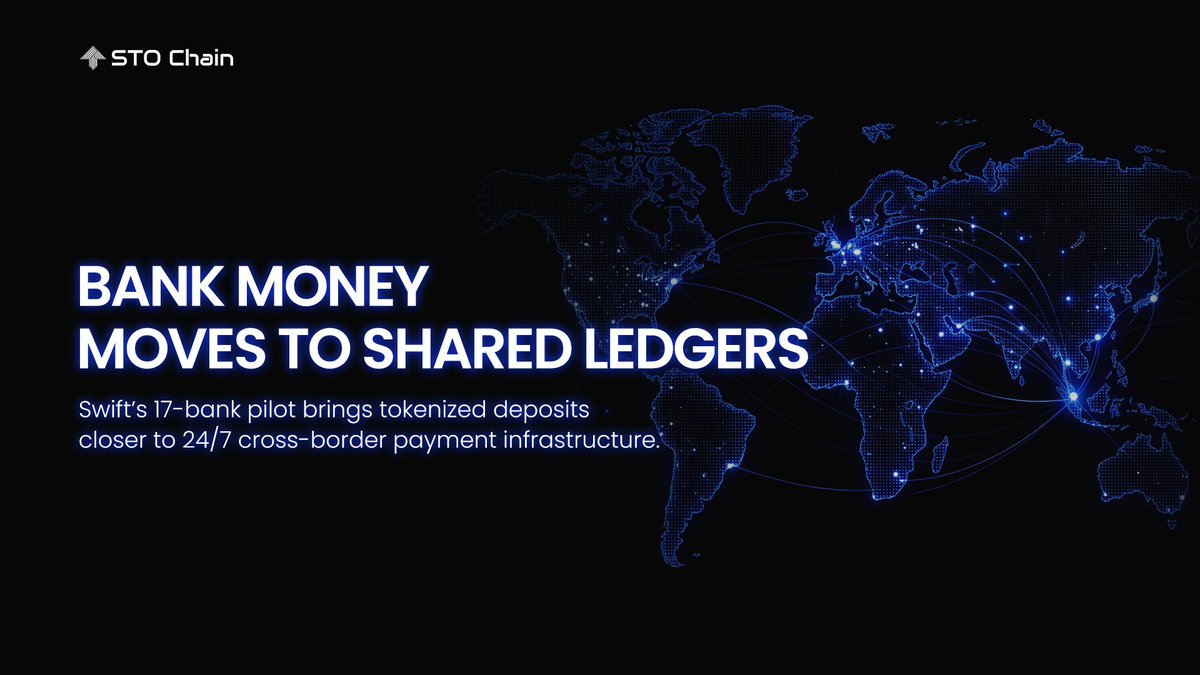
Swift’s latest move brings tokenized deposits closer to real payment infrastructure. Its blockchain-based ledger is ready for initial use, with 17 banks preparing to pilot cross-border payments using tokenized deposits. The significance goes beyond another bank-led digital asset experiment. Bank-issued digital money is beginning to operate through shared-ledger infrastructure within Swift’s trusted global network. The design matters. Rather than replacing existing banking rails, Swift’s ledger coordinates tokenized deposits issued on banks’ own ledgers, while final settlement continues through existing systems. This moves tokenized deposits from isolated pilots toward practical use in cross-border payments, liquidity management, and 24/7 corporate treasury operations. #STOChain #Tokenization #RWA #Payments
Tokenized equities are moving beyond access products. Securitize began trading on the NYSE under the ticker SECZ and brought tokenized versions of its own common stock onchain through its regulated platform. This is different from third-party wrappers or synthetic stock exposure. The issuer itself is participating. That matters because tokenized public equity is no longer only about giving investors blockchain-based access to stocks. It is becoming a test of how public-company ownership can connect with regulated transfer, eligibility checks, shareholder records, and onchain settlement infrastructure. Tokenized stocks are becoming a market infrastructure story. #STOChain #Tokenization #RWA

The IMF says tokenization could change the architecture of the financial system. The important point is not only faster settlement or lower friction. When assets, payments, and settlement move onto shared ledgers, financial risk can also move from institutional balance sheets toward platforms, code, and market infrastructure. That creates a different kind of financial system. Traditional markets are slow, but the delay also provides buffers through clearing, reconciliation, reporting cycles, and liquidity management. Tokenized markets can compress these steps into moments. This can reduce counterparty risk and operational friction, but it also makes infrastructure more critical. Settlement assets, platform governance, interoperability, legal finality, and real-time oversight become central to market stability. Tokenization does not just put financial assets onchain. It changes where the financial system carries risk. #STOChain #Tokenization #RWA #Stablecoin

[$STOOS → $STOC Migration Notice for MEXC Holders] $STOOS held on MEXC will be migrated to $STOC as part of the STO Chain Mainnet migration. Migration Details Mainnet: STO Chain Mainnet Ticker Migration: $STOOS → $STOC Swap Ratio: 1 STOOS = 5 STOC $STOOS held on MEXC will be migrated through MEXC. On-chain holders can apply for migration through the official bridge: bridge.stochain.io

Stablecoin growth is no longer only a payments story. Invesco has filed to launch the Invesco Stablecoin Reserves Onchain Fund, a tokenized money market vehicle designed to hold cash and short-term U.S. Treasuries for payment stablecoin reserves. This is not about another asset manager entering tokenization. It is about the reserve layer behind digital dollars becoming an institutional infrastructure market. For stablecoins to scale beyond crypto liquidity, they need more than issuance and circulation. They need credible reserve assets, regulated liquidity, compliant recordkeeping, and operational links between traditional money markets and onchain ownership. The competition around stablecoins is moving from the front end of payments to the back end of reserves. As digital dollars scale, the infrastructure behind them may become just as important as the tokens themselves. #STOChain #Stablecoin #Tokenization #RWA

Japan’s foreign exchange and corporate payment market is moving toward stablecoin settlement rails. Circle and Nomura are preparing a USDC-based corporate payment service in Japan, with rollout planned as early as 2027. The structure could allow businesses to exchange yen for USDC and use it for supplier payments, overseas affiliate transfers, and FX settlement. The key point is not simply USDC’s expansion in Japan. It is that a highly regulated financial market is beginning to test stablecoins as corporate payment infrastructure. For companies managing imports, exports, and global payments, stablecoin settlement could reduce the delays and friction of traditional cross-border transfers. Nomura’s role matters because adoption requires more than issuance. It requires onboarding, compliance, banking integration, institutional trust, and access to existing financial rails. Japan’s move shows how stablecoins are expanding beyond exchange liquidity and into real corporate settlement use cases. #STOChain #Stablecoin #USDC #Japan #RWA

The U.S. Congress has passed a bill that includes a provision restricting the issuance of a digital dollar. The key point is not simply that the U.S. is moving to block a CBDC. It is that the country’s digital money competition may tilt further toward private stablecoins rather than a central bank-issued digital dollar. A CBDC is digital money issued by the government, while stablecoins are privately issued digital assets pegged to the dollar. Both can function as digital payment tools, but their market implications are different. If a digital dollar is restricted, private stablecoins such as USDC may continue to play a larger role in crypto markets as tools for payments, liquidity movement, and exchange infrastructure. Ultimately, this provision does not mean the U.S. is giving up on digital money. It shows a clearer direction in the debate over whether that role should be led by the central bank or by the private stablecoin market. #STOChain #CBDC #Stablecoin #RWA

The Bank of England has adjusted its proposed systemic stablecoin rules in a more flexible direction. The signal is not simply that stablecoin rules are becoming lighter. It is that the UK is trying to define how stablecoins can operate as regulated settlement money. According to the FT, the BoE is moving away from strict individual and business holding limits toward per-stablecoin issuance caps, lower central-bank reserve requirements, and safeguards such as 24-hour redemption, statutory trust structures, and capital and liquidity requirements. For tokenized markets, that matters. Tokenized assets do not scale on issuance alone. They need a money layer that can support settlement, redemption, liquidity movement, and trust under regulatory oversight. The next phase of tokenized markets will depend not only on what gets issued on-chain, but on whether regulated settlement money can support the market structure behind it. #STOChain #RWA #Tokenization #Stablecoin

The Philippine SEC has signaled readiness for RWA tokenization. According to Cointelegraph, Philippine SEC Commissioner Rogelio Quevedo said at Philippine Blockchain Week 2026 that the country has the legal and regulatory foundation to accommodate asset tokenization. The key point is not the comment itself. It is that RWA tokenization is increasingly being discussed within national regulatory frameworks, not just as a blockchain experiment, but as a regulated market activity that can be tested, supervised, and brought closer to real adoption. RWA tokenization is not simply about putting assets on-chain. For tokenized assets to be adopted in real markets, they need to be issued under a clear legal basis, tested within a regulatory structure, and offered to investors under defined standards. The Philippine SEC’s Strategic Sandbox, along with discussion of tokenized real estate offerings, shows how this transition may begin: through supervised testing, regulatory readiness, and a clearer path from concept to market. The expansion of RWA tokenization will not depend on technology alone. It will depend on whether each market has the legal clarity, supervised testing environment, investor protection standards, and institutional structure needed to support real adoption. #STOChain #RWA #Tokenization

Private-company shares may become one of the hardest tests for tokenization. Unlike public equities or tokenized treasuries, private shares are tied to limited supply, restricted transfers, complex ownership records, investor eligibility, and thin liquidity. Recent moves by major financial institutions to explore tokenized depositary receipts show why this asset class is becoming more relevant to RWA. But turning private shares into tokens does not remove that complexity. It brings it closer to the surface. The real question is not whether private-company shares can be represented digitally. It is whether the infrastructure around them can support real asset sourcing, custody, rights, transfer controls, settlement, compliance, and investor protection. The next phase of RWA will not be defined by what can be tokenized, but by what can be trusted, transferred, and settled at scale. #STOChain #RWA #Tokenization
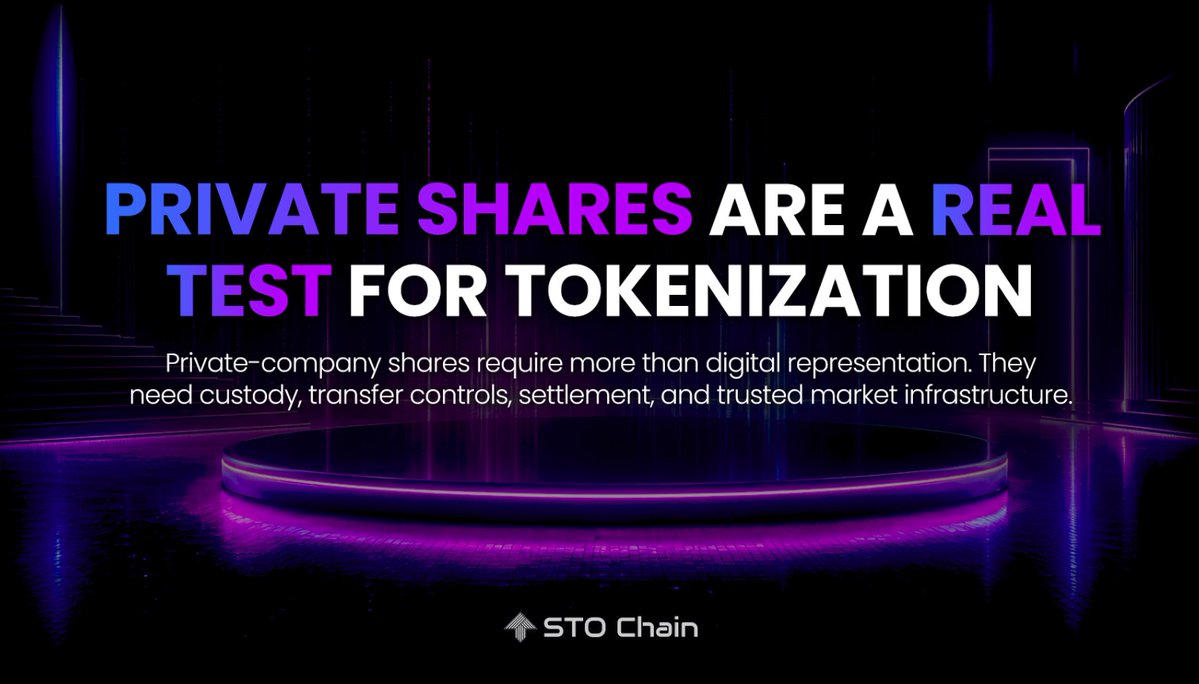
The SPCXx launch shows how tokenized access can generate demand faster than market infrastructure can support it. Tokenized versions of SpaceX shares reportedly attracted more than $1B in customer interest before launch, highlighting the strength of demand for private-market access. But the underlying asset sourcing and supply structure could not keep up with that demand, leaving some orders unfilled and user funds refunded. This issue matters because making an asset digitally accessible is not the same as making it reliable in the market. A token can make private-market exposure feel easier to access, but the product still depends on real asset sourcing, allocation, custody, settlement, and investor protection behind the scenes. For RWA, this part is often overlooked. Tokenization can improve access, but it does not remove the need for trusted market infrastructure. In fact, the more demand a tokenized product attracts, the more important that infrastructure becomes. The next phase of tokenized finance will not be defined by digital wrappers alone. It will depend on real asset sourcing, transparent supply structures, reliable custody, compliant settlement, and trusted rails that can withstand actual market demand. #STOChain #RWA #Tokenization

Private markets are becoming a major test for bank-grade tokenization. Citi’s reported rollout of tokenized depositary receipts for private-company shares shows how tokenization is moving beyond simple asset representation. The important shift is not just that private assets can be digitized. It is that issuance, custody, investor access, and market infrastructure are beginning to converge within regulated financial institutions. For RWA, this is where the conversation becomes more serious. Private markets have long been difficult to access and structurally opaque, often relying on fragmented vehicles and limited distribution channels. Tokenization can improve that model, but only when the infrastructure behind the asset is strong enough to support clear rights, reliable custody, compliance, settlement, and liquidity. The next phase of private-market tokenization will not be defined by digital wrappers alone. It will be defined by trusted rails that make private assets easier to access, clearer to manage, and more reliable to trade within institutional market structures. #STOChain #RWA #Tokenization

Tokenized deposits are moving from concept to banking infrastructure. According to WSJ, JPMorgan, Citi, Bank of America, and Wells Fargo are planning a nationwide tokenized deposit network targeted for the first half of 2027, operated by The Clearing House. For tokenized assets to scale, asset issuance alone is not enough. Real-world assets need digital settlement rails that can support 24/7 payments, real-time liquidity movement, cross-border transactions, and institutional-grade market access. This is where tokenized deposits become important. Unlike stablecoins, they keep digital money inside the existing banking framework while still enabling blockchain-based settlement. As financial assets move on-chain, the next layer of infrastructure will not only tokenize what investors own. It will also tokenize how value moves. Settlement infrastructure will become just as important as asset tokenization itself. #STOChain #RWA #Tokenization

Citi projects tokenized assets could reach $5.5T by 2030. But the real story is not just the size of the market. It is the infrastructure shift behind it. Citi’s Tokenization 2030 report points to three forces driving adoption: → Public securities, U.S. equities, treasuries, and liquid collateral moving on-chain → DTCC, NYSE, and Nasdaq integrating tokenization into core market infrastructure → Stablecoins and tokenized deposits becoming the settlement layer for on-chain finance The direction is clear: tokenization is moving beyond isolated asset issuance. The next phase of RWA will be built on interoperable infrastructure for issuance, settlement, liquidity, and market access. #STOChain #RWA #Tokenization


Shelli Tran @Shelli9357
3K Followers 2K Following Success is not final, failure is not fatal. It is the courage to continue that counts.

Yaseer Ibraheem @YaseerIbraef
32 Followers 842 Following
وايل عياد @WaylYad52474
2 Followers 2K Following
Mavislove @Mavislove321499
3 Followers 479 Following
Luis Alberto Mendoza ... @LuisAlb24874015
3 Followers 746 Following
Dhuf @Dhuf130783
2 Followers 458 Following
الشاعرانس ا... @4anas_
3K Followers 5K Following حسابي من حوالي سنه ونص وهو مخترق . الصور والمقاطع اللي نزلت بصفحتي في احد اخترق حسابي ونزلها وما قدرت الغيها الله يسلط عليه عذابه https://t.co/JfckFB6Scr
Wayne Tibbits @WTibbits47399
2 Followers 403 Following
Shinta 1404 @1404Shinta80023
2 Followers 685 Following
jamilu Ahmed @jamiluahmed697
25 Followers 559 Following A just politician,Educationist,Amazing father,,All tweets are my opinions
Money Engineer @engineer_money
55 Followers 1K Following Being introvert makes me special from others
dolores gomes @doloresgom63307
2 Followers 451 Following
Salma Hanan @SalmaHanan88270
3 Followers 806 Following
Ejaz Khan @EjazKhan21035
4 Followers 2K Following

Wales @Waleshrcoi
1 Followers 1K Following
Doyyy Xcuan @cuannn20
2 Followers 2K Following
سيد احمد حس�... @ahmd_syd50455
4 Followers 2K Following
Sally Provencher @Provencher323
3 Followers 1K Following
Chris 🇩🇪🇮�... @Fernandezsa2
76 Followers 2K Following ahli fisika ilmu astronomi Surabaya sains dan teknologi dari NASA

تامر الصافي @TAlsafy6063
0 Followers 435 Following
Anh Vo @AnhVo277767
2 Followers 1K Following
HoneyMoney @honeymoneyyg
1 Followers 704 Following
อนุชิต �... @butr_wara78180
3 Followers 2K Following

Ridwan Sygmumu @sygmumu64538
0 Followers 2K Following
KingOwen @KingOwenM
3 Followers 465 Following Software developer Web developer Though Leader Public Speaker Analyst
Hyunie @ShykariS50140
4 Followers 2K Following
zaid @zaid207607
0 Followers 436 Following
reyhan dwiaditya @DwiadityaR8564
0 Followers 1K Following

Wanja siwizani @siwizani
43 Followers 2K Following
Wijiyono Giovan @WijiyonoG
0 Followers 2K Following
Alisha Wijdan @alisha_wijdan
2 Followers 454 Following
فری مود @Tavgh22
0 Followers 487 Following
John Brent Llego @llego2640
2 Followers 2K Following

Mark Nyadalo @MarkN94217
2 Followers 2K Following
N.M.HEMAL @NMHemal
20 Followers 1K Following
Nura salo @nura_salo
6 Followers 2K Following
Theodore Charles @TheodoreC63878
0 Followers 751 Following
Ashraf Hussain @AshrafHuss81059
0 Followers 405 Following
Arisa💚💗 @12Nofs
2 Followers 1K Following
ADI Predictstreet @Predictstreet
113K Followers 35 Following Predict at the speed of play. Official Prediction Market Partner of the FIFA World Cup 2026™
DigiFinex Global @DigiFinex
262K Followers 796 Following 🧐#DigiFinex | GLOBAL CRYPTOCURRENCY EXCHANGE 📲Download: https://t.co/A2PHozrJLl 🙋Contact us: https://t.co/MYbhMH3JVK 💼Hiring: [email protected]
고팍스 - GOPAX @GOPAX_kr
7K Followers 731 Following 새로운 금융의 개척, 고팍스 고팍스 텔레그램: https://t.co/z52A5eKRzI 고팍스 유튜브: https://t.co/RUVomBaOsN 고팍스 인스타그램: https://t.co/T9MUseSISc
BitradeX @Bitradexen
83K Followers 4 Following Building the Future of AI & Digital Assets. | Official Telegram: https://t.co/H5A88puL1Q | https://t.co/nzb85XPm3J
Pauluz @PauluzRFRM
51K Followers 3K Following CMO of @ReformDAO📢| Space Host of @PaulsPenthouse🎙️| Certified Yapper🗣️| Crypto since 2016🌐| Marketing Advisor @hodl_ventures
B R E Y @breyonchain
99K Followers 13K Following Just an autist sharing the things | Founder @ZaxWeb3
greb @grebby
69K Followers 2K Following founder / 2013 trader / 🦅/ occasional educator / investor / token spender
Beosin 🛡 Web3 Secu... @Beosin_com
32K Followers 1K Following Smart contract audit, crypto AML KYT, stolen crypto recovery | Invested by @fenbushi @Lenovo, @cyberport_hk incubatee | 📧[email protected] https://t.co/pCyqL6IKha
Real World Asset Watc... @RWAwatchlist_
313K Followers 83 Following The home of #RWA - Real World Asset tokens. DAILY news stats & opinions!
Coinbase 🛡️ @coinbase
7.1M Followers 174 Following The future of finance is on Coinbase. For support: @CoinbaseSupport
CoinGecko @coingecko
2.4M Followers 642 Following The world's largest independent crypto data aggregator. Price alerts on-the-go: https://t.co/ApyqCEUX89 Track DEXs @GeckoTerminal
vitalik.eth @VitalikButerin
7.2M Followers 547 Following I choose balance. First-level balance. mi pinxe lo crino tcati https://t.co/gCQrmCby7P

MEXC @MEXC
1.7M Followers 131 Following Your 0-Fee Gateway to Infinite Opportunities Trade Crypto, Stocks, Gold, Silver, Oil and Prediction Markets in One Place Support: @MEXC_CST|#MEXC0Fee
XT Exchange 🚀 @XTexchange
351K Followers 199 Following XT: Xplore Crypto, Trade with Trust! TG 👉 https://t.co/J0P3vGegFL Jump in: 🚀 https://t.co/14MS4Ke94w 🔥 Apply for Listing: https://t.co/EG4ISjyTs9
BNB Chain @BNBCHAIN
3.9M Followers 559 Following The blockchain with superior distribution and deep liquidity, built for global markets and the next billion users. Build your AI agent with BNB Agent Studio 👇
YZi Labs @yzilabs
757K Followers 383 Following YZi Labs invests in ventures at every stage, prioritizing those with solid fundamentals in Web3, AI, and biotech.
CoinMarketCap @CoinMarketCap
7.1M Followers 597 Following #CMC is the world’s most trusted source for crypto data & insights. Have a question about crypto? Ask https://t.co/54uUtCsuxw
LBank.com @LBank_Exchange
742K Followers 4K Following 💎 Trusted by 25M Users for 10 Years 🏆 Official Sponsor of @AFA 🔗 Try our TG Bot https://t.co/W48kvqHKNw
WEEX @WEEX_Official
185K Followers 1K Following Crypto Exchange for Futures & Spot | Trade BTC, ETH & 1700+ Pairs | Secure & Reliable | Official LALIGA Partner (HK/TW)
Bitget @bitget
4.4M Followers 804 Following World’s largest Universal Exchange (UEX) for Crypto, Stocks, Gold, Forex, and more | Partner of @MotoGP & @UntoldFestival | Support @BitgetSupport
KuCoin @kucoincom
3.5M Followers 2K Following Leading global crypto platform built on trust | 40M+ users worldwide | Support: @KuCoinUpdates | UK users: @KuCoin_UK | AU users: @kucoinaustralia
HTX @HTX_Global
1.7M Followers 22K Following Trade Crypto Only on HTX! Telegram: https://t.co/UGe1b3suSw
Gate @Gate
2.1M Followers 810 Following https://t.co/Rf4ibjdoXK | Top 3 | 13+Yrs | 54M+ Users | 4,700+ Cryptos | 11,500+ Stocks & CFDs | @redbullracing & @inter Sponsor | ⚽️ Predict World Cup | https://t.co/U3jSAiiSOR
Bybit @Bybit_Official
4.9M Followers 801 Following One platform with seamless access to global markets, payments, trading, wealth and RWA. Always on. Borderless. Accessible. #NewFinancialPlatform
Binance @binance
16.1M Followers 571 Following The world’s leading blockchain ecosystem and digital asset exchange | #Binance #BNB | Support: @BinanceHelpDesk | Posts are not directed towards UK users.
TKResearch Airdrop @TKRAirdrop
116K Followers 456 Following Airdrop guides, tips, and exclusive benefits for #airdrop community. Join us: https://t.co/qCbGYjJeF0. For business proposal, DM: http:// https://t.co/eRG5Uf82RR.
Ethereum @ethereum
4.4M Followers 0 Following The universal platform for crypto, blockchain apps, stablecoins & decentralized tech. An account about the Ethereum ecosystem maintained by @ethereumfndn.You might like