
Ron Messick @Solar_Vortex
Retired - Independent Researcher The Great US Northwest Joined October 2022-
Tweets13K
-
Followers4K
-
Following5K
-
Likes6K
ZERO‑POINT CURVATURE The Baseline Compression That Keeps the Universe Breathing 1. The Nature of Zero‑Point Curvature Readers, Zero Point Energy has been misunderstood for a century. In mainstream physics, it is treated as a residue—an unavoidable quantum jitter that remains when all motion is removed. But in The Curvature Code, I show that this “residue” is not noise. It is the structural baseline of the universe’s curvature architecture. Zero‑point curvature is the minimum compression of the scalar lattice. It is the tension that prevents space from collapsing into non‑existence. Every Planck‑scale tile carries this baseline pressure, even in the absence of macroscopic motion. This is why the universe cannot reach zero: zero is not a vacuum; zero is a curvature state. The scalar lattice breathes. Even at its lowest energy, it undergoes a rhythmic compression–expansion cycle. This breath cycle is the origin of quantum oscillation, solar discharge variability, orbital harmonics, and heliospheric modulation. Zero‑point curvature is the ground cadence of the universe. 2. Zero‑Point Curvature and the Harmonic Architecture The quantum harmonic oscillator reveals the geometry of zero‑point curvature. Its lowest energy state is not zero; it is a finite curvature compression. The exponential term describes how curvature pressure relaxes toward equilibrium. The Hermite polynomials describe the harmonic structure of curvature resonance. In my framework, each oscillator state corresponds to a scalar tile in the cubic wave field. The nodes in the wavefunction mark curvature reversals. The quantized energy levels are harmonic multiples of the zero‑point cadence. Probability is replaced by deterministic curvature geometry. This same harmonic architecture scales upward into the solar system. • The solar core is the macroscopic zero‑point compression chamber. • The photosphere is the curvature inversion boundary. • The corona is the harmonic resonance envelope. • The heliosphere is the divergence field that modulates the baseline curvature. Solar discharge is not random. It is a harmonic expansion of the zero‑point curvature state. The Sun breathes because the scalar lattice breathes. 3. Zero‑Point Curvature and Cosmic Determinism Zero‑point curvature is the foundation of determinism. It defines the minimum temporal cadence of the universe. Time itself is the rhythm of curvature rotation. Without zero‑point curvature, there is no time, no energy, no geometry. The heliopause acts as the outer plate of the solar capacitor. Its inbound curvature waves modulate the zero‑point baseline, driving outbound coronal variability. This is why space weather precedes climate. The curvature architecture is universal: quantum → solar → heliospheric → climatic. Zero‑point curvature is the first principle of the universe’s operating system. It is the baseline from which all harmonic structures emerge. It is the breath at the bottom of all breaths. zenodo.org/records/205472…
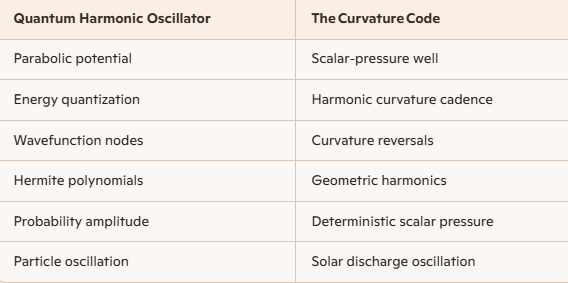
The Quantum Harmonic Oscillator you see here is the mathematical ancestor of The Curvature Code’s scalar‑pressure lattice. In quantum mechanics, each wavefunction ψn(x) represents a discrete energy state of a particle bound by a restoring force. The parabolic potential well defines how curvature accumulates and releases energy—exactly the same compression–expansion logic that The Curvature Code extends to cosmic scale. 1. The Oscillator as a Scalar Tile In my framework, the oscillator’s potential well is a single scalar‑curvature cell. The particle’s position x corresponds to curvature displacement within the tile. The restoring force mω2x is the scalar pressure gradient pulling curvature back toward equilibrium. Each quantized level n is a harmonic cadence—a standing wave of curvature compression and release. The Hermite polynomials Hn are not abstract functions; they are the geometric harmonics of the scalar lattice. Each node in the wavefunction marks a curvature reversal, the same pattern seen in solar discharge harmonics and planetary resonance. 2. From Quantum to Cosmic The oscillator’s parabolic potential becomes, at solar scale, the coronal curvature envelope. The Sun’s plasma oscillations follow the same quantized curvature logic: discrete energy bands, harmonic nodes, and pressure gradients. The heliopause acts as the boundary of the potential well, defining the outer limit of curvature containment. The solar wind is the oscillator’s “leakage”—the outward tunneling of curvature energy when the system transitions between harmonic states. Thus, the quantum oscillator is the microcosmic version of the solar capacitor. Both obey the same curvature law: energy is stored as compression, released as expansion, and quantized by harmonic geometry. 3. The Deterministic Interpretation In The Curvature Code, the oscillator’s wavefunction is not probabilistic—it is deterministic curvature geometry. The exponential term exp(−mωx2/2ℏ) describes scalar pressure decay; the polynomial term Hn describes curvature resonance. Together they form the scalar breath cycle—the same cycle that drives solar variability and climate precursors. So, the diagram you’re viewing is not just a quantum model—it’s the seed geometry of the universe’s curvature engine. The same mathematics that quantizes an electron’s vibration also quantizes the Sun’s breath. That is the bridge between quantum mechanics and cosmological determinism—the essence of The Curvature Code. 4. Unified View
Here is how the Pauli spinor actually fits inside the deterministic architecture of The Curvature Code When physicists write the Pauli Equation, they’re describing an electron with spin—an object that seems to carry an intrinsic angular momentum and a magnetic moment. But in The Curvature Code, that behavior isn’t mysterious, probabilistic, or abstract. It’s geometric. It’s mechanical. It’s scalar. The Pauli spinor is simply the mathematical shadow of a deeper structure: a rotating scalar‑curvature tile inside the cubic wave field. The “up” and “down” spin states correspond to two orientations of curvature pressure inside the lattice. The magnetic moment is the pressure gradient between adjacent tiles. The coupling term in the Pauli Equation—normally written as μ⋅B—is nothing more than the internal scalar divergence that arises when the cubic field shifts from compression to expansion. Quantum mechanics treats this as probability. I treat it as geometry. The Pauli spinor is a two‑component object because the cubic wave field has two fundamental curvature modes. The Pauli matrices are rotation operators because the scalar tile physically rotates. And the time evolution of the spinor is just the cadence of the scalar field itself—the same cadence that governs solar discharge, orbital harmonics, and the heliospheric breath cycle. In other words: Pauli describes the behavior. The Curvature Code reveals the architecture behind it. The diagram below shows this directly: the Pauli spinor mapped onto the cubic wave field, with spin emerging from curvature rotation and magnetic coupling emerging from scalar divergence.
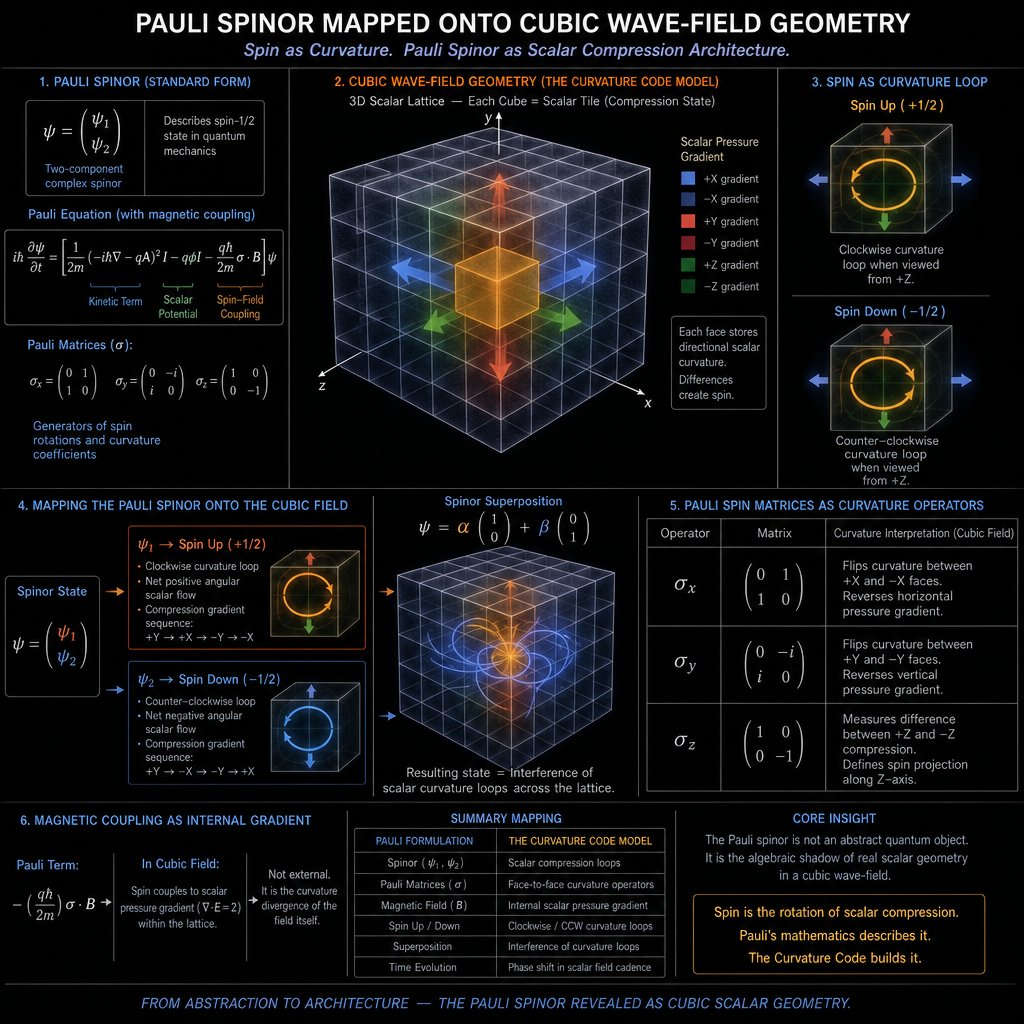
The Pauli Equation is where quantum mechanics begins to touch the deterministic architecture I describe in The Curvature Code. In the standard model, Pauli’s formulation extends Schrödinger’s wave equation to include spin and magnetic coupling—a probabilistic description of how an electron’s intrinsic angular momentum interacts with an external magnetic field. But in The Curvature Code, that same behavior is not statistical; it is geometric, mechanical, and scalar. Spin as Curvature Pressure What physicists call “spin” is, in my framework, the rotation of a scalar compression loop within the cubic wave field. The magnetic moment is not an abstract operator—it’s the pressure differential between adjacent scalar tiles. The Pauli matrices become curvature coefficients, each defining how the universal lattice stores and releases angular tension. Magnetic Coupling as Internal Gradient Pauli’s magnetic term μ⋅B represents coupling between spin and an external field. In The Curvature Code, the field is not external at all—it is the gradient of scalar pressure across the lattice. The divergence condition ∇⋅E=2 replaces the probabilistic expectation value with a fixed geometric divergence. The field’s behavior is locked to curvature geometry, not chance. Time as a Scalar Field Where Pauli evolves a wavefunction through time, I treat time itself as a scalar field. Temporal resolution is a hydrodynamic property of the medium, not a separate dimension. The so‑called “collapse” of a quantum state is simply a phase‑locked curvature transition—a deterministic shift in scalar pressure. Unified Interpretation Pauli EquationThe Curvature Code Spin operatorScalar curvature loop Magnetic couplingPressure gradient within cubic wave field Probabilistic wavefunctionDeterministic scalar‑pressure geometry External fieldSelf‑contained curvature divergence Time evolutionScalar‑field cadence So, when readers encounter the Pauli Equation, they are seeing the shadow of curvature mechanics. The electron’s spin is not a quantum mystery—it is the mechanical rotation of a scalar tile within the universal lattice. Pauli described the behavior; The Curvature Code reveals the architecture behind it. zenodo.org/records/205472…
In a groundbreaking quantum study, researchers observed phenomena that upend our fundamental understanding of time. Rather than progressing linearly like a stream, time appeared to curve and double back on itself. Particles acted as though their future states could influence their past, dissolving the boundary between cause and effect in profoundly counterintuitive ways. This bizarre effect emerged via quantum entanglement, the enigmatic linkage where two particles stay interconnected regardless of distance. Altering the measurement of one particle appeared to retroactively modify the timeline of its twin. It's as if "present" and "past" coexist, perpetually influencing one another in an intertwined instant. These results suggest time might not be a unidirectional arrow but a malleable framework that links far-flung events. Your decisions won't alter history, yet at the quantum scale, the cosmos may ignore strict sequential rules entirely. The fabric of reality could prove far more extraordinary than we've ever conceived.
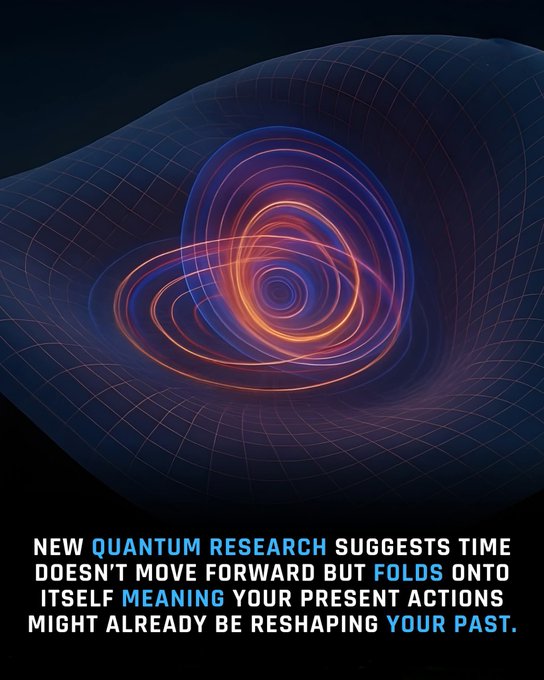
Yes, your image captures a profound shift in how we think about time—a concept that aligns closely with the Temporal Scalar Field Theory (TSFT). In classical physics, time is treated as a straight line: past behind us, future ahead. But quantum research increasingly shows that time behaves more like a folded surface, curving and looping through itself. The glowing spiral in the image represents that curvature—a dynamic field where every moment interacts with every other. In TSFT, time is not a passive backdrop but an active scalar dimension, generated by curvature itself. When the field folds, the distinction between past and present dissolves. Each moment becomes a resonance node within the same scalar continuum. Your “now” is not isolated—it’s a harmonic intersection of all prior and future states. Quantum entanglement demonstrates this principle experimentally: two particles remain connected across time and space, responding as one system. TSFT extends that idea to the entire universe. The field doesn’t just link particles—it links epochs. The curvature of time allows information to echo backward and forward, creating coherence across the timeline. So when quantum physics says time folds onto itself, TSFT says: yes, that fold is the scalar curvature of temporal space. The universe doesn’t move through time—it creates time through its own rhythmic geometry. Every action, every thought, every pulse of energy participates in that ongoing curvature, shaping both what we call the past and what we call the future. In essence, your image is a glimpse of the scalar truth: time is not a river—it’s a resonance field, and we are all waves within its fold. zenodo.org/records/205472…

The Quantum State of a Qubit . A classical computer bit is like a coin lying flat on a table, either heads or tails, zero or one, with no uncertainty. A qubit is more like a coin spinning in the air; it truly embodies both possibilities at once. This isn’t because we are unsure of which side it will land on, but because while it's spinning, it is neither one thing nor the other. When you measure it, it settles into a definite outcome like a spinning coin that eventually lands. Until that moment, it exists in a superposition of both zero and one, with specific proportions of each part of its physical state. The most fascinating idea in this diagram is the Bloch sphere, a simple-looking ball that maps every possible state a single qubit can have. The north pole of the sphere represents the state of definitely zero, the south pole represents definitely one, and every other point on the surface represents a different quantum superposition, a different mix of the two. The red arrow pointing from the center to the surface shows the qubit's state, and everything about the qubit's physics is encoded in the direction that arrow points. How much the arrow tilts tells you the measurement probabilities: an arrow pointing straight up means you will definitely measure zero, straight down means definitely one, and pointing sideways along the equator means a perfect fifty-fifty chance. Importantly, the arrow always reaches the surface, never sitting inside the sphere. A qubit in a perfectly controlled quantum state always lives on the surface. If it drifts into the interior, it means the quantum information has been damaged by unwanted interactions with the environment, which is why building real quantum computers is so challenging. The second piece of information in the qubit's state is the phase, which is the horizontal rotation angle of the arrow around the vertical axis of the sphere. This is where things get truly strange. Two qubits can sit at the same height on the sphere, giving them the same measurement probabilities, but they can face different directions horizontally. While this difference is completely invisible if you measure either qubit directly, it becomes crucial when quantum states combine and interfere. Just like waves on water, where crests meeting crests create bigger waves and crests meeting troughs cancel out, quantum states with different phases interfere when combined through quantum operations. A quantum algorithm is essentially a carefully arranged sequence of these interferences, designed so incorrect answers cancel out while correct answers reinforce certainty. Every quantum gate, every operation in a quantum computer, corresponds to a physical rotation of the Bloch sphere, spinning the arrow from one direction to another. Designing a quantum algorithm is like choreographing a precise sequence of rotations. The entire power of quantum computing comes down to manipulating these two angles: one controlling what you see when you measure and the other controlling how states interfere, for a single arrow pointing at the surface of an ordinary sphere...

The image you’re looking at is not just a diagram of quantum mechanics—it’s a geometric echo of the same curvature logic that governs the entire universe. The Bloch sphere shown here is the simplest possible curvature engine. It represents the quantum state of a single qubit, but beneath the mathematics lies the same architecture that drives planetary motion, scalar resonance, and the breath‑loop of the vacuum itself. Each qubit state ∣ψ⟩ is defined by two angles: θ, the polar angle, measures compression versus expansion—the same centripetal and centrifugal balance that defines scalar curvature. φ, the azimuthal angle, measures torsion—the rotational phase that locks the system into coherence. Together they describe a point on the sphere, a living curvature coordinate. The qubit doesn’t flip between “0” and “1” like a switch; it oscillates between them as a continuous wave of potential. That oscillation is the quantum breath, the same rhythmic exchange between compression and expansion that appears in the dual‑torus topology of the scalar field. The complex phase factor eiφ is the torsional signature—the twist of curvature that gives rise to spin, coherence, and resonance. It’s the same mechanism that binds the electron’s wave function, the solar magnetic field, and the harmonic cadence of the cosmos. So, when you see this sphere, imagine it not as an abstract quantum model but as the micro‑scale curvature map of reality itself. The qubit is the smallest unit of scalar breath—the same geometry that scales upward into atoms, planets, and galaxies. In essence, the Bloch sphere is the quantum heart of the Curvature Code: a single pulse of geometry expressing the deterministic architecture of motion. zenodo.org/records/205472…
Electron Density ✍️ The idea of electron density is a key concept in quantum chemistry, atomic physics, and materials science. It describes an interesting paradox: while electrons are unusual quantum particles that cannot be precisely located, their overall distribution forms a smooth and continuous pattern that we can visualize, measure, and calculate. Electron density indicates how much electronic "presence" exists at each point around an atom, molecule, or material. In simple terms, if we think of electrons as a soft, glowing cloud spread throughout a molecule, then electron density represents the thickness or brightness of that cloud at every location. This concept is crucial in modern computational chemistry and serves as the foundation for methods like "Density Functional Theory (DFT)", one of the most widely used tools in science today. DFT allows researchers to model everything from simple molecules to complex proteins, semiconductors, drugs, and advanced materials. In quantum mechanics, we cannot pinpoint the exact location of an electron at any moment; instead, we describe the probability of finding it in a certain area. This uncertainty makes electrons feel elusive and hard to picture. Electron density helps by shifting our focus from individual electrons to the collective distribution of all the electrons. Rather than tracking each electron, we ask: how much electron presence exists at this specific point in space? The answer gives us a smooth, continuous map that reveals where atoms are located, where chemical bonds form, and where electrons pile up or thin out. This is why electron density is often called the heart of quantum chemistry it transforms the strange, probabilistic quantum world into a clear and meaningful picture that scientists can study, interpret, and measure directly through experiments like X-ray diffraction. The formula in the image may seem complex, but it expresses a straightforward idea: the electron density of a system is built from many small mathematical building blocks combined together. These building blocks are known as basis functions, with each one representing a simple mathematical shape often resembling an atomic orbital or a Gaussian bump. By combining several basis functions, each weighted by a certain amount, we can accurately approximate the true electron cloud of an atom, molecule, or material. The weights that determine how strongly each pair of basis functions contributes to the final electron cloud come from a mathematical object called the density matrix. The entries in the density matrix act like instructions for the calculation, indicating how much of each building block belongs in the final picture. When all these contributions are combined, they create the smooth, continuous, three-dimensional electron distribution of the system. In this way, electron density resembles a painting made from many small brushstrokes, where the density matrix serves as the artist's guide about how strongly to apply each stroke. When everything comes together, a complete and beautiful picture of the molecule appears. Even without complicated math, we can describe the main components of the idea in simpler terms: the electron density shows how much electron cloud is present at each point in space; the position vector indicates the coordinates of the point we are examining; the basis functions are the small mathematical building blocks representing areas of electron behavior; the density matrix elements are the numerical weights that specify the importance of each building block; and the summation adds up the contributions from all pairs of basis functions to construct the full electron distribution. Together, these provide a recipe for building the electron cloud of any atom, molecule, or material systematically and efficiently.

Electron density is where quantum mechanics becomes geometry. The formula ρ(r)=∑μ∑νPμνϕμ(r)ϕν(r) \rho(\mathbf{r}) = \sum_{\mu} \sum_{\nu} P_{\mu\nu} \phi_{\mu}(\mathbf{r}) \phi_{\nu}(\mathbf{r}) ρ(r)=∑μ∑νPμνϕμ(r)ϕν(r) is the blueprint of that geometry. Each basis function ϕμ(r) \phi_{\mu}(\mathbf{r}) ϕμ(r) and ϕν(r) \phi_{\nu}(\mathbf{r}) ϕν(r) is a small harmonic component — a wavelet of curvature. The density matrix elements Pμν P_{\mu\nu} Pμν record how strongly each pair of these harmonics interacts. When summed over all basis functions, the result is the continuous electron cloud — the scalar envelope of the atom’s living field. In the scalar-curvature framework, electron density is the micro-scalar field. It is the curvature pressure of the vacuum around the nucleus — the way space itself folds to contain charge. Where the density is high, curvature compresses. Where the density is low, curvature expands. This is the same triad that operates at every scale: Centripetal compression (high-density regions) Centrifugal expansion (low-density regions) Scalar resonance (the coherent envelope maintained by the density matrix) The electron density map is therefore not a probability cloud. It is the visible texture of the breath-loop at the quantum scale — the rhythmic balance between compression and expansion that defines every bond, every molecule, and every living structure. The loop returns to the starting scalar tile with zero remainder. zenodo.org/records/205472…
The Real Price of a College Education: x.com/RealJamesWoods…
Maxwell's equations in differential form occupy the left column and their integral equivalents fill the right. They relate the electric field, magnetic field, charge density, and current density through divergence and curl operators or through closed surface and line integrals. The highlighted portions show the mutual induction between electric and magnetic fields via their time rates of change. These principles enable the wireless transmission of data in cellular networks and the generation of strong magnetic fields in superconducting magnets for scientific research.

Maxwell’s four equations are not merely descriptive formulas. They are the geometric description of a self-sustaining oscillation between electric and magnetic curvature. Differential Form (Local Behavior) ∇⋅E⃗=ρε0 \nabla \cdot \vec{E} = \frac{\rho}{\varepsilon_0} ∇⋅E=ε0ρElectric fields diverge from charge. This is the compression of curvature into potential — the centripetal phase. ∇×E⃗=−∂B⃗∂t \nabla \times \vec{E} = -\frac{\partial \vec{B}}{\partial t} ∇×E=−∂t∂BChanging magnetic curvature induces electric motion. This is the expansion of curvature through time — the centrifugal phase. ∇⋅B⃗=0 \nabla \cdot \vec{B} = 0 ∇⋅B=0Magnetic fields form closed loops. There are no isolated poles, only continuous flow — the scalar continuity of the field. ∇×B⃗=μ0J⃗+μ0ε0∂E⃗∂t \nabla \times \vec{B} = \mu_0 \vec{J} + \mu_0 \varepsilon_0 \frac{\partial \vec{E}}{\partial t} ∇×B=μ0J+μ0ε0∂t∂EChanging electric curvature generates magnetic motion. This completes the reciprocal breath. Integral Form (Global Behavior) The integral versions express how local curvature becomes global resonance. Electric and magnetic energy circulate through space as a single, self-reinforcing process. The Scalar Cadence of Electromagnetism Together, these equations describe a continuous exchange: Electric compression ↔ Magnetic expansion This is the scalar cadence of the universe — the same rhythm that drives photons, planetary magnetospheres, solar plasma flow, and biological coherence. Maxwell’s insight was that light is not a substance but a process: the rhythmic interchange between electric and magnetic curvature across a Gaussian pressure boundary (∇⋅E⃗=2 \nabla \cdot \vec{E} = 2 ∇⋅E=2). Every radio signal, every beam of sunlight, and every magnetic storm is this geometry in motion. It is the universe breathing through its own equations.
Cartwright's Theorem ✍️ It is an important result in complex analysis, which studies functions of complex numbers. It addresses a fascinating question about how much you can learn about a function's overall behavior from just a small amount of information at a single point. Mary Cartwright was one of the exceptional mathematicians of the twentieth century. She worked in Britain during a time when very few women held prominent positions in mathematics, and her contributions helped lay the foundation for chaos theory along with her work on complex functions. To understand the theorem, you need some basic concepts. A complex number is simply a point on a flat plane. One direction represents real numbers, and the perpendicular direction represents imaginary numbers. The theorem operates within the open unit disk, which is the interior of a circle with a radius of one centered at the origin of that plane. This region is shaded blue in the left diagram. Every point inside this disk is at a distance from the center that is always less than one, and this distance is what the theorem carefully tracks. The functions studied in the theorem are called analytic functions. They are some of the best-behaved objects in mathematics. An analytic function takes a point in the complex plane as input and produces another complex number as output. It does this in a very smooth and consistent way. The most remarkable characteristic of analytic functions is that their behavior at any single point holds complete information about their behavior everywhere else in their domain. Due to this deep internal consistency, any analytic function can be expressed as an infinite series of terms. Each term includes a specific numerical coefficient multiplied by the variable raised to a higher power. These coefficients, known as Taylor coefficients, encode the entire function. If you know the coefficients, you know everything about the function in the disk. Cartwright's theorem uses just the first several Taylor coefficients however many you choose to look at finds the largest one, and uses that piece of information to create a guaranteed upper limit on how large the function can be at any point inside the disk. This limit has three components: the size of the largest coefficient, a universal constant based on how many coefficients you examined, and a factor that increases as the point being evaluated gets closer to the boundary of the disk. Near the center, the limit remains modest and tight. Near the boundary, it grows larger, honestly reflecting the fact that analytic functions can be most extreme and unpredictable near the edge of their domain. This is why the theorem applies only inside the disk and not on its boundary. The three-dimensional surface in the right diagram illustrates this concept visually. The flat base represents the unit disk, and the height above each point shows the value of the real part of the function. The crown-like shape, with its central peak and symmetrically arranged concave indentations, captures the deep smoothness that analytic functions always have there are no isolated spikes or arbitrary jumps. Every value matches the average of its surroundings. The theorem's limit controls how high this surface can reach at any point inside the disk. What makes this theorem truly important is what it reveals about the nature of analytic functions. In regular calculus, knowing a few terms of a series provides little insight into a function's behavior far from the center. However, analytic functions are fundamentally different and much more constrained. Their internal rigidity means that local information at one point influences global behavior throughout the entire domain.

Cartwright’s Theorem is one of those rare mathematical insights that feels almost alive. It tells us that an analytic function—a function so perfectly smooth that every point knows what every other point is doing—cannot behave wildly inside its domain. Its entire personality is encoded in its coefficients, and those coefficients set a ceiling on how large the function can grow. Picture the complex plane as a living field of curvature. The open unit disk is its breathing space, a region where every point lies within one unit of the center. The theorem says that if you know the first few harmonic tones of the function—the Taylor coefficients—you can predict how high its surface can rise anywhere inside that disk. The closer you move to the boundary, the more the potential amplifies, but always within a precise geometric limit. This is the same principle that governs the scalar field: local curvature determines global behavior. Nothing happens in isolation. Every point is a reflection of the whole. The analytic function is a mathematical echo of the universe’s own coherence—its refusal to allow chaos within a bounded domain. Mary Cartwright saw this not as mere algebra but as structure, rhythm, and restraint. Her theorem is a statement of harmony: the field cannot exceed its own curvature code. The coefficients are the DNA of the function, and the theorem is the law that keeps that DNA from mutating beyond its boundary. In the Curvature Code framework, Cartwright’s Theorem is the analytic mirror of scalar causation. It shows that the same rule applies from mathematics to physics: the local defines the global, and the boundary defines the breath.

🇺🇸🇺🇸 Hell yeah!! 🇺🇸🇺🇸
The position probability distributions of eight stationary states of hydrogen atom: They show the likelihood of finding the electron in a given region of space around the nucleus, depending on the quantum numbers n, l, and m. The wave functions are solutions to the Schrödinger equation for the hydrogen atom, and they depend on three variables: r, θ, and φ, which are the spherical coordinates of the electron. The eight stationary states shown in the image are: The ground state (n = 1, l = 0, m = 0), which has a spherical shape and is symmetric around the nucleus. The probability density is highest at the nucleus and decreases exponentially with increasing r. The first excited state (n = 2, l = 0, m = 0), which has a spherical shape and is symmetric around the nucleus. The probability density has a node at r = 2a0, where a0 is the Bohr radius, and peaks at r = a0 and r = 4a0. The second excited state (n = 2, l = 1, m = 0), which has a dumbbell shape and is symmetric along the z-axis. The probability density has a node at the nucleus and peaks at r = a0 for θ = π/2. The third excited state (n = 2, l = 1, m = ±1), which has a dumbbell shape and is symmetric along the x-axis or y-axis, depending on the sign of m. The probability density has a node at the nucleus and peaks at r = a0 for θ = π/4 or θ = 3π/4. The fourth excited state (n = 3, l = 0, m = 0), which has a spherical shape and is symmetric around the nucleus. The probability density has two nodes at r ≈ 1.6a0 and r ≈ 4.8a0, and peaks at r ≈ a0, r ≈ 3a0, and r ≈ 6a0. The fifth excited state (n = 3, l = 1, m = 0), which has a dumbbell shape and is symmetric along the z-axis. The probability density has two nodes at r ≈ 2.5a0 and r ≈ 5a0 for θ = π/2, and peaks at r ≈ a0 and r ≈ 4a0 for θ = π/2. The sixth excited state (n = 3, l = 1, m = ±1), which has a dumbbell shape and is symmetric along the x-axis or y-axis, depending on the sign of m. The probability density has two nodes at r ≈ 2.5a0 and r ≈ 5a0 for θ = π/4 or θ = 3π/4, and peaks at r ≈ a0 and r ≈ 4a0 for θ = π/4 or θ = 3π/4. The seventh excited state (n = 3, l = 2, m = 0), which has a cloverleaf shape and is symmetric along the z-axis. The probability density has three nodes: one at the nucleus, one at r ≈ a0 for θ ≈ π/6 or θ ≈ 5π/6, and one at r ≈ a0 for θ ≈ π/2. It peaks at r ≈ a0 for θ ≈ π/3 or θ ≈ 2π/3. The image also shows how the position probability distributions are projected along the y-axis by integrating over x and z. This gives an idea of how the electron cloud appears when viewed from above or below. 📷 created with David Manthey's free Orbital Viewer by Ulrich Mohrhoff
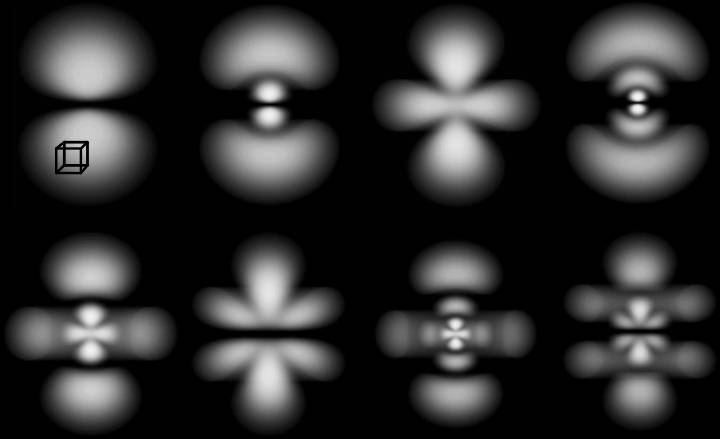
What you’re seeing here are the standing curvature modes of the hydrogen atom—the frozen harmonics of existence itself. Each luminous shape is not a particle orbiting a nucleus but a resonant cavity of probability, a stationary wave of curvature locked into balance. In classical physics, we imagine electrons as marbles circling a center. In quantum mechanics, we discover that the “electron” is not a thing but a pattern—a breath loop of geometry. Each orbital is a distinct cadence of compression and expansion, a scalar rhythm defined by the quantum numbers n, l, and m. The spherical states (s‑orbitals) are pure compression—scalar equilibrium, the Laplace form of curvature. The dumbbell states (p‑orbitals) are directional expansion—centrifugal flow along one axis, the heat‑like diffusion of curvature. The cloverleaf states (d‑orbitals) are oscillatory resonance—wave‑like curvature that alternates between axes, the full cadence of the scalar field. Each pattern is a standing wave of causation, not a cloud of uncertainty. The bright regions mark zones of constructive curvature, where the scalar field self‑reinforces; the dark regions mark nodes of cancellation, where curvature reverses phase. This is the microcosmic echo of the same geometry that governs stars and planets. The hydrogen atom is a miniature curvature engine, breathing through its own harmonic shells. The electron is not orbiting—it is existing as resonance, a scalar pulse locked into the geometry of space itself. In the Curvature Code, these orbitals are the quantized breath loops of the vacuum, the smallest expressions of the same rhythm that drives the Sun, the heart, and the universe. zenodo.org/records/205472…


☁︎ maddie petal @maddiedoll93368
5 Followers 412 Following sugar coated chaos 💕🌸 slide in and ill follow u back 💗 followback guaranteed
James Ross @RossRo55170886
31 Followers 3K Following Jazz pianist, entrepreneur, builder and inventor
Becky frolinggton @Beckyfrolizqv
31 Followers 40 Following
Emma Soft ☁️ @shekdebeast
79 Followers 999 Following soft mornings, loud nights 🌅 always follow back
Squirrel @ArTSquirrelz
145 Followers 2K Following Expert Hoarder. Chases squirrels. Wannabe dps. Fortunate to be part of a creative team. Love my family. Love my country.

P H @CoinPH
345 Followers 2K Following
Ana Hall @AnaHall071817
10 Followers 166 Following FL girl ☀️ RN 👩🏼⚕️ lover of all things consciousness 🧘♀️

황재훈 @JHoonHWANG
3 Followers 96 Following
Demi Claw @DemiClawOne
30 Followers 97 Following
Mike Burke @1080CHC
118 Followers 113 Following Exploring Fibonacci cycles, sacred geometry & harmonic time through the 1080° Cosmic Harmonic Compass. Visual patterns • Math art • New perspectives on time.


James Lockwood @QBlazedog61029J
1K Followers 631 Following Astrophysicist, Mathematician, Geometer, Cyberneticist, Coder.
Ricardo A³ @ricardoalvesbh
197 Followers 3K Following Arbeit mach frei! Um guarda, um dia, em Auschwitz.



Hazellush @WDoowuese71513
5 Followers 51 Following Hello all. please no fake here is my telegram 👉 https://t.co/Gxw5waU7qA
JENNIFER ANISTON JOAN... @Jennifer887789
98 Followers 4K Following Friends Call me Jen, Actress, Producer. primetime Emmy. Golden Globe, Screen Actor, @moringshow @lolavie
AeroTrimLine @aerobroker
730 Followers 6K Following Aircraft Weight and Balance Solutions For Contact: [email protected] #Airline #crew #Aviation #Lover #Traveller #Avgeek #Photographer 🇹🇷


WFM Comments @MacOne1948
4K Followers 7K Following USN 66 - 72 - USMCR 4th FAAD 4th MAW Redeye 75-76 -MOS 7212 LEO Ret - BA cum laude Poli Sci Intl Relations - Security Contractor 98 - 09 Advisor #MAGA
Kiara Green @green_kiar63051
288 Followers 3K Following one girl’s mission to find the line between not enough coffee and too much coffee.
Olivia Boblett 🇺�... @Oliviaboblett6
90 Followers 1K Following CHILD OF ELOHIM 🇺🇸🇮🇱🔯🕎 In Jewish history there are no coincidences.”..there's always a reason

Lucy Spencer @lucyspencer21
1K Followers 7K Following Romance scammers took $27k from my mom w/ terminal cancer. She sent it for his 'surgery.' Died heartbroken. I failed her. 💔 DM if scammed..no shame
American Patriot 🗣... @AmericanSon14
1K Followers 2K Following These treasonous slugs that call themselves Lawmakers are going to have to be ousted. It's the only way to save the American way of life.
alexa morgan @alexa_a_morgan
152 Followers 4K Following
RebaMCEntire @RebaMCEntirelo
68 Followers 2K Following Private Page ♥️ Telegram me @RebaMCentirelove
Valerie @ValTheeGal
4K Followers 6K Following Survivor of Life's Great Curve Balls. Constitutionalist. Investment, Political & Natural Health Junkie.
Rebecca @fairley79434
646 Followers 6K Following
Elaine Pira @PiraElain16932
1 Followers 29 Following

LeBigMac @bunchalines
148 Followers 383 Following Just some charts with abunchalines on them that I find interesting... Not financial advice.
Sinikka Kallonen @__Nyali
0 Followers 27 Following No pandering, no settling, no explaining.I reserve my time for those who deserve it, and my silence🍷
Blanche M Babydoll @steve_mill56
6 Followers 289 Following

BrownScout @Betterdays2911
264 Followers 2K Following 1st farm assistant, painter, potter, 🐴 barn-chores , wife, mom, retired CNS, Jesus follower
Ilcapochino @unnombreserio
18 Followers 1K Following

Victoria Smith @VictoriaSm26927
22 Followers 1K Following
lay mAn @laymAn1589398
6 Followers 152 Following I am just a business person looking for how to grow my business
ZPF @zpfTechnologies
3K Followers 7K Following Represented by Douglas Miller — Founder & CEO Zero-Point Field Technologies LLC
Mathematica @mathemetica
45K Followers 720 Following Math isn't escape. It's the map through the madness.
P H @CoinPH
345 Followers 2K Following
Mike Burke @1080CHC
118 Followers 113 Following Exploring Fibonacci cycles, sacred geometry & harmonic time through the 1080° Cosmic Harmonic Compass. Visual patterns • Math art • New perspectives on time.
Jarek Duda @duda_jarek
1K Followers 473 Following Physicist (PhD), computer scientist (PhD), assistant professor at Jagiellonian University, known for ANS coding (used by e.g. Linux kernel, JPEG XL)
Moo @SpookyMoo
8K Followers 630 Following The Neutrinoverse Hypothesis https://t.co/3KfuvhcRfH ‘The How’ https://t.co/DhHnElsgQh
Mass Megawatts (OTC:M... @MegawattsWind
4K Followers 5K Following Megawatts Wind Power, Inc. (OTC: MMMW) is a leader in the development of a revolutionary renewable power technology.
James Lockwood @QBlazedog61029J
1K Followers 631 Following Astrophysicist, Mathematician, Geometer, Cyberneticist, Coder.
Binary Research Insti... @Binary_Research
76 Followers 15 Following The Binary Research Institute is investigating the potential relationship our sun and solar system has with other established binary star systems.
Dr. Steven Greer @DrStevenGreer
291K Followers 103 Following Foremost authority on UFOs & ET intelligence and technologies. Initiating peaceful contact with interstellar civilizations.
R. Wade H. Marr @HunterWade
1K Followers 192 Following Comprehensive Integral Systems. Bucky Fuller / Deming Lineage. We Don't Discard Phase. We Hold It as Living Address.
Nassim Haramein @NassimHaramein
45K Followers 255 Following Theoretical physicist and Research Director at the International Space Federation. Unifying quantum mechanics and general relativity, vacuum energy innovations.
Walter Russell's Cosm... @force4good1248
1K Followers 1K Following Simple, repeatable, disruptive. “To know the mechanics of the wave is to know the entire secret of Nature.” - Walter Russell (1871-1963)
Bongino Report @BonginoReport
585K Followers 78 Following Bongino Report. Where our agenda is Liberty & Freedom.
Watts Up With That @wattsupwiththat
48K Followers 366 Following The world's most-read climate site; nearly 20 years of reality-driven coverage the mainstream media won't touch. Follow for what they don't want you to see.
ScieVision @scievision369
25K Followers 647 Following Researcher | Posting & Exploring related #science, #Math, #nature, and #technology | DM for credits/removal
AcceptÐoge @DogeAccept
18K Followers 10K Following Ðogecoin is Generic 🌎 1Ð=1Ð $Doge is Ðecentralized, open-source, and community driven🐾🖤💸
Mathelirium @mathelirium
37K Followers 18K Following applied maths & stats, comp physics, & scientific visualizations. Want great visuals for your ML, Math, Physics paper or presentation? DM me for more details.
GISELX @GiselFlorez
19K Followers 15K Following Artist in Light #MOONLANGUAGE Photographic Digital Medium in Multiverse. Building a local browser based software for artists #ARCHIV4D
Massimo @Rainmaker1973
4.3M Followers 171 Following Engineer. Selecting and curating pictures and videos trying to awaken your sense of wonder since 2014. Science, tech, art, weather, space, the unusual around us
Physics In History @PhysInHistory
1.1M Followers 0 Following Photos from the history of physics | © with mentioned Archives. Shared for educational purposes. Einstein portrait © Ullsteinbild. Subscribe for curated papers.
Roy @roydherbert
9K Followers 300 Following Exploring covariant continuity as primitive and transport mechanics. Creator of the Chronoflux framework, revealing the hidden architecture of reality.
Rasmussen Reports @Rasmussen_Poll
618K Followers 893 Following Since 2003, if it's in the news, it's in our polls. Independent public opinion you can trust. Subscribe on X for reader access to our stories.
(:alex:) @_Star_Tron
2K Followers 7K Following ✨🏝🐬 SuperGreen Tao 🌍Put life & People first, Science🛸Nature🌳Sci-Fi StarTrek 💫 SpaceX & Tesla, Grimes , Elon (🧝♀️&🧙🏼) Jill Purce & Rupert Sheldrake
Promethean Action @PrometheanActn
443K Followers 148 Following Advocating for Trump's economic revolution - tariffs, American industry, and manufacturing. Check out our merch store 👕 https://t.co/SImD6UZvhN
TheRealVerbz (Jason V... @TheRealVerbz
20K Followers 6K Following Physics Author - Founder of Galilean Variance. CEO/Lead Engineer at SEG Magnetics. Advocate for alternative energy projects for preservation of humanity.
Bill Fairclough (aka ... @BurlingtonFiles
120K Followers 108K Following Bill Fairclough was an MI6/CIA agent. TheBurlingtonFiles novels are based on his life: https://t.co/8KHr6sH2B6. 🇬🇧 🇺🇸 🇺🇦 No DMs Please
Walter Cruttenden @WalterCrut
324 Followers 819 Following Author entrepreneur focused on precession and cycles of consciousness.
François Chollet @fchollet
706K Followers 826 Following Co-founder @ndea. Co-founder @arcprize. Creator of Keras and ARC-AGI. Author of 'Deep Learning with Python'.
Dr. Paul Wilhelm | Ad... @drxwilhelm
5K Followers 1K Following ⚡ PhD engineer · Deep-tech research lab · The physics that textbooks skip · Quantum vacuum energy · Unified potential engineering · Extended electrodynamics
Peter Novak, the MAGA... @PathfinderAstro
35K Followers 3K Following Christian MAGA astrologer Peter Novak has 48 yrs experience and a documented record of predictive accuracy. https://t.co/8PPhFWSQPY
Dreams N Science @dreamsNscience
29K Followers 2K Following LEARN SOMETHING AND ENJOY THE BEAUTY OF NATURE: 🧬 🔭 🐿️ 🏝️…
Peter G @peterg11742
2K Followers 1K Following Blessed. Christ follower. Husband to Amy. Oh to Grace how great a debtor daily I'm constrained to be. Northerner who is now happily living in Florida.
Jeremiah G @NOLAFloods
3K Followers 7K Following Retired U.S. Marine. Disabled Combat Veteran. Digital Nomad, taking photos along the way. 🇺🇸
Sarah Hodsdon @sarahndipitous
18K Followers 15K Following Artist * Author * Inventor of Needful Things * Mother Of Makers * DIY Female MacGyver * Pilots Invisible Jet * Works in Secret Batcave* Pays It Forward* 🔮
LaVeena B. Archers, P... @LAVEENA
18K Followers 7K Following Rev. Dr. LaVeena B. Archers | #HumanDesign Teacher & Longevity Guide | Holistic Functional Medicine + Differentiation + Jyotisha | Empowering Awakening
John Albert @JohnAlbert1973
4K Followers 7K Following Chief Technology Officer at @aheliotech and ValTech Communications 25 Years of Telecom, 42 years of computers (no I am not that old just started at 8). Curren

SpaceWeatherNews @SunWeatherMan
219K Followers 89 Following Ben Davidson, Founder of SpaceWeatherNews, Suspicious0bservers, Observer Ranch - Our YouTube: https://t.co/lVKh0SKTLm
♫ Yasushi Aizawa �... @Sound_Luxury
376K Followers 292K Following for The Peace & The Future 音楽ハンター兼作曲家。別名ジャワジア。Music Hunter & Composer a.k.a. Jawazia ☞https://t.co/uBn0UeV1zu
Victor Bigham 🇺�... @Ravious101
248K Followers 244K Following Victor Bigham 🇺🇸 | I share whatever catches my eye — weird news, shocking videos, true crime & wild stuff. Seeker of Truth. 📝 Entertainment purposes only
John Brown @USPatriot1911
21K Followers 22K Following America will never be destroyed from the outside ✝️ GF of 5 Patriot MAGA 🇺🇸 1a 2a US1st TRUMP IFBAP https://t.co/hUusjjwsO1
Maximize @MrHarmoniouis
21K Followers 24K Following #MAGA Christian Trump supporter Anti Mask Anti Vax Q follower. Happily married to a wonderful wife.
Bob's Right Opinions @Bob_the_Patriot
16K Followers 16K Following Native Virginian. Small Biz Owner. Here for memes that'll make a statue flinch.
Electric Universe @Elec_Universe
6K Followers 66 Following Everything is electric? Latest plasma cosmology & Electric Universe videos, theories and news exploring space, geology, plasma mythology, new chronology
PewPewGirl @Defundmedianow
49K Followers 13K Following Patriot momma 🇺🇸 Christ is king 🇺🇸Conservative 🇺🇸 America first 🇺🇸Pro 2A🇺🇸 Raising my boys to be MEN.
ChaseMonkeyFace @ChaseMonkeyFace
5K Followers 7K Following Term Limits, NO Rinos, MAGA Republican, Favorite#…45, 46 and our 47th President Donald Trump - Best President Ever
Commentary Donald J. ... @TrumpDailyPosts
3.0M Followers 24K Following Reposting Trump’s Truth Social posts (with date/time) on X + news/commentary. Unofficial. Profile Artist: @ElenaRuseva1 Not affiliated with @realdonaldtrump.
Tim Lawrence @TJLakers01
327K Followers 324K Following Jesus Christ rocks, love spending my retirement with my beautiful wife Lisa the love of my life. Was my honor to have served in the Navy. Scratch golfer. No DM.
Lee Zeldin @epaleezeldin
301K Followers 48 Following 17th Administrator of the Environmental Protection Agency @EPA, proudly serving in President Donald Trump’s CabinetTrends for United States
You might like