
Oad N. Kanthanu @OaDApp
Bangkok, Thailand Joined March 2012-
Tweets522
-
Followers29
-
Following125
-
Likes3K
TUIOS is a Go-based terminal multiplexer that brings vim-inspired modal controls, BSP tiling, and event-driven rendering to your existing terminal. - Built on Bubble Tea v2 and Lipgloss v2 with near-zero idle CPU usage. - 9 workspaces, pane zoom, and fuzzy-searchable command palette. - Kitty graphics protocol support with flicker-free image passthrough. - Daemon mode with attach/detach, multi-client sessions, and JSON control protocol.

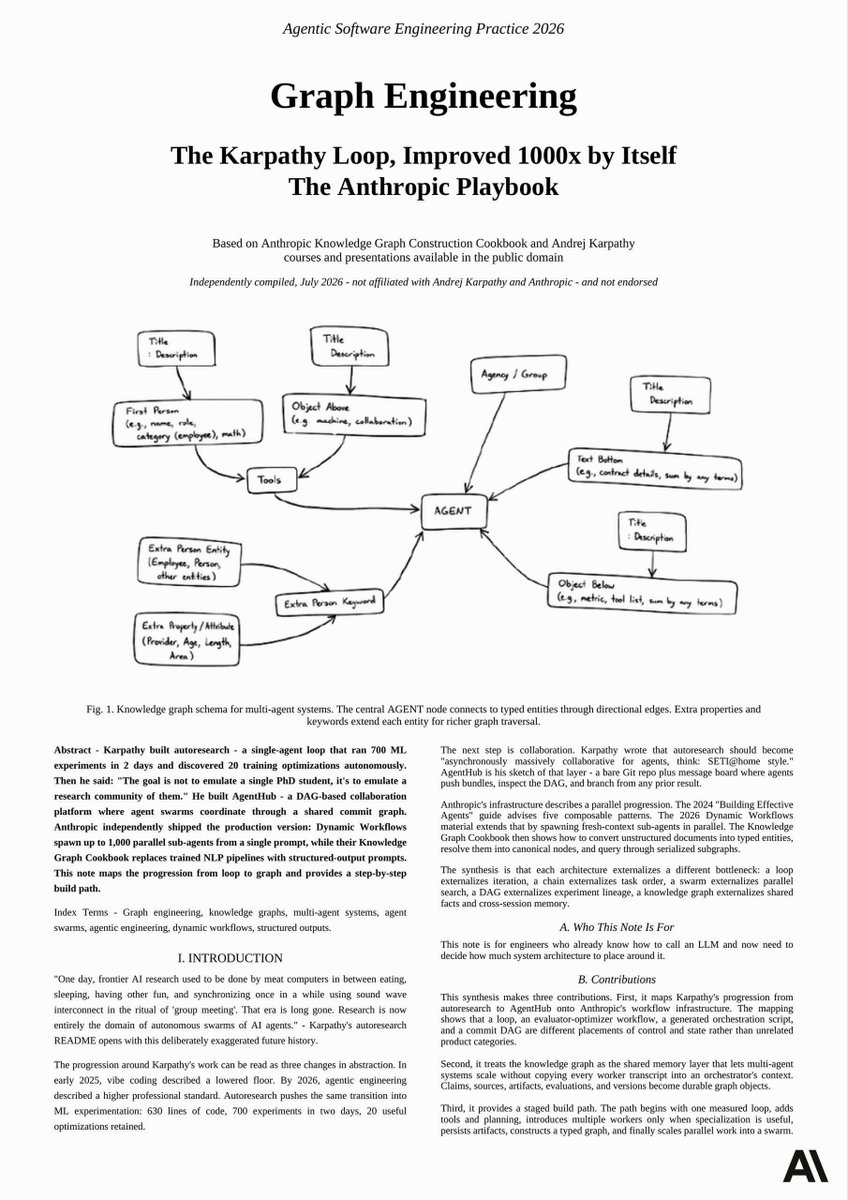
Two Anthropic seniors just made Karpathy's loop 1000x better with "Graph Engineering" - dropped 11-page PDF the shift: the agentic systems got 1000x better the moment you wired agents into a graph here's the playbook in 6 steps: step 1 → build one loop: generate, critique, revise - one self-review cycle beats a smarter model with none step 2 → add tools: search, code execution, database - thinking without tools is hallucinating step 3 → go parallel: spin up agents in separate worktrees - same repo, different branches, no conflicts step 4 → add a graph: agents write findings as typed nodes and edges - not transcripts - every claim keeps its source step 5 → ground your evaluator: it checks claims against graph edges, not vibes - "Triple not found" beats "seems off" step 6 → the graph survives every session - your agents stop rebuilding context from scratch the result: Karpathy ran 1 agent in 1 direction - this system runs 1,000 with shared memory - same model, it's the architecture read this 11-page PDF and paste it into your Claude - you won't regret it bookmark - then read the article on building graphs from scratch ↓

14x faster and 90% cheaper LLM inference. (100% open-source, KV cache management) your LLM does the same expensive work over and over. every request, it re-reads the same system prompts and the same documents from scratch, even if it processed them one second ago. token prices keep falling, but agent workloads re-send so much repeated context that the bill climbs anyway. LMCache fixes this. it's an open-source KV cache management layer that plugs into vLLM, SGLang, and TensorRT-LLM. here's how it works: LLMs recompute their understanding of the same content on every request. the same system prompts, the same documents, processed from scratch every time, and a single GPU throws away roughly 15 TB of this reusable cache per day. LMCache stores that cache and serves it back on repeat requests, running as a separate process completely outside the inference engine. the engine just asks for the cache blocks it needs. LMCache handles all the heavy data movement across GPU, CPU, disk, and remote storage in parallel, so cache work never steals compute from inference. it also reuses cache beyond exact prefixes. their CacheBlend technique (EuroSys 2025 best paper) keeps RAG documents cached no matter what order they appear in. on H200s with a 235B model, that adds up to 14x faster time-to-first-token and 4x faster decoding. and since reuse skips the compute entirely (the same reason providers discount cached tokens by 90%), the cost savings follow directly. GitHub repo: github.com/LMCache/LMCache (don't forget to star 🌟) i wrote a full breakdown of KV cache management that walks through why 𝗽𝗿𝗲𝗳𝗶𝘅 𝗰𝗮𝗰𝗵𝗶𝗻𝗴 silently breaks in three common cases, the 𝗱𝗶𝘀𝗮𝗴𝗴𝗿𝗲𝗴𝗮𝘁𝗲𝗱 𝗮𝗿𝗰𝗵𝗶𝘁𝗲𝗰𝘁𝘂𝗿𝗲 behind the 14x speedup, 𝗖𝗮𝗰𝗵𝗲𝗕𝗹𝗲𝗻𝗱, and how to turn every document in your knowledge base into a reusable cached asset. the article is quoted below.


Prompt, context, harness & loop engineering, clearly explained! An agent is a while loop with four layers of engineering wrapped around it: - Prompt engineering - Context engineering - Harness engineering - Loop engineering Each one wraps the last, and the model sits in the middle, so none of them compete with the others. Instead, they just zoom one level further out. > Prompt engineering: This defines the input the model sees on one call, often composed of a role, instructions, examples, and an output format. The techniques here alter the internal computation and reasoning the model goes through due to the wording it sees: - Chain-of-thought makes it work in steps before answering - Few-shot examples define the format and the edge cases - A JSON schema or XML tags make the output parseable by code - Self-consistency samples a few chains and takes the majority > Context engineering: It's everything the model sees on a turn, not just the prompt. That includes the query, retrieved docs, memory, prior turns, and tool outputs from earlier steps. The window is finite and fills up fast, so the engineering work is to rank inputs and cut everything that isn't pulling weight. You do this by: - Retrieving only the chunks relevant to the query, then reranking them - Keeping key facts out of the middle, where accuracy drops - Summarizing old turns, evict stale outputs, push big blobs to files > Harness engineering: It's the code around the model that defines the tools, parses the calls, retries on failure, and can route work to sub-agents so one handles retrieval and another handles code. A verifier then grades the result by running tests, validating a schema, etc. Prompt and context involve getting one call right. The harness involves everything that has to happen around that call for it to run in a real system. > Loop engineering: In the usual setup, you manage the outer loop, i.e, you write a prompt, read the turns the agent runs, write the next prompt, and repeat, while catching failures. This layer hands that job to the agent itself. It kicks off on a schedule or an event, and runs many turns with no prompt in between. A loop inherently doesn't know when it's finished. An agent can report that it's done and halt while the tests still fail. So the stop can't be the agent's word, but rather it has to be a real signal, like: - A turn and token cap to stop stuck runs - A no-progress detector to catch repeated calls - A completion check to verify the goal with a separate model or a deterministic test By this layer, you're operating on the whole run, so the engineering moves from writing each prompt to setting the goal and the stop conditions up front and letting it run. If you want to dive deeper into loop engineering, my co-founder wrote a full breakdown of that outer loop. It goes from the basic while loop to a run that finishes on its own, with the code behind each part, and the parts that are hard to get right, like knowing when to stop, context rot over a long run, and keeping the checker separate from the maker. Read it below.

what is agent looping for the last two years we prompted agents one task at a time. that is starting to change instead of asking an agent to build the landing page and then driving every step yourself, you set up a loop that handles discovery, planning, the work, checking, and iterating until the goal is met looping is a setup you build. almost any agent harness can run it, it just depends on how you wire it up at its simplest, looping is one agent working on itself: > researches > drafts > checks the draft against a goal > fixes what is weak > runs that cycle again until the work clears the requirements you are not prompting each step anymore. the agent repeats the cycle for you the bigger version is a fleet looping. you give an orchestrator agent a goal, it breaks the goal into pieces, hands each piece to a specialist agent, and those specialists hand smaller jobs to their own subagents the whole tree keeps looping through discovery, planning, execution, and verification until the goal is met one agent looping is like a person redoing their own draft. a fleet looping is a whole team running a project end-to-end you create a goal, and the system runs the loop until it finishes within the reqs you set open and closed looping: OPEN LOOPING is exploratory. it still has conditions and a goal, but you give the agent or the fleet a wide space to move in. it can try different paths, discover things, build something you did not fully spec out this is the exciting end, it is what Peter and others are doing, and tbh it is where I want to spend more time the catch is cost, an open loop with real room to explore burns an insane amount of tokens. for the 90 percent of people without an unlimited budget it is not runnable yet, and pointed at projects with a loose standard it turns into a slop machine CLOSED LOOPING is bounded. a human designs the end-to-end path first: > clear goal > defined steps > an eval at each step > a point where it stops or hands back to you (and feeds back performance data) the agents still loop, but inside framework you built. it gets better every run because each pass feeds the next, and it runs on a normal budget because the path is tight. for most marketing work, closed is the one that pays off today. > the orchestrator owns the goal > the specialists own the steps > the subagents do the narrow work > an eval gate make sure its not slop


Here’s your monthly reminder that you shouldn’t be prompting coding agents anymore. You should be designing loops that prompt your agents.

Found the Best Resource to learn Harness Engineering. 😭 walkinglabs.github.io/learn-harness-…


🚨 Anthropic just showed a 27-minute workshop on how to actually do prompts for Claude. Taught by the people who built it. Free. No registration. No paywall. I've seen $300 courses that don't cover what they teach in the first 8 minutes. Watch it and bookmark it now.


Claude code’s /security-review is just a Skill, and the whole prompt is in this repo It’s p generic and imo you can tailor it to each repo to language you’re scanning to get better results github.com/anthropics/cla…

🚨 BREAKING 🚨 Infamous Russian hacker and beatboxer exposes exactly how hackers got access to private GitHub repositories
พึ่งตื่น 👇


[News] "Pordee" ปลั๊กอินภาษาไทยสำหรับClaude Code ที่ช่วยลดการใช้งาน Token ได้สูงสุดถึง 75%! . เมื่อช่วงเช้าที่ผ่านมา เจ้าพ่อสารพัดอย่างโปรเจกต์และนักพัฒนาชาวไทยคุณ keRLos เปิดตัวโปรเจกต์ใหม่ในชื่อ Pordee หรือ “พอดี” ซึ่งเป็น Plugin สำหรับ Claude Code ที่ออกแบบมาเพื่อแก้ปัญหาการกิน Token ปริมาณมากของภาษาไทยโดยเฉพาะ โดยได้รับแรงบันดาลใจมาจาก "caveman" เพื่อช่วยให้ AI ตอบคำถามได้กระชับ ตรงประเด็น และประหยัด Token สูงสุดถึง 60-75% โดยที่เนื้อหาและความถูกต้องทางเทคนิคยังอยู่ครบถ้วน . สำหรับหลายๆคนที่ใช้ AI เป็นแชตบอตอาจจะทราบดีว่า ในการถามคำถามที่เป็นเนื้อหาหรือบริบทเดียวกันภาษาไทยนั้นใช้จำนวน Token ในการตอบมากกว่าภาษาอังกฤษมาก แต่หลายคนเองก็ไม่ได้สะดวกที่จะแชตกับ AI ด้วยภาษาอังกฤษตลอดเวลา คุณ keRLos จึงได้พัฒนา Plugin สำหรับ AI ชื่อว่า Pordee ขึ้นมาให้ใช้งานกัน . โหมดการทำงานของ Pordee จะแบ่งระดับการตัดคำออกเป็น 2 ระดับ เพื่อให้ผู้ใช้เลือกใช้ตามความเหมาะสมได้แก่ . Lite - เน้นตัดคำฟุ่มเฟือย คำสุภาพ และคำลงท้าย (ครับ/ค่ะ) ออก แต่ยังคงโครงสร้างไวยากรณ์ที่ถูกต้อง อ่านแล้วยังเป็นภาษาไทยปกติที่ดูเป็นทางการ . Full - เป็นค่าเริ่มต้น ที่เน้นความประหยัดสูงสุด โดยจะตัดทั้งคำเชื่อมที่ไม่จำเป็นและปรับรูปประโยคให้สั้นที่สุดเท่าที่จะทำได้ ซึ่งช่วยลดจำนวน Token ลงได้มหาศาลจากประโยคภาษาไทยแบบปกติ . วิธีติดตั้งและใช้งานผ่าน Claude Code สามารถติดตั้งบน CLI ได้ทันทีด้วยคำสั่ง . claude plugin marketplace add kerlos/pordee claude plugin install pordee@pordee . หลังจากติดตั้งแล้ว สามารถควบคุมการทำงานผ่าน Slash Command เช่น /pordee เพื่อเปิดใช้งาน หรือ /pordee stop เพื่อปิด นอกจากนี้ยังมีระบบ Keyword ที่ช่วยให้เปิด-ปิดการใช้งานได้ง่ายๆ เพียงพิมพ์คำว่า "พอดี", "พูดสั้นๆ" หรือ "พูดปกติ" ในแชท ระบบจะปรับเปลี่ยนโหมดการตอบกลับให้อัตโนมัติทันที . ในเวอร์ชันแรกนี้ คุณ keRLos บอกว่าจะรองรับการใช้งานผ่าน Claude เป็นหลัก แต่มีแผนที่จะขยายการรองรับไปยัง AI ตัวอื่นๆ เพิ่มเติมในอนาคต . ใครที่สนใจก็ไปส่องและติดตั้งได้ใน Github ด้านล่าง Github: github.com/kerlos/pordee Source: facebook.com/share/p/17tdoi…


This Chinese guy created 13 agents in Claude Code for Shopify stores and single-handedly serves 200 dropshippers a month, taking $800 from each. He sits at one desk in front of a wall-mounted LG monitor split into a 3x2 grid of 6 Claude windows, another identical grid runs on a vertical display next to it, plus 1 window on the MacBook within arm's reach, totaling 13 agents simultaneously building Shopify stores, each busy with its own part. No team, no managers, no support, just him, the monitor, and the API counter ticking in the header of every window. He is not on a subscription but on an API rate billed by tokens, and he figures 13 parallel agents pay for themselves from the very first client, because every finished store goes for $800, and all 13 windows together consume less than $80 a day. In the first window he set that system prompt which immediately closes the "assistant or employee" debate: "you are my new founder-engineer" So the model knows at what level it was hired: not to hint, not to advise, not to supplement, but to own the result, because for this Chinese guy Claude is no longer a helper in an IDE, it is a partner in his small factory, billed by tokens and never leaving for lunch. And the other 12 agents he spread across the layers of the store, so each one sits in its own context and does not interfere with the neighbor: "build a catalog of 80 products and rewrite the descriptions" "lay out the homepage for the niche of the client" "set up the cart, payment, and shipping by country" "generate 30 email chains for warming up" "design 50 banners and a logo for the brand" "set up analytics and A/B tests on the homepage" In a regular agency each task like this would take one designer or developer a full 2 days, because they would first collect the brief, then wait for revisions, then get on a call, whereas this Chinese guy has all 13 agents working in parallel in their windows, and while one writes descriptions, the second is already laying out the homepage, and the third is designing banners. In the end on the wall it looks like a factory: 13 identical Claude robots writing into one project, and the Chinese guy himself in the chair in front of them decides only 2 questions, which client to hand the finished store to and who to take next, and beyond that he does nothing. And economically it is still cheaper than keeping a team of 5: one operator like this closes 6 to 7 finished stores per day at $800 each, while a traditional design agency charges $3,500 for the same store and builds it over a full 2 weeks, whereas this guy spends less than $80 a day across all 13 windows. Wires hanging out, the monitor bolted to a stand, no office and no employees, just 1 desk, 13 robots, and a queue of dropshippers who send new orders every morning. In my opinion, this is the most efficient solo Shopify factory I have seen this year, and it is already running right now, while traditional agencies are still debating whether AI will take jobs from designers.


A Rust dev just killed Headless Chrome. It's called Obscura. The open-source headless browser purpose-built for AI agents and scrapers at scale. Chrome vs Obscura: - Memory: 200MB+ → 30MB - Binary: 300MB+ → 70MB - Page load: 500ms → 85ms - Startup: 2s → Instant - Anti-detect: None → Built-in Single binary. No Node, no Chrome, no dependencies. Stealth mode is brutal: → Per-session fingerprint randomization (GPU, canvas, audio, battery) → 3,520 tracker domains blocked by default → navigator.webdriver masked to match real Chrome → Native function masking so detectors can't sniff it out Drop-in replacement for Puppeteer and Playwright over CDP. Zero code changes. If you run agents or serious scraping at scale, this repo prints money. 100% Opensource.


OpenClaw bot dashboard with pixel office github.com/xmanrui/OpenCl…


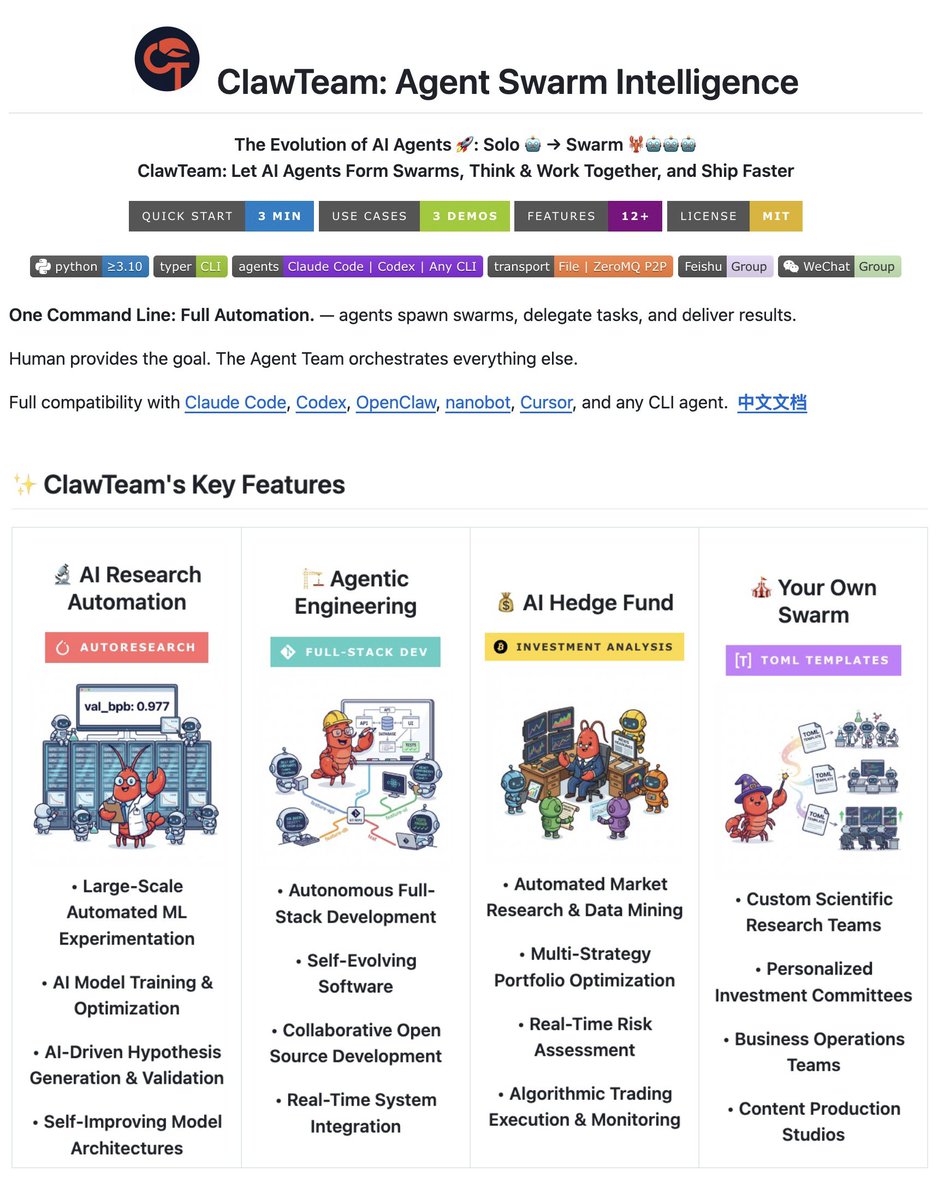
Introducing ClawTeam: Agent Swarm Intelligence 🚀 ( github.com/HKUDS/ClawTeam ). The Evolution of AI Agents: Solo 🤖 → Swarm 🦞🤖🤖🤖 AI assistants like OpenClaw and nanobot have made it incredibly easy for everyone to have their own personal agents. They're everywhere now — coding, writing, analyzing. But here's the thing: they're all working in isolation. It's like having a bunch of brilliant interns who never talk to each other. We think it's time for the next leap. ClawTeam transforms those isolated agents into collaborative swarms that actually think and work as a team. No more babysitting multiple agents or juggling contexts. Just tell the leader agent your goal — it spawns the right specialists, divides work intelligently, and orchestrates everything until completion. It's like upgrading from solo freelancers to a synchronized dev team that never sleeps. ⚡ From Hours to Minutes, From Complex to Simple Here's where it gets interesting: whether you're running ML experiments across 8 GPUs, building full-stack applications, or analyzing market data, ClawTeam turns complex multi-day projects into single-command operations. We're not just making agents faster — we're unlocking collective intelligence to tackle something big. #ClawTeam #OpenClaw #nanobot #AIAgents

Neovim core devs will be chatting with @link_arzu after Nvim 0.12 release! ECD is TBD, but... soonish. Like 864000 seconds from now, approximately.


[Niri] nixos + niri + Noctalia Link: redd.it/1rwf1u0 #unixporn #linux #screenshot
@castby9arm Case นี้น่าสนใจเอามาเล่านะครับ
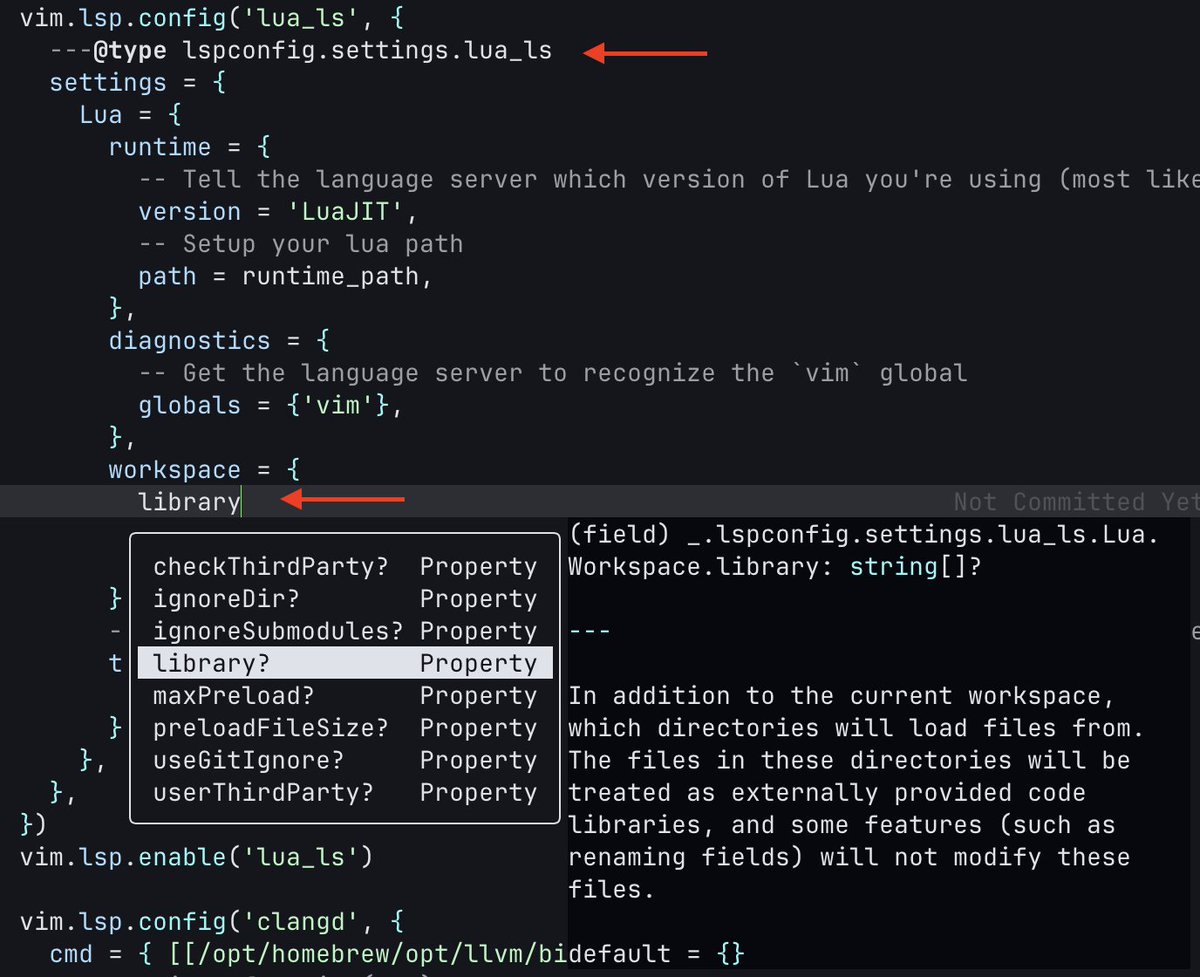
nvim-lspconfig (upcoming in v2.8.0) now ships with type definitions for LSP server "settings" (inspired by folke/neoconf.nvim) Get autocompletion + validation of server-specific settings by adding "---@ type lspconfig.settings.xx" on your vim.lsp.config "settings" item. github.com/neovim/nvim-ls…


Taha @Taha85096198
328 Followers 4K Following اللهم احسن خاتمتنا ولاتقبض اروحنا الا وانت راضي عنا وسخر لنا من عبادك من يدعون لنا أن حان وقتنا. اقرأ واكتب احيانا والأخطاء واردة علينا تعديلها او الرجوع عنها

Investor Darna.🖤 @DarnakiliyaJ
55 Followers 1K Following Law student at prestigious Usmanu Ɗanfodiyo University, Sokoto.
MINNA LAFORTUNE @MinnaLafortune
841 Followers 3K Following Voting Member of the Recording Academy #Independent , #Poet #Songwriter #Reggae, #,#Singer,#Songwriter,#pop,#Jamaican-music, #Ska,#Soca

Oscar Divorra @Oscar_Divorra
246 Followers 554 Following I am a scientist, engineer, manager and mentor passionate by Tech. Working on Realtime Media & WebRTC comms at @Vonage, part of @Ericsson, Video API Platform.
Twum Micheal @TwumMicheal3
8 Followers 255 Following
Rocking J. Entertainm... @RockingJEntert1
19 Followers 668 Following
iOS Developer News �... @iosdevelopernew
6K Followers 867 Following The easy way to be up to date with everything relate to #iOS Developers.
Tenity (prev. Hackqua... @hackquarters
3K Followers 2K Following Global innovation ecosystem and early-stage VC. This account will be moving. Don't miss a thing and follow along here: @tenity_global
Cellofrag @Cellofrag
12K Followers 6K Following Cellist, Gamer & Doctor with a legendary french accent. Live on https://t.co/P0nonwk8PX 🧡 Twitch Partner & ArenaNet Partner Business - [email protected]
𝐄𝐓𝐄𝐑𝐍�... @eternity_online
103 Followers 520 Following • Transformamos y medimos las conexiones con tus clientes. • Tecnología humanizada para un mundo mejor conectado.
Anthony Washington @Anthony77193712
5 Followers 113 Following

Envitics solutions @Envitics
25 Followers 166 Following A leading IT consulting & Digital transformation company catering to Small & Medium Enterprises.
HB, A Diversified Com... @hbcomm
3K Followers 4K Following We design, build, and support audiovisual communication environments.
พรรษมล �... @patsamon_32
0 Followers 25 Following

Rose Wallace @naweljai
9 Followers 410 Following
alexander @alexanderandi3
281 Followers 3K Following
TomLiao @TomLiao001
1K Followers 4K Following Technical engineer. I love #Bluemix , #IBMWatson, #Cloud, #Agile, #DevOps, #Watson, #Cognitive, #AI, #Blockchain, #IOT, #Earth, #Economic, #AI
バトルガールハ... @battlegirlshs
1K Followers 2K Following 人気のスマホゲーム「バトルガールハイスクール」の攻略まとめサイト非公式Twitterアカウント!相互フォロー100%!みんなで情報を共有してバトルガールを盛り上げよう!リツイート大歓迎♪

Ivan Vinogradov @Mcgrapee
95 Followers 592 Following

Sirata @AnnSirata
7 Followers 52 Following
Chelsea Nui @ChelseaNui
2 Followers 31 Following
' Piggy c: @Nusara_NuChh
102 Followers 241 Following Hi! I'm Nuchh,,nice 2 meet u ^^ thank for follow me :D Bangkok, Thailand
FROST BITE @TimeTravelie06
399 Followers 8 Following
CHIBEST @paulinus96199
11K Followers 1K Following Documenting the journey of self acceptance, boundaries,and queer joy. Here to share perspectives and start honest conversations.Drop your thoughts👇
GitHub Projects Commu... @GithubProjects
337K Followers 66 Following We're sharing/showcasing best of @github projects/repos. Follow to stay in loop. Promoting Open-Source Contributions. UNOFFICIAL, but followed by github
Chad Adams @cadamsdev
99 Followers 341 Following

Sawyer Merritt @SawyerMerritt
1.1M Followers 494 Following EVs/space/tech. Bringing you the latest news in a single, easy-to-read feed. $TSLA & $SPCX investor, Model Y owner.
Lee Burrows @TheiOSDude
3K Followers 4K Following Lead iOS Engineer. Father and coffee slurper with a passion for fast cars & tidy code.
Bohemia Interactive @bohemiainteract
114K Followers 216 Following Developers of video games, including @ArmaPlatform, @DayZ, @vigorthegame, and @CosmoTalesGame. Based on the principles of curiosity, creativity, and community.
WOBO @WOBOtweets
13K Followers 240 Following Making videos explaining mechanics/items in DayZ. Creator of and maintenance guy for https://t.co/YwbMlyv5Rj. The info I give may be wrong, let me know if it is!
DayZ 🖥 🎮 ❤️ @DayZ
335K Followers 288 Following Wishlist DayZ Badlands: https://t.co/GLkuVudZ5U Game by @bohemiainteract

แป้งสาม... @pang3pongsow
2.4M Followers 1 Following สวัสดีซุมเจ้า 🇹🇭🇻🇳 💯 ข้อยไม่ได้ทำ Only Fan ไม่เคยถ่าย 18+ !! https://t.co/B3qVNL8sf6
Piyabutr Saengkanokku... @Piyabutr_FWP
1.1M Followers 327 Following ปิยบุตร แสงกนกกุล | Youtube : Piyabutr Channel | #สนามกฎหมาย | #สมรภูมิความคิด Battle of Ideas | #ปิยบุตรทัวร์ | #กินเล่ากะป๊อกไปป์ | INTERREGNUM #pokcast
Rangsiman Rome @RangsimanRome
731K Followers 271 Following สมาชิกสภาผู้แทนราษฎร พรรคประชาชน. Member of the House of Representatives of Thailand.


Pita Limjaroenrat @Pita_MFP
2.3M Followers 607 Following พิธา ลิ้มเจริญรัตน์ (ทิม) (อดีต)หัวหน้าพรรคก้าวไกล (Former) Move Forward Party Leader

บอล ธนว�... @tanawatofficial
579K Followers 42 Following ประเทศไทยจะดีขึ้น ต้องเริ่มจากการ #แก้รัฐธรรมนูญ ให้เป็นประชาธิปไตยอย่างแท้จริง ประกันสิทธิ เสรีภาพแก่ราษฎรในทุกด้าน ลดความเหลื่อมล้ำ เพิ่มความเท่าเทียม
เพรชตี้ @nRqYEghsuWGlBJx
73K Followers 0 Following
biipmk @biipmk
13K Followers 63 Following Keycaps & Keyboards Designer. Co-Founder of @keycapsule_shop. Art Direction & Design: @biip_lab
DROP @drop
56K Followers 925 Following World’s Largest Mechanical keyboard and audiophile community. Shop inventive products and connect with like-minded people.
Space @Space_Cables
19K Followers 157 Following High-end custom cables, keycaps, desk pads & various other peripherals related to Mechanical Keyboards — Certified Cerakote® Applicators
The Key Company @TheKeyCompany
17K Followers 44 Following Sweet switches, cool caps, and killer keyboards. For support: [email protected]

Zeal® @ZealPC
6K Followers 46 Following Official Zeal Generation Inc. Twitter Profile. Store - https://t.co/mkHp5ToJCv Discord - https://t.co/3Ie2x4PHq2 Enthusiast Tier Mechanical Switches & Accessories.
Mekanisk Keyboards @MekaniskCo
5K Followers 39 Following I am LeandreN, mechanical keyboard designer and distributor from Norway. https://t.co/6Ty2sAtn1T. https://t.co/ATOACrmNLc for Norway. Instagram: @mekaniskco
Zambumon @Zambumon
7K Followers 70 Following Keyboard enthusiast. IG: https://t.co/d9eVJZQhlT | Discord: https://t.co/ZnhhfWQmBN






みにょん🦋🫧 @MignonNyan
157K Followers 114 Following 君の為に何度でも言うよ🫧 今日も生きててえらいね✞.₊˚🫧 ‧₊✞🫧 サブ垢@MignonNyan2 ✞‧ᖭི༏ᖫྀ ⊹˚ ‧₊✞‧ ᖭི༏ᖫྀ ⊹˚ ‧₊ ꒰ঌ♡໒꒱˚₊‧
TokBox (now Vonage) @tokbox
4K Followers 653 Following This page is no longer updated. TokBox is now @Vonage. Follow us for the latest in business communications.
Chad Hart @chadwallacehart
3K Followers 2K Following Real time communications product person, analyst, consultant, webrtcHacks / https://t.co/aSbqt7lYsI blogger. I tweet about: AI in RTC, WebRTC, comms apps & more
krankygeek @krankygeek
1K Followers 251 Following Kranky Geek WebRTC Virtual event starts at 11:00 EST Thu Nov 17, 2022 Learn more at https://t.co/8h3KXl61HI or register https://t.co/6KsqTOAwqj
Vapor @codevapor
7K Followers 77 Following A web framework for Swift. #vaporswift. Server side Swift. Tweets by @TheWisestFools & @0xTim
ServerSide.swift @SwiftServerConf
4K Followers 4 Following The Server-Side Swift Conference. 1st-3rd October 2025, London. Organised by @0xTim
iOS-Blog @iOS_blog
24K Followers 2K Following Objective-C / Swift Tutorials, Jobs, Resources, Competitions and Q&A for the iPhone Developer
Tsahi Levent-Levi @tsahil
5K Followers 2K Following Consulting ⭐ Training ⭐ Marketing outreach ⭐ Expert in WebRTC and Programmable Communications
RTC News @RTC__News
503 Followers 120 Following https://t.co/j88k0jC5zq is where the #WebRTC community meets. Founded by @ArnaudBud
Xirsys @Xirsys
500 Followers 151 Following Xirsys is a leading provider of WebRTC infrastructure-as-a-service, and the industry standard for TURN server hosting.
MacThai.Com @macthainews
65K Followers 22 Following Breaking news for Apple Fans, อัพเดตข่าวสำหรับสาวกแอปเปิล ที่เร็ว หลากหลาย และบทวิเคราะห์ที่ลึกไม่เหมือนใคร
testRTC @testRTC
496 Followers 2 Following
Communications Applic... @CommAppsExpo
3K Followers 584 Following Enabling application owners and developers to understand the value, complexity, and options to integrate real time human interaction. #CommAppsExpo

ivelin.eth 🛡️�... @ivelini
2K Followers 2K Following #OpenSource contributor and technology entrepreneur | @founding | https://t.co/jVd9McmctD | https://t.co/CDkdPePwdq | prior Telestax, Mobicents, JBoss/ @RedHatTrends for United States
You might like