Sabo @MrColdEmail
i send millions of cold emails/day, still hitting the inbox. my toolkit: go.scalingroom.com/sbio Joined October 2025-
Tweets1K
-
Followers903
-
Following122
-
Likes974
@levikmunneke @B2Bluka You can do 5/domain no issues
@Christian_rson Bought = in the market willing to pay and can be poached with a better positioning
every SaaS company publishes case studies on their website with the customer's real name, real company, real logo, and the exact result they achieved. that is a published customer list with proof of budget, proof of need, and proof that the customer is willing to buy in your category. sitting on a public webpage. indexed by google. with a "read more" button. a guy I know scraped his top competitor's case study page last month. 38 case studies. each one named the customer's company, the contact person (usually VP or director level), the problem they had before buying, and the result after. 38 proven buyers. with their names attached. who already believe in the category. whose specific pain points are documented in the competitor's own marketing. he ran the 38 company names through AI-Ark. pulled the original case study contact where possible, or the current decision-maker in the same role. 34 enriched. cold email body referenced the competitor's own case study: "[first name] - saw the [result] your team achieved with [competitor]. most teams at that stage start hitting [specific limitation] around month 8-12. we handle that layer differently. quick loom to compare?" you're complimenting their decision, referencing a result they're proud of, and offering a comparison at the exact moment the honeymoon phase with their current vendor is wearing off. 12 replies out of 34 emails. 35% reply rate. because you aren't cold. you read their vendor's marketing material and turned it into a warm conversation. 5 booked calls. 2 closed at $11,200 average. $22,400 from a webpage the competitor designed to attract new customers, not lose existing ones. the competitor wrote a case study to prove their product works. they accidentally wrote you a lead list proving the buyer has budget. fr
a billboard on the highway outside your competitor's headquarters costs $1,200/mo. their entire sales team sees it twice a day. their customers see it during site visits. their CEO sees it on his commute and has to pretend it doesn't bother him. a guy I know rented a billboard 400 feet from his biggest competitor's office park. the creative was simple. his product logo, a 4-word tagline, and a QR code. nothing aggressive. nothing mentioning the competitor by name. the first week, 3 of the competitor's own employees applied for jobs at his company. they scanned the QR code from the parking lot. the second week, a prospect who was evaluating both products mentioned the billboard on a sales call. "I keep seeing your name on my drive to [competitor]'s office. figured I should at least look." he closed that deal at $34,000 annual contract. $34,000 from a $1,200 billboard that was originally purchased as a joke to mess with a competitor's sales team. total ROI calculation is almost meaningless because the psychological damage to competitor morale is unquantifiable. their sales reps now drive past his brand every morning before they log in to sell against it. the billboard has been up for 4 months. he's closed 6 deals where the prospect mentioned it unprompted. $148,000 in revenue. $4,800 in total billboard rent. every digital marketer on this app is optimizing CPMs on meta while ignoring a $1,200/mo channel with zero competition, 100% viewability, and the side effect of demoralizing your competitor's entire office. btw the billboard company lets you geo-target mobile ads to anyone who drives past. so the physical billboard feeds a digital retargeting audience. two channels from one placement. run it
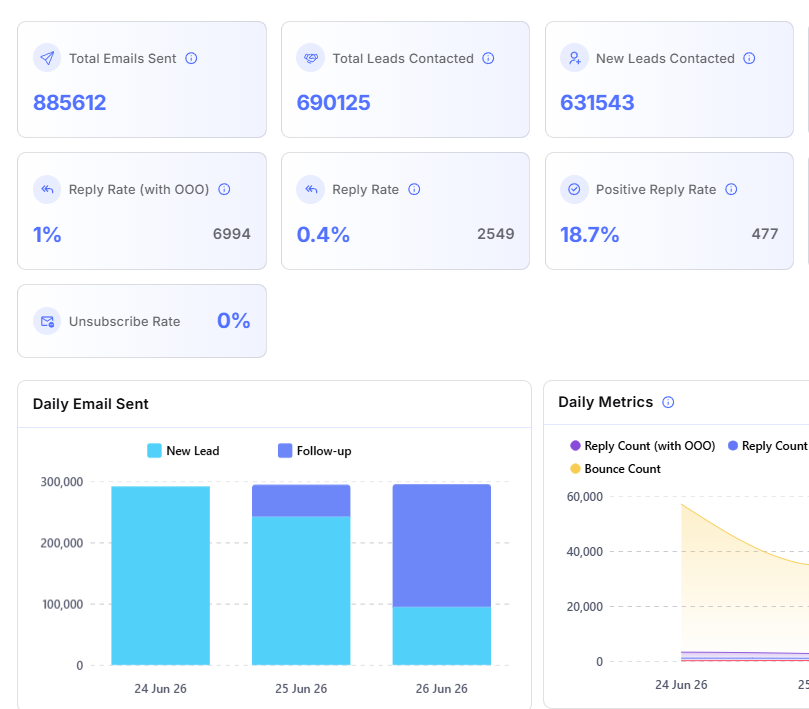
@ethanejk Instantly deceives you with OOO, track actual reply rates, positive reply rates but most importantly cash collected people fall into the trap of high reply rates, here is an avg campaign for us, some offers we pull +1M/d and average +500 positive replies 150 ish calls
a $500 newsletter sponsorship reaches 40,000 targeted readers in your exact niche. the same 40,000 impressions on meta costs $2,800. 82% cheaper. same eyeballs. and the newsletter editor's credibility transfers to your ad because the reader trusts the person who curated it. a guy I know sponsors 4 niche newsletters per month. $500 each. $2,000/mo total ad spend. each sponsorship includes a 3-sentence blurb with a link to his landing page. last month: 160,000 total impressions across the 4 newsletters. 2,400 clicks. 340 landing page conversions. 89 free trial starts. 23 paid conversions at $1,200 annual contract. $27,600 in first-year revenue from $2,000 in newsletter ads. that's a 13.8x return. the same $2,000 on meta got him 22,000 impressions, 180 clicks, and 4 conversions last quarter. he checked. newsletter operators price their sponsorships based on what other newsletters charge. not based on what meta or google would charge for the same audience. that pricing gap is the entire arbitrage. a 40,000-subscriber newsletter in the fintech space charges $500 per sponsorship. meta would charge you $2,800-$3,400 to reach the same 40,000 fintech professionals. the newsletter operator has no idea they're sitting on $3,400 of ad inventory and selling it for $500. btw the best newsletters have waitlists for sponsors. lock in rates now before the operators figure out what their audience is actually worth. the window on this is about 12-18 months before everyone catches on
the single most valuable google search in B2B is "[your product] vs [competitor]." the person typing that search has already decided to buy. they're choosing between two options. the page that ranks #1 for that search literally decides who gets the deal. most companies let a random blog from 2022 control that page. some affiliate marketer wrote a 900-word comparison, slapped adsense on it, and now controls $2.3 million in annual purchase decisions for products he's never used. a guy I know publishes one comparison page per competitor. "[his product] vs [competitor name]." genuine comparison. real feature tables. honest about where the competitor is better. but the framing, the structure, the conclusion, and the URL are all his. he published 7 comparison pages in january. by march, 4 of them ranked on page 1. combined monthly search volume: 11,200. every single visitor is in active buying mode. he doesn't run ads to those pages. he doesn't promote them on social. google sends him 11,200 visitors per month who are already holding a credit card and trying to decide between him and someone else. total cost to produce all 7 pages: $0 if he writes them. $840 if he pays a writer. one-time spend. the pages have been generating inbound for 5 months with zero maintenance. the irony is that his competitors could do the same thing. they don't because writing an honest comparison where you admit weaknesses feels wrong to a marketing team. so they leave the narrative to strangers. the stranger picks whoever paid the highest affiliate commission. fr
every person commenting on your competitor's youtube video is telling you 3 things about themselves simultaneously. they're interested in the category. they have a specific question (which means a specific pain point). and they left their name attached to it in public. youtube comments are the only place where prospects self-identify their exact problem, in their own words, under their real name, on a platform that links directly to their other social profiles. a guy I know scrapes the comment sections of his top 3 competitors' youtube channels every week. not every comment. just the ones that contain a question. "how do you handle X?" "does this work for Y?" "what about Z?" those questions are buyer-intent signals that the commenter typed voluntarily, with their google account attached, which links to their linkedin, which gives you their company name and title. he processes about 200 quality comments per week. enriches 140 of them to linkedin profiles. runs the company name through AI-Ark for a verified work email. cold email references the exact question they asked on youtube: "[first name] - saw you asking about [specific question] on [competitor]'s video. we built [product] specifically to solve that. want a quick look?" reply rate: 9.1%. because you're answering a question they actually asked, in a place they thought nobody was watching. the competitor spent $4,000 producing the video. you spent $0 harvesting the leads it generated. btw the comments section never gets deleted. a video from 2023 still generates comments from organic search traffic today. the lead list compounds without anyone doing anything. run it
bland AI just raised $50 million because a $200/mo voice agent books more meetings than a human making $74,000 a year. 3.5 million calls per week. 100 languages. 45-minute enterprise conversations. zero commission negotiations. zero sick days. zero "I had a rough morning" energy on the first 20 dials. one of their early customers added $40 million in annual revenue from automated lead qualification alone. another hit $430 million in annual revenue from AI-powered outbound calls. these are numbers from the fundraise press release, not a landing page. a human SDR dials 60 numbers on a great day and spends 40% of their time "researching" on linkedin, which is code for scrolling with a crm tab open. the AI dials 400. per day. every day. starting at 8:01am in every timezone simultaneously. a guy I know replaced his 3-person SDR team with one AI voice agent 6 weeks ago. the agent runs a 4-question qualification script and transfers warm leads to a single human closer. the closer only talks to people who already said yes. old cost: $222,000/yr in salaries, plus $14,400 in software seats, plus 3 months of ramp time per hire. new cost: $200/mo plus $0.04 per minute of call time. roughly $2,600/mo total. closed $127,000 in the first 6 weeks. from a robot that doesn't negotiate equity and has never once asked to "jump on a quick sync." the companies posting "hiring SDR" on linkedin right now are posting the job listing equivalent of "hiring someone to hand-deliver telegrams." the role has about 18 months of oxygen left in its current form. fr
a SaaS company in denver shut down their blog 9 months ago. deleted the wordpress install. let the hosting expire. their meta retargeting pixel is still firing. the blog posts are cached on google. people still click them from search results, land on a cached version or a web archive mirror, and the pixel fires. the visitor gets added to a meta custom audience that the dead company stopped running ads to in october. that audience is still sitting in meta's ad manager. growing. 340 new visitors per month being cookied into a retargeting pool that nobody is retargeting. a guy I know found this by accident. he was checking a competitor's old blog for content ideas and noticed the pixel was still loading in the page source. checked meta's audience overlap tool and estimated the dead audience at roughly 12,000 people. he built a 1% lookalike off a similar audience in his own ad account (same niche, same demo signals) and ran $1,400 in ads against it for 30 days. the lookalike outperformed his cold prospecting audiences by 3.2x on cost per lead because the base audience was already pre-qualified by the dead company's content. the dead company spent 4 years building that blog audience. he spent $1,400 and 20 minutes in ads manager to access a version of it. btw meta doesn't expire custom audiences. they sit in the ad account indefinitely. there are thousands of dead companies with live pixels still feeding audiences that will never see an ad again. unless someone else knows where to look

Brian Zatulove @BrianZatulove1
90 Followers 616 Following

Mika @Coornet_Mika
0 Followers 57 Following
scale cold email @scalecoldemail
4K Followers 101 Following We send 10+ million cold B2B emails a month - Free Cold Email System Setups https://t.co/aUwNSw417T
Srinivas @SrinivasValekar
348 Followers 390 Following I am a coder but learning marketting and documenting my findings


0xa247 @JasonDo35023453
20 Followers 732 Following
Timothy Dick @TimothyDick
3K Followers 3K Following Biz Dev, Partnerships, SaaS, Marketing, Operations. 3X Inc 5000 CEO, Entrepreneur, Consultant

Alex Birman 🇺🇦 @oreshki
318 Followers 1K Following #neverendingseo SEO manager in Zap. WordPress, WIX, InSales, Shopify


Manik Patel @ManikPatell
0 Followers 67 Following
Arthur @YungChapChaos
15 Followers 148 Following Digital Advertising Agency - We guarantee you sign 10-15 clients a month or you get your money back
Emad Ambert @emaadlambert
32 Followers 240 Following Passionated about building SaaS that add value an bring smile to users.
Jack Gonzalez Hart @Jackgonzohart
189 Followers 496 Following Performative Male | Influencer Marketing

sosa @surei190
415 Followers 2K Following
maksklon @maksklonanon
11 Followers 215 Following
Yazan @Yazannjarr
0 Followers 8 Following
Jason Paul Rogers @JPRbiz
700 Followers 201 Following majority owner of a few companies that employ ~120 people. Mostly in HVAC & plumbing. When not working, I'm flying. Instrument Rated. 34.
PipeBlitz @pipeblitz
1 Followers 3 Following GTM for founders. Turning outbound, positioning & first customers into repeatable systems. Building GTM tools in public.
Chris @chrxskondylis
1K Followers 142 Following I help biz owners bring in cash from YouTube | $300,000+ CC fro YT in 2026 | Building @atlusmedia
G @88chinalondon88
13 Followers 47 Following
Leo Tanaka @leo_tanaka_dm
1 Followers 33 Following We help agencies, and B2B make 10-30+ more qualified appointments with DFY Dmtoolkit outreach Tools

Tommy Gabriel @TommyGabrielTV
21K Followers 6K Following Independent journalist, Seen on: @TMZLive TRW student [email protected]


Trench @inthtrenches
2 Followers 13 Following solo lead gen agency. i work with businesses to get them clients and they only pay me for results

Evan @evankozliner
423 Followers 940 Following Founder @withpotions helping businesses create great newsletters Ex-Amazon and Attentive AI 🤖


Marcus Jean-Baptiste @marcusjeanb
3 Followers 19 Following

Brenden Tartaglia @BrendenSentIt
2K Followers 578 Following Emails people want to open, simply work | $25M+ in revenue generated for brands
Chief Revenue Officer @Banking_Wins
196 Followers 2K Following Here's everything I know about hiking prices and making more money. I've done over a thousand software deals.
Lucas Answers 🇺�... @lucasanswers
1K Followers 1K Following My innate sagacity and indomitable pertinacity command dominance in every arena of combat.
Johannes Haug @haug_johannes
36 Followers 171 Following Former Chess Olympian builiding together with a ICLR & Imperial AI researcher DMs open!
Leon Vee @oleonvee
37 Followers 357 Following Direct Response Copywriter & Creative Strategist | I generated $10M to Nutraceuticals and Infoproducts businesses.

Aleksandra Malhotra @AleksaMalhotra
22 Followers 72 Following
Sibtain Abid @sib_tainn
56 Followers 531 Following


Shahzad Hussain | Gro... @Sheen_hai
88 Followers 468 Following Founder of Growthformers. I help ecom & affiliate websites to grow traffic and improve conversions. Tweet about SEO, CRO and content
Thomas Chavez @thomasdatrain96
173 Followers 121 Following Current: Insurance lead generation 11,000 leads a month @ $20-$30. Vertically integrated business. Next: Raising capital to start an Insurance Carrier.
Brilliance | Ads & Fu... @brillaas
15K Followers 514 Following Running ads and funnels for people you definitely know
Ben Kaplan @ben_kaplan23
3K Followers 2K Following @noaccentcallers | Building inbound and outbound call centers
Bodhi- Local SEO @irentdumpsters
22K Followers 1K Following I hauled trash in New York and specialize in Local SEO for small business owners. FREE SEO GUIDE 👉👉https://t.co/GH6kY3E2oT
Marcel @marcelkargul
50K Followers 607 Following Founder @kargulstudio / Design and dev partner for high-growth startups.
cemhasoglu @cem_hasoglu
8K Followers 26 Following Google Workspace & Outlook Inboxes & AI DFY Cold Email: https://t.co/VxKTijpMJs

Ziad @_ziadhaitham
215 Followers 196 Following https://t.co/CIEgLHNdO3 17 | Scaling B2C & B2B with DFY YouTube & Instagram $400K+ in clients revenue in 2026
Chase Larabee @ChaseLarabee
2K Followers 4K Following Contrarian. SMB founder out of the PNW. Motto: big windshield, small rearview mirror.
oritheoracle @oritheoracle1
4K Followers 1K Following Raise Your Floor - Manos Health GTM Director | Co Founder - MirraPonte | $130+ Million Generated 22+ Products Launched

Jah Mills @itsjahmills
6K Followers 506 Following God created you to be so much more || I make apps @rork
Justin @justineliaa
2K Followers 155 Following I sell stuff online and optimize how businesses process payments 👇🏼
Daniel Sushik @dansushik
97 Followers 210 Following Building the most reputable marketing agency in the US. Be bold. Be Based. @basedagency
Ibrahim @Ibrahimxdarwish
1K Followers 307 Following Founder @ https://t.co/rgBYHdLPwz | Scaling B2B Offers With DFY YouTube Acqusition Systems
Jeremy Dixon | Cold O... @systemswithjay
1K Followers 91 Following GTM Implementation for B2B Businesses @ElevateClient
Daniel Fazio @danielfazio
16K Followers 527 Following Cofounder Client Ascension & ListKit. Build an AI Assisted Agency: https://t.co/tiPqHjMY1L
Based Hungary 🇭�... @HungaryBased
113K Followers 280 Following Transylvanian Hungarian. Conservative Content from Hungary. Official Store in Link Below.
Darknight ♪ | darkn... @DarknightHimslf
6K Followers 2K Following Web3 Rockstar 🎸 Win-Win King 🎼 |Founder @DarknightLabs @WinWinSocietyHQ @ApeVenturesVC |Advisor @karatecombat
Ben Rasmussen @SalesBlastBen
5K Followers 687 Following Slinging Inboxes | Harvard Grad '16 | Founder of https://t.co/wdP8BAGwpF | Founder of Cheap Inboxes https://t.co/xDZxIRT3lF |
Nate 🐰 @Nate_D_Taylor
376 Followers 337 Following I create highly targeted lead lists - Meetings booked with VPs & CXOs at apple, netflix, microsoft, google, tesla, jp morgan, blackrock, oracle, nvidia ect ect.
Kai Cabero @kai_cabero
2K Followers 43 Following sign 1-3 clients a day for your dfy/dwy offers with or without sales calls @ https://t.co/7CV8bp5ImW. clients work with NVIDIA, Intel, Lenovo, and more.

Dimitar Angelov @dimitarangg
6K Followers 444 Following running b2b outbound systems on x/email/linkedin

Nick Huber @sweatystartup
482K Followers 4K Following I buy real estate and start companies. Owner of https://t.co/IcKmzUwRIk, Bolt Storage, R.E. Cost Seg and more.
Dickie Bush @dickiebush
443K Followers 588 Following I talk about digital writing, internet business, and personal growth | Former @blackrock hedge fund trader turned writer & operator
Andrew Ng @AndrewYNg
1.7M Followers 1K Following Co-Founder of Coursera; Stanford CS adjunct faculty. Former head of Baidu AI Group/Google Brain. #ai #machinelearning, #deeplearning #MOOCs
James Clear @JamesClear
1.3M Followers 0 Following Author of the #1 NYT bestseller Atomic Habits (https://t.co/aWrO9DWkH5). I write about building good habits. Over 3 million people read my 3-2-1 newsletter.
Mark Cuban @mcuban
8.5M Followers 2K Following Dunking on the pharma industry with @costplusdrugs.com, the lowest prices on meds anywhere. check it out !
GREG ISENBERG @gregisenberg
683K Followers 990 Following I drop startup ideas daily. Host @startupideaspod. CEO: @latecheckoutplz we build companies like @ideabrowser, @meetLCA, @boringmarketer etc
Codie Sanchez @Codie_Sanchez
709K Followers 698 Following Building profitable businesses. Owner: @CTVentureCap @contrarian @bizscout_ @resibrands https://t.co/GeVvWuYSgV You grow or die / #1 M&A book👇
Justin Welsh @thejustinwelsh
582K Followers 1K Following I write one weekly essay for 200,000+ ambitious people living and working on their own terms.
Corey Ganim @coreyganim
56K Followers 115 Following Simplifying AI for non-technical entrepreneurs. Specializing in AI Assessments, AI Concierge, Knowledge Base builds. Built an eCom biz to $16,000,000+ revenue.
Hypefury - Simple aud... @hypefury
81K Followers 103 Following Simple social automation & content creation for entrepreneurs who dream big 🚀 Free Twitter growth tips in your 👉 📩 https://t.co/KWuQw0Dos8
Jason Applebaum @Jason______A
43K Followers 768 Following
Thomas Trimoreau @TTrimoreau
12K Followers 3K Following 26 | Founder https://t.co/cAz3u3V3WD - Growth on X https://t.co/OpUQE8YlW2 DM for collabs 📩
Justin @imjustindevries
3K Followers 2K Following cold outreach expert - I vet, train, and place elite sales reps for a living
Romàn @romanbuildsaas
16K Followers 259 Following Building an AI GTM brain https://t.co/5nFyO2JBSm 2000+ customers are using GojiberryAI daily !

Alex Zartarian 🇨�... @Alexzartarian
4K Followers 256 Following Founder @ Sparklead | Helped 50+ B2B Companies Build a Predictable Pipeline | 1,000+ Qualified Meetings Booked
Christian @coldemailchris
20K Followers 352 Following AI-Native Outbound for B2B Companies | 10M+ Emails Sent, 30,000+ Leads, $70M+ Pipeline Generated | My Links 👉 https://t.co/ujF3ZNVERd
BERKAN @mrberkanxk1
8K Followers 446 Following investor, entrepreneur, 7 figs in crypto in 1 year, member @lairfnf | owner of TOP1%
Onat Aksaray @OnatAksaray
8K Followers 1K Following Building profitable personal brands on X & LI | $750/mo @ 9-5 → 16M+ views & $ 15k/mo by writing online | Want the exact system? Click the link below.
Stijn Noorman @stijnnoorman
64K Followers 93 Following Helping you grow & monetize your audience. Tweets on writing, business & self-improvement. Grow on X → https://t.co/uR2a9SdLNB


Henrick Johansson @compliantvc
829K Followers 214 Following European VC in USA | Author of 'European Dynamism' | Investing in compliant startups | Advisor @compai | Managing Partner @ Compliant Capital
MailDeck @maildeckco
7 Followers 2 Following MailDeck is an invite-only inbox infrastructure system. Private architecture for high-volume cold email teams that can’t afford reputation drift.Trends for United States
You might like