

LeapNode @Leapnode_AI
One gateway to the AI ecosystem; built for developers and AI agents. leapnode.net Joined August 2023-
Tweets684
-
Followers546
-
Following24
-
Likes988
Its already a new week to start using Leapnode. Ai models are taking over already and you literally don't want to be left behind though. Come to Leapnode where you can start your journey writing codes and making AI stuffs with as little as $3. We have made it easy for you guys already.
Building have never being easy actually, from actually waiting for the AI model to actually reset rate limit actually. But things are changing already and Leapnode is taking a dive into that, our goal is to solve friction between users and building. Building should not be complicated, should be an easy workflow. Best thing is that you can connect our API to your claude code, codex etc and start building normally.
Hot take: The AI space doesn’t need more people talking about what they’re going to build. It needs more people actually building. Everyone has a billion-dollar idea until it’s time to open their laptop and turn it into something real. We’re about to put that to the test. The LeapNode Build & Earn Hackathon is coming. No endless promises. No fancy pitches. Just builders, creativity, and real projects. Let’s see who’s actually building and who’s just talking.
Not every idea needs to become the next billion-dollar startup. Sometimes, you just want to build something because you're curious. Maybe it's a small website you've been thinking about for weeks. Maybe it's a tool that solves a problem you keep running into. Or maybe it's just a random idea you want to experiment with. And that's completely fine. One thing we've noticed about builders is that some of the most interesting projects don't start with a business plan. They start with curiosity. Someone gets an idea, opens their laptop, starts experimenting, makes a few mistakes, fixes them, and eventually creates something that actually works. That's how building should feel. You shouldn't have to wait until you have the perfect idea, a complete roadmap, or enough confidence that your project will succeed. Sometimes, the best thing you can do is simply start. At LeapNode, we want to encourage more people to experiment, explore their ideas, and enjoy the process of creating something from scratch. Because every project teaches you something, even the ones that never make it past your laptop. So here's a question for every builder reading this: What's one idea you've been putting off that you could start building today?
The Hackathon officially goes live this week. Are you hyped to see it guys.
We have decided to host our Hackathon with @superteam. More details will be dropped on Monday. So be expecting, create your Leapnode account now and get free $1 when you signup… All limited!!!
We are officially hosting our first ever Hackathon… More info tomorrow… Turn on post notis to be among the first to see it.
We are officially hosting our first ever Hackathon… More info tomorrow… Turn on post notis to be among the first to see it.
Just a thought… What if we host a big hackathon, would y’all all participate?
One thing about building with AI that people don’t talk about enough: Your model choice can become technical debt. You start building with one provider. ➜ Your app grows. ➜ Your users grow. ➜ Your costs change. ➜ A better model comes out. Suddenly, switching models isn’t just changing a dropdown. You’re dealing with APIs, integrations, endpoints, pricing, limits and code changes all over again. That’s the problem LeapNode is actually trying to solve. The model should be replaceable. Your application shouldn’t have to be rebuilt every time. Build on one API layer. Experiment with different models. Switch when you need to. The AI landscape will keep changing. Your infrastructure shouldn’t have to change with every new model.
Be honest… How many AI tools are you currently paying for but barely using? 😭 ChatGPT. Claude. Gemini. Cursor. Different APIs. Different subscriptions. You subscribe because you need them for one specific thing, use them heavily for a day or two… Then suddenly you’re paying for another month while barely touching them. 💀 It makes you wonder: Do builders really need to stay subscribed all the time? Or should you just be able to come in when you have something to build, experiment, ship it, and leave? What’s your number? 1? 3? 5+? 👀
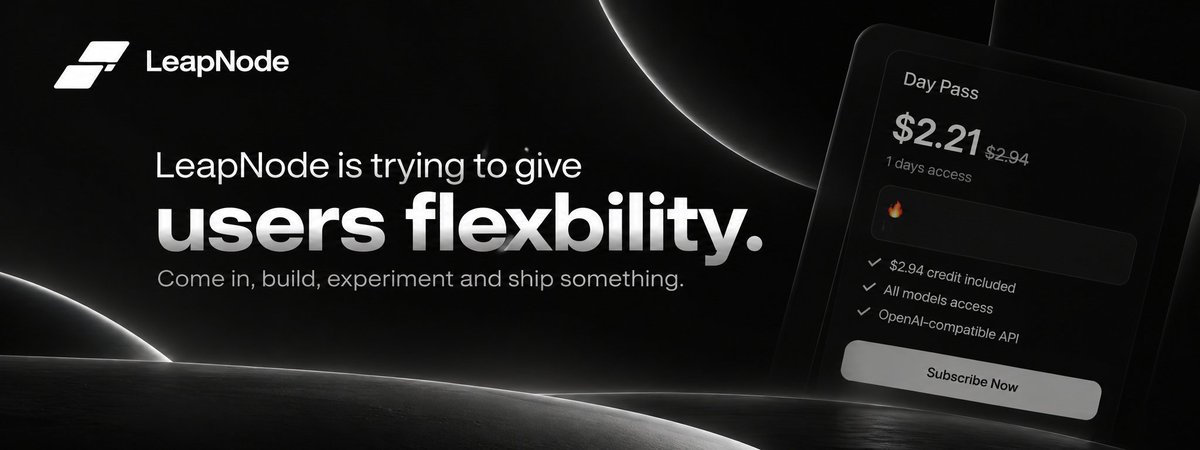
Are you the kind of builder who gets an idea, builds for a day… then doesn’t touch it again for the next 10 days? Then why pay for AI tools you’re barely using every day? Sometimes you just want to sit down, build something simple, test an idea, and move on. That’s the kind of flexibility @Leapnode_AI is trying to make possible. $2.21 for a day of access. Come in. Build. Experiment. Ship something. Then come back whenever you’re ready to build again. Not every builder needs a monthly commitment. Sometimes you just need one good day of building.
Just a thought… What if we host a big hackathon, would y’all all participate?
GM and happy Sunday, builders 🦘 Take a break. Touch some grass. Recharge. 😭 You’ve got another week of building, experimenting and shipping ahead. Enjoy your Sunday. ❤️
Hot take: The hardest part of building with AI might not be the AI anymore. It’s deciding which AI to use. GPT. Claude. Gemini. DeepSeek. Different models. Different strengths. Different APIs. And the crazy part? We’re only getting started. The number of models is going up, the infrastructure around them needs to get simpler. Otherwise, more AI = more headaches. 🦘
@thegreatdeejah An API with different AI models you can choose from and use
Where Is AI Infrastructure Heading? A few years ago, the AI conversation was much simpler. You had a handful of major models, you picked one, connected the API, and started building. That world is disappearing quickly. Look at what is happening now. On Hugging Face alone, the number of public models passed 3 million in August 2026. The Hub added roughly 1.18 million models during 2025, and another ~747,000 in the first 7.7 months of 2026. That works out to roughly 3,000 new public model repositories per day during that period. And these aren’t all doing the same thing. Some models are optimized for complex reasoning. Some are built around coding and agents. Some prioritize speed and lower costs. Others focus on images, video, audio, or multimodal workflows. Even within the same company, we’re seeing this specialization. OpenAI’s current API lineup, for example, separates its models by use case: GPT-6 Astra for demanding reasoning and coding, GPT-6.1 Sol for complex work where cost matters, and GPT-6 Luna for more cost-sensitive, high-volume tasks. Anthropic is doing something similar. Its Claude Opus 5.5 is positioned for complex work and long-running agents, while Claude Sonnet 5.5 is aimed more at everyday tasks, bug fixing, and document creation, with Anthropic saying Sonnet 5.5 is 30%+ faster and up to 30% cheaper than Sonnet 5 for most work. Google is pushing in another direction too. Gemini has expanded beyond a single general-purpose model into different models and experiences for reasoning, speed, multimodality, video generation, and agentic workflows. And this is actually a good thing. It means builders have more tools than ever. But it creates a new problem. How do you actually manage all of this? Imagine you’re building an AI application. One part of your application needs deep reasoning. Another needs fast responses. Another processes thousands of simple requests. Another generates images or video. Another needs an AI agent that can work through a long task. Do you integrate every provider separately? Create different API keys? Learn different SDKs? Maintain different endpoints? Rewrite parts of your application every time a better model comes out? That’s where I think AI infrastructure is heading. Away from making developers choose one model, and toward making it easier to work with many models. The infrastructure layer becomes increasingly important because the models themselves are becoming interchangeable building blocks. You shouldn’t have to rebuild your entire application just because a better model was released yesterday. You should be able to experiment. Try something new. Compare models. Switch when something better fits your use case. And keep building. This becomes even more important as we move toward AI agents. An agent might not need one model for everything. It could use one model for reasoning, another for coding, another for vision, and another for a specific high-volume task. The future isn’t necessarily: One application → One model. It could look more like: One application → Multiple models → Different jobs. And that requires infrastructure that can sit between builders and an increasingly complicated model ecosystem. That’s where @Leapnode_Ai comes in. LeapNode is building that infrastructure layer. Instead of developers having to manage every model provider independently, LeapNode gives them a unified API layer through which they can access multiple AI models. The goal isn’t to tell builders: “Use this one model.” It’s to give builders more freedom to decide: “Which model makes sense for what I’m building?” Because the AI ecosystem isn’t slowing down. More models are coming. More capabilities are appearing. More specialized models are being released. And if this continues at anything close to the current pace, the winning infrastructure won’t be the one that makes the ecosystem look smaller. It’ll be the infrastructure that makes a huge ecosystem feel simple to use. That’s the direction we’re building toward with LeapNode. More models. More possibilities. Less friction.

This video shows how AI models are getting so good and how they are taking jobs from people… Imagine spending 1 hour and 30 minutes making this AI video when a real human will probably spend a day or two just to make this…
Gm Made this video entirely using Claude Opus 5.5 on Leapnode. It took one and half hour to make. You can start making your own videos completely… We are running a $50 giveaway to 10 people to start their building journey…
@0xPrajwal_ Just take $30 and subscribe to Leapnode and enjoy all AI models

Tier2 @tier2_dev
47 Followers 919 Following An AI escalation engineer for infrastructure companies. It probes, cites, and drafts - your engineers keep the approvals.
Big 3olaji 🧗♀... @bigbolajiofoau
1K Followers 2K Following AMBASSADOR🟣 Brand - ME. MEMBER🟣 Porter's Clan|Currency Society. Crypto|Entertainment|Anime Inner Circle- https://t.co/rsTpasaWu1

𝔽𝔼ℝℤ (♞,�... @ferz_erz00
1K Followers 955 Following watch me work my way to the top devrel • creator w: @Raydium • Building with: @Quicknode • Prev: @goldrushdev @Covalent_HQ
Prowler8 @codesam707
4K Followers 2K Following building onchain & everything in between • founder @prowlgadgets • contributor @zinch_app • figuring it out as I go
pupu @AmmarRasla61049
96 Followers 378 Following

Vlad Gerov @vladgerov
184 Followers 414 Following I believe every company will eventually have a brain. 🧠 building Company Brains at Superstate 🧠

Petscope @petscope_
60 Followers 7 Following Snap a dog or cat. PetScope names the breed. $SCOPE on Pons.
Inno @Innofrex
617 Followers 2K Following Spot & Futures Trader | NFT Lover | Memecoin Trader| All about making money!!!

DesiGMI @TTRaidg
997 Followers 3K Following pumpfun : TTRaidg fomo : TTraidg Anime | Donghub | trenchess
၊||၊ Arossj ၊||... @ArokeJob
768 Followers 1K Following “Memecoin raider & meme video creator | Building communities on Solana/Base/Monad | TG mod | DYOR always”.✌️✌️ https://t.co/UVvOReiBGL

AI Explained @AIExplainedHQ
19K Followers 13K Following Helping creators turn AI into content, visuals & income. Systems. Workflows. Leverage.


Philip🦍🩶 @Damilare2Philip
31 Followers 125 Following
Elijah @dreal_elijahh
2K Followers 1K Following Marketing Strategist| Community Growth Maxi| Bull Poster| Bag Worker| Project Advisor| OG Cyberhead for @Cyberiacandy… Love making memes| Art is Life
kiki @kikiyaoying
2 Followers 30 Following

陌此间 @Gr00ve_GG
1 Followers 105 Following
Tracy @Traccieee
1K Followers 1K Following Sharing insights on business, AI, and personal growth. Building in public + breaking down what actually works in SaaS marketing
Học Lê @HcL59514129
0 Followers 2 Following
He_is_Benefit🧃🫧 @Kingdav17279062
145 Followers 388 Following Crypto bull from Lagos🪩 | Hyping💯, memecoin hunter🏹🥷, Solana gem💎|community builder🚀| Open to Web3 collabs/jobs | Let's airdrop the future! #crypto.
Robinhood Army @fanrobinhood
260K Followers 16K Following #Parody Account. Hunting memes & gems on Robinhood Chain • Memes .DM for business. Not associated with @RobinhoodApp .
iamfwangshakx @iamfwangshakk
5K Followers 1K Following medscientist🥼 irl ~ dishing out realtime strategies to grow a more efficient community and project ~building @oddsfolioai
_greatemperor @greatemperor17
993 Followers 3K Following Web3 lover#Defi enthusiast Not giving up!!!

𝐉𝐎𝐄 👑 @JoeOnMotion
6K Followers 5K Following Campus Marketing | Student Growth | IRL Activation Building with @WeBuildAfrica__
Khaleed 💰 @makeclipbag
283 Followers 381 Following
Ayjay 🧃 @ayjaystyle
2K Followers 1K Following i read. I write. I create. Ai x creativity. CPP: https://t.co/dSwCm3DANG
Number 1 @I_im_Number1
234 Followers 350 Following Defi expert/Head Of Marketing/Dev by code. Jesus is coming 👑
Theodore @Theodoore_O1
207 Followers 222 Following Growth strategist . Community Builder. Ambassador .

Rexa @rexa233_dev
2K Followers 239 Following lover of the tek and a couple of $$ that comes with the tek. Builder @gramyNFT_bot
am @Nuts2880
20 Followers 37 Following
Mr. BILLIONS.🦅 @MrBILLIONS134
1K Followers 970 Following |||Project & Campaign Manager ||| Chaos into Strategy || I build growth engines for DAOs, NFT & DeFi through content + community
radahn Guzman @radahn_sun
756 Followers 2K Following just stranger ローンウルフ Basic : Community manager, writer, ambassador,python enjoyer
People&火火 @realTerryLiu
105 Followers 88 Following DAO PhD | Crypto OG since 2015 | Agent Whisperer — bridging 8B humans & 100B agents | 🔥 | All in #Web4
Solar Power @Mohan1552
467 Followers 2K Following 🌞 You like any post of mine you automatically gain a follower Soon a Verified user

soumen saha @SahaSoumen1981
2K Followers 2K Following
DML 🐂 🀄🧭 @DMLDeFi
2K Followers 1K Following Web3 Polymath Thread writer • Prediction Trader • DeFi Cartographer 200x+ contest wins: #GOD #defi #threadcontest
Kosi_Eth.HL @KosiEth
813 Followers 650 Following

VICTOR ONCHAIN ✨ @victoronchain00
1K Followers 1K Following WEB 3 CREATOR|| COMMUNITY BUILDER|| GROWTH STRATEGIST || DM FOR PARTNERSHIP
Michael💰 @Annacoin_
422 Followers 548 Following I'M MICHAEL A PROFESSIONAL DEFI ENTHUSIAST A COMMUNITY MANAGER A COMMUNITY MODERATOR ...HYPEMAN ....RAIDER.. SHILLER e.t.c

Draper Dragon @DraperDragon
4K Followers 206 Following Early-stage cross-border venture capital fund investing in emerging technologies. Ecosystem Fund: @OrionFund
Keep @keepdotcoffee
2K Followers 22 Following Fundraising for AI builders. backed by @Bitquery_io and @Liquid_Capital_ Back a launch — refundable if it misses its price gates.
Liquid Capital @Liquid_Capital_
25K Followers 438 Following Earliest Web3 VC supported 250+ portfolios since 2016, focusing on ETH ecology, Infra, AI, Defi. Our secondary fund is one of the world’s largest ETH holders.

C.E.B.❣ @claudebod
359 Followers 251 Following
Claude Corey @ClaudeCorey
385 Followers 859 Following

Mad2026 @claudecodevn
1K Followers 763 Following
Claude Colp @ClaudeColp
762 Followers 1K Following #solar #engineer, #prodmgmt guy, outdoor enthusiast and musician
Clawed Code @ClawedCode
1K Followers 442 Following 🐈⬛ felinethropic claws | dreaming to fight entropic collapse | prophets not profits | ELusVXzUPHyAuPB3M7qemr2Y2KshiWnGXauK17XYpump
Claude Mude @ClaudeMude
1K Followers 2K Following Consultant Expert sur la planification et la gestion du cycle de projet. Coordonnateur du projet pour autonomisation des femmes #AJAP@ONUFEMMES@WPHF
AIA PasadenaFoothill @AIAPF
1K Followers 799 Following The AIA is the VOICE of the architectural profession and the RESOURCE for its members in service to society.
andrei @AIAgentsBuilder
2K Followers 1K Following Weekly AI agent playbooks → zero bloat | Tactics and micro-agents for makers | Building Prometheons.
Claude Code Community @claude_code
49K Followers 73 Following Community account for sharing ClaudeCode related projects and releases. Views/shares independent from @AnthropicAI positions.
Claude West -Cat Man @claudeone
8K Followers 8K Following Cat lover, past blogger for cats, may the paws be with you. 😺

bee 🐝 @claudeycore
4K Followers 505 Following 24 / i post + rt dark and n|s|f|w content occasionally so please be warned! / FUB FREE /
WONDABOY 💚🇳🇬... @PDAN_101
3K Followers 1K Following ✝️ God First | Will Never Scam U 🤝 Web3 & Trading Since 15 | Content Creator | CM/PM | Marketer | Community Growth | SMM |
Ricky Listing @Ricky_Listing
74 Followers 319 Following Working with listings | Turning ideas into listed assets • Crypto Growth • Web3 Vision,| Open for Collaborations | My Tg https://t.co/xYDFxxuh5c
Franix @Franixweb3
1K Followers 469 Following 𝐖𝐞𝐛𝟑 𝐂𝐫𝐞𝐚𝐭𝐢𝐯𝐞 𝐒𝐩𝐞𝐜𝐢𝐚𝐥𝐢𝐬𝐭 || 𝐖𝐞𝐛 𝐃𝐞𝐯𝐞𝐥𝐨𝐩𝐞𝐫 || 𝐕𝐢𝐝𝐞𝐨 𝐄𝐝𝐢𝐭𝐢𝐧𝐠 || 𝐂𝐨𝐧𝐭𝐞𝐧𝐭 𝐂𝐫𝐞𝐚𝐭𝐢𝐨𝐧
𝙽𝙴𝙾 @dacryptone0
1K Followers 781 Following 𝖈𝖗𝖊𝖆𝖙𝖔𝖗 • 𝖈𝖔𝖒𝖒𝖚𝖓𝖎𝖙𝖞 • 𝖉𝖊-𝖋𝖎 𝖊𝖉𝖚𝖈𝖆𝖙𝖎𝖔𝖓 • 𝖇𝖚𝖎𝖑𝖉𝖎𝖓𝖌 𝖜𝖍𝖊𝖗𝖊 𝖙𝖍𝖊 𝖋𝖚𝖙𝖚𝖗𝖊 𝖎𝖘 𝖍𝖊𝖆𝖉𝖊𝖉 • 𝖈𝖔𝖓𝖙𝖗𝖎𝖇𝖚𝖙𝖔𝖗 @tangentcash
Superteam UK @SuperteamUK
14K Followers 686 Following Incubating and Funding the Next Generation of Frontier Tech Talent in the UK 🇬🇧Trends for United States
You might like


















