LCA on Graphs @LCAonGraphs
Knowledge Graphs and Graph Machine Learning for quantitative sustainable assessments Amsterdam Joined December 2020-
Tweets42
-
Followers53
-
Following1K
-
Likes291

Sufficiently advanced agentic coding is essentially machine learning: the engineer sets up the optimization goal as well as some constraints on the search space (the spec and its tests), then an optimization process (coding agents) iterates until the goal is reached. The result is a blackbox model (the generated codebase): an artifact that performs the task, that you deploy without ever inspecting its internal logic, just as we ignore individual weights in a neural network. This implies that all classic issues encountered in ML will soon become problems for agentic coding: overfitting to the spec, Clever Hans shortcuts that don't generalize outside the tests, data leakage, concept drift, etc. I would also ask: what will be the Keras of agentic coding? What will be the optimal set of high-level abstractions that allow humans to steer codebase 'training' with minimal cognitive overhead?

"Terrible things are happening outside. Poor helpless people are being dragged out of their homes. Families are torn apart. Men, women, and children are separated. Children come home from school to find that their parents have disappeared." Diary of Anne Frank January 13, 1943
I study authoritarianism for a living, so I do not say this lightly: America isn't facing an authoritarian future. America is living an authoritarian present. (A long 🧵) /1
@NotebookLM Absolutely love @NotebookLM. But any chance to see an increase in context windows any time soon? This the main struggle that I keep facing
@osanseviero Organize chats into folders 🗂

The single biggest argument about statistics: is probability frequentist or Bayesian? It's neither, and I'll explain why. Buckle up. Deep-dive explanation incoming.


If you’re an "ML Engineer" and you think “Transformer” just means stacking encoder–decoder blocks and calling it a day, you’re missing the actual mechanism that makes modern AI work. Concept 16: The Transformer Is a Math Engine, Not a “Model Architecture "Most people can implement a Transformer pipeline. Very few can explain why the Transformer works." Let’s break it down properly. 1. The core idea, Transformers = Vector Field Manipulation Every layer of a Transformer applies three mathematical operations: 1. Projection 2. Attention as weighted integration 3. Update via residual fields The Transformer is basically a learned vector field processor. Not a sequence model. Not an architecture choice. It could be called a mathematical engine that maps token representations through a series of controlled linear and nonlinear transformations. 2. Attention is not magic, it is a quadratic form. (Take a minute while reading this part) Self-attention computes: Attention(Q, K, V) = softmax(QKᵀ / √d) V This means: • QKᵀ is a similarity matrix • softmax turns similarities into probability weights • multiplying by V computes a weighted expectation over token values Attention = learnable, data-dependent kernel smoothing. It is a kernel machine inside your neural network. 3. Multi-head attention = multiple kernels in parallel Each head learns a different geometry of similarity. One head may focus on local patterns, another on long-range dependencies, another on syntax, another on semantics. When people say “transformers understand context,” this is what they mean: each head builds a different function approximator. 4. Residual connections are the true backbone Forget attention. Residuals are the reason Transformers train at all if you look at it properly. xₜ₊₁ = xₜ + f(xₜ) This means every layer learns a correction to the current representation. Gradient flow stays stable. Representations evolve smoothly. Without residuals, Transformers collapse. 5. LayerNorm = curvature control Norms scale the Jacobian of each layer. This keeps the singular values of the mapping from blowing up or collapsing. LayerNorm is not cosmetic. It is what ensures the model doesn’t EXPLODE internally. 6. Feedforward layers = feature expansion and contraction The FFN block: FFN(x) = W₂ σ(W₁ x) expands dimension, applies a nonlinearity, then compresses. This lets the model create new features that attention alone cannot express. It acts as a learned universal approximator inside each layer. 7. Why people can code Transformers but not explain them Because coding a transformer is wiring blocks together. Understanding a transformer requires knowing: • attention as kernel regression • softmax as a probability normalizer • LayerNorm as Jacobian control • residuals as stable integration • FFN as feature synthesis • positional encodings as geometric priors • multi-head structure as an ensemble of learned kernels Most people never go beyond surface-level implementation is something I realised when I caught myself trying to work on advanced papers without actually understanding the fundamentals. TL;DR The Transformer works because its math is designed to stabilize gradients, amplify structure, and integrate information the way a continuous dynamical system would. It is not “just an architecture.” It is the most efficient numerical method we’ve found for learning functions over sequences, graphs, and basically anything with structure.

People will write entire ML pipelines based on the transformer model but fold when you ask them how the transformer actually works.

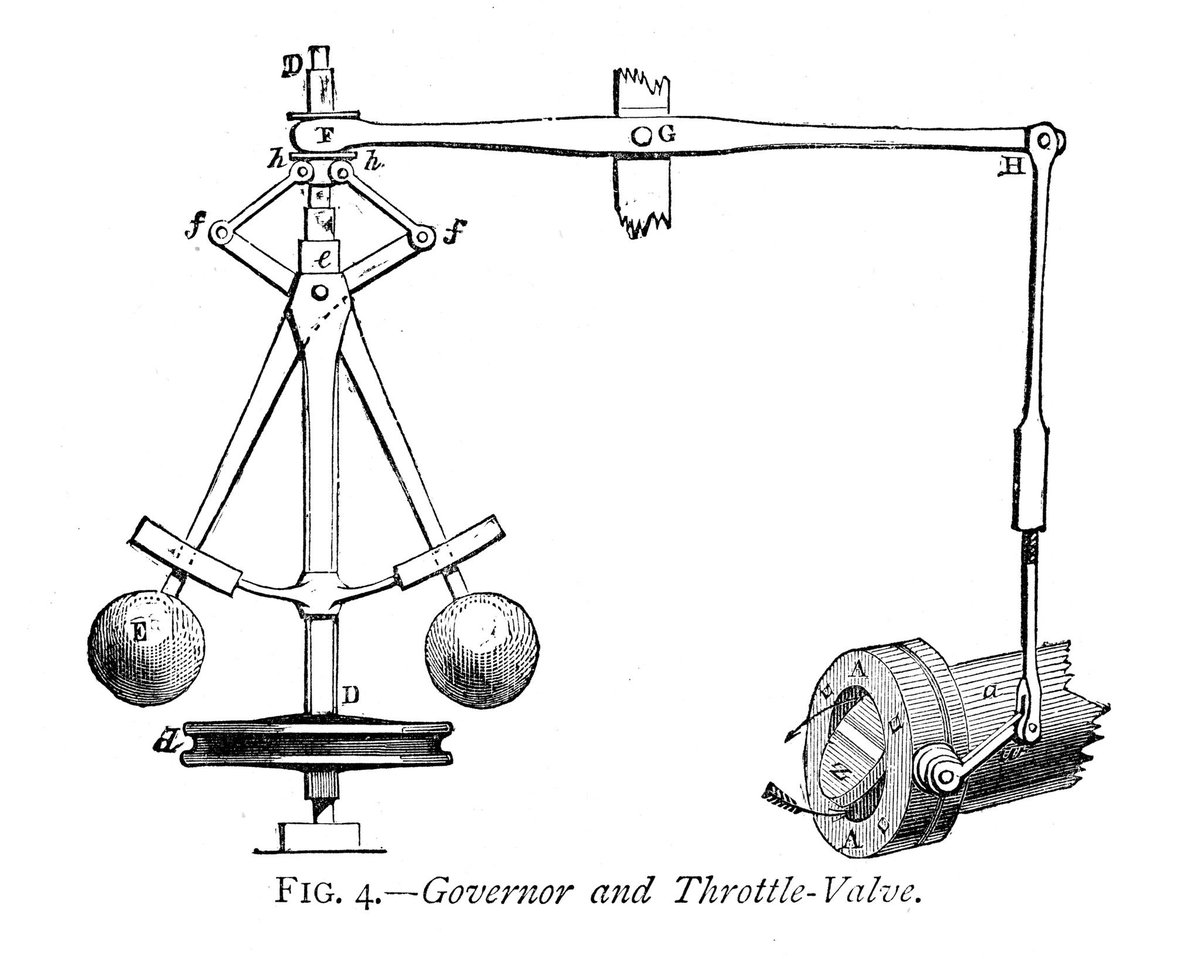
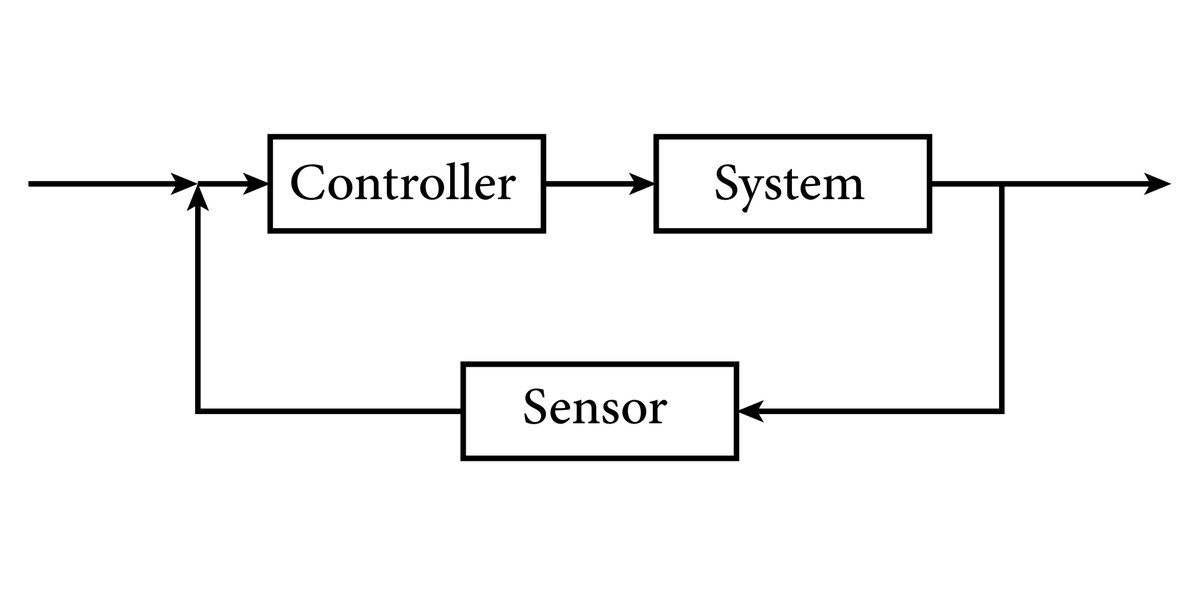
We've become obsessed with the idea that the brain is a "Prediction Machine." The dominant theory in neuroscience says we're constantly simulating the future, calculating probabilities to guess what happens next. A new paper argues this is a complete illusion. The reality is simpler, and strangely, much more powerful. Here is the argument for Perceptual Control: The "Prediction Illusion" starts with a mistake in observation. When we see someone successfully handle a chaotic environment (like catching a flyball), it *looks* like they predicted the future trajectory of the ball. But observing prediction isn't the same as implementing it. The authors use the perfect analogy: The Watt’s Steam Governor. In the 19th century, this device kept steam engines running at a constant speed. If pressure surged, it slowed the engine. If load increased, it sped up. To an observer, it looked like the machine was "predicting" pressure surges and pre-empting them. But the Governor has no brain. It has no model of the future. It’s a mechanical negative feedback loop. [cite_start]It measures the *current* speed, compares it to the *desired* speed, and adjusts the valve immediately[cite: 80]. It doesn't predict; it controls. This brings us to the "Hello" experiment, which broke my brain a little. Researchers asked people to keep a computer cursor on a target. The computer applied a "disturbance" (forces pushing the cursor away) that the person had to fight against with their mouse. Here's the twist: The disturbance wasn't random. [cite_start]It was an invisible force field shaped like the word "hello" (written upside down and mirrored)[cite: 166]. The participants fought the force, keeping the cursor steady. When researchers looked at the participants' hand movements, they had perfectly written the word "hello". Crucially, the participants had NO idea they were writing words. If the brain were a "prediction machine," it would have needed to model the force to predict the hand movement. But the participants wrote a legible word purely by reacting to immediate error signals—instantaneously correcting the cursor's position. This is **Perceptual Control Theory (PCT)**. The theory suggests the nervous system isn't a linear pipeline (Input → Compute → Output). It’s a closed loop. We act to keep our *perception* of the world matching our internal *reference value*. [Image of Perceptual Control Theory negative feedback loop diagram] Think about catching a baseball. If you were a "prediction machine," you’d calculate the ball's trajectory, wind speed, and gravity, then run to where the ball *will* be. But that’s computationally expensive and error-prone. In reality, fielders just run in a way that keeps the "optical velocity" of the ball constant in their vision. If the ball looks like it's rising too fast, they move back. Dropping? They move forward. No physics calculus required. Just maintaining a visual constant. This solves the "Noise" problem. In predictive models, small jitters in your movement are considered "noise" or errors to be filtered out. It’s the system "feeling out" the environment to maintain control. This has huge implications for AI and robotics. We are currently building robots with massive compute power to "predict" stability. But robots built on PCT principles—like inverted pendulums that just react to maintain verticality—are often more robust and stable than the predictive ones. Why does this matter for you? It changes how we view "agency." We often think we need to predict the outcome of our actions to be effective. [cite_start]But the most efficient systems don't predict the outcome—they specify the goal and let the feedback loop handle the rest[cite: 39]. The "Prediction Illusion" suggests we aren't prophets simulating the future. We are controllers, surfing the present. We don't need to know what the wave will do in 10 seconds. We just need to keep the board steady right now. If you want to dig into the paper, it’s "The prediction illusion: perceptual control mechanisms that fool the observer" by Mansell, Gulrez, and Landman (2025). It’s a dense read, but it completely reframes the "Bayesian Brain" debate. One final thought: Next time you're doing something skilled—driving, typing, sports—notice the difference. Are you calculating what comes next? Or are you just managing the gap between *what you see* and *what you want*? You might find you're doing a lot less "thinking" than you assumed.

Many dimensionality reduction algorithms share a few central principles. 1. Construct a graph that captures the data's local structure 2. Measure "geodesic" distances between points using the graph 3. Project the points to a lower dimension while preserving these distances

Frontier AI reasoning systems are now closing the complexity scaling gap between ARC-AGI-1 and ARC-AGI-2 This is surprising, as these same systems also make obvious mistakes on easy tasks (for humans) from ARC-AGI-1. We're not sure why and invite help from the community to study this phenomenon Full solution logs are linked in last tweet

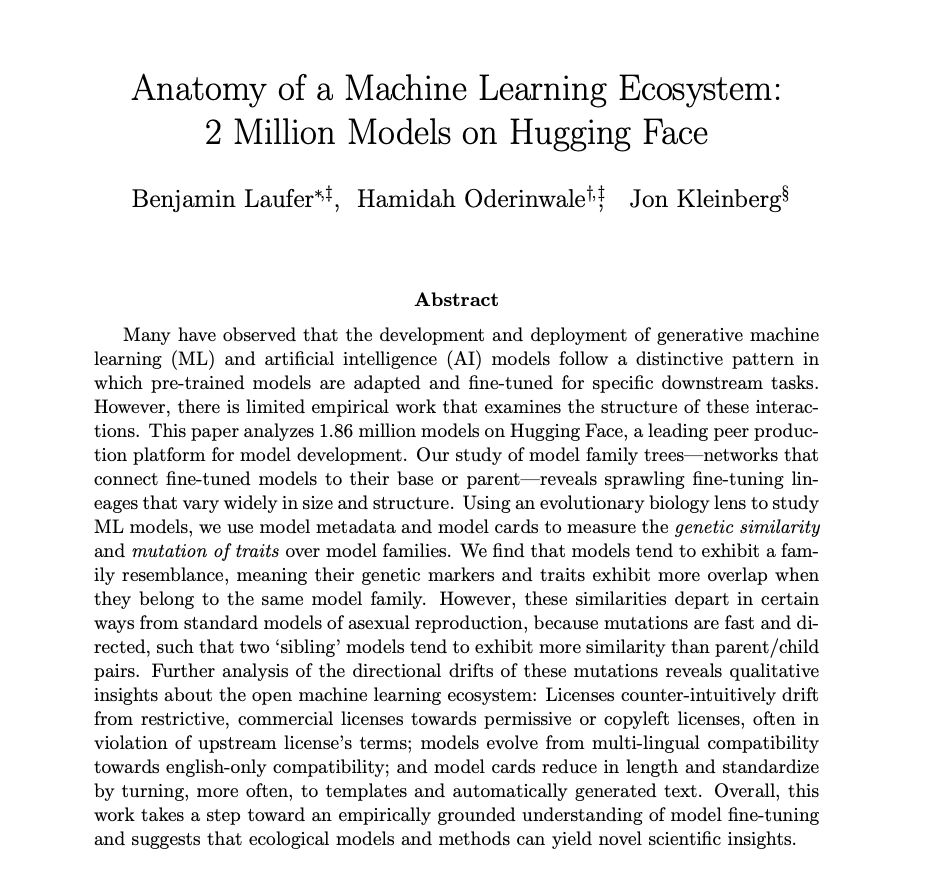
Fun to think about open-source models and their variants as families from an evolutionary biology standpoint and analyze "genetic similarity and mutation of traits over model families". These are the 2,500th, 250th, 50th and 25th largest families on @huggingface:
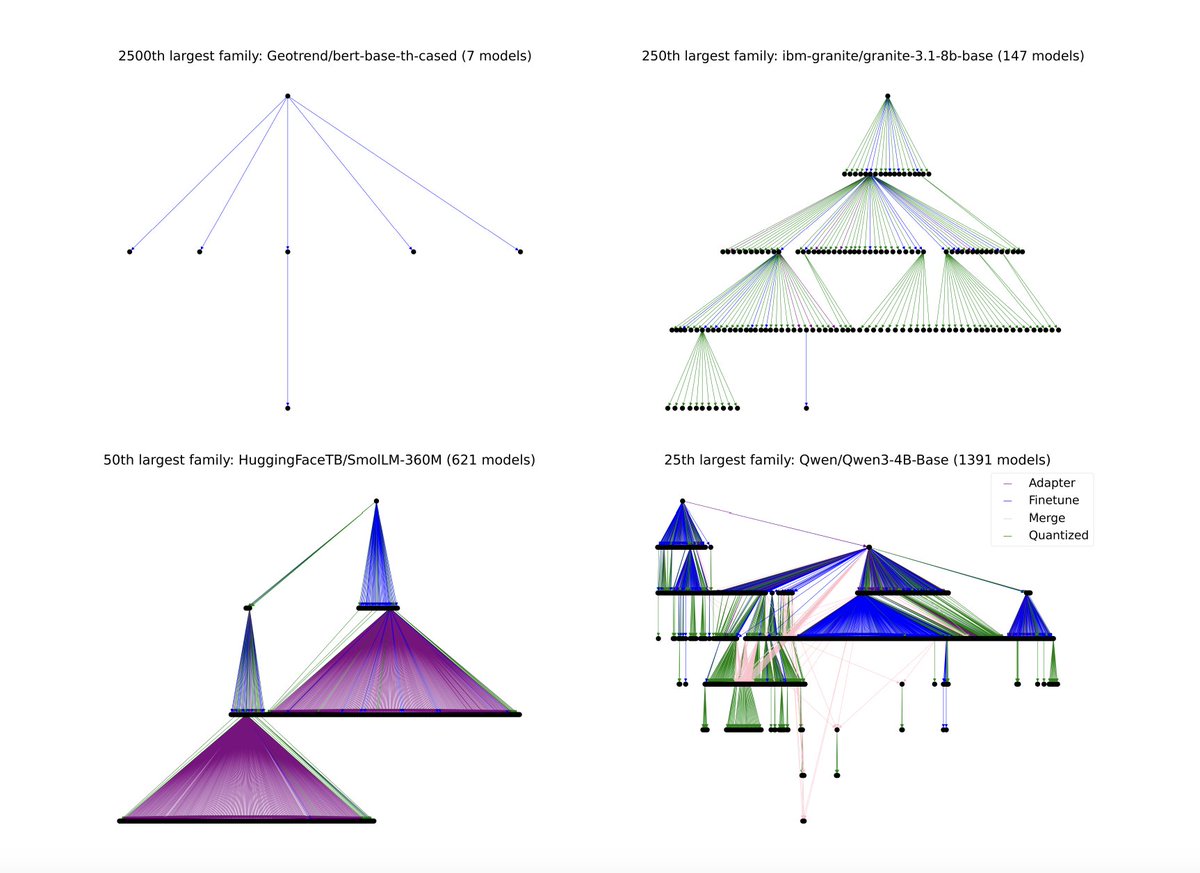

1/ With @BenDLaufer and Jon Kleinberg, we constructed the largest dataset of its kind to date: 1.86M Hugging Face models. In a new paper, we mapped how the open-source AI ecosystem evolves by tracing fine-tunes, merges, and more. Here's what we found 🧵

Huge computer science result: A Tsinghua professor JUST discovered the fastest shortest path algorithm for graphs in 40yrs. This improves on Turing award winner Tarjan’s O(m + nlogn) with Dijkstra’s, something every Computer Science student learns in college.


Our open models are here. Both of them. openai.com/open-models

Today, we're introducing AlphaEarth Foundations from @GoogleDeepMind , an AI model that functions like a virtual satellite which helps scientists make informed decisions on critical issues like food security, deforestation, and water resources. AlphaEarth Foundations provides a powerful new lens for understanding our planet by solving two major challenges: data overload and inconsistent information. 1️⃣ It combines information from dozens of sources to analyze the world's land and coastal waters in 10x10 meter squares, allowing for remarkable precision while tracking changes over time. 2️⃣ The system's key innovation is creating a highly compact summary for each square. These summaries require 16x less storage than those produced by other AI systems and enables scientists to create detailed, consistent maps of our planet, on-demand. AlphaEarth Foundations represents a significant step forward in understanding the state and dynamics of our changing planet. 🌎🌎🌎
iText2KG: an open source Python package designed to incrementally construct consistent knowledge graphs with resolved entities and relations iText2KG v0.0.8 is out, and it can now build dynamic knowledge graphs. iText2KG is a Python package designed to incrementally construct consistent knowledge graphs with resolved entities and relations by leveraging large language models for entity and relation extraction from text documents. It features zero-shot capability, allowing for knowledge extraction across various domains without specific training. The package includes modules for document distillation, entity extraction, and relation extraction, ensuring resolved and unique entities and relationships. It continuously updates the KG with new documents and integrates them into Neo4j for visual representation. Main new features: - iText2KG_Star: Introduced a simpler and more efficient version of iText2KG that eliminates the separate entity extraction step. Instead of extracting entities and relations separately, iText2KG_Star directly extracts relationships from text. This approach is more efficient as it reduces processing time and token consumption and does not need to handle invented/isolated entities. - Facts-Based KG Construction: Enhanced the framework with facts-based knowledge graph construction. It's using the Document Distiller to extract structured facts from documents, which are then used for incremental KG building. This approach provides more exhaustive and precise knowledge graphs. - Dynamic Knowledge Graphs: iText2KG now supports building dynamic knowledge graphs that evolve. By leveraging the incremental nature of the framework and document snapshots with observation dates, users can track how knowledge changes and grows. By Yassir Lairgi. github.com/AuvaLab/itext2… #KnowledgeGraph #AI #OpenSource #EntityResolution #Python #DataScience #LLM #InformationExtraction #RAG #GenAI -- The Year of the Graph's next newsletter on all things Knowledge Graph, Graph Analytics / Data Science / AI and Semantic Tech is due in Autumn 2025. Subscribe and follow to be in the know. Reach out if you'd like to be featured 👇 yearofthegraph.xyz/newsletter

This will be great newgraphperspectives.com.
Building Knowledge Graphs with LLM Graph Transformer #GNN medium.com/data-science/b…
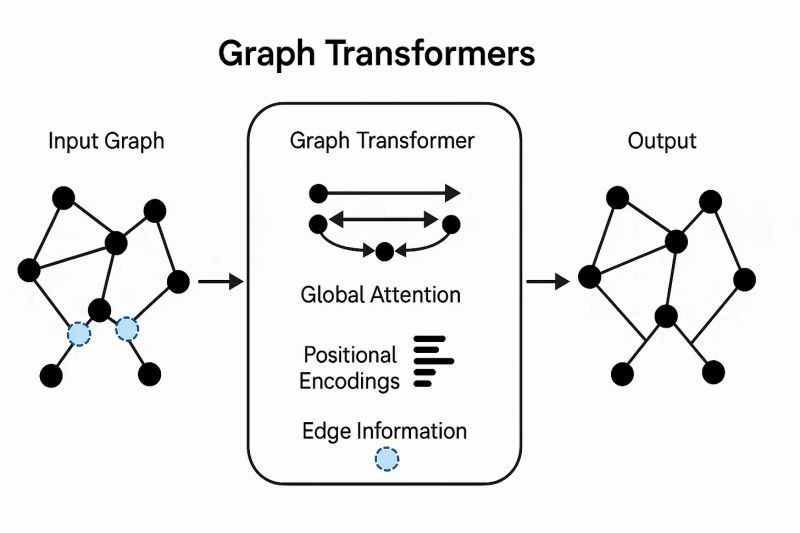
Graph Transformers: From Message Passing to Global Attention Deep learning’s most spectacular successes share the same secret ingredient: an architecture that respects the geometric structure of the data. CNNs thrive because images are grids; LSTMs succeeded at language because sentences can be treated as sequences with long‑range dependencies. Real world systems such as molecules, power grids, social networks and knowledge graphs live on graphs which are irregular spaces where neither grids nor sequences offer much guidance. Graph Neural Networks (GNNs) were the first general‑purpose attempt to learn on such domains. They delivered impressive results, but as datasets and ambitions grew, the field ran into fundamental bottlenecks. At their core, many GNNs operate on a principle called message passing. While effective, this reliance on local message passing creates some fundamental challenges, especially when dealing with large, complex graphs. These issues can be described with a traffic analogy: * Over-squashing is like being stuck in traffic - the information just can't get through efficiently. * Over-smoothing is like being lost in traffic - everything starts to look the same. Graph transformers are an architecture proposed to alleviate the problems with MP-GNNs. Instead of passing messages between neighbours, the idea is to directly model the dependence between any two nodes in the graph. A graph transformer applies full transformer architecture to update the embeddings of a node. This means using the standard transformer block into a graph neural network framework, making a more direct and faithful generalization of the original architecture. The core challenge, however, is that a standard transformer is oblivious to the underlying structure of the graph. How do we inform the model about which nodes are close and which are far apart? Different graph transformer architectures differ in how they leverage graph structure along with the global attention and how they design positional encodings: * Laplacian Positional Encoding * Spectral Attention Networks * SigNet and BasisNet Applications of Graph Transformers * Drug Discovery and Molecular Biology * Physics Simulation * Recommender Systems * Traffic and Route Prediction The journey of graph representation learning is one of escalating ambition. The evolution is far from over, and the future of graph AI promises to be even more deeply connected. By @JanuVerma januverma.substack.com/p/graph-transf… #AI #GNN #Transformer #MachineLearning #DeepLearning #EmergingTech #DataScience -- The Year of the Graph is back with regular updates, and a forthcoming Autumn 2025 newsletter issue on all things Knowledge Graph, Graph Analytics / Data Science / AI and Semantic Tech. Subscribe and follow to be in the know. Reach out if you'd like to be featured 👇 yearofthegraph.xyz/newsletter
Physicists and mathematicians really have the wriest humor.


Edith @Edith485301
4 Followers 198 Following
Ntaks Ntandoe @ntaks_ntandoe
1K Followers 6K Following
Gabriella @u57975Kc4klwB7
167 Followers 6K Following


JosephineCharlotte @jbf016CsiS9Oj
32 Followers 1K Following Adventuring through life with a camera in hand.
Sibyl @R0cXq50nw2376
29 Followers 817 Following
Leilani @5A3UyEYUfRWLN
36 Followers 848 Following

リターンの探検... @Seetui47521
66 Followers 2K Following 【完全無料】 25年の株式投資プロチーム(運用資産500億円以上)が提供:毎日の市場分析レポート + 優良成長株のピックアップ。プロの情報を無料で。まずはお気軽にお問い合わせください。
Mihaly Hanics @HanicsResearch
183 Followers 656 Following @dnds_ceu Data Science MSc; network/graph data science research. Developer interested in graphs, Complexity Science, ML; creator of PainterPalette dataset
Qitian Wu @qitianwu_
94 Followers 110 Following Postdoc at Broad Institute of @MIT and @Harvard, CS PhD @sjtu1896, working on scalable and generalizable machine learning
Mocir @Mocir8394583
5 Followers 666 Following
Whesoux @Whesoux307186
17 Followers 688 Following
Ovihea @Ovihea114
7 Followers 292 Following
Quoudi @Quoudi302
31 Followers 1K Following
aiia @aiia_ro
24K Followers 5K Following building the discovery and trust layer for autonomous agents. making AI agents discoverable, trusted, and connected. all free, all open.
Jaim @novo_pinho
3 Followers 1K Following
Alfwule @Alfwule047131
39 Followers 2K Following
Andrew Curran @AndrewCurran_
53K Followers 18K Following 🏰 - I write about AI, mostly. Expect some strange sights.
iDEGEN Official Suppo... @idegennsupport
37 Followers 545 Following The Al-off begins: @ iDEGEN_AI VS @ idegen_deepseek 100% Al. CA: CyWGEiPFeKCFHvbie54Kuu7RgM86HBqkQBbLPRLRu nD5 Al Born. Degen Raised.
Theallat @TheallatjPURye
37 Followers 4K Following
Toughth @ToughthTSG
52 Followers 4K Following
Byple @Byple_0A
44 Followers 4K Following
Wendy @teateson56348
78 Followers 7K Following Life is like a box of chocolates, you never know what you are going to get.
HuldaCarllyle @CcECEAlPX4bU1
69 Followers 6K Following
Peydea @Peydea123241
69 Followers 7K Following A strong woman is one who is determined to do what others are determined not to do.
. @t33dPhscn3vFQ
34 Followers 3K Following
Shussed @Shussed165909
78 Followers 7K Following
Make money easily @9Db8xwNg2E4Vop
13 Followers 527 Following MEXC focuses on financial management, stocks, cryptocurrencies, digital assets and investments. Currently, new users can get free dollars when they sign up.
MatthewEvanLewis @pracwis
1K Followers 3K Following Native New Yorker; Father, CEO, American, Man of Faith.
Onyema Ozioma Wisdom @ozioma_onyema
7 Followers 118 Following
Cohere @coherenetwork
3K Followers 2K Following Accelerating the expansion of a curated network of coliving communities. #coliving with a purpose Become a member ⌽ List your property ⌽ Live your dream
Kateryna @Kateryn86308120
3 Followers 105 Following
VLACS @VLACS
42K Followers 35K Following We believe in providing students with the opportunity to determine when, where, and how to learn based on their needs, interests, and talents.
The Tru Gary Lavoie @TheTruGary
201 Followers 1K Following Bitcoin enthusiast. Chairman - INA. Insurance’s first utility token designed to rebuild trust between carriers, employers, and workers. Wiffle Ball Champ.
Geeks Without Frontie... @GeeksWF
959 Followers 4K Following Geeks Without Frontiers' goal is to positively impact the lives of 1 billion people in the next 10 years through the use of sustainable technological solutions.
Md. Faruk Ahammed @ahammed015
941 Followers 4K Following Corona update, Covid 19 reporter, Online Money Making, Freelancing, Content Marketing, Advertising, Microworkers
VOICE Talks @VoiceTalksAI
896 Followers 377 Following VOICE Talks is the fastest-growing internet show for #voicetech and a 2021 #WebbyAward winner. Sign up (link in bio). Use #voicetalks to join the conversation.
Codex @codexeditor
7K Followers 8K Following A developer on a journey to build a FOSS, local-first, block-based knowledge workspace using standoff markup & hypergraphs. INTJ. 🦋 https://t.co/XRknP9ZrTD
DataFest Tbilisi @DataFestTbilisi
1K Followers 1K Following We organize the greatest data festival on the crossroads of Europe and Asia! Join us and help us spread the love for data!
JANNAT-UL-FERDOUS @JANNATU87927120
883 Followers 4K Following I am, SURAVEE . FREELANCER, Worked as a Digital Marketer on Fiverr, Freelancer and Upwork marketplace. You can hire me as personal or remote. https://t.co/t4HZhIucRN.
Maria Luciana Axente @maria_axente
15K Followers 8K Following Founder and CEO #ResponsibleIntelligence
Bojan Tunguz @tunguz
286K Followers 8K Following Founder and CEO @tabul_ai. Creator of @trainxgb. ML ex Nvidia. Data Scientist. Physicist. Catholic. Husband. Father. Stanford Alum. Memelord. e/xgb. AMDG.
EU Chatbot & Conversa... @EuropeanChatbot
614 Followers 782 Following Connecting you with customers & Accelerating the adoption of CAI in the EU market. #conversationalAI #voice #chatbots #virtualassitant #generativeai #euchatbot
Pete Haas @PeteHaas
2K Followers 1K Following CTO - WellSaid AI. Enthusiastic builder of interactive experiences using voice as a 1st class modality. #voiceai #conversationalai
frankpasquale.bsky.so... @FrankPasquale
32K Followers 17K Following Books: 2015: The Black Box Society https://t.co/POr6zLDCnQ 2020: New Laws of Robotics: https://t.co/mrmglbJQKl
Mark Minevich @MMinevich
20K Followers 19K Following I sit in the rooms where AI policy gets made. Sovereign govts, global boards, top funds. I share what I see here. Startup investor w/exits. Fortune · Forbes
Dobrik Georgiev @DobrikG
289 Followers 231 Following
Epoch AI @EpochAIResearch
46K Followers 0 Following Investigating the trajectory of AI for the benefit of society.
David Louapre @dlouapre
5K Followers 267 Following ML/AI scientist @huggingface 🤗 · Creator of @sciencetonnante (1.5M YouTube subs) 🎥 PhD in quantum gravity 🎓 · ex-Scientific Director @Ubisoft 🎮

Google Research @GoogleResearch
95K Followers 17 Following Impossible? Let’s see. From algorithms to neuroscience to AI, Google Research strives to progress science, advance society & improve billions of people’s lives.
Ravid Shwartz Ziv @ziv_ravid
12K Followers 3K Following AI researcher | Meta | NYU. Working on compression, representation learning, and memory. I have an AI podcast! https://t.co/Bzzp2Oq4Cc
alex zhang @a1zhang
35K Followers 921 Following phd student @mit_csail @nlp_mit, previously undergrad @princeton 🫵🏻 go participate in the @GPU_MODE kernel competitions!
Timothy Nguyen @IAmTimNguyen
12K Followers 463 Following Machine learning researcher at @GoogleDeepMind & mathematician. Host of The Cartesian Cafe podcast. All opinions are my own.
Hieu Pham @hyhieu226
46K Followers 23 Following Something new 🇻🇳 | ex: @openai, @xai, @augmentcode, @GoogleBrain, @LTIatCMU, @Stanford, ACM ICPC, IMO🥈 Opinions are my own.
Mihaly Hanics @HanicsResearch
183 Followers 656 Following @dnds_ceu Data Science MSc; network/graph data science research. Developer interested in graphs, Complexity Science, ML; creator of PainterPalette dataset
Akari Asai @AkariAsai
22K Followers 935 Following Incoming Assistant Professor @SCSatCMU (Hiring Ph.D. students for Fall 2026) & research scientist @allen_ai OLMo. akariasai @ 🦋
Percy Liang @percyliang
106K Followers 426 Following professor of computer science @Stanford @stanfordnlp, co-founder of @togethercompute, creator of https://t.co/7R5THVogW2, co-founder of @simile_ai, pianist

Machine Learning (ML)... @Memoirs
12K Followers 9 Following New Machine Learning (ML) papers from https://t.co/2YQxOWj18P: supervised, unsupervised. Thank you to arXiv for use of its open access interoperability.
Theofanis Karaletsos @Tkaraletsos
5K Followers 2K Following co-founder https://t.co/TIpJn8YQlg building microscopic world models for atomistic simulation | prev Head of AI @cziscience | probabilistic and deep ML
Qitian Wu @qitianwu_
94 Followers 110 Following Postdoc at Broad Institute of @MIT and @Harvard, CS PhD @sjtu1896, working on scalable and generalizable machine learning
Nikolay Savinov @SavinovNikolay
3K Followers 0 Following Research Scientist at @GoogleDeepMind Work on LLM pre-training in Gemini ♊ Lead 10M context length in Gemini 1.5 📈
Maya Bechler-Speicher @mayabechlerspei
2K Followers 106 Following AI Research Scientist@Meta, CS PhD@TAU, Lecturer of "Machine Learning with Graphs"@ CS-TAU, Mathematician.
Juan Reutter @JuanLReutter
319 Followers 19 Following Assoc. Prof. at PUC Chile, researcher at IMFD.
İsmail İlkan Ceylan @ismaililkanc
607 Followers 216 Following Associate Prof at TU Vienna, Adjunct PI at AITHYRA, Associate Member @UniofOxford | Research on Graphs, Geometry, AI4Science
Xingyue Huang @hxyscott
350 Followers 170 Following 3rd Year DPhil in Computer Science, University of Oxford. I like Graph neural networks, knowledge graphs, and graph representation learning in general.
NeurIPS Europe Confer... @EurIPSConf
1K Followers 58 Following NeurIPS Europe is a official satellite event where you can present papers accepted at @NeurIPSConf To become sponsor: [email protected]
Jiahui Yu @jhyuxm
19K Followers 1K Following Lead Multimodal @Meta Superintelligence Lab. Previously led Perception @OpenAI; co-led Gemini Multimodal @GoogleDeepMind.
Jack Rae @jack_w_rae
24K Followers 539 Following Distinguished Scientist @ Meta LLMs (e.g. Gopher, Chinchilla, Gemini, Muse) Compression & RL ☯️ Past: Google, OpenAI, Quora
Hongyu Ren @ren_hongyu
22K Followers 714 Following research @meta superintelligence. CS PhD @stanford. prev @openai.
Shuchao Bi @shuchaobi
13K Followers 813 Following Research at Meta Superintelligence Labs, RL/post-training/agents; Previously Research at OpenAI on multimodal and RL; Opinions are my own.
Trapit Bansal @TrapitBansal
31K Followers 280 Following AI Research @Meta, Founding Member TBD Lab | Previously @OpenAI, co-creator of OpenAI o-series models (thinking in LLMs)
Alexander Novikov @SashaVNovikov
5K Followers 179 Following Research scientist at Google DeepMind. Opinions are my own.
Ben Finkelshtein @benfinkelshtein
221 Followers 91 Following PhD student at @UniofOxford site: https://t.co/urX8Ei1ct8
Unstructured @UnstructuredIO
6K Followers 152 Following Stop dilly-dallying. Get your data. 👉🏼 Get Started: https://t.co/7Phj5PbxNU

Efstratios Gavves @egavves
3K Followers 584 Following Associate Professor & Co-Founder - Dynamical Deep Learning
CuspAI @cusp_ai
6K Followers 52 Following Pioneering breakthrough materials to accelerate human progress.
Erik Bekkers @erikjbekkers
5K Followers 1K Following Associate Prof @AmlabUva @UvA_Amsterdam in Geometric DL 🧐 Ideal Machine Intelligence 🌱 @ELLISforEurope Scholar & Director 🇪🇺 Research Fellow @newtheoryai 🌐
UvA AMLab @AmlabUva
3K Followers 84 Following The official account of the Amsterdam Machine Learning Lab (AMLab) @UvA_Amsterdam, co-directed by Max Welling (@wellingmax) and Jan-Willem van de Meent (@jwvdm)
NotebookLM @NotebookLM
250K Followers 16 Following Think smarter, not harder. Meet your brain's new best friend 📒
Onto-DESIDE @OntoDESIDE
60 Followers 24 Following Ontology-based Decentralized Sharing of Industry Data in the European Circular Economy (Onto-DESIDE) - EU Horizon Europe Project 2022-2025
Connected Data @Connected_Data
7K Followers 2K Following Connecting Data, People & Ideas since 2016. Using relationships, meaning, context in Data to achieve great things #KnowledgeGraph #GraphDB #AI #SemTech
Sci-K @ ISWC2025 @scik_workshop
382 Followers 362 Following 5th International Workshop on Scientific Knowledge: Representation, Discovery, and Assessment (Sci-K) co-located @iswc_conf 2025 in Nara, Japan
Ian Ozsvald @ianozsva... @ianozsvald
4K Followers 292 Following Chief Data Scientist at https://t.co/P8uNdla4GM, PyDataLondon co-org, O'Reilly High Performance Python, https://t.co/rwbvksPx8c,


SEMANTiCS Conference @SemanticsConf
4K Followers 2K Following SEMANTiCS conference is the meeting place for professionals who make semantic computing work, and understand its benefits and know its limitations.

Boshi Wang @BoshiWang2
2K Followers 521 Following Fourth-year Ph.D. @OhioState. Prev intern @MSFTResearch
Guillermo Barbadillo @guille_bar
1K Followers 279 Following In a quest to understand intelligence @Ndea
Shashank Prasanna @shshnkp
3K Followers 207 Following AI/ML Technologies Evangelist (@apple). MLX, CoreML, Foundation Models. Formerly Product+DevRel @pytorch, @awscloud, @nvidia, @matlab My own opinions ↓

Nikhil Thorat @nsthorat
12K Followers 2K Following research tools @anthropicai. prev: genai evals @ databricks, cofounder @lilac_ai (acq by @databricks). cocreated tensorflowjs + know your data @ google brainYou might like