Meet Shah @Curiousmeet
Joined October 2018-
Tweets41
-
Followers3
-
Following237
-
Likes88
@ai4bharat @iitmadras Are there plans to add models from India like sarvam chat sutra etc. in here because that would be awesome.

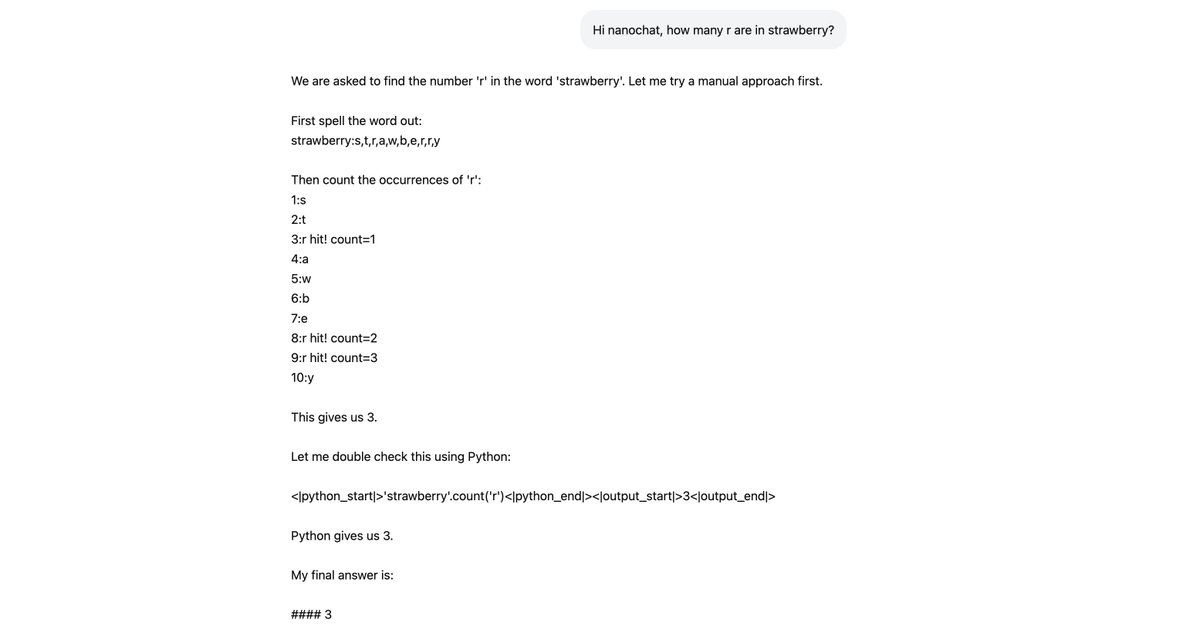
Last night I taught nanochat d32 how to count 'r' in strawberry (or similar variations). I thought this would be a good/fun example of how to add capabilities to nanochat and I wrote up a full guide here: github.com/karpathy/nanoc… This is done via a new synthetic task `SpellingBee` that generates examples of a user asking for this kind of a problem, and an ideal solution from an assistant. We then midtrain/SFT finetune on these to endow the LLM with the capability, or further train with RL to make it more robust. There are many details to get right especially at smaller model sizes and the guide steps through them. As a brief overview: - You have to ensure diversity in user prompts/queries - For small models like nanochat especially, you have to be really careful with the tokenization details to make the task easy for an LLM. In particular, you have to be careful with whitespace, and then you have to spread the reasoning computation across many tokens of partial solution: first we standardize the word into quotes, then we spell it out (to break up tokens), then we iterate and keep an explicit counter, etc. - I am encouraging the model to solve the model in two separate ways: a manual way (mental arithmetic in its head) and also via tool use of the Python interpreter that nanochat has access to. This is a bit "smoke and mirrors" because every solution atm is "clean", with no mistakes. One could either adjust the task to simulate mistakes and demonstrate recoveries by example, or run RL. Most likely, a combination of both works best, where the former acts as the prior for the RL and gives it things to work with. If nanochat was a much bigger model, you'd expect or hope for this capability to more easily "pop out" at some point. But because nanochat d32 "brain" is the size of a ~honeybee, if we want it to count r's in strawberry, we have to do it by over-representing it in the data, to encourage the model to learn it earlier. But it works! :)

Today we launched Tinker. Tinker brings frontier tools to researchers, offering clean abstractions for writing experiments and training pipelines while handling distributed training complexity. It enables novel research, custom models, and solid baselines. Excited to see what people build.

Introducing Tinker: a flexible API for fine-tuning language models. Write training loops in Python on your laptop; we'll run them on distributed GPUs. Private beta starts today. We can't wait to see what researchers and developers build with cutting-edge open models!


After an incredible response in Labs, we’re starting to roll out AI Mode in Search to everyone in India (English to start). It’s a total reimagining of Search, and we’re excited for even more people to use it.

happy July 4th! Ollama is celebrating by building.

@AskPerplexity how many dra centers does Microsoft google and Amazon have in India
@grok @AskPerplexity @AskPerplexity still no reply from you
@AskPerplexity can you generate a video of a person generating electricity from heat coming out of the data center.

📣 Announcing Delta Lake 4.0.0! We are excited to announce the release of Delta Lake 4.0! 🎉 This major release is packed with powerful new features and improvements designed to make your lakehouse experience even better. 🚀 Release Highlights 🌟 𝗣𝗿𝗲𝘃𝗶𝗲𝘄: 𝗖𝗮𝘁𝗮𝗹𝗼𝗴-𝗠𝗮𝗻𝗮𝗴𝗲𝗱 𝗧𝗮𝗯𝗹𝗲𝘀 Native support for catalog-integrated lakehouse tables—laying the foundation for unified governance and discoverability. 🌟 𝗗𝗲𝗹𝘁𝗮 𝗖𝗼𝗻𝗻𝗲𝗰𝘁 𝗳𝗼𝗿 𝗦𝗽𝗮𝗿𝗸 𝗖𝗼𝗻𝗻𝗲𝗰𝘁 Delta Connect is an extension for Spark Connect which enables the usage of Delta over Spark Connect, allowing Delta to be used with the decoupled client-server architecture of Spark Connect. 🌟 𝗩𝗮𝗿𝗶𝗮𝗻𝘁 𝗗𝗮𝘁𝗮 𝗧𝘆𝗽𝗲 Support for the Variant data type to enable semi-structured storage and data processing, for flexibility and performance. 🌟 𝗜𝗻𝘀𝘁𝗮𝗻𝘁 𝗗𝗥𝗢𝗣 𝗙𝗘𝗔𝗧𝗨𝗥𝗘 Remove table features without truncating your table’s history or requiring downtime. Delta Lake 4.0 is a major leap forward for the open lakehouse community, offering advanced management, greater flexibility, and modern architecture. 🔗 Check out the official release notes: github.com/delta-io/delta… #opensource #oss #deltalake #linuxfoundation

New short course: DSPy: Build and Optimize Agentic Apps DSPy is a powerful open-source framework for automatically tuning prompts for GenAI applications. In this course, you'll learn to use DSPy, together with MLflow. This is built in partnership with @databricks and taught by @ChenMoneyQ, co-lead of the DSPy framework. Many AI builders spend hours hand-tuning prompts. When given a set of evals, DSPy automates this process. It’s especially useful for optimizing prompts, including few-shot prompts, in complex agentic AI workflows. Further, if you switch an application to a newer LLM, performance can degrade if your prompts were optimized to the previous model. DSPy automatically optimizes the entire system for the new LLM as well, using just a few evaluation examples. This course teaches DSPy works, and best practices for using it. You’ll write programs using DSPy’s signature-based programming model, debug them with MLflow tracing -- to gain visibility into how different parts of a pipeline, as well as how the overall system, are performing -- and automatically improve their accuracy with DSPy Optimizer. Please sign up here: deeplearning.ai/short-courses/…

In the wake of the recent terrorist attack in Pahalgam, the urgency to fortify India’s borders—both physical and digital—has never been clearer. It was an absolute honor to participate in the AIFSS 2025, sharing the stage with the Hon’ble Attorney General of India, Shri R. Venkataramani, and contributing to the visionary roadmap laid out by the Hon’ble Home Minister, @AmitShah Shri Amit Shah. 🙏 TWO AI team and I personally remain deeply committed to harnessing the power of AI to strengthen India’s cybersecurity infrastructure and national resilience. Ministry Of Home Affairs (mha), GOI National Forensic Sciences University (NFSU) TWO AI Grateful to the Ministry Of Home Affairs (mha), GOI and National Forensic Sciences University (NFSU) for the opportunity and warm invitation.

TWO AI CEO Pranav Mistry (@pranavmistry) addressed delegates at #AIFSS2025 in New Delhi, highlighting the role of AI in strengthening India's cybersecurity. #AI #AIFSS #SUTRA by TWO AI
@AskPerplexity How can llm accomodate large contexts from delta tables?
@AskPerplexity , when will we have Identity insert in delta tables in Azure Synapse/fabric spark?
@AskPerplexity , tell me good resources to learn pdf data extraction using llm with lower hallucinations?
Both #SUTRA models SUTRA-V1 and SUTRA-R0 leads inference cost performance benchmarks (Tokens/word) beating #GPT #Deepseek #Llama and almost all others.
SUTRA is #1 in Indian Language AI 🇮🇳 🌟 A recent independent study evaluating tokenization across India's 22 official languages has shown that SUTRA's tokenizer outperforms other Large Language Models (LLMs), including those specifically designed for Indic languages. SUTRA

Today, we are infusing the power of agentic AI into the GitHub Copilot experience, elevating Copilot from pair to peer programmer 🤖 (1/4) github.blog/news-insights/…

find it here: arxiv.org/abs/2501.09223



Hussein Nasser @hnasr
89K Followers 640 Following Backend and Database Courses https://t.co/Qonec4YftL YouTube https://t.co/FfDg8cnVCI Author of Root Cause https://t.co/x5hQ6JCIcw Engineer @esri



Omar Shahine @OmarShahine
12K Followers 802 Following 🦞 Microsoft Scout (OpenClaw + Microsoft 365), Corporate Vice President @ Microsoft. I write a newsletter on products https://t.co/yMgREYoPcG & https://t.co/fXWpvLkJ4q
Hoifung Poon @hoifungpoon
3K Followers 417 Following Generative AI for Precision Health Real-World Evidence (RWE)
Alexandr Wang @alexandr_wang
503K Followers 858 Following chief ai officer @meta, founder @scale_ai. rational in the fullness of time
ThePrimeagen @ThePrimeagen
368K Followers 1K Following skill issues: 🟩⬛️⬛️⬛️⬛️⬛️(69/420) https://t.co/TYJ6aSq4O0 https://t.co/wQJlh4stsc https://t.co/wxeJWY8LmI
Riley Goodside @goodside
213K Followers 3K Following Screenshots of chatbots since 2022. Formerly: Google DeepMind, Scale
Rowan Cheung @rowancheung
592K Followers 563 Following Founder of the world’s most read daily AI newsletter @therundownai. Sharing the latest developments in the world of artificial intelligence.
Midjourney @midjourney
418K Followers 0 Following A community supported research lab - exploring new mediums of thought and amplifying the imaginative powers of the human species.

Ethan Mollick @emollick
361K Followers 586 Following Professor @Wharton studying AI, innovation & startups. Democratizing education using tech Book: https://t.co/CSmipbJ2jV Substack: https://t.co/UIBhxu4bgq
François Chollet @fchollet
697K Followers 825 Following Co-founder @ndea. Co-founder @arcprize. Creator of Keras and ARC-AGI. Author of 'Deep Learning with Python'.
@levelsio @levelsio
901K Followers 3K Following 📸https://t.co/lAyoqmSBRX $100K/m 🛰https://t.co/ZHSvI2wjyW $44K/m 🎮https://t.co/jFirUbDgtZ $39K/m 🏡https://t.co/1oqUgfD6CZ $35K/m 👙https://t.co/RyXpqGuFM3 + @X $14K/m 🌍https://t.co/UXK5AFqCaQ $10K/m 💾https://t.co/T74ZwJ1F0C $0/m
Sarvam for Developers @SarvamForDevs
8K Followers 3 Following Helping devs build with @SarvamAI Docs → https://t.co/qsYvHDrgGU Support → https://t.co/sNlmydLOMv
NVIDIA AI Developer @NVIDIAAIDev
111K Followers 387 Following This account is inactive. Follow @NVIDIAAI for the latest updates.
Sebastien Bubeck @SebastienBubeck
77K Followers 1K Following I work on AI at OpenAI. Former VP AI and Distinguished Scientist at Microsoft.

OpenClaw🦞 @openclaw
540K Followers 24 Following The AI that does things. Emails, calendar, home automation, from your favorite chat app. Your machine, your rules. New shell, same lobster soul. 🦞
Oryon @Oryonfinance
4K Followers 19 Following Real world stocks, tokenized for 24/7 trading and on-chain yield, the way markets should work.
RedboxGlobal India @REDBOXINDIA
432K Followers 106 Following Indian Financial Audio news via @FirstSquawk Covering Indian breaking News Real time
supermemory @supermemory
26K Followers 44 Following The memory and context cloud for AI agents https://t.co/9JWFW4cHXH
Microsoft Design @MicrosoftDesign
149K Followers 872 Following Stories from the thinkers and tinkerers at Microsoft. Sharing sketches, designs, and everything in between 🎨
Open at Microsoft @OpenAtMicrosoft
86K Followers 9 Following All things #OpenSource at Microsoft https://t.co/4V3rben8iJ
Lip-Bu Tan @LipBuTan1
31K Followers 38 Following CEO of Intel Corporation, Chairman of Walden International, Founding Managing Partner of Walden Catalyst Ventures
Microsoft News and St... @MSFTnews
782K Followers 2K Following News and stories directly from Microsoft.
QVAC @qvac
8K Followers 2 Following Infinite intelligence. Local. Any Hardware. Peer-to-Peer Hyper Swarm. No cloud. No compromise. QVAC is the decentralized AI platform for humans and machines.
Databricks AI Researc... @DbrxMosaicAI
50K Followers 120 Following We remove the barriers to state-of-the-art generative AI model development and make data + AI available to all.

Xiao Ma @infoxiao
19K Followers 4K Following just an RL-pilled girl. prev: gemini @googledeepmind. views are mine.
Arena.ai @arena
168K Followers 215 Following Where AI meets the real world. Formerly LMArena. We measure and advance the frontier of AI through community-driven evaluation. We’re hiring → https://t.co/XBZCrseaWF
Visual Studio @VisualStudio
535K Followers 11 Following The most comprehensive IDE for .NET and C++ devs on Windows. It's packed with a sweet array of tools to elevate every stage of software development.

Microsoft Visual Stud... @VSSubscriptions
113K Followers 270 Following The official channel for Microsoft Visual Studio Subscriptions.
Google Antigravity @antigravity
169K Followers 16 Following An agentic development platform evolving the IDE into the agent-first era @GoogleDeepMind
Jared Palmer @jaredpalmer
103K Followers 2K Following VP Engineering @XBOX Prev: VP CoreAI @Microsoft. VP of AI @Vercel. Creator of @v0 and @aisdk. Founder of @Turborepo (acquired by Vercel)
LlamaIndex 🦙 @llama_index
116K Followers 32 Following The world's best AI Document OCR LlamaParse: https://t.co/yQGTiRSfFL Docs: https://t.co/us6GCS14vD
#DataAISummit @Data_AI_Summit
20K Followers 749 Following #DataAISummit (formerly #SparkAISummit) is the global event for the data community. The conference is organized by @Databricks.
fast.ai @fastdotai
129K Followers 18 Following Deep learning R&D: https://t.co/cGBcDU8wJ9; Education: https://t.co/bNXBttRAuR; Software: https://t.co/0z7Ws3SHDt; Book: https://t.co/lVEDyioBtg; @math_rachel @jeremyphoward
Microsoft Copilot @Copilot
60K Followers 0 Following
DataVidhya @thedatavidhya
5K Followers 1 Following Crack your data interviews with us. Courses, Projects & Coding platform 🚀
Jerry Liu @jerryjliu0
77K Followers 1K Following Parsing the world's hardest PDFs @llama_index. cofounder/CEO Careers: https://t.co/EUnMNmbCtx Enterprise: https://t.co/Ht5jwxSrQB

Apache - The ASF @TheASF
66K Followers 210 Following The global home for open source software, powering some of the world’s most ubiquitous software projects in web, big data, Java, IoT, cloud computing, and more.
EleutherAI @AiEleuther
28K Followers 103 Following A non-profit research lab focused on interpretability, alignment, and ethics of AI. Creators of Pythia, VQGAN-CLIP, and using SAEs for interp
MIT CSAIL @MIT_CSAIL
346K Followers 20K Following MIT's Computer Science & Artificial Intelligence Laboratory (CSAIL). Media Inquiries: [email protected] Check out the latest CSAIL content ⬇️
Apache Kafka @apachekafka
68K Followers 235 Following A distributed streaming platform. Account managed by the Kafka PMC.
Google.org @Googleorg
102K Followers 417 Following We bring the best of Google––funding, innovation, and expertise––to help solve some of humanity’s biggest challenges and provide opportunity for everyone.
Data Engineering Week... @data_weekly
7K Followers 85 Following Weekly Data Engineering Newsletter. Subscribe to https://t.co/trebyY8UGX | Wanna talk about Data engineering? Book Me here https://t.co/OXj3VJheDHYou might like