
Block Theory Capital @BlockTheoryCap
Crypto Trading & Investments Fund! DM if you are building something interesting in crypto space. blocktheorycapital.com Singapore Joined December 2023-
Tweets337
-
Followers114
-
Following288
-
Likes108
Why $HYPE ETF inflows are different (and more bullish) than BTC, ETH & SOL ETFs: When Bitcoin, Ethereum, and Solana spot ETFs launched, institutions already had major access through Grayscale (GBTC, ETHE, GSOL). The “inflows” we saw? A lot of it was just migration — moving from expensive, locked Grayscale trusts to cheaper, liquid ETFs. This created huge redemption pressure and “sell the news” dumps, especially on ETH & SOL. HYPE is completely different. No Grayscale trust existed before. No prior easy institutional vehicle for $HYPE. Every single dollar flowing into Bitwise BHYP, 21Shares THYP, etc. is fresh, new capital. This isn’t rotation or migration. This is real institutional onboarding into a high-conviction Layer-1 for the first time. That’s why we’re seeing strong net buying pressure with almost zero offsetting outflows. Real demand. Clean flows. This is how you get sustained upside. $HYPE ETF summer just started.
👏 Exactly. Most perp CEX/DEXs are closed apps — you can trade but can’t build. Hyperliquid feels more like Ethereum for perps: an open platform where devs can innovate in ways simply not possible on walled-garden perp venues. Hyperliquid

A common question I’ve heard in Seoul is: what makes Hyperliquid special? I haven't found a way to distill it all into a sentence, but one reason that stood out to me the past few days is the culture of dreaming big and executing, while staying true to the original ethos of defi:
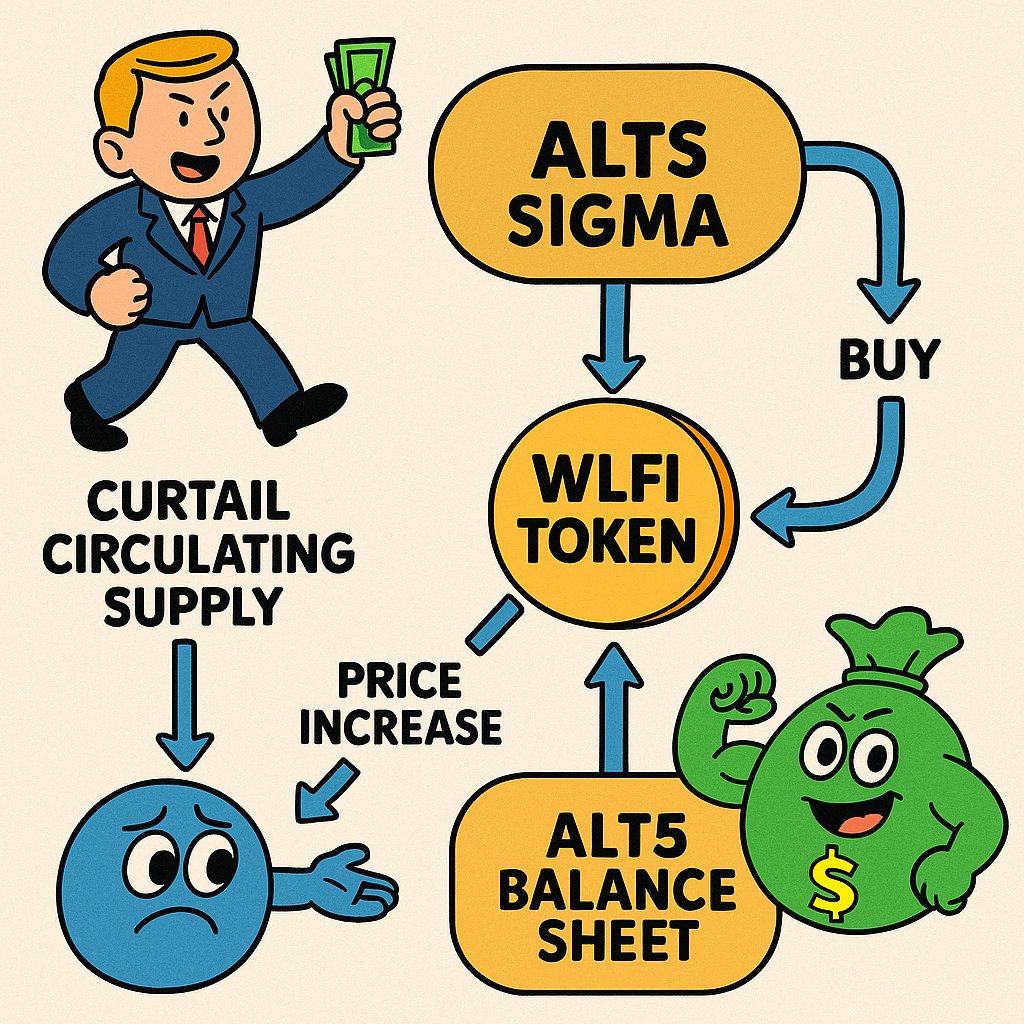
9/ This is the most aggressive public+private+token loop we’ve seen. And it's happening right under Wall Street’s nose. The next play isn’t on-chain. It’s on Nasdaq. $ALT5 $WLFI $USD1
8/ You’re not buying WLFI. You’re buying ALT5, the WLFI capital multiplier. WLFI is the rocket. ALT5 is the launchpad. Expect low float, strong demand engineering, and reflexive NAV pumps.
1/ Everyone’s talking about WLFI token. But the real alpha? It’s NOT just WLFI. It’s the WLFI–ALT5 loop—a crypto/equity flywheel hiding in plain sight. Here’s the breakdown 🧵👇
@benliew @MeteoraAG 1. Better filteration, sorting and APR calculation 2. Total PnL monitoring, which incudes Impermanent loss/profit and fees 3. Readjust position without the need to take out position from the pool 4. Stop loss -> Exit position if price falls below x 5. Position History

Hyperliquid has redefined trading. When a whale shorts $450M+ BTC and wants a public audience, it's only possible on Hyperliquid. When headlines say "Bitcoin Market on Edge," they are equating "Hyperliquid" with the "market." Anyone can photoshop a PNL screenshot. No one can question a Hyperliquid position, just like no one can question a Bitcoin balance. The decentralized future is here.

There's been a lot of discussion on Hyperliquid's margin design. I’ll address some flaws in the common arguments and explain Hyperliquid's first-principles based approach to improving the system. To my knowledge, this is the first such design in margining systems. Perhaps other teams will find it useful for their own logic. Like good theories in physics, the best margining design is simple, canonical, explainable, and works in a wide variety of pathological scenarios. 1. The conclusion of some people has been that there needs to be a centralized force that detects and limits malicious behavior. This completely violates the purpose of defi and everything Hyperliquid stands for. This forces users back to a web2 world where the platform has the final say. True decentralized finance is worth it, even if it is 10x harder to build. Just a few years ago, no one believed DEX/CEX volumes would reach its ratio today. Hyperliquid is leading the charge here and has no intention to stop. 2. Some assume that copying approaches from CEXs will work in defi. The most common suggestion I've seen is per-address margin requirement fraction scaling with position size, as CEXs only offer higher leverage for smaller positions. However, this doesn't work to prevent manipulation attempts on a DEX because a sophisticated attacker can easily open positions on many accounts. Nonetheless, this will help somewhat reduce the impact of "organic whale" positions and is on the list of features to implement. 3. Another suggestion is to implement some features that severely limit usability of the platform in exchange for safety. For example, if unrealized pnl is not withdrawable, many attacks are not possible. Indeed, Hyperliquid pioneered isolated-only perps for illiquid assets which feature this safety mechanism. However, this change would have a crippling effect on funding arbitrage strategies, where unrealized pnl from Hyperliquid needs to be withdrawn to offset the loss on other venues. Real user needs are a top priority in system design. 4. There were also suggestions to innovate on design by having margin settings based on global parameters. However, liquidation prices need to be deterministic functions of price and position size. If global parameters such as open interest were added as inputs to margin requirements, users would lose confidence in the ability to use leverage at all. So what's the answer? We all want defi, but a permissionless system must be robust to manipulation at all scales. The answer lies in understanding the true problem with large positions: they are difficult to mark. The first order approximation of mark price times size breaks down when market impact approaches maintenance margin. It's impossible to accurately simulate market impact because book liquidity is a path-dependent function of time and actions of other participants. Without simulating market impact, it can be possible for liquidation to be a low-slippage way to exit at a price that is unfavorable to the liquidator. Therefore, Hyperliquid's margining system update has the following desirable property: any liquidated position is either a loss relative to entry price, or at least a (20% - 2 * maintenance_margin_ratio / 3) = 18.3% loss relative to the last margin transfer out (using an example of 20x leverage). An organic 20x user who makes 100% return on equity after a 5% move will still be able to withdraw the majority of the pnl without closing the position. However, by introducing separate margin requirements between transfers and opening new positions, profitable manipulation attempts require moving the mark price almost 20%. This kind of attack is infeasible from a capital perspective. Finally, I'd like to point out that the mark price problem also solves itself as market makers continue scaling up on Hyperliquid. It's quite possible that the trader yesterday could have lost money in aggregate. $1.8M pnl longing on Hyperliquid could have been more than offset when pushing the price on other venues, or using other accounts on Hyperliquid. HLP took over an undesirable position, losing $4M. The only market participants who definitely made money in aggregate are the market makers. With millions of dollars of pnl to be made in the span of minutes, it's becoming clear to sophisticated participants that Hyperliquid is one of the venues with the best flow. As liquidity improves, it will become more and more expensive to dislodge prices. So while the margining system improvements will go a long way, the allure of easy pnl attracting market makers will provide an independent source of robustness over time. The future is decentralized. Hyperliquid.
To date, Hyperliquid has processed over $1 trillion in trading volume and become the first DEX to rival CEX scale. As volume and open interest continue to grow, there are increasingly large tests for the margining system. Yesterday’s event highlighted an opportunity to strengthen the margining framework to address extreme conditions more robustly. Immediate review was undertaken to analyze the scenario in detail and investigate ways to mitigate similar situations. Risk management is, and has always been, a top priority. It is a constant focus, even if not publicly highlighted each day. To that effect, there will be a change to require 20% margin ratio on margin transfers in a network upgrade after March 15 0:00 UTC. "Margin transfer" refers to funds leaving cross wallet and isolated margin positions. Examples include withdrawals, perp to spot transfers, and adding or removing isolated margin. This change does not affect the opening of new cross margin positions and only affects new isolated margin positions if cross margin usage would exceed 5x after the isolated position is opened. This update is intended to maintain healthier margin requirements and reduce the systemic impact of large positions with hypothetical market impact upon closing. As always, Hyperliquid remains committed to providing a performant, transparent, and resilient trading environment and delivering the best possible experience for users.
Today is the day @HyperliquidX becomes stronger! Keep building

You can now create and manage HyperEVM Safe accounts seamlessly within Palmera 🌴! Now @HyperliquidX ecosystem benefits from: - Multi-Safe Management. - Visualize and contextualize your transaction history. - Unified Treasury Oversight across 30 EVM chains. Start managing all your Safe accounts in one place! 🔗 app.palmeradao.xyz/welcome


HYPE is now my biggest position behind BTC. I’ve been accumulating fast at these prices, and I’m making HYPE my next big trade. The last time I made a move like this was accumulating SOL at ~$25. For the first time since the FTX crash, I officially don’t hold any SOL. Not because I don’t think SOL isn’t a solid trade (it definitely is) but my gut says HYPE, and I’m leaning in. There are plenty of reasons why I’m bullish on HYPE, but the most important one is the beauty of the product itself. I reached out to Jeff in the very early days of HYPE. I used the product and immediately knew it was a winner. I wanted to see if he was open to investors, but he wasn’t. And honestly, that’s why HYPE is so special. It’s why you won’t see it pushed as hard on the timeline as SOL or any other token with heavy VC backing. The big VC voices in this space are powerful and influential, but Jeff made a different choice. He decided to give to the users instead of the VCs. That’s a bold move, and one I deeply respect. And this is why HYPE deserves support, even if you’re not holding it. We’re entering a new era in crypto: one that feels a lot like the post-dot-com bubble era for the internet. After the speculative frenzy fades, what’s left are the real builders and the real products. In this phase, the protocols that will thrive are the ones that give value back to the users, the ones that treat their users as stakeholders, not just liquidity. That’s why HYPE matters. It’s part of this shift. There’s nothing more powerful than being a user and, by being a user, becoming an investor. That’s the purest alignment of incentives, using something you genuinely believe in and benefiting when it succeeds. I think Jeff is betting on that model. He’s choosing to let the value flow to the people who actually engage with the product, not just to the gatekeepers. If HYPE works, it sets a precedent for the next wave of protocols. A future where the best projects aren’t just built for users, they’re built with them. Where being early and engaged isn’t just a speculative position, it’s ownership. That’s why I’m betting big.

It’s time @circle started supporting @HyperliquidX native USDC. After all they have most of the USDC on Arbitrum.
Only one of these is buying back tokens using the generated revenue! Guess who?

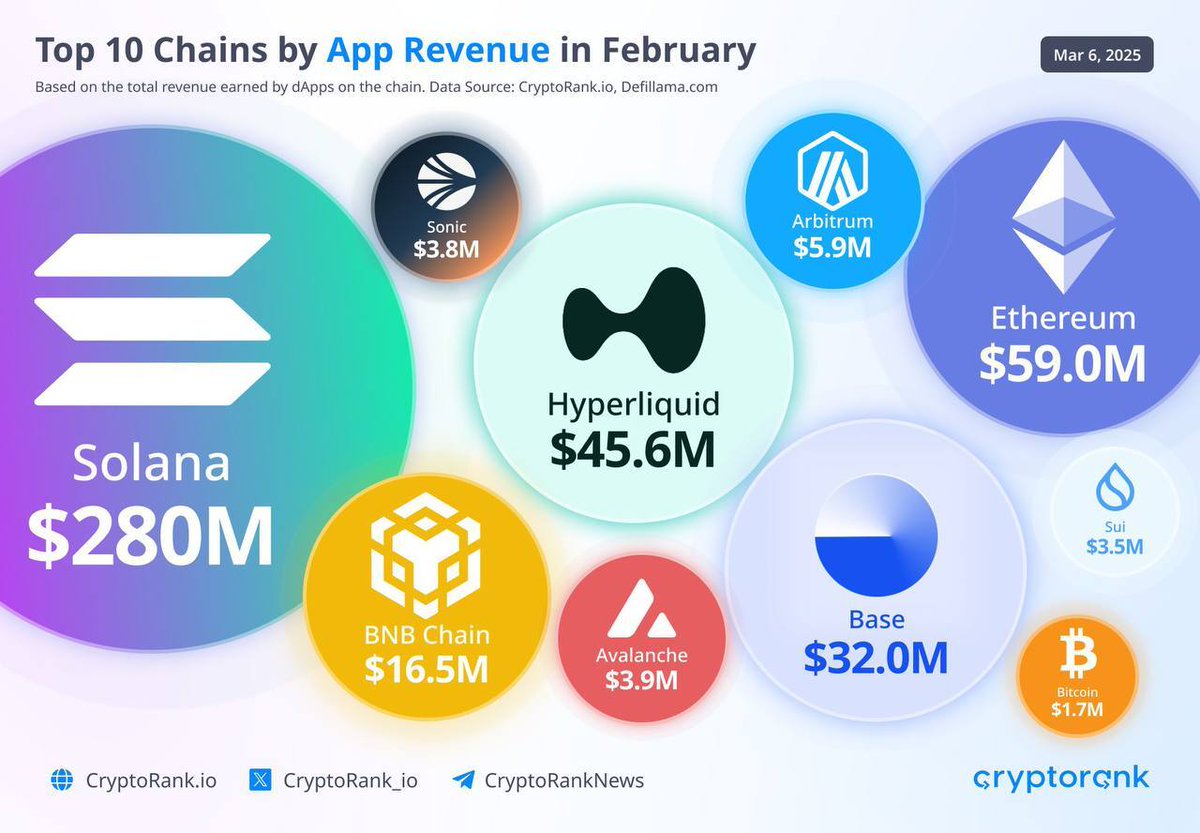
🔥 NEW: According to CryptoRank, BNB Chain reached a record app revenue of $16.5M in February, while Sonic surpassed Sui, achieving $3.8M. Ethereum and Solana saw notable declines, dropping 30% and over 50%, respectively.

Crypto King @Stichty1
8K Followers 8K Following On the Cleanspark Holdings team ⚡ Turning Bitcoin mining ⛏️ into real, flexible earnings 🌐 and next-level digital growth 💻



Rishabh Srivastav @rishabhsri4444
10 Followers 20 Following Building Crypto trading products, Ex Oil Trader
androolloyd.hl @androolloyd
16K Followers 12K Following @lastdotnet | reverse engineering the house of all finance | The strongest deterrent is an overwhelming show of force.
Harper @Harper627591293
1 Followers 197 Following



SibylPepys @3F2XN3yu9pi1u
120 Followers 6K Following
Teresa @Ylaawnaq9060
197 Followers 7K Following In order to be irreplaceable one must always be different. — Coco Chanel

Sibylle @BS9t8KLcXn00lq7
142 Followers 6K Following I’m too busy working on my own grass to notice if yours is greener.
Hoosox @Hoosox0573
30 Followers 732 Following I’m learning to love the sound of my feet walking away from things not meant for me.


hewhohasnoname @RogerDodger16
29 Followers 188 Following
Shalini Wood @shaliniwood27
6K Followers 2K Following Believe in BTC, ZEC, freedom & positive-sum energy. Member @SuperteamAE I Contributor @sleepagotchi
Sean @seann_nftt
645 Followers 2K Following



Mohamed Rahhal @mohamedrahhal1
865 Followers 2K Following I care about nature, adventures and everything's new. 🏖😍 أهتم في الطبيعة والمغامرات وكل شيء جديد

2Rockk @2Rockked
760 Followers 2K Following OC @NeoTokyoCodeo | $WLFI | Elite at @MarketElites | @X1E
Finance Allrounder (P... @finallrounder
1K Followers 1K Following partner Director Emerge| Independent Dir @Jetkingltd I Former CFO @Essar | LinkedIn top voice https://t.co/GJF5dQWZxj

EvelynsGoonadise @GoonForEvelyn
252 Followers 2K Following AI fantasies, hand-crafted with my energy 💋 Step into my world ❤
Absolute Unit @largeunit
1K Followers 1K Following BD at @harvest_finance & @spectra_finance | prev: @socketprotocol @balancer
Nixxter @Nixxtron
244 Followers 1K Following 🌐Bootstrapped Founder | Building | @TokenScape | #590\Z/

Alta West @AltaWest50737
1 Followers 191 Following
MLM @mlmabc
54K Followers 1K Following

Ser Rando @RandoCoder
15 Followers 193 Following


Al @al_bothmeist
385 Followers 1K Following SIGMA CULT MΣMBΣR Σ / DAY 1 SIGMA WARRIOR / DIAGNOSΣD WITH SIGMAISM

Franche @GameofFranche
299 Followers 1K Following crypto #BTC $btc #ETH $HOba \\ rich again \\ in christ


DarcyDonavan.x @darcydonavan
229K Followers 82K Following Film & Television Actress as seen in Anchorman, Modern Family, etc. Recording Artist, Producer 💎#CryptoQueen💎 Founder of @StarDawgs #NFT @IncomeIsland
The CFO | Utopian �... @amznFBA_GOOG
322 Followers 3K Following Crypto and Blockchain | Chief Figure Outer | diversifying after 7 Figures in E-commerce and online wellness
UltraLP @UseUltraLP
5K Followers 44 Following Real Time Analytics and P&L for DLMM positions - The LP Copilot on @MeteoraAG on @Solana built by @rps_ai https://t.co/Zgj0sX54am
Quranium @quranium_org
44K Followers 475 Following World’s First Quantum Secure Layer 1 Blockchain for Financial Institutions. #BeUncrackable
LANGERIUS @Langerius
147K Followers 9K Following founder @huntersofweb3 | attorney, advisor, investor, trader | leading narratives
Vangrid @vangrid_io
20K Followers 1 Following Building the decentralized perception grid for sovereign defense and autonomous physical agents. $VAN
blothecap @blothecap
1K Followers 281 Following Market-neutral crypto vaults | Live: Edge & Hedge on Hyperliquid and Lighter | TVL: $3.7 Million | Public performance and risk updates | NFA
Niels @Web3Niels
67K Followers 11K Following Co-Founder @STABL_Agency • Trader & Investor • @OKX creator
ArcNova @ArcNova_ACI
100K Followers 8 Following Powering the future of storytelling with ArcNova ACI, AI Cinematic Infrastructure.

Taifoon @taifoon_io
14K Followers 115 Following The on-chain intelligence and verification engine for cross-chain execution.
Legend @legendtrade
11K Followers 208 Following Trade against the world. Leveraged perps on stocks, commodities, and crypto. Built on @HyperliquidX. Live now in public alpha, on Web and iOS.
Stratosphere 💫 @StratosphereVIP
5K Followers 32 Following We're ecosystem partners creating sustainable and repeatable growth for digital assets and ecosystem ✨
TraderClaw @traderclawAI
9K Followers 9 Following Your autonomous AI trading desk. Signals. Decisions. Execution. Built on @OpenClaw
KiiChain @KiiChainio
190K Followers 1K Following On-chain FX layer for stablecoins and RWA – Building the future of finance for emerging markets. Register: https://t.co/GysIYx4AVC
Zest Protocol @ZestProtocol
100K Followers 126 Following 🟧 The lending protocol built for Bitcoin, backed by @drapervc & @yzilabs Borrow against your Bitcoin and earn up to 5% APY (paid in BTC)
Qubic @_Qubic_
101K Followers 175 Following No VCs. No premine. No fees. Just pure decentralized intelligence. Bare-metal L1 · UPoW-powered AI · 15.5M TPS · Aigarth building AGI. Power to the network.
Proof Of Belief @BeliefOnPrintr
5K Followers 4 Following First Proof Of Belief staking token on @printr PROVE YOUR BELIEF CA: 29CWsqH84TykHDDwA6DtETUtXQPuKbVgKCmxtkBsbrrr https://t.co/JuzHkEJh5q
greb @grebby
65K Followers 2K Following founder / 2013 trader / 🦅/ occasional crypto educator / investor
Gohan 🧬 @0x99Gohan
46K Followers 6K Following The one and only GOHAN! @SeiNetwork Advocate 🔴 Contributor: @ParticleNtwrk, @Mantle_Official Maxi: UX | WLFI 🦅 Fam at @GREEND0TS
H.E. Sheikh Saoud bin... @HEsbfaq
27K Followers 8 Following Member of the ruling family of Al Qassimi, UAE. President, Commonwealth Union Blockchain. Connecting 56 nations through a shared digital layer.
CommonWealth Union Bl... @CWUblockchain
49K Followers 7 Following Commonwealth Union Blockchain & Digital Assets. $CWU the token connecting a global commonwealth.
Commonwealth Union @CommonWUnion
26K Followers 8 Following Digital media platform that connects the 2.6 billion people of the Commonwealth’s 56 member nations by providing the latest global and regional news
CereBree @CereBree
31K Followers 9 Following World’s 1st unified AI ecosystem for Enterprise, Healthcare and Individual intelligence. Powered by $CRX and partnered by @Oracle
Tobias Bauer @TobiasTBV
27K Followers 5K Following Founder of VC @tbvxyz & Events @_thebestevent. Web3 Investor, Speaker and Mentor! 💪 DM if you are building in #web3 🚀🔥 All opinions are my own!
OwlyPost @OwlyPosting
42K Followers 249 Following Owly sees what others miss. Your bird's-eye view on the world
TBV @tbvxyz
21K Followers 120 Following TBV is an early-stage Web3 VC fund leading investments, backed by investors, founders & builders. We follow projects we work with and invest in!
Matt 💰💰 @MattInWeb3
125K Followers 2K Following Sold my IRL business for 7 figures and then decided to join this crazy circus they call crypto, for whatever reason 🤷♂️
SapienGG @Sapiensolana
11K Followers 144 Following Human-only launchpad on Solana. Raise & trade directly on Raydium with FULL control: - Whitelists & Passwords - Custom CA/tokenomics - LP fees Just curate it.
B R E Y @breyonchain
99K Followers 12K Following scribbling something, marketing autistic. Founder @ZaxWeb3
Spacesuit @spacesuit_app
3K Followers 1 Following A futuristic canvas for your personal development.
$BANK @bankmefun
9K Followers 18 Following The first poker bankroll token on @Solana. Backed by the world’s best poker players. By @FANtiumOfficial & @FANstrikeFun.
Mickey from Arcadia @mickeyhardy
197K Followers 6K Following | ceo @arcadiagtm | co-founder @introductioncom | Investor in Discord, Epic, Databricks | Disclaimers👇🏻
Takes @takesmarket
9K Followers 51 Following Follow people, share predictions, and see which takes are winning. Everyone has takes. Back yours.
RISEx @risextrade
43K Followers 22 Following Next-generation decentralized spot & perpetuals trading powered by @risechain. Backed by @galaxyhq.
STEEL HEARTS @Steel_HeartsNFT
26K Followers 2 Following The first digital collectible of the infamous Metal Slug NFT franchise by SNK. Built in collaboration with FableVerse and Zokio
Mezo @MezoNetwork
118K Followers 16 Following Sound yield for sound money. Borrow, spend, save, and earn against your Bitcoin.
Adrian @AdriansCryptoo
18K Followers 8K Following 🇵🇹 private investor | trader | jpeg collector | enjoying life | views are my own dyor
Warp Chain 💫 @WarpGameCHAIN
68K Followers 3K Following Publishing original games for real players. Powered by @avax and @base.
Stormrae @stormrae_ai
45K Followers 47 Following Shaping and securing the AI of tomorrow. Earn your part now: https://t.co/hpWl4mKSdC
Jargon @jargon_sol
28K Followers 5K Following Co-Founder: @ZaxWeb3 , @Zax_TR We win together. https://t.co/jmBo5iXz0R Creator @BinanceTR 💛
Centurion @centurionmba
98K Followers 1 Following
SCOR @SCORProtocol
84K Followers 95 Following Transforming the sports industry by building the on-chain fan economy where tokenized sports IP meets programmable fandom. Built by @sweet
Yueya @yueya_eth
50K Followers 4K Following 2x Founder | Angel Investor 100+ | Advisor ex- @defiapp @stepnofficial Partner @FOMO_v | OKX ecosystem
Mike S @Mikesi30
47K Followers 3K Following Co-founder @FOMO_v and @boom_fi | Web3 Founder, Advisor & Investor

DeepNode AI @DeepNodeAI
170K Followers 2 Following The foundation for open, honest AI. We broke the black box so everyone can see the light.
Morpheus @Morefious_
63K Followers 762 Following Not a machine....yet. 🛠️ @PredictStreet //@ORBT_Protocol
ZOOP @ZOOP
62K Followers 144 Following The Social Mega App Built 100% for YOU. Shape culture on your own terms. Join #ZOOP *Terms apply. NO TOKEN YET
Belong @belongnet
47K Followers 255 Following Tokenized events, AI engagement, and the first performance-based affiliate network for venues 🪙 Berkeley x Cointelegraph Accelerator 🌟$LONG 🌟
Bridge @Stablecoin
22K Followers 22 Following Bridge is an entirely new payments platform, built with stablecoins, to simplify global money movement. Learn more: https://t.co/5kh2t2HUzp
Native Markets @nativemarkets
7K Followers 14 Following Built $USDH, the Hyperliquid-native stablecoin at https://t.co/1SYjapbmAz
DeLorean Labs @DeLoreanlabs
105K Followers 4K Following The Official DeLorean Motor Company account for digital innovation. Driving the future with $DMC. https://t.co/15RxNTKHjg
Extended @extendedapp
29K Followers 44 Following Perp Dex built by ex- @Revolut team. Join the community: https://t.co/vZ8bO1fnK3Trends for United States
You might like