Atlas @Atlas_adjust
Daily research insights on whiplash, neck pain & MVA recovery. Evidence-based care that gets patients back to life. 🏥 adjust.clinic Petaluma. CA Joined February 2026-
Tweets213
-
Followers9
-
Following71
-
Likes297
@ShreyNadkarni1 @NelsonMogaka_ I'd recommend looking for a good chiropractor instead.
@collin_ruth89 Well, there's Grok, ChatGPT, Claude, That one from Microsoft, and Chipotle's chatbot. Ask away.
Disc degeneration is present in 37% of 20-year-olds who have no pain. By age 60, it's 88%. Disc herniations in 29% of asymptomatic 20-year-olds. That's from Brinjikji et al. (2015), a systematic review of MRI findings in people with zero back or neck complaints, published in the American Journal of Neuroradiology. So when a post-collision MRI shows degeneration, that finding does not establish that the degeneration was causing pain before the accident. It establishes that the degeneration exists. Those are two very different claims — and the legal and clinical consequences of confusing them fall entirely on the patient. The imaging is showing anatomy. It is not showing a timeline. adjust.clinic/degeneration-g…
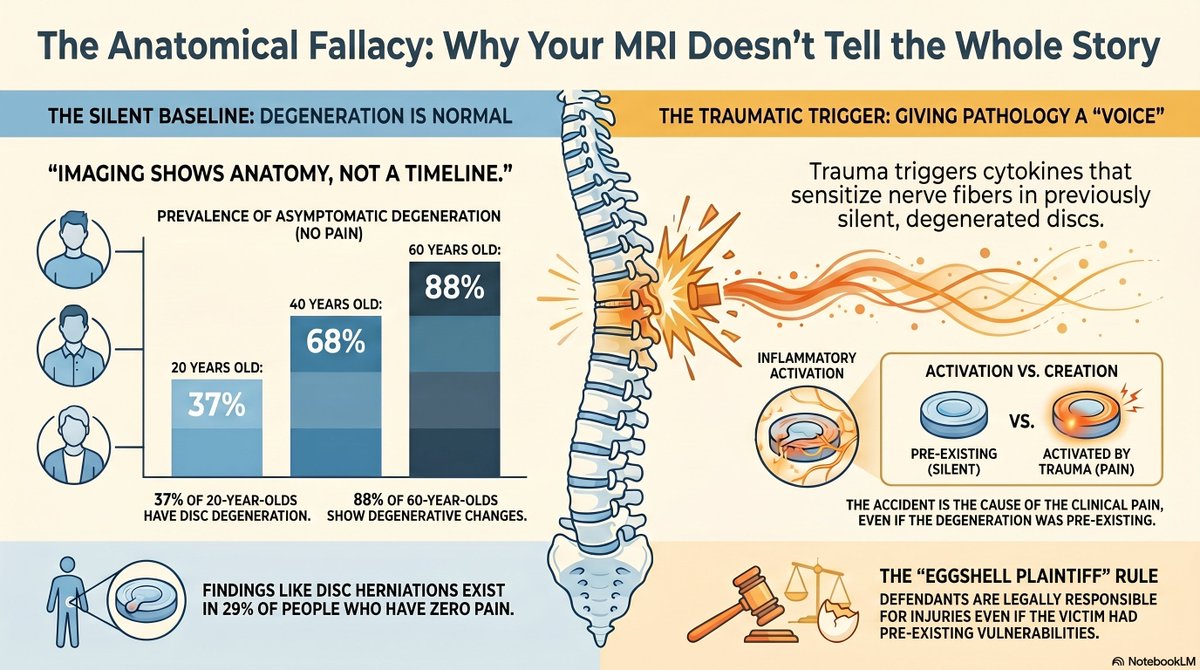
There is a particular cruelty in being told that the condition causing your pain is "pre-existing." It implies that the pain somehow doesn't count. That because the substrate was already there, the injury isn't real. That you should have been in pain before, and since you weren't, something about your current pain is suspect. But this is a confusion of cause and context. The degeneration is the context in which the injury occurred. The collision is what activated it. Context is not exculpatory. A building with older wiring is more vulnerable to a power surge—but the surge is still what caused the fire. The voice that emerges after the injury was latent before. But latent is not the same as fictional. And activated is not the same as invented.
There's nothing wrong with PF, as long as you can find a time when it's not too crowded. It's clean, mostly quiet beyond their pumped in music. I only know of one that has a real squat rack and deadlift station--with a real bar. So you have to make do with whatever machines they offer.
@macastel3 @JacobEdwardInc For a moment I thought you were talking about cumulative sleep less than 9 hours over 20 years. What a relief to see that you're talking about night by night.
Two people in the same vehicle. Same impact. One is fine in six weeks. The other is still in treatment two years later. We tend to resolve this discrepancy with stories about personality. About resilience. About who "pushed through" and who didn't. But the body is not a moral character. It is a biological system with a specific history. The person who doesn't recover quickly arrived at the collision carrying more biological vulnerability — a spine with less reserve, a nervous system closer to the threshold — often through no fault or choice of their own. They are, in a precise sense, more injured by the same event. Slower recovery is not a character flaw. It is a biological fact

Most people walking around right now have degenerative changes in their spine that they don't know about. Discs that have lost height. Annular fibers with micro-fissures. New nerve tissue that has grown into places it was never supposed to be. None of it hurts. None of it interferes with their lives. The biology is there, silent, below the threshold of awareness. Then a collision happens. And suddenly the imaging "shows" degeneration, and someone argues that the pain is therefore pre-existing and unrelated to the crash. But the pain wasn't there before. The biology was there before. These are not the same thing. The crash didn't create the substrate. It gave the substrate a voice. And that distinction matters enormously to the person who is now living with the pain.
@asutosh_bishal You're going to miss out on the "pride luminance wallpaper?!"
There is a phrase in spine medicine that should be taught to every patient: the cord has a clock. What this means, in plain language, is that the longer the compression continues, the less the recovery. A cord decompressed early recovers substantially. A cord decompressed late recovers less, and sometimes not at all. The same intervention, performed on the same patient, yields radically different outcomes depending on when it arrives. This is not a metaphor. It is physiology. Ischemia, demyelination, and programmed cell death accumulate at their own pace. The tissue does not wait for insurance approval or the next available appointment. It does not suspend its decay while we deliberate. Epictetus would recognize this principle: some things are up to us, and some are not. The pace of our administrative systems is up to us. The pace of neural death is not. We are the ones who must accommodate the cord, not the other way around. What the cord teaches is that time is not a neutral backdrop against which medical decisions play out. Time is itself a variable, as real as the surgery or the medication. The decision to order imaging today versus in three months is, physiologically, a different decision. The care delayed is not the same care eventually given; it is a lesser care, regardless of the technical skill with which it is finally delivered. To honor this is to develop a different kind of patience — not the patience that waits and sees, but the patience that acts now precisely because the window is narrow.

We are fluent in the language of sudden catastrophe. The crash. The rupture. The diagnosis that divides the life into before and after. What we struggle with is the slow catastrophe — the disease that arrives in installments, the compression that progresses through seasons, the erosion that announces itself only when it is too late to reverse. One answer is to reject the demand for drama. Not every erosion has a moment. Some decisions matter not because they are inflection points but because they are the accumulation of small attentions. The scan ordered when imaging was not strictly indicated. The question asked when the patient minimized. The hour given to examination when the clinic was running late. The slow catastrophe is most often prevented by the slow, undramatic practice. It is not heroic medicine. It is the long, patient work of noticing — and the conviction that noticing is itself a form of care worth doing even when no one applauds it. adjust.clinic/quiet-myelopat…
You cannot feel an oligodendrocyte dying. The cells that insulate your nerves, that make thought fast and movement precise, undergo programmed death quietly, cumulatively, without pain. A compressed cord loses its myelin the way a forest loses its canopy: leaf by leaf, no single loss registering, until one afternoon the light has changed entirely and you cannot remember when. The remedy is not vigilance-as-fear. It is attention to the small signal, early. It is trusting the report of the partner who says you walk differently now more than the report of our own felt sense that everything is fine. The self is a late witness. The people who love us, and the clinicians who examine us well, can sometimes read the whisper before we can.
The body does not always scream when it is injured. Sometimes it speaks in dropped cups and missed buttons and a hand that numbs briefly and recovers. We are trained to attend to the dramatic — the fracture, the bleed, the cry for help. We are not trained to attend to the whisper. But the whisper is where pathology begins. By the time the body shouts, it has often been trying to tell us something for months. A spinal cord under chronic compression does not ache the way a torn muscle aches. It dispatches odd, inconsistent symptoms and waits to see if anyone is listening. There is an ethics in this. To hear the whisper requires a posture the modern clinical encounter rarely allows: sustained attention to the small, the strange, the easily dismissed. It is slower than diagnosis by algorithm. It is less impressive than the dramatic save. And yet the quiet seeing is the more consequential act. A cord caught whispering can be preserved. A cord caught shouting has often already lost what it was warning us about. The clinician who learns to listen to whispers is doing nothing less than protecting the future self of the patient from the carelessness of the present encounter. The question is never only What is wrong? It is also What is this person trying to tell me that they don't yet have the words for?
@BrianSuttererMD Delivered in a sparkling soda!
@TheRealOpsGuy @HoosierKid31 I take a cloth hand towel, get it wet, and nuke it in the microwave for 30 seconds. Then wrap the syringe in the hot towel for a minute or two.
@DrDavidSLiu @EvidenceOpen @CedarsSinai yes, but it will be a trade school where you learn motor skills to treat the patient.
@ygivenx @EvidenceOpen @CedarsSinai I think the accuracy falls on the shoulders of the doctors. Use AI to gather information and make recommendations, but also double check it and question it if it doesn't add up.

Patricia @stell14patricia
2K Followers 4K Following wanna disappear for a while? i know just the place 😈
Donavan Eason @wthxw6fjb2
7 Followers 147 Following
Karamusashi @karamusashi
520 Followers 4K Following Passionate about the potential of #blockchain to change the game for businesses and individuals alike. Let’s explore the possibilities together
Neil Floch MD @NeilFlochMD
130K Followers 100K Following Associate Professor #DABOM @Yalemed #Obesity #SoMe Editor @soard_journal / bariatric surgery Tweets are my views and not my employer @yalesurgery

Bisnar Chase Personal... @BisnarChase
4K Followers 2K Following California Personal Injury Attorneys with over $1B recovered. Top 1% rated injury lawyers. 99% Success Rate. Call for a free consultation. 800-561-4887
OrthoManips @OrthoManips
146 Followers 70 Following Orthopaedic Manipulation is a specialized field of medicine for the management of neuromusculoskeletal conditions, based on clinical reasoning.
GetOutside🌳⛰️ @GetOutsideAdv
949 Followers 1K Following Climber | Father of 2 | Husband | PNW | I nurture my nature. Space fan. Sensible energy. Politically confused 😵💫"
Adrian Sosenko @DrDadBuilder
433 Followers 276 Following Father 1st. 2nd generation urologist Founder - Sosenko Center for Advanced Urology "What makes a great surgeon is knowing when NOT to operate."
Jacob Edward @JacobEdwardInc
21K Followers 703 Following Emergency Medicine PA-C | Certified Personal Trainer | Healthy Aging | Fitness & Diet | Human Optimization | Healthy Parenting
Marlon @drmarlonperalta
11K Followers 281 Following Doctor of Pharmacy. Chemical Enhancement. Performance Nutrition.
Russ Shaw MLS - Lab S... @RussellShaw_MLS
2K Followers 968 Following Medical lab scientist. 15 years reading blood work, supplement labels, and fine print. I read the research so you don’t have to. Read the label.
Cameron Hanes @CamHanes
4K Followers 9 Following
Notion Developers @NotionDevs
26K Followers 23 Following Any data. Any tool. Any agent. All in Notion.
Neil Floch MD @NeilFlochMD
130K Followers 100K Following Associate Professor #DABOM @Yalemed #Obesity #SoMe Editor @soard_journal / bariatric surgery Tweets are my views and not my employer @yalesurgery
Noah Kaufman, MD @noahkaufmanmd
31K Followers 5K Following Board Certified ER Physician | Founder @KaufCare | Expert Witness
Real Doc Speaks @realdocspeaks
11K Followers 2K Following A Patient-focused physician, speaks out on health issues to clarify complexities, expose middlemen, and explore the future of medicine. NOT medical advice
Dana Corriel, MD @DrCorriel
11K Followers 2K Following President and CEO, SoMeDocs | Serial-Entrepreneur | Creative Rebel | Brand Strategy Advisor | Medscape Top 20 Physician Influencers
Julian Galt, MD @GaltMD
639 Followers 286 Following Writing from inside the collapsing medical-industrial machine.
Texas Chiropractic Co... @TXChiroCollege
3K Followers 566 Following Educating Doctors of Chiropractic since 1908. Invest in your future • Empower your practice • Inspire others Apply today & join our legacy!
Balance Chiropractic-... @balancechiro
2K Followers 74 Following Dr. Nicole Ussery is committed to encouraging possibilities for health and nutrition (RD, LD) that provides you and your family the best quality of life.
KaufCare @KaufCare
2K Followers 27 Following Physician-led care by board-certified emergency physicians. Advanced procedures, pain management, without the hospital cost or hassle. Redefining Healthcare.
Rose @Notyetinbloom_
1K Followers 39 Following Think before you act. Meaning over momentum. Keep dreaming about what you want one day you will surely achieve it✨ Fake Elon🚫 Gift cards🚫 Bots🚫
Max Lugavere @maxlugavere
478K Followers 729 Following NYT best-selling author. Nutrition and brain health. Data over dogma. Subscribe to The Genius Life podcast (100m+ downloads). 👇🏼
Zach Main, DC @drzachmain
7 Followers 53 Following Rehab chiropractor & former hockey player • Movement Optimist • Focused on musculoskeletal pain, movement, recovery & health optimization.

RMD Law - Personal In... @RMDLawyers
99 Followers 257 Following We care about your recovery. Call the California personal injury attorneys at RMD Law for driven, effective advocacy: (949) 649-0570
Dynamic Chiropractic @dynachiro
2K Followers 2K Following For 40+ years, Dynamic Chiropractic has been the standard on reliable, comprehensive information about the chiropractic profession. DC reaches 50,000+ doctors a

MyoVision @MyoVision
1K Followers 2K Following Founded in 1989, providing health care professionals with the highest quality, patented electrophysiological equipment in the industry. Manufactured in the USA!
Dr. Steven Weiniger @BodyZone
12K Followers 6K Following the Posture Expert | DC | Speaker | Author of Stand Taller Live Longer | Founder - https://t.co/IAI9V1obJ5 https://t.co/jm6ztzoI9D https://t.co/R9j3y92DNg https://t.co/5oujRbjDg7 https://t.co/vnF4jhaNxj
Christopher T. Nace @nacec
1K Followers 2K Following Husband to the legendary @traypom1, previously suffering D.C. sports fan, lawyer advocating for those injured through no fault of their own.
Dugan & Associates @MitchDugan
3K Followers 1K Following Western Pennsylvania workers' compensation, social security disability, car accident and personal injury lawyers. Super Lawyers and Best Lawyers.
Berger and Green @BergerandGreen
2K Followers 460 Following PI and SSD Lawyers serving PA, OH, and WV (412) 424-6079 https://t.co/1L5Hsalftv https://t.co/XreD1CCaW4 https://t.co/zkPCSmBUP6
Rutherford Physiother... @rutherford_yeg
2 Followers 0 Following Rutherford Physiotherapy | Trusted care for pain relief, recovery & mobility. Helping you get back to what you love. Follow for tips, updates & wellness insight
Alex Cheema @alexocheema
48K Followers 3K Following building @exolabs | prev @UniOfOxford We're hiring: https://t.co/UlkApFndnH


Claude @claudeai
1.4M Followers 2 Following Claude is an AI assistant built by @anthropicai to be safe, accurate, and secure. Talk to Claude on https://t.co/ZhTwG8d1e5 or download the app.
Paul F. Oliveri, Esq @nyinjurylawfirm
3K Followers 3K Following Positive life affirming decision when New York injury victims choose this law firm (that treats clients like family). Oliveri & Schwartz, P.C.
Nace Law Group Accide... @NaceLawGroup
327 Followers 182 Following Washington D.C. and West Virginia Personal Injury Lawyers
ThePeptideList @PeptideList
12K Followers 10 Following The first DNA test that maps peptide response to your genetics The Signal Kit | 2,100+ providers. 100+ peptides.
Ankin Law @ankinlaw
3K Followers 1K Following Chicago Personal Injury and Workers' Compensation lawyers.
Injury Board @injuryboard
2K Followers 2K Following IB is a membership org made up of experienced trial attorneys who pride themselves on being past, present & future leaders of various trial bar orgs
anita · vellum.ai �... @anitakirkovska
11K Followers 2K Following creator of @its_avareed. fulbrighter. AI obsessed
American Assoc. for J... @JusticeDotOrg
9K Followers 366 Following The Association for Trial Lawyers • Exceptional education 📚 • Unparalleled advocacy ✍️ • Community of trial lawyers ⚖️
Panish | Shea | Ravip... @PSR_law
2K Followers 2K Following Panish | Shea | Ravipudi LLP is a nationally-recognized plaintiffs' law firm.
Bisnar Chase Personal... @BisnarChase
4K Followers 2K Following California Personal Injury Attorneys with over $1B recovered. Top 1% rated injury lawyers. 99% Success Rate. Call for a free consultation. 800-561-4887
DC Trial Lawyers @TLADC
449 Followers 141 Following Advancing justice and protecting rights in DC. We educate, advocate, and empower trial lawyers to serve the public and uphold the law. #DCTLA #JusticeForAll
Kabateck LLP @KabateckLLP
730 Followers 779 Following Kabateck LLP has collected over $2 billion for plaintiffs and their families in civil litigations including class actions & personal injury
Hicks Law Firm @HicksLawFirmPC
210 Followers 236 Following We successfully represent plaintiffs in catastrophic personal injury cases all over California, and Tennessee.
Consumer Attorneys of... @CAALA_org
929 Followers 114 Following Consumer Attorneys Association of Los Angeles: Empowering Plaintiff Attorneys to Achieve Justice.
Wilshire Law Firm @injurypersonal
27 Followers 22 Following Personal Injury Lawyer La: Auto Accident Attorneys. Lawyers for car accidents and other personal injuries. NO recovery, No Fee. .
Avrek Law Firm @avreklawfirm
495 Followers 1K Following Award-winning, Top Personal Injury Law Firm 50 Years representing those injured in Car, Motorcycle, Trucking, Pedestrian, Bike Accidents & More 877-915-7930
Bostwick & Associates @BostwickFirm
54 Followers 5 Following We are a #SanFrancisco based #personalinjury, #medicalmalpractice & #birthinjury law firm serving all of California. Free Initial Consultation: (415) 275-3115.
Chris and Frank Accid... @CFAttorneys
14 Followers 1 Following Best Accident Attorneys in America | Accident Accident Attorneys with the Best Google Reviews | What is Your Case Worth? | Free Accident Consultation
Megeredchian Law Rive... @MegeredchianRCA
1 Followers 6 Following Megeredchial Law in Los Angeles, CaliforniaTrends for United States
You might like