Andy Fairchild Publishing @AndyFairchild
A Simple Path to Publication. Providing value for authors and readers alike. #writingcommunity #selfpublishing #authors andyfairchildpublishing.com Kitchener, ON Joined October 2025-
Tweets319
-
Followers54
-
Following141
-
Likes236
Syntax vs Grammar According to the Chicago Manual of Style (CMOS 18th edition), grammar encompasses everything about a language. Grammar includes three main categories: punctuation, sentence structure, and parts of speech. "In its usual sense, grammar is the set of rules (or the study of the rules) governing how words in a given language are put together to communicate ideas" (5.1). Many people confuse grammar with syntax. Syntax is how words are ordered in a sentence so that they make sense. In other words, syntax defines the rules for how sentences are structured and in what order we put the words. Syntax is a subset of grammar. For example, "Traditional grammar has held that there are eight parts of speech: nouns, pronouns, adjectives, verbs, adverbs, prepositions, conjunctions, and interjections." (5.5). Syntax cares about how these words are put together in a sentence so that the sentence has meaning and is comprehensible. "Syntax is the collective term we use to denote all the rules governing how words are arranged into sentences. In an analytic language like English—one that uses word order to show word relations—syntax is particularly important in expressing meaning" (5.217). Some languages, like Latin, have tense and person built right into the verb. For example: ambulo = I walk ambulatas = You walk ambulatant = They walk ambulavi = I walked ambulavisti = You walked ambulaverunt = They walked In English, an analytic language, we must add the pronoun to show person (1st—I, we; 2nd—You; 3rd—He, She, It, They) and change the base form of the verb (if necessary) to create the tense (past, present, future). To understand English grammar—study my book: amazon.ca/Write-Simplici… To write your own book—study my workbook: amazon.ca/How-Write-Publ…
Next post will be about syntax vs grammar. Yes, there are very different.
What is a finite verb? A finite verb, on its own, shows tense, as in "ate" or "swam" or "is" or "walks" or "will." Each of these verbs has only one tense. But non-finite verbs do not show tense, for example "swimming." "Swimming" can mean "I will be swimming" or "I was swimming." "Swimming" needs a finite verb like "will be" or "was" to show tense. The Chicago Manual of Style (CMOS 18th edition) states: "A clause is a grammatical unit that contains a subject, a finite verb, and any complements that the verb requires" (5.232). For a word to be a finite verb (according to CMOS), it must meet the following three conditions: 1. The verb on its own shows tense (past, present, or future). "I ate (past tense) a cookie." 2. The verb agrees in number (singular or plural) with the subject. "I ate [I is singular and ate is singular] the cookie." 3. The verb agrees in person with the subject (1st person (I, we); 2nd person (you); 3rd person (he, they, she)). "I ate [ate agrees in person with I] the cookie." "A finite verb agrees with its subject in person and number—which is to say that a singular subject takes a singular verb {the solution works}, while a plural subject takes a plural verb {the solutions work}" (5.143). "A verb’s person shows whether the act, state, or condition is that of (1) the person speaking (first person), (2) the person spoken to (second person), or (3) the person or thing spoken of (third person)" (5.141). P.S. I have sent an email to CMOS asking: Why isn't there a definition for a "finite verb" in CMOS. A finite verb is characterized by the fact that the finite verb shows tense. But I don't see that anywhere is CMOS.
What type of a sentence is "Tell the world how glorious he is."? a) simple b) compound c) complex d) compound-complex According to the Chicago Manual of Style (CMOS 18th edition): "A simple sentence consists of a single independent clause with no dependent clause" (5.224). "A compound sentence contains two independent clauses . . . with no dependent clause" (5.225). "A complex sentence contains a single independent clause with one or more dependent clauses" (5.226). Remember, dependent clauses start with words like because, since, and although. "A compound-complex sentence contains multiple independent clauses and at least one dependent clause" (5.227). The answer is a).
"Tell the world how glorious he is" (Psalm 66:2, NLT). What kind of a sentence is "Tell the world how glorious he is."? a) dependent b) determinative c) declarative d) imperative First off, does the following sentence contain correct punctuation: What kind of sentence is "Tell the world how glorious he is."? Yes. The weird combination of ."? is correct. According to the Chicago Manual of Style (CMOS, 18th edition), "only those punctuation points that appeared in the original material are included within the quotation marks; all others follow the closing quotation marks" (6.19). What kind of a sentence is "Tell the world how glorious he is."? The answer is d). CMOS states: "A directive or imperative is a sentence that instructs somebody to do or not to do something" (5.221). In the Scripture above, someone is instructing us to "Tell the word how glorious he is." If you are a Christian, and you have a book to share, get it published and tell the world how glorious he is.
AFP is publishing their first art book: "Moved by his Spirit." The artist is Andrea Lelkes from Slovakia. The text is in Hungarian and English. Here is a rough draft.


Commas and nonrestrictive clauses "Therefore, let all the godly pray to you while there is still time, that they may not drown in the floodwaters of judgment" (Psalm 32:6, NLT). Why is there a comma before "that" in the above? a) because "that" is a relative pronoun, and nonrestrictive relative clauses are set off by commas b) because "that" is a subordinating conjunction, and nonrestrictive dependent clauses are set off by commas The word "that" can be either a relative pronoun or a subordinating conjunction. "THAT" CAN BE A RELATIVE PRONOUN According to the Chicago Manual of Style (CMOS, 18th edition), "A relative pronoun is one that introduces a dependent (or 'relative') clause and relates it to the independent clause. Relative pronouns in common use are 'who, which, what' and 'that'" (5.60). "THAT" CAN BE A SUBORDINATING CONJUNCTION "A subordinating conjunction connects clauses of unequal grammatical rank. The conjunction introduces a clause that is dependent on the independent clause . . . {Marcus promised 'that' he would help}" (5.206). We cannot determine if the answer is a) or b) simply because "that" is in the sentence. "That" can be either a relative pronoun or a subordinating conjunction. We need to understand how the clause after "that" is functioning in the sentence. Once we know the purpose of the clause after "that," we will know if the answer is a) or b). FUNCTIONING OF THE CLAUSE AFTER "THAT" "[T]hat they may not drown in the floodwaters of judgment" is answering the question: why should they pray? Why should they pray? "[T]hat they may not drown in the floodwaters of judgment." The clause if functioning as an adverbial clause. Note on square brackets. "Sometimes the bracketed material replaces rather than amplifies the original word or words" (6.105). Square brackets can be used if the writer wants to show a change they made to the original (in the above, I changed the original "that" to "That"). If the clause is acting like an adjective describing or modifying a noun in the preceding independent clause, then the clause is a relative one. In our case, "that they may not drown in the floodwaters of judgment" is not acting like an adjective, therefore the dependent clause is not a relative clause. The answer is b). "[T]hat they may not drown in the floodwaters of judgment" is functioning as an adverbial clause—it answers the question: "Why should they pray while there is still time?"
"So be strong and courageous all you who put your hope in the Lord! (Psalm 31:24, NLT)" Here are some true or false questions regarding the above. 1. (True or false) There doesn't have to be a period after the closed parentheses because there is an end of sentence exclamation mark after Lord. 2. (True or false) There is supposed to be a comma somewhere in the sentence. 3. (True or false) The quotation marks are in the correct places. 1. False: there has to be a period 2. True: there is supposed to be a comma 3. False: one quotation mark is in the wrong spot The correctly punctuated verse (according to the Chicago Manual of Style, 18th edition) looks like this: "So be strong and courageous, all you who put your hope in the Lord!" (Psalm 31:24, NLT). Now for the CMOS rules. THE PERIOD "When matter in parentheses or brackets, even a grammatically complete sentence, is included within another sentence, the period belongs outside" (6.13). This means our period belongs outside of (Psalm 31:24, NLT). THE COMMA "Names or words used in direct address are set off by a comma (or two in the middle of a sentence); this comma is known as a vocative comma" (6.57). In our Scripture verse above, the noun phrase "all you who put your hope in the Lord" is a vocative—an address to a group. Vocatives are set off by a comma. THE SCRIPTURE REFERENCE CMOS says "Any writer or editor working extensively with biblical material should consult the latest edition of 'The SBL Handbook of Style,' which offers excellent advice and numerous abbreviations" (14.138). SBL stands for the Society of Biblical Literature. This is from from the Student Supplement for the SBL Handbook of Style (official companion) and university guides directly based on the 2nd edition: “When God began to create” (Gen 1:1 CEB). “Let us make humankind in our image” (NRSV). "Blessed are the merciful, for they will be shown mercy" (Matt 5:7 NIV). Periods outside the parenthesis.
Commas and compound predicates "The voice of the Lord twists mighty oaks and strips the forests bare" (Psalm 29:9, NLT). Why isn't there a comma in the above sentence? a) the sentence does not contain a list b) the sentence is too short c) there is ellipsis using the subject d) the ideas are closely related CMOS doesn't have a single section that explains the answer. We have to patch together a few sections to come up with the answer. Let me give you the answer first and then explain it. The answer is c). PATCH 1: The Chicago Manual of Style (CMOS, 18th edition) states: "A comma is not normally required before a coordinating conjunction that joins the two parts of a compound predicate" ( 6.24). In our case, the "and" comes before the second part of a compound predicate, which is "strips the forests bare." PATCH 2: We have a coordinating conjunction in the above quote, which is the word "and" (6.22). PATCH 3: (now the trickier part). We also have a compound predicate in the above quote. What is a compound predicate? 3a) "Generally, a sentence's predicate is the part that contains a verb and makes an assertion about the subject" (5.20). The predicate in the above is "twists mighty oaks and strips the forests bare." 3b) The definition of "subject" is not provided in CMOS. The "subject" of a sentence is what the predicate is making an assertion about. In our case, "The voice of the Lord" is the subject. (I emailed CMOS to ask them why they do not have a definition for "subject" in their manual.) 3c) CMOS provides an example of a compound predicate that does not require a comma. "'She arrived early and stayed late.' Traditional grammarians have tended to call this a simple sentence with a compound predicate (where 'arrived' and 'stayed' are coordinated verbs)" (5.225). 3d) Grammatical ellipsis is defined by CMOS as: "A grammatical ellipsis (sometimes called an omission) occurs when part of a clause is left understood and the reader or listener is able to supply the missing words" (5.236). In our case, "The voice of the Lord" is the elliptical subject, as the sentence could be written as: "The voice of the Lord twists mighty oaks, and the voice of the Lord strips the forests bare." If we were to include the elliptical subject, we would put a comma before the coordinating conjunction "and" (because we would need to separate the two independent clauses). But as it stands, the verse contains an elliptical subject and a compound predicate (therefore, no comma is needed before "and"). To understand English grammar—study my book: amazon.ca/Write-Simplici… To write your own book—study my workbook: amazon.ca/How-Write-Publ…
I'm reading "What Editors Do" (by the way, sorry for the quotation marks, but Elon has blocked italics—hey Elon! you are making CMOS italics for book titles impossible) edited by Peter Ginna. In the book, there is a quote from one of the essays: "I finally came to understand that there is one question every author must be able to answer in order for me to work with him or her: 'Why do you want to write this book?'"—Susan Rabiner. That is a great question. It forces any writer to think through their message to their audience. If you find yourself rambling about what is in your book, rather than talking about why you wrote it, you have some more work and thinking to do. Here is another gem from Susan Rabiner: "It is only by having an author write a long, thick table of contents that an agent can see that structure developing and ideally identify problems with it up front, so that they won't hobble the author when it's time to write the book. I now ask all my authors to think in terms of a table of contents of around fifty pages, with each chapter summarized in five to ten pages. Writing clarifies thinking, never more so than in a table of contents." I completely agree. To understand English grammar—study my book: amazon.ca/Write-Simplici… To write your own book—study my workbook: amazon.ca/How-Write-Publ…
Common comma issues "Even when I walk through the darkest valley, I will not be afraid, for you are close beside me" (Psalm 23:4, NLT). For the above, which two primary CMOS reasons support the use of commas in the sentence? a) a comma separates independent clauses b) a comma is needed because there is a list c) a comma follows a dependent clause d) a comma sets off an introductory adverbial phrase Here is one of the relevant CMOS sections. The Chicago Manual of Style (18th edition) states: "When a dependent clause precedes the main, independent clause, it should be followed by a comma" (6.26). The dependent clause above is "Even when I walk through the darkest valley". [I put the period outside the quotation mark to show that the independent clause does not contain a period.] It is also called a subordinate clause. It answers the question "under what conditions will I not be afraid?" and therefore, it is more fully known as an adverbial subordinate clause. A comma follows it (specifically after "valley"). The second comma precedes a coordinating conjunction ("for") and separates two independent clauses. The two independent clauses are "I will not be afraid" and "you are close beside me". [I put the period outside the quotation mark to show that the independent clause does not contain a period.] The answers are a) and c). Just so you know, I am not making up any trick questions. The questions and answers are based on the technical definitions found in the Chicago Manual of Style (18 edition). If you don't know the technical definitions of an independent clause, a dependent clause, or a phrase—you are never going to write grammatically correct sentences (especially when it comes to punctuation). To understand English grammar—study my book: amazon.ca/Write-Simplici… To write your own book—study my workbook: amazon.ca/How-Write-Publ…
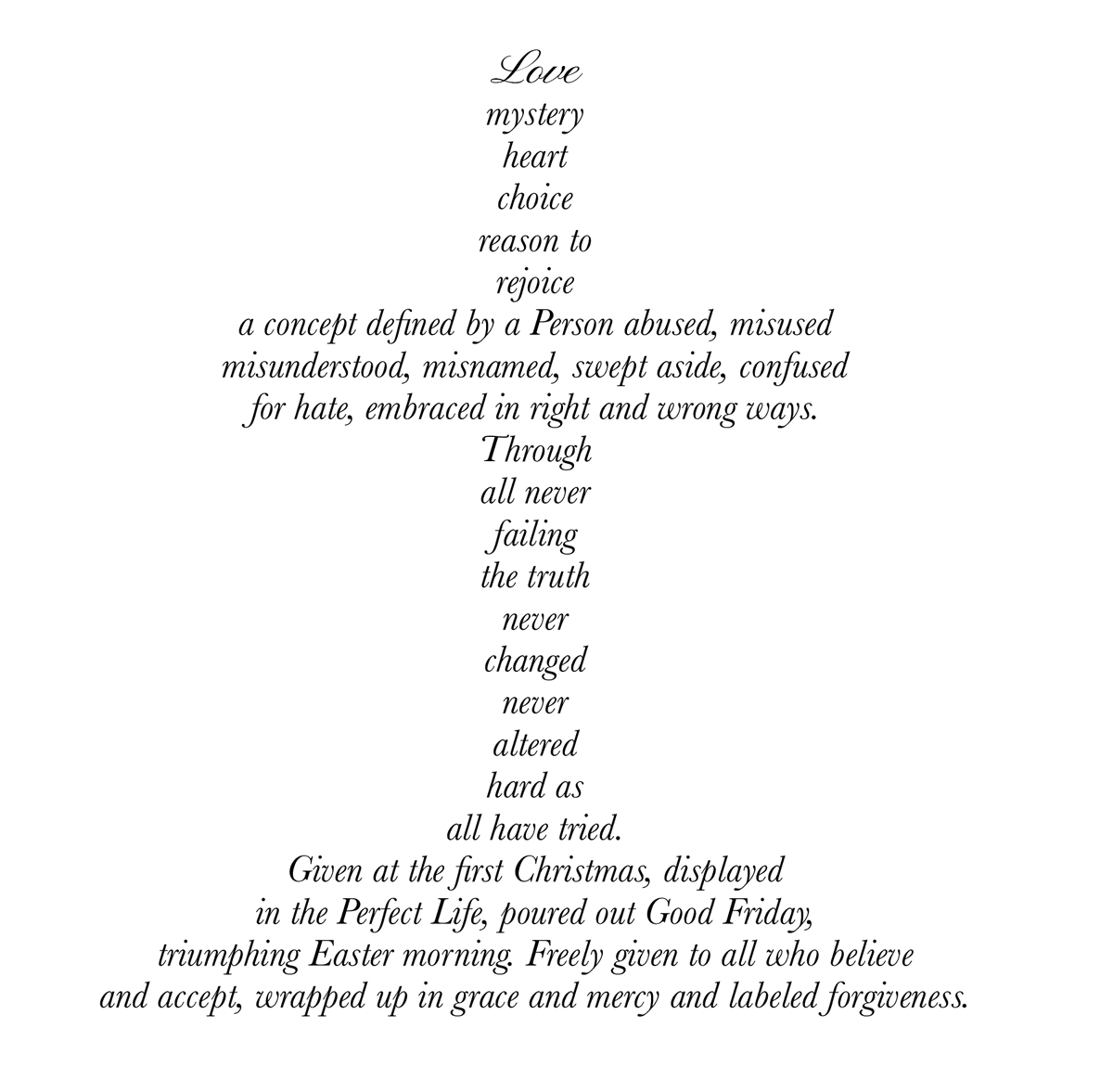
One of Andy Fairchild Publishing's authors (Lee Wesley) is about to release her book: "Earthsent." In it she has a poem (look closely and Merry Christmas):
If you don't like poetry, you are going to love the book "Flight of Wonder—Whispers to His Child." It is a book of poems written by Tracy Francis. amazon.ca/Flight-Wonder-… If you love poetry, you are going to love the book. It is written with such beauty and elegance—it is awe-inspiring. You sense God in every page, and He will open your eyes once again to the beauty all around you, as if you are looking at His creation through the eyes of a child. "How do I invite a reader into a place of intimacy—of surrender, rediscovery, and childlike wonder? These are not easy places to enter. They ask something of us. They ask us to slow down, to come honestly, and to be willing to remember what we’ve forgotten." — Tracy Francis I hope you buy the book. It will bless you and help you appreciate all that God has created.
Commas before participial phrases What word does the participial phrase start with in the following passage? "He guides me along right paths, bringing honor to his name" (Psalm 23:3, NLT). a) He b) bringing c) along d) to The Chicago Manual of Style (CMOS, 18th edition) states: "Participial phrases begin with a past or present participle and modify a noun . . . Likewise, a comma sets off such a phrase at the end of a sentence unless the phrase is used restrictively" (6.33). The answer is b). "bringing" is a present participle. "bringing honor to his name" is modifying the noun "He" but more importantly is modifying the verb "guides" and answers the question "why does he guide?" Therefore, the participial phrase "bringing honor to his name" is an adverbial participial phrase. The adverbial participial phrase "bringing honor to his name" is a nonrestrictive phrase. CMOS states about nonrestrictive phrases: "At the end of a sentence, a comma is necessary only when the phrase is used in a nonrestrictive sense, providing information that is not essential to the meaning of the rest of the sentence" (6.34). Psalm 23:3 is using the phrase in a nonrestrictive sense, and therefore, the comma before it is justified. To understand English grammar—buy and study my book: amazon.ca/Write-Simplici… To write your own book—buy and study my workbook: amazon.ca/How-Write-Publ…
Semicolons (not semi-colons) Which option most closely meets the conditions for when to use a semicolon? a) when your sentence is too long b) when your sentence contains many ideas c) when you have two independent clauses in a sentence that are closely related and are joined by a comma and a coordinating conjunction d) when you have two independent clauses in a sentence that are closely related but are not joined with a coordinating conjunction The Chicago Manual of Style (CMOS, 18th edition) 6.60 states: "In regular prose, a semicolon is most commonly used between two independent clauses not joined by a coordinating conjunction to signal a closer connection between them than a period would." The answer is d). "The Lord is my shepherd; I have all that I need. He lets me rest in green meadows; he leads me beside peaceful streams" (Psalm 23:1–2, NLT).
Browse these HEA (HFN) romances all month long; includes my gritty Christian romance novel, Wonder of Light: books.bookfunnel.com/nonxmasfreebie…
Read a free sample of my book on AllAuthor. #mybook #readasample #freechapters #mustread #ebooks #allauthor Read a Sample --> allauthor.com/preview/98647



Olusola Sophia Anyanw... @olusola_anyanwu
6K Followers 5K Following Loves God, family, pets. ACW. YGGS. Unife. Abuloma. Writer. Poet. Award Winning author. #BlackHistorypromoter #TheirJourneyonEarthtoHeaven,#TheCaptivesCrown
Mark Schultz @wordrefiner
61K Followers 64K Following Hyper-Speller and Proofreader. DM for book business only. Don't add me to a group w/o asking me 1st. A retired tinner, Air Force. NO PORN OR CRYPTO!
Damian Westfall Autho... @AuthorDamian
351 Followers 631 Following ✍️ Author 📚 Poems for Earth & The Quodlibet Sacred texts • Yehoshuai Faith 🌿✨
Curious write(Oyakhir... @Curious_Write
242 Followers 4K Following we tell stories, here for all indie authors
Jessica Scachetti, Au... @JessScachetti
15K Followers 14K Following #IndieAuthor #GrittyChristianRomance; Debut: @Wonder_of_Light Owner: @candlesbyJessS Beliefs: Christian ✝️ Bible=Truth; RP🚫= Endorsement of RP'd content; #NoDM
Bahitya 🇺🇬 @BahityaRonaldo
53K Followers 44K Following ⚽Bringing you daily updates on all Football legends and today’s biggest stars—all in one place! ( 18+ )👊
Author E. Masson @AuthorEMasson
2K Followers 1K Following Author E. Masson Global Book Award-Winning Author " EMPIRE OF BILLIONS: THE QUADRILLIONAIRE BROTHER"
✞ A.C.Tea ✞ (Alex... @Ninja4Jesus
32K Followers 5K Following Ps34:3 Mat 5:16 original poem and acapella song a day. Praying for revival. Love God and people here to help and edify. Any support is appreciated. God Bless!
Íñigo Goñi Davó @Inigogoni_
290 Followers 442 Following Periodista y filósofo. Sublime sin interrupción, como Umbral.
Michelle Liew Author ... @kwektsuilin
3K Followers 3K Following I am a professional freelance writer who loves pets, music and poetry!
Shivam Gautam @ishivamgautam
11K Followers 9K Following Power Electronics Enthusiast, also an Author/Researcher who is in the path of finding the unfound...
Rick Blevins @RickBlevins_777
13K Followers 7K Following Time is short-You Can Have Eternal Life:John 3:16-18,6:47 |Trust God's Plan:Jeremiah 29:11|Sealed For Redemption:Ephesians 1:13|Husband-Father-Brother-Patriot
Barbara Navarro #Boyc... @BarbaraNavarro
21K Followers 20K Following #Author #Artist #NewFantasyAdventureRainforestBookForChildrenJustOut! #Boycott Products of #Deforestation Gold, PalmOil #Boycott4Wildlife #BoycottGOLD4Yanomami!
Tim Herzog 🇺🇸�... @KingHerzog1
1K Followers 1K Following Award winning Author. Tweets are my own. Christian, Husband, Son, Teacher. MEd Social Studies. 32 years experience teaching.
AnUnimportantPerson @TheUn_important
30K Followers 25K Following Author of raw, unforgettable books. My debut 'An Unimportant Person' was compared to Spare. All are written for the three F's, Friends, Family, & Fun.
Meagan @MeaganEleene
79 Followers 125 Following Writes fantasy. Powered by snacks, chaos, and emotional damage. Accidentally traumatizes characters on purpose.
Angels With Guitars @AngelsWGuitars
4K Followers 5K Following Playlist Spotify: https://t.co/9Btj0PzRYK
Vivian Colebrooks @ReadersRoot
122 Followers 944 Following Spent months on your manuscript but stuck on what comes next? I help authors edit their work, pitch to publishing agentsbuild real sales momentum for their book
William J. Goyette @wjgoyette
3K Followers 3K Following Author of This Guy Walks Into a Bar and the Jake Hawksworth Thriller series: In Our Blood and Phobia; coffee fiend; Peloton fanatic; fair-weather runner
Adedayo Testimony @adedayotesty07
201 Followers 2K Following Book Promotion | Author Visibility | Book Trailers | Market Research for Authors | Helping indie authors reach readers.
Kira griffo @kiragriffoo
5K Followers 2K Following literary pro|📖 Turning pages like they hold secrets. 📚 Book whisperer by night, reality dodger by choice. #FictionAddict #QuietRebel
Sibusiso Anthon Mkhwa... @Critical_VP
4K Followers 7K Following 📖 South African 🇿🇦 Author 🏆 | 29 Self-Published Books 🎖 | Multi-Genre Storyteller ✍🏾 | GAMBLING WITH GHOSTS (Upcoming Series) 🔥
Driven Mindset @DrivenMindset01
136 Followers 106 Following Helping you become the best version of yourself, and that starts in the mind.
Victor Kohnen, Author @Nemoralis86
14K Followers 10K Following Pick the pains that are worth the trouble. Nemoralis, scholarly fool #writingcommunity #writerslift #AuthorsOfTwitter #fantasy #epicfantasy #followback
𝓛𝓪𝝂𝓮𝓷�... @LavenderKiss7
5K Followers 5K Following Create in me a clean heart, O God, and renew a steadfast spirit within me.🕊️✝️🤲❤️
Novelicious @noveliciouss
389K Followers 292K Following Join Me On Kickstarter On 13 October: https://t.co/FWjH36yoHo
Cobalt Lily 🌸💙 @Cobalt_LilyJ
19 Followers 156 Following Fearless in my pursuit of joy, and relentless in my chase of authenticity. 💫💙
🇺🇸🌺 Jess �... @J6ssicaWatkins
35K Followers 10K Following Patriot, Artist, Writer, Satirist, Girly Nerd, Serial Contrarian. Haram. Keenanite. Fmr: 11b-OEF '02-1/75th, Firefighter/EMT, J6 Political Prisoner. No DMs
Janice @Snuffledxx
568 Followers 4K Following That Awkward Moment when it`s all silent and someone says "awkward"
The Order of Light �... @OrdoLuminis
79K Followers 38K Following Christ First | King James I–Davenant Anglican | Creedal and Confessional | Union with Christ | Against Legalism and Antinomianism | Matt. 5:16
Philip Nation @philipnation
51K Followers 46K Following Encouraging you to be bold with your faith, life, and leadership. Publisher with @HCChristianPub & @NelsonBibles. Preacher. Professor. Author.
Michael J Carter @grand30515
1 Followers 2 Following


jesusfollowers7m @jesusfollowrs7m
297 Followers 2K Following
Lilia de Veris Auteur... @Lilia_de_Veris
196 Followers 570 Following 📚 Auteure de romances contemporaines & feel good 💕 Des histoires d’amour modernes qui font voyager ✈️ #Romance #Autoédition #Books #BookLover #RomanceBooks
Corey McLendon @AskForCorey
863 Followers 957 Following Artist 🎤Blogger✍️Activist✊🏾Serial Entrepreneur 💼Marketing Expert📈Real Estate Investor🏡 #AskForCorey #F4F #Motivational
Catholic Quotes @CatholicQuote12
81K Followers 4K Following Catholic/To support my endeavours:👉 https://t.co/f4yId3klFf
Jonathan Clarke @JESUSroseforUS
4K Followers 4K Following I have been saved by my Lord Jesus Christ from a painful eternity. | Get saved now - https://t.co/rYSkBLHBVn || Pray this now - https://t.co/sdKojwFMWk
Anchored in Truth @xitin623
766 Followers 3K Following Sharing hope, encouragement, and truth through faith in Jesus Christ. ✝️
Daniel Justice @BereanHouse
3K Followers 4K Following Christian Writer Philosophy of Religion/Science You don't have to lose your brain to follow Jesus. Just your pride.


CROSS & COUNTRY @kate224489
1K Followers 1K Following Faith. Freedom. Community. Here for honest talk & hope in a noisy world.
Ray Skilton @SkiltonRay
61K Followers 11K Following Christian Author. Jesus is my Lord & Saviour. NO DIRECT MESSAGES PLEASE! Fellowship at Jubilee Church, Maidstone. https://t.co/GHeFoSyLnc
Holy Bible @BibleVerses
292K Followers 130K Following posting beautiful verses daily 🙏 God bless! ❤️
Olusola Sophia Anyanw... @olusola_anyanwu
6K Followers 5K Following Loves God, family, pets. ACW. YGGS. Unife. Abuloma. Writer. Poet. Award Winning author. #BlackHistorypromoter #TheirJourneyonEarthtoHeaven,#TheCaptivesCrown
Curious write(Oyakhir... @Curious_Write
242 Followers 4K Following we tell stories, here for all indie authors
Rebecca A Clark | Aut... @authorrcclark
8K Followers 6K Following I am a 3x award-winning author. 2026 10th Annual Austin Spotlight Film Festival Official Selection. Wrote/editing books 2-5. Currently writing book #6. 📚✨
Robbee Thomas @RobbeeWrite
2K Followers 2K Following This account is primarily used for promotions for my creative work. Go to the website below for contact information. No DMs! #RobbeesReadingRainbow
Patricia @Patricia90003
206 Followers 1K Following Patricia, Book Promoter | Email Marketing|Book Trailers| Social Media| Content Marketing | Connecting Readers with Top Authors | Let's Connect
Abel Montero @monteroauthor
2K Followers 445 Following Author | Booktuber | THE CRIMSON FIRE is out now! 👇🏼📚▶️👇🏼
Author E. Masson @AuthorEMasson
2K Followers 1K Following Author E. Masson Global Book Award-Winning Author " EMPIRE OF BILLIONS: THE QUADRILLIONAIRE BROTHER"
Despoina | Book Desig... @DKemeridou
42K Followers 19K Following Book marketing design & strategy for indie authors and boutique presses — by an author who writes more poems than books. Owner of Graphindy. ~Dark Veil Society~
Cheyne Ausley @ausley56991
434 Followers 2K Following
KayKaul @forens123
23 Followers 15 Following Christ Follower (Jesus is the truth, the way and the life.) Im the conspiracionist who likes crazy fandoms.

Kyle Davison Bair @zkbair
217 Followers 561 Following Love Jesus. Love everyone. Speak the truth like you love the person you're talking to. And always ask good questions. Stay curious.
Lissette @Liz_529
25K Followers 4K Following Sharing the heart of the Father. Call to Me, and I will answer you, and show you great and mighty things, which you do not know Jer 33:3 Deep calls unto deep 🦅
Stephen Gerard @stephen72916029
22K Followers 11K Following Fundamental Independent Baptist Associate Pastor, Husband, Dad, loving Grandpa, Great Grandpa,and friend to all.
Bahitya 🇺🇬 @BahityaRonaldo
53K Followers 44K Following ⚽Bringing you daily updates on all Football legends and today’s biggest stars—all in one place! ( 18+ )👊
Gabriel Snowboy @GabrielSnowboy
225 Followers 966 Following Movie Enthusiast | Variety Gamer | Streamer | Habs Fan. Author of Galactic Holiday: The North Pole Awakens. Book: https://t.co/DCb9OucKIr via @Amazon
Garrett Jensen @realgajensen
13 Followers 42 Following LitRPG & Fantasy Author | 32 books & counting | 3 free books for subscribers on Substack
E.L. Lyons, Dark Epic... @Lyons_Pen
4K Followers 4K Following Author of Starlight Jewel, first book in the Gifts of the Auldtree series, no AI, AI witch hunter, is not taking suitors at this time
Jessica Scachetti, Au... @JessScachetti
15K Followers 14K Following #IndieAuthor #GrittyChristianRomance; Debut: @Wonder_of_Light Owner: @candlesbyJessS Beliefs: Christian ✝️ Bible=Truth; RP🚫= Endorsement of RP'd content; #NoDM
T.C. Pendragon @tcpendragon
520 Followers 529 Following Author • Editor • Publisher • Promoter • Ghostwriter • Proofreader • Formatter • Author Coach • Facilitator • Director of Pendragon Books
Diane Nichols @DNicholsAuthor
11K Followers 5K Following Author✍️| Magazine Journalist| Ghostwriter📚| Hopeless Twitter, GIF & Hashtag Addict - Rep'd by Robert Diforio @d4eo #writingcommunity
Íñigo Goñi Davó @Inigogoni_
290 Followers 442 Following Periodista y filósofo. Sublime sin interrupción, como Umbral.
Peter Ong @peterongkl
2K Followers 243 Following Japanese Language & Mandarin Trainer | Podcast Host | Whiteboard Animation Video Creator | Transforming Lives Through Language Learning & Podcasting
Daniel EG @DanielEGUgbah
979 Followers 958 Following Your gift is your voice. Protect it. Grow it. And never let anyone convince you that it is too small to change the world.. https://t.co/Bu9ZGB685a
Nate The Lawyer @NatetheLawyer
113K Followers 414 Following Youtube Lawyer Check me out on: Locals | https://t.co/mg7UFeBUC3 Rokfin | https://t.co/ziw0lSi217
Nomwesigwa 🇮🇱 @Nomwesigwa07
14K Followers 7K Following Mark 16:15 And he said unto them, Go ye into all the world, and preach the gospel to every creature.
Mary York @Mary_ork
8K Followers 8K Following Helping authors get their books seen, read, and appreciated | Book marketer & publisher passionate about supporting writers and great stories
Ken Lussey @KenLussey
5K Followers 5K Following Author, photographer, traveller, husband, father, grandfather and lover of Scotland and all things Scottish.
Anna Mead (The Book G... @annamead551
5K Followers 7K Following Book Marketing Expert. I build the trends your readers follow. Strategy. Branding. Momentum. DM let’s collab. #indieauthor #booktwitter
Bryan Hepp @BHepp1105
2K Followers 1K Following For God has not given us a spirit of fear, but of power and of love and of a sound mind. What is your relationship with Jesus Today ASK Him into your Life
𝐁𝐞𝐧𝐣𝐚�... @TheBelieverJC
90K Followers 7K Following The time has come; the kingdom of God is at hand. Repent and believe this good news: Jesus is coming soon ✞
𝓕𝓸𝓻𝓰𝓲�... @TheonlywaytoGod
22K Followers 3K Following Jesus Christ died for our sins. He was buried and He rose again the third day according to the Scriptures. (See 1 Cor. 15:1-4, Acts 16:31)
Shivam Gautam @ishivamgautam
11K Followers 9K Following Power Electronics Enthusiast, also an Author/Researcher who is in the path of finding the unfound...
Jesus loves you! @aluko_aanu
981 Followers 1K Following A child of God. Lawyer. Author. Feminist. Living life. @EberesGIFTHUB.
Dyrk Ashton @UnDyrk
13K Followers 11K Following Now: Author of The Paternus Trilogy & Kraken Rider Z, Professor of Film. Then: #SPFBO Finalist, Actor, Filmmaker. Always: Knucklehead. https://t.co/O6y9rmGAYW
Michelle Liew Author ... @kwektsuilin
3K Followers 3K Following I am a professional freelance writer who loves pets, music and poetry!
Barbara Navarro #Boyc... @BarbaraNavarro
21K Followers 20K Following #Author #Artist #NewFantasyAdventureRainforestBookForChildrenJustOut! #Boycott Products of #Deforestation Gold, PalmOil #Boycott4Wildlife #BoycottGOLD4Yanomami!
Tim Herzog 🇺🇸�... @KingHerzog1
1K Followers 1K Following Award winning Author. Tweets are my own. Christian, Husband, Son, Teacher. MEd Social Studies. 32 years experience teaching.
AnUnimportantPerson @TheUn_important
30K Followers 25K Following Author of raw, unforgettable books. My debut 'An Unimportant Person' was compared to Spare. All are written for the three F's, Friends, Family, & Fun.
Meagan @MeaganEleene
79 Followers 125 Following Writes fantasy. Powered by snacks, chaos, and emotional damage. Accidentally traumatizes characters on purpose.
Angels With Guitars @AngelsWGuitars
4K Followers 5K Following Playlist Spotify: https://t.co/9Btj0PzRYK
NW Martin Author @NWMartinBKS
446 Followers 661 Following Books by N. W. Martin and more — bestsellers, hot new releases, and trusted reviews for readers who love great stories.✨
Catholic Quotes @CatholicQuote12
81K Followers 4K Following Catholic/To support my endeavours:👉 https://t.co/f4yId3klFf
Anchored in Truth @xitin623
766 Followers 3K Following Sharing hope, encouragement, and truth through faith in Jesus Christ. ✝️
Lilia de Veris Auteur... @Lilia_de_Veris
196 Followers 570 Following 📚 Auteure de romances contemporaines & feel good 💕 Des histoires d’amour modernes qui font voyager ✈️ #Romance #Autoédition #Books #BookLover #RomanceBooks
jesusfollowers7m @jesusfollowrs7m
297 Followers 2K Following
𝓛𝓪𝝂𝓮𝓷�... @LavenderKiss7
5K Followers 5K Following Create in me a clean heart, O God, and renew a steadfast spirit within me.🕊️✝️🤲❤️
P.F. Donato, Author �... @PFDonato
48K Followers 19K Following Author & Screenwriter of #fantasybooks #scifibooks Serving the #WritingCommunity & #ReadingCommunity since 2013 Look for ADD YOUR LINK to showcase your workYou might like