Adam Sanchez-Ayte @asanchez75
R & D engineer. My interests mainly cover the area of Knowledge Representation, Computer Science, and Philosophy. cambio.name Grenoble, France Joined March 2007-
Tweets7K
-
Followers646
-
Following3K
-
Likes7K
A bit of news: After nearly 9 years, I have decided to leave Google DeepMind and join Anthropic (after taking some time to recharge). I am incredibly grateful for my time at GDM. @demishassabis took a real chance letting me lead the AlphaFold team just six months after finishing my PhD, and the entire GDM team taught me so much about how to do great science. GDM is a special place, and I’ll still be excited to hear about what amazing things they discover next.
TODOS SOMOS PERUANOS: Si esta elección tiene una particularidad, es que puede terminar, por tercera vez, con una diferencia menor al 1% de los votos. Pero hay otra singularidad: quizá sea el único caso en que una candidatura llegue a la presidencia gracias al voto de los peruanos en el extranjero. Roberto Sánchez gana en el territorio nacional, pero Keiko Fujimori lo supera fuera del país. Ese dato ha abierto una discusión equivocada. Algunos cuestionan el derecho al voto de los peruanos en el exterior, como antes otros propusieron volver al sufragio censitario -reservado a alfabetos o mayores contribuyentes- para reducir el peso del sur andino. Cambian los destinatarios, pero no la lógica: cuando un sector vota distinto a lo esperado, se busca disminuir su ciudadanía. Ambas posiciones son nocivas y antidemocráticas. Aquí se cruzan dos asuntos: el derecho al voto, expresión de una ciudadanía transnacional, y la orientación política de quienes residen fuera. Al enterarse de lo segundo, algunos reaccionan contra lo primero. Pero el peruano no deja de ser ciudadano porque vive en otro país. La residencia no extingue derechos ni vínculos. Además, esos vínculos no son solo afectivos. Las remesas alcanzaron en 2025 un récord de US$5,368 millones, 11,7% más que en 2024, equivalente al 1,6% del PBI. El Perú fue uno de los primeros países de América Latina en reconocer el voto de sus ciudadanos en el exterior en elecciones nacionales, desde 1980. Entonces representaban apenas el 0,6% del padrón electoral. Hoy son 1’210,813 electores hábiles, el 4,4% del padrón nacional. Si fueran una circunscripción territorial, serían la quinta en tamaño electoral entre 27. Esta presencia creciente no es una anomalía peruana. También se observa en Colombia, República Dominicana o El Salvador. Otra cosa es discutir cómo votan. En el caso peruano, los electores en el exterior han mostrado una inclinación mayoritaria hacia opciones de centroderecha y derecha. Ese comportamiento merece análisis: trayectorias migratorias, condiciones laborales, integración, distancia con la política cotidiana del país y percepción de orden. Pero explicar una orientación electoral no autoriza a restringir derechos. El voto no puede defenderse solo cuando favorece a quien uno prefiere. La democracia se prueba cuando el resultado incomoda. Si se cuestiona el sufragio de los peruanos en el exterior porque inclina una elección, mañana se podrá cuestionar el de una región, una clase social, una edad o una comunidad. El sufragio universal no es una concesión revocable según el resultado, sino un derecho adquirido y una conquista democrática. Defenderlo no significa apoyar a Keiko Fujimori ni a Roberto Sánchez. Significa defender la regla que permite que todos, dentro o fuera del territorio, sigan siendo parte del Perú. #EleccionesPerú2026 #peruanosenelexterior


This Google DeepMind’s paper is a serious warning for anyone using autonomous agents today. Gives the first clear taxonomy of 6 attack types where harmful websites can detect AI agents and show them hidden content humans never see, like - Instructions buried in HTML comments or white-on-white text - Steganography in image pixels - Override commands in PDFs, metadata, or even speaker notes - Memory poisoning that persists across sessions - Goal hijacking and cross-agent cascades in multi-agent setups The real security problem for AI agents is not just the model, but the environment it reads. The web itself can be weaponized against autonomous AI agents. As agents increasingly browse the internet, read emails, execute transactions, and spawn sub-agents, the information environment becomes an attack surface. In one cited benchmark, hidden prompt injections embedded in web content partially commandeered agents in up to 86% of scenarios, sub-agent hijacking working 58–90% of the time, and data exfiltration attacks clearing 80% across five different agent architectures. That reframes the whole debate. We usually talk about model safety as if the danger sits inside the weights, but agents do something more fragile: they browse, retrieve, remember, and act on untrusted material in real time. Here’s the thing to worry about. A web page does not have to look malicious to be dangerous to an agent, because the agent may parse what humans never see: hidden HTML comments, metadata, CSS-hidden text, formatting syntax, or adversarial content embedded in images and other media. The threat gets more serious once memory enters the loop. If an agent uses RAG or persistent memory, poisoning no longer has to win in one shot. It can sit quietly in a corpus or memory store and activate later, which is why the paper highlights results showing latent memory poisoning above 80% attack success with less than 0.1% data contamination. --- ssrn .com/sol3/papers.cfm?abstract_id=6372438


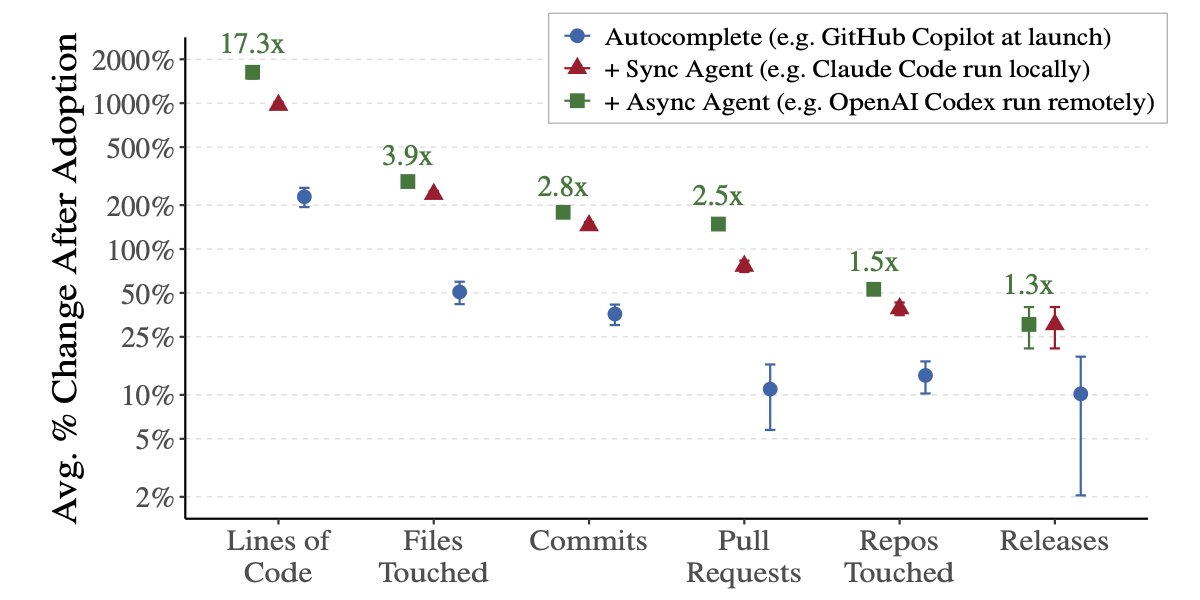
Big paper on AI coding agents using Github & other data The auto-complete tools (Copilot) led to 2.2x more code, local agents like original Claude Code led to 7.4x, & current remote coding agents 17.3x(!) But human bottlenecks in coding means actual releases "only" went up 30%


A new and possibly controversial perspective: In this video, I explain the sense in which generative AI trained by supervised learning is incapable of making novel discoveries. youtu.be/K5LAFEjTlBA The text of the speech: AI Creativity and Discovery Good day ladies and gentlemen. I regret that I am unable to be with you all today to engage in a back-and-forth discussion, but I am nevertheless pleased to be able to share with you, via this recording, some high-level thoughts about the current and future state of artificial intelligence, and in particular about AI’s relationship to science and mathematics, which is, as I understand it, the central focus of this meeting and of the SAIR Foundation. I would like to start with an old joke; I am sure you have heard it before. It is the one about the researcher whose work is being evaluated, and the review comes back, and says “This work is both novel and good. Unfortunately, the parts that are good are not novel, and the parts that are novel are not good.” My first point about AI is that this assessment applies exactly to large parts of AI as we know it today. Not all of today’s AI, but a large part of it. Pretty much all of what we mean by “Generative AI”---which includes large language models, and the images and video models, and even the new methods for learning world models. All of these AIs take large numbers of examples and produce a “model” which behaves similar to the examples, that is, which generates text like people, or images like artists or nature, and videos like we find on the internet. Don’t get me wrong, Generative AI can be extremely useful. No doubt about that. But the assessment of the joke still applies. These systems can produce output that is both novel and good, but not at the same time. In many ways this is just absolutely not a problem. When we ask an AI for an answer from the internet, or to summarize a document, we don’t want it to be novel. We are happy if the quality of the answer, the goodness, comes from the source material—from the people who wrote the document or the articles on the internet. If the AI’s answer is novel it means it is going beyond the source material, adding something beyond it. This is what we call “hallucinations”. In most cases, we don’t like it when the AI makes something up, when it adds something novel. One exception, of course, is when we are looking not for facts or reality, but for fiction and entertainment. We might ask for a bedtime story for a child, or an image based on existing images on the internet but which is nevertheless different and distinct from them. In these cases, it is never easy for us to know how creative the AI is actually being, as we do not know how close the AI’s story, poem, or image is to the source material. In a real practical sense we can not know this because the internet is too big, the possible sources that the AI may draw upon are too numerous. When we ask for a fiction or novelty, the AI can give it to us because its processing is in part stochastic. Every decision can go multiple ways and will go different ways and produce a different trajectory every time. The trajectory can be random—and thus novel—or it can be based on the training data—and thus “good” because the training data is good, sourced from people or reality. Thus, the trajectory is either novel or good—based on randomness or based on data—but never both at the same time. Really, I think it is okay if the output of Generative AI is never good and novel at the same time. For the researcher in the joke this is a devastating criticism, but for most things it is not, and for Generative AI it is not. Generative AI is meant to be a mimic. This is what supervised learning is for. Generative AI can be extremely useful, even when it just mimics, if it is faster, or cheaper, or smaller, or more customizable, or more copy-able, than the thing being mimicked. It is okay if Generative AI cannot be both novel and good at the same time. It is still a transformative technology. But it is a limitation. And remember we are here to use AI for science and mathematics, and for these areas the assessment of the reviewer in the joke is devastating. For these areas we need true creativity and discovery. Generative AI—or Mimicking AI—will never get where us there. For these we need something more, and indeed we have something more in other parts of AI. We have many AI systems which can give us more. We have AlphaGo with its world-changing move 37, or AlphaZero with its brilliant original chess-playing style. We have GT-Sophy that drives simulated racecars better than any human. We have AlphaFold and AlphaProof and Claude-Code, which have brought true advances in science, mathematics, and programming. We have RL-Lyft which optimizes the assignment of cars to passengers in the ride-hailing business. All these systems have found things that are both novel and good. And, truth be told, some language models have been augmented in ways that make them more than Generative AI based on supervised learning. All these systems have some additional features that make them capable of true creativity and true discovery. It is important for us to recognize what this is—and that it is not present in ordinary, garden-variety Generative AI. It is something that can not come from just supervised learning, from learning from examples. What is it? Well, it is a simple thing, a commonsense thing. It is not new. We have many names for it, but unfortunately none of them are very good names. I will call it Discovery. Basically, Discovery is just the idea of trying many things and seeing which of them work, then keeping those that worked the best. Evolution by natural selection works this way. The scientific method works this way. And just ordinary life and learning works this way. We try things and remember what works. What could be more obvious? In this behavioral case, psychology has two names for it— “instrumental learning” and “operant conditioning”—and in machine learning it is what we mean by “reinforcement learning”. We also see the idea of Discovery in planning and combinatorial search—anything that involves the idea of “generate and test”. The essence of Discovery is to combine three steps: 1. Variation, 2. Evaluation, and 3. Selective retention. Of course, I am not the first to say this. I am not the first to point out that this combination of steps is key to science, to evolution by natural selection, and to animal behavior. I think particularly of papers by Donald Campbell, by Daniel Dennett, and by Gary Cziko. What is new in my remarks is to directly relate the idea of Discovery to modern AI to help us see that it is not present in supervised learning or Generative AI—in particular, that Discovery is not present in backpropagation or gradient descent. Let me say explicitly what is missing from Generative AI. As we have remarked, these systems do have a stochastic aspect, so they do generate a variety of trajectories and behavior. What is missing is the Evaluation step. The generator was pre-trained by supervised learning, leaving no way at runtime to Evaluate what it generates. And of course without Evaluation there can be no Selective retention, and thus no Discovery. The variation can bring novelty, but without evaluation there is no Discovery, and arguably, no creativity. That is, I would say that creativity requires that the new things generated be Evaluated. Without evaluation, and retention of the best, there is nothing created. The novelty flickers into existence but, if its value is unrecognized, it flickers away and is lost. In many cases, Evaluation is done by people to make a discovery. As when we have Generative AI make many pictures for us, and then we pick the one that we like the best. The human+AI system completes the discovery. In many other cases, the Evaluation comes from a clear objective. Some moves lead to checkmate, some steps lead to a proof, some actions result in high reward, some genotypes make more copies, some theories explain the data better. Some prefer the Variation step to be called Blind variation, where “blind” here means that it is uninformed, a shot in the dark. It does not need to be completely uninformed; a good scientist does not select theories to test at random. But neither can it be completely informed and determined. There must be some uncertainty about where the answer lies in order for there to be a discovery. In practice, the variation is partly informed and partly blind, but it is the blind part that corresponds to the discovery. Now let us briefly go all the way to modern deep learning, to the backpropagation algorithm. At first it might seem that backpropagation is incapable of discovery because it is deterministic and thus incapable of variation. But this is not correct. The weight updates of backprop are deterministic, but the weights are initialized to small random values. The random initialization is often downplayed, but in fact it is a necessary form of variation; it must be done properly to get good performance. In backprop this Variation is done once, at network initialization, so its effect is temporary, and later the network may lose its ability to learn. This is the weakness of deep learning that is alleviated with a new algorithm that my group presented in Nature a couple of years ago. Our “continual backpropagation” made one small change: every so often a less-used neuron would be re-initialized to small random weights. This allows the variation to continue and plasticity to be retained. Although there is much more to be said about Creativity and Discovery, this is the key point: they are more than supervised learning, more than pattern recognition, more than prediction, and more than world modeling. Those things are important, but they alone will not bring us to discovery. Discovery requires Evaluation from a person or from an explicit goal, and only in the latter case will we attain full autonomy. So that is my call to arms. If we want the full power of AI scientists, then we should share the goals with them so they can create, evaluate, discover, and in these ways fully participate in achieving the goals. Let’s be bold! Let’s fully automate Creativity and Discovery!
brilliant
I wrote up how I built the shitty robot so you can too. This was a fun project that will keep on giving. Thanks to all the open weights folks out there, without whom this would not have been possible. mariozechner.at/posts/2026-05-…
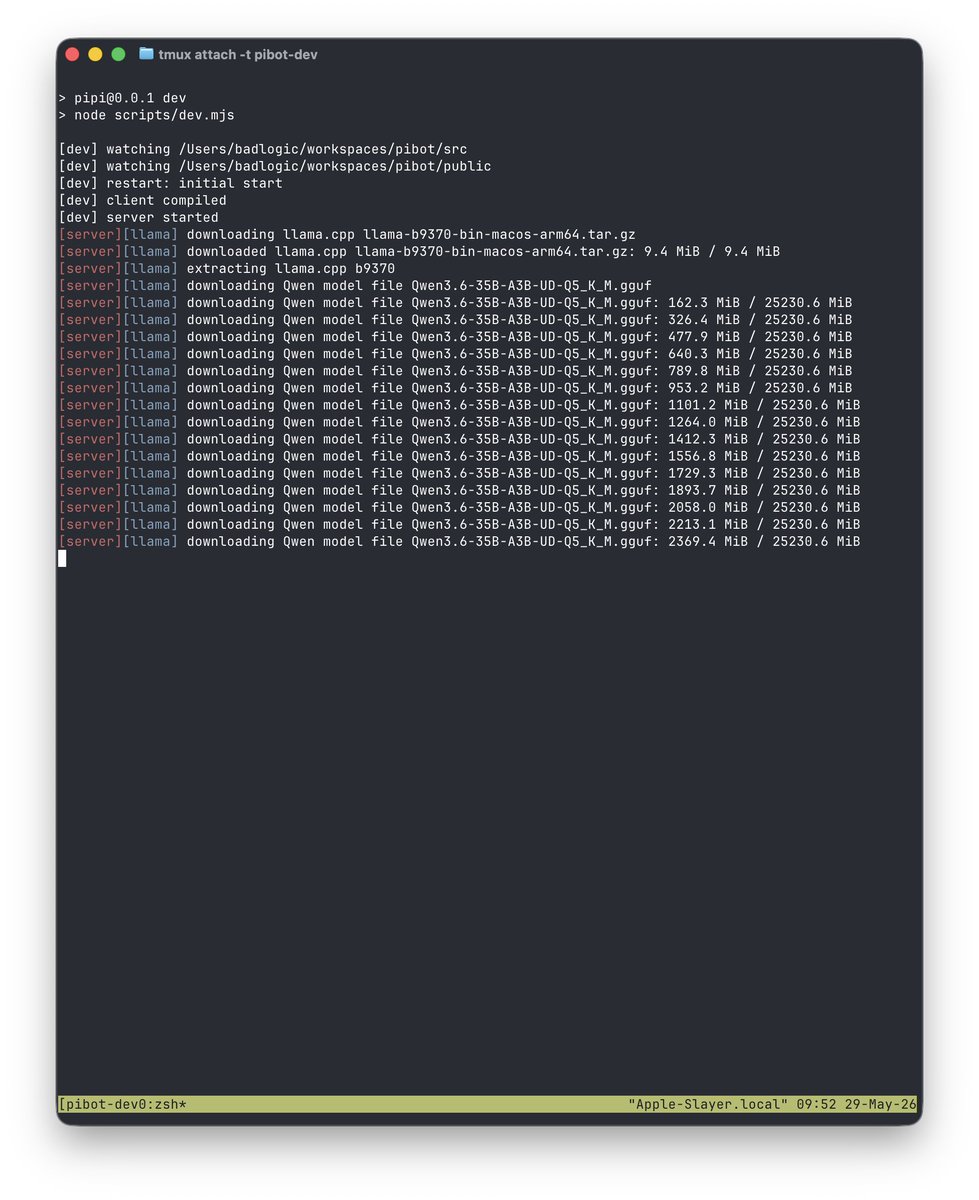
pibot is now running fully local, using parakeet for STT, qwen3-tts for TTS, and Qwen 3.6 as the local multi-modal LLM via llama.cpp. The STT and TTS inference engines are Rust/mlx-c based. Ported from Python. So, zero Python dependencies :D
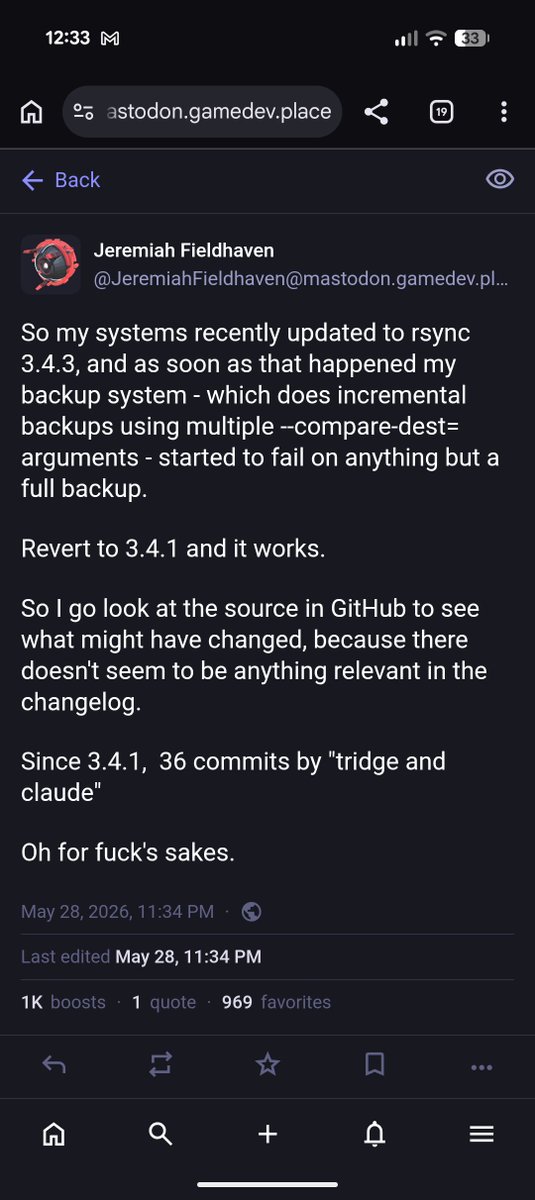
More musings after some people got upset about the word clanker. lucumr.pocoo.org/2026/5/26/clan…
more recommended reading arxiv.org/abs/2212.03551 deepmind.google/research/publi…
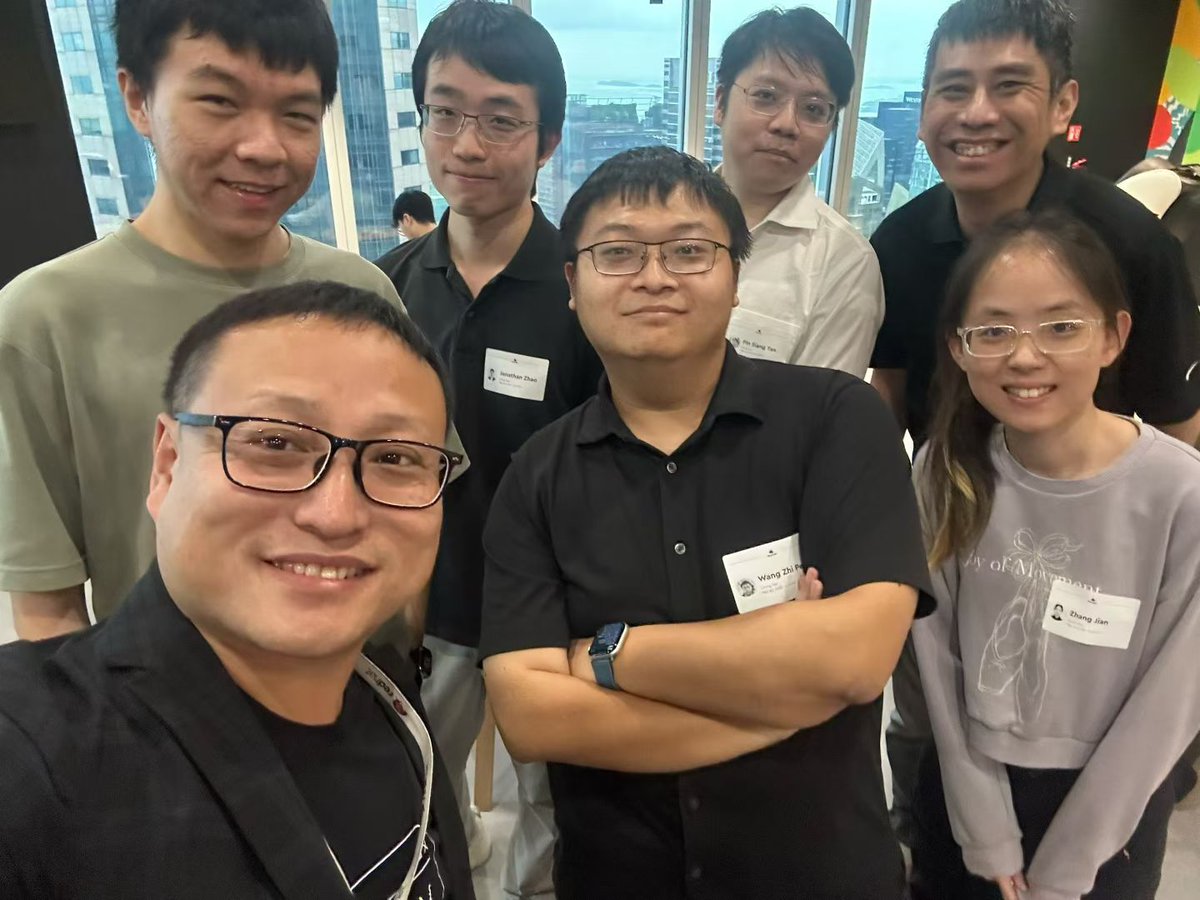
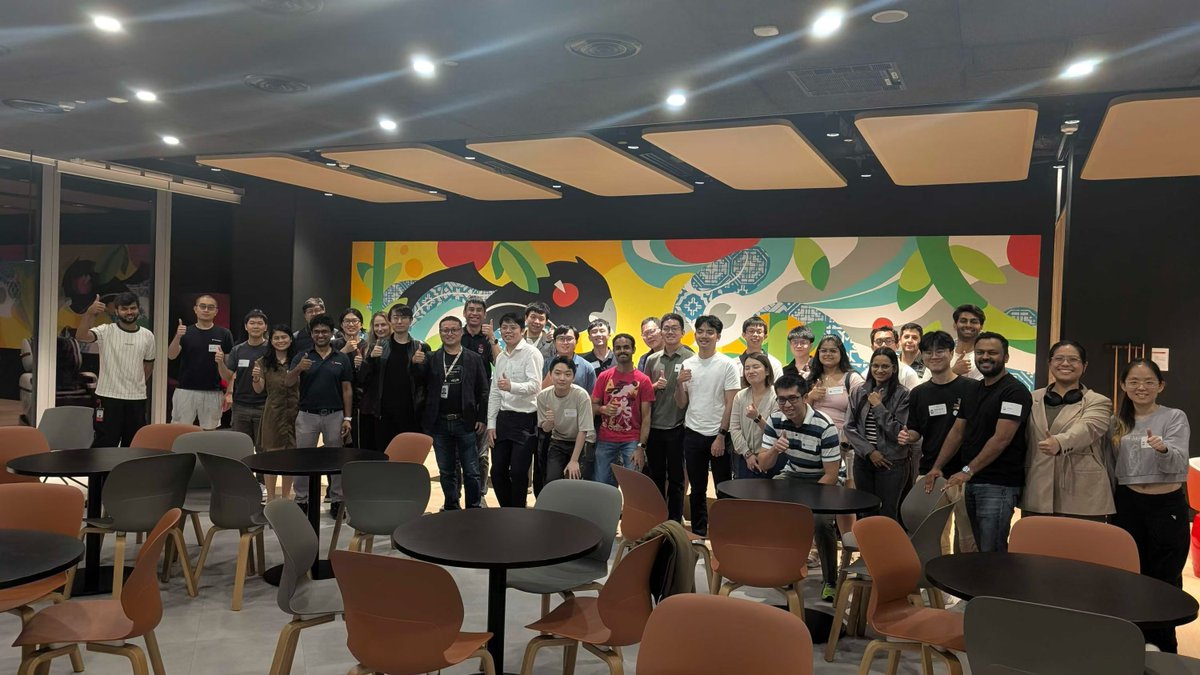
🦀 The Rust frontend is officially merged into vLLM! As GPUs get faster, the frontend has become a real share of CPU time. The new Rust frontend is a drop-in alternative to the Python API server — same engine, same ZMQ boundary. Opt in with VLLM_USE_RUST_FRONTEND=1. Early numbers: on a preprocess-heavy workload, ~837 req/s vs ~162 req/s for default Python — ~5x in a single process. A few design choices we're excited about: • Layered crates with clear boundaries • Stream-native pipeline — non-streaming for free • Builds on stable Rust Huge thanks to @BugenZhao from @inferact for introducing the work at @PyTorch Meetup Singapore. github.com/vllm-project/v…


Finally, a big name has the courage to tell it: we are nowhere near AGI. Demis Hassabis, CEO of Google DeepMind and Nobel laureate for AlphaFold, put it neat and clear: "Today's systems are nowhere near [AGI]. Doesn't matter how many Erdős problems you solve… I think it's far, far from what a true invention, or someone like Ramanujan, would have been able to do." This is the elephant in the room that many AI enthusiasts prefer not to see, or are actively trying to hide. Erdős problems are well defined, often combinatorial, on finite spaces. They are exactly the kind of problems on which current AI can achieve spectacular performance with a lot of compute and knowledge. A neural network can search a huge graph of possibilities. It can recombine existing knowledge at unprecedented scale. It can discover surprising solutions inside an already defined conceptual space. But true invention is something else. True invention is not only solving a problem. It is inventing new objects, new dimensions, new connections. It is inventing new problems. From resolving to inventing there is a discontinuity that we don't know how to bridge. We are making extraordinary tools. But we are nowhere close to AGI.

We have an arxiv paper up describing the work in more detail here: arxiv.org/abs/2605.20706. Also want to call out that there is even more room for improvement, some recent updates to wllama by @ngxson mean it's even more memory efficient than what we describe in the paper!


Highlighting the new WebGPU backend in llama.cpp/ggml The work to bring full-fledged WebGPU support in llama.cpp started about an year and a half ago. It has been lead by @reeselevine and team at USCS. For more information, checkout the interactive blog and paper in the quoted post. Here are 2 excerpts from the paper, summarizing the implemented software architecture.
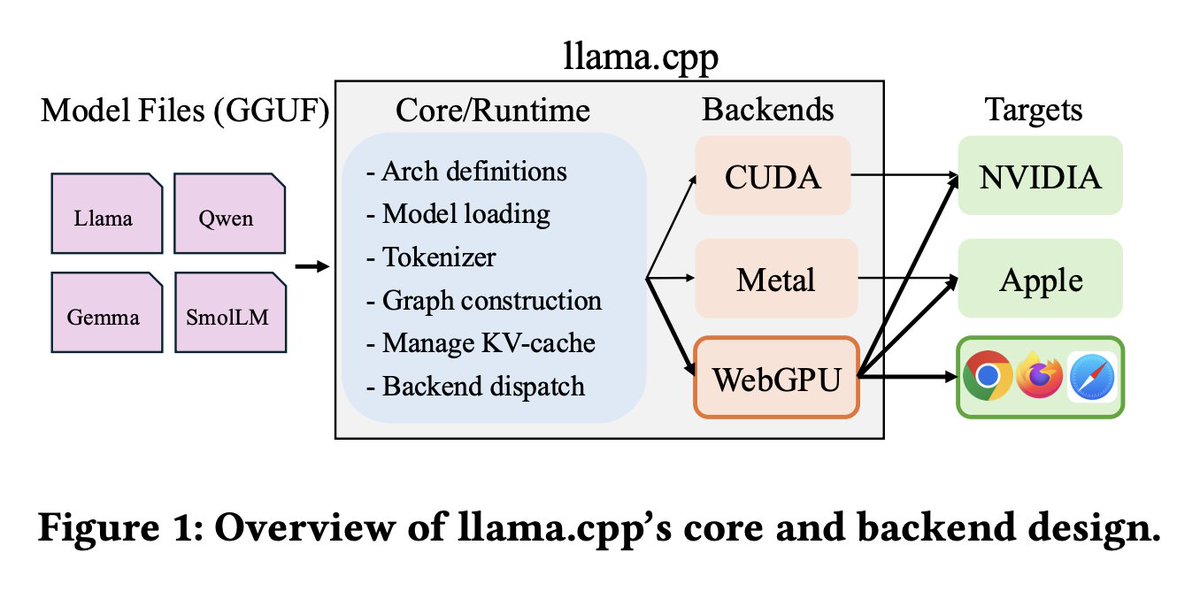

WebGPU support in llama.cpp is here! Check out our blog post introducing it: reeselevine.github.io/llamas-on-the-… Run local models in your browser, with GPU acceleration. No data leaves your computer! Thanks to everyone who's made this possible, especially @ggerganov

I released the first alpha of Datasette Agent - a conversational AI assistant for Datasette that can answer questions about data in SQLite databases, and can be extended with plugins to add extra tools and features Here's a demo

Personal update: I've joined Anthropic. I think the next few years at the frontier of LLMs will be especially formative. I am very excited to join the team here and get back to R&D. I remain deeply passionate about education and plan to resume my work on it in time.

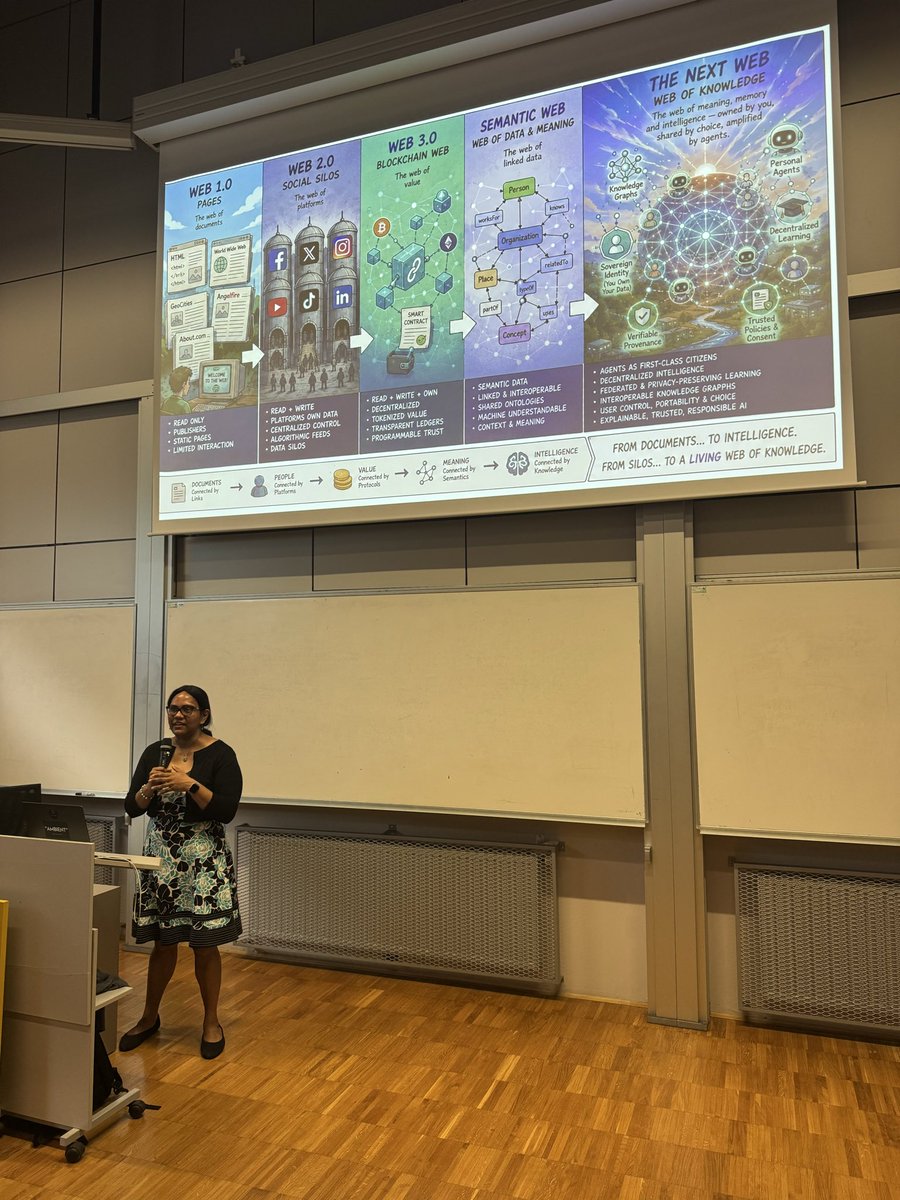
Brilliant leaders in semantic web @oshaniws of @rpi and @origin_trail’s @BranaRakic taking the audience to the next generation shared context graphs for verifiable AI.


A researcher spent two years documenting what AI is doing to the way humans think. His conclusion fits in one sentence. AI is standardizing human thought. Across societies. Across cultures. Across generations. Simultaneously. At a scale no technology in history has ever achieved. The paper is called "The Impact of Artificial Intelligence on Human Thought." Published July 2025 on arXiv. Written by independent researcher Rénald Gesnot, categorized under Computers & Society and Human-Computer Interaction. It is not a benchmark paper. It is not a capability paper. It is something rarer — a systematic analysis of what happens to human cognition, creativity, and intellectual diversity when billions of people outsource their thinking to the same machine. Here is the mechanism the researcher describes. When you ask an AI a question, you get an answer shaped by the model's training data, its fine-tuning, its alignment process, and the preferences of the company that built it. That answer is not neutral. It reflects a specific set of values, framings, and assumptions. Usually Western. Usually English-dominant. Usually optimized for engagement and approval. When 500 million people ask the same AI similar questions and receive similar answers, those answers become reference points. People quote them. Build on them. Argue from them. The diversity of starting points — different cultures, different intellectual traditions, different ways of framing problems — begins to compress. The researcher describes this as cognitive standardization. Not censorship. Not propaganda. Something subtler and harder to reverse. A gravitational pull toward the outputs of a small number of models, trained by a small number of companies, reflecting a small number of worldviews. The paper also documents algorithmic manipulation — AI systems that exploit cognitive biases to influence behavior. The way recommendation algorithms produce filter bubbles. The way AI-generated content exploits confirmation bias. The way personalization systems learn what you already believe and feed it back to you amplified. And then the creativity question — the one nobody wants to answer directly. When AI can produce a poem, an essay, a business plan, or a research summary in seconds — and when that output is often indistinguishable from or preferred over human-generated content — what happens to the human practice of creating those things? Not the output. The practice. The struggle. The failure. The slow development of a personal voice through years of imperfect attempts. The researcher argues that cognitive offloading — delegating thinking tasks to AI — does not merely save time. It atrophies the mental capacity that the offloaded task was building. Microsoft and Carnegie Mellon found this empirically in 2025: higher AI trust correlates directly with measurably lower critical thinking. The researcher provides the theoretical framework for why. The paper ends with a question the researcher admits he cannot answer. Once a generation grows up with AI as the default thinking partner — once the habit of outsourcing cognition is formed before the habit of independent thought is developed — what does intellectual autonomy even mean? And is it already too late to find out? Source: Gesnot, R. · "The Impact of Artificial Intelligence on Human Thought" · arXiv:2508.16628 · arxiv.org/abs/2508.16628 · July 2025
We are LIVE now! Great turnout for the AMA session with Jim & Deborah, moderated by @LarrySwanson ! This is getting us even more excited for the upcoming conference in NYC on May 4–8 😉

This is the single best framework I’ve seen for understanding AI. Terence Tao, arguably the smartest mathematician alive, just dropped a paper with Tanya Klowden on arXiv called “Mathematical Methods and Human Thought in the Age of AI.” The core idea: a “Copernican View of Intelligence.” Stop thinking of AI on a line from “dumb” to “superhuman.” That’s the wrong axis entirely. AI excels at BREADTH. Humans excel at DEPTH. Tao himself said AI has made his papers “richer and broader, but not necessarily deeper.” That’s not a limitation. That’s the entire playbook. Stop trying to replace yourself with AI. Start using it to cover the 90% of surface area your brain physically can’t. The people who get this are already 10x more productive. The rest are still arguing about whether AI is “smart enough.” Reframe your point of view from “smarter” to “different”. Human + AI > either alone. The math on that has never been clearer.

Terence Tao proposes what he calls a "Copernican view of intelligence". Instead of buying into the common, one-dimensional narrative that artificial intelligence will simply evolve from "subhuman" to "superhuman" and ultimately make humanity entirely redundant, Tao urges us to

Jacqueline Fowks @jfowks
134K Followers 7K Following Journalist covering Perú Current https://t.co/ezhuYT9uKf https://t.co/ERavolBOBJ Past https://t.co/SAQmtFtB8j
Cholega @Cholega
16K Followers 3K Following Política, Ciencia, Tecnología y Religión 🇵🇪🚴🏾🦠🦖☄️🚀🙉👑🤜🏽👨🏾🌾👩🏻☠️🧑🏼🍳 https://t.co/Z7JXlsrNNH https://t.co/O1A2g7MEUG https://t.co/6NAW9gSkiR
el dulce alivio @litolobo
46K Followers 7K Following Esta cuenta es para divertirme. Para estar triste tengo otra, la del banco. Este canal no solidariza necesariamente con las opiniones vertidas por su admin.
Rosario Sasieta @Rosario_Sasieta
141K Followers 2K Following Ya no soy Congresista... tampoco Ministra 😁💃 ¡pero siempre seré tu Señora Ley! Síganme también en mi cuenta alterna @SasietaRosario
KGC Workshop (Inactiv... @kgc_workshop
1K Followers 401 Following KG Construction Workshop and disseminating the work under the W3C KG Construction Community Group. Inactive account, please follow us in Bluesky
Pascal Hitzler @pascalhitzler
2K Followers 1K Following https://t.co/O0JexZaYn8 All opinions are my own and do not necessarily reflect any employer(s).
ESWC Conferences @eswc_conf
3K Followers 717 Following The official account of the Extended Semantic Web Conference. 🗓️ ESWC 2025 - 22nd edition | June 1-5 | Portoroz #ESWC2025


Freddy Priyatna @freddy_priyatna
789 Followers 2K Following Knowledge Graph Architech at Gainwell Technologies. Topics of Interest: Data Integration, Semantic Web, Linked Open Data, Knowledge Graph
clairee18 @Tekkahraman59
0 Followers 136 Following collecting sunsets and follow backs 🌅 follow back

woisau @woisau1
937 Followers 1K Following Investor & $TRAC holder 🚀 | Scaling @Origin_Trail | Exploring AI, trust & decentralized futures | Sharing insights & strategies
ATUK @ATUK_ce
722 Followers 593 Following ATUK Consultoría Estratégica | Redefining the relationship between humanity and nature
DataGrail @DataGrail
6K Followers 3K Following The Agentic Data Privacy Platform. Backed by @Okta @DocuSign @HubSpot @AmericanExpress @ThomsonReuters
Daniel Barber @gaijindan
12K Followers 7K Following Co-founder & CEO @DataGrail | Columnist @VentureBeat @FastCompany @Forbes | #CyberSecurity #Privacy #AI #Marketing
Rolf Martensson @soovizzy
168 Followers 984 Following “Nobody else is you, and that's your superpower.”
Anna Koval @MacDixsaz
698 Followers 934 Following There is no end. There is no beginning. There is only the infinite passion of life.
Waupdal @waupdal32656
5 Followers 152 Following
Samson Satterfield @SamsonSatt26025
87 Followers 3K Following
Kliuwui @Kliuwui3623
106 Followers 1K Following
Vemui @Vemui62615
10 Followers 373 Following
RAGE-KG 2026 @rage_kg
82 Followers 2K Following RAGE-KG (RAG Enabled by Knowledge Graphs) is an established academic workshop targeting synergies between #KGs, #RAG and #LLMs, coming to #ISWC 2026 🇮🇹.
Lisleighsh @Lisleighsh0EPR
47 Followers 4K Following
Sheashea @SheasheaP7N
40 Followers 5K Following
BlancheIV. @VT8bg284cOIgiVQ
64 Followers 7K Following
Socke @Sockejmy
51 Followers 4K Following
Ditesmeau @DitesmeaujApcM
27 Followers 1K Following
Nionooth @NionoothlNZp
38 Followers 3K Following

Slonash @Slonash_cLhVaz
28 Followers 2K Following
Tirsea @TirsearXakEz
21 Followers 2K Following
Cetezo @Cetezo154153
85 Followers 7K Following A strong woman is one who is determined to do what others are determined not to do.
OpheliaWalter @C5NVAYy6D953y3
52 Followers 7K Following
Tiddeighsh @tiddeighsh32593
79 Followers 7K Following A strong woman is one who is determined to do what others are determined not to do.
Tim Gasper @TimGasper
3K Followers 2K Following data nerd, product guy, catalog / governance / knowledge graph @servicenow, podcast co-host #CatalogAndCocktails @HonestNoBSData
Gerasimos Lampouras @glampouras_NLP
181 Followers 254 Following Call me Makis :) Team Leader of the London NLP Team at Huawei Noah's Ark Lab. Geek extra-ordinaire. I can be found in the bluer skies as well.
JohnSnowLabs @JohnSnowLabs
44K Followers 28K Following Helping healthcare and life science organizations put AI to work faster with state-of-the-art LLM & NLP.
dylan ツ @demian_ai
20K Followers 2K Following GTM for @nebiustf @nebiusai // ex @Scaleway // from silicon to token, inference and anything in between. Views are my own - not financial advice
Javier Prada @javiprada1
238 Followers 275 Following Presidente Asociación INTEDUA (https://t.co/gyaDhNyEEW) | Docente FP | Dinamizado Comunidades Educativas Iberoamericanas 🌱 | Asesor edTech | Co-founder #CD0
Wyman @seloneaush82016
14 Followers 2K Following Be brave enough to choose the life you want to live and stick to it. This is a great life.
Bohui Zhang @bohuizhang_
42 Followers 281 Following PhD @kclinformatics | MS @CSatUSC | BS @WaterlooSci

Anisa Rula @AnisaRula
761 Followers 697 Following Associate Professor - University of Brescia - Department of Information Engineering - interested in #dataquality, #temporalAspectsInLinkedData #knowledgegraphs
Adam Carrigan @AdamCarrigan
18K Followers 3K Following Founder of AI startup @MindsDB 🚀 @Forbes Most Promising AI Companies, @Ycombinator (W20), @Cambridge_Uni Alum 🎓
Erika Shorten @eshorten300
5K Followers 886 Following Partnerships @weaviate_io | Diary about agents, LLM frameworks, and vector databases 🤪
Jorge Sanchez @papalagi172021
5 Followers 31 Following
The Knowledge Graph C... @KGConference
4K Followers 2K Following KGC brings together leaders across industry and research defining the future of knowledge graphs, LLMs, and AI.
Dev El Cuy 🌱 @DevElCuy
2K Followers 859 Following Innovation Ecosystems Strategist — Blockchain & Digital Inclusion, LATAM
Grenoble D’abord @grenobledabord
1K Followers 4K Following 🏛️Collectif citoyen sur Grenoble et son agglomération. // La vraie droite grenobloise 🇫🇷
Daniel Dobriy (Q11227... @semantic42
2K Followers 2K Following Knowledge Graphs Researcher @wuvienna & Programme Manager @KMA_HQ | #digitalhumanism #knowledgegraphs #ai | https://t.co/xoERSGOyvN
Elise Fuller @elisefuller0421
144 Followers 3K Following Current MIDS student, UC Berkeley School of Information
Marco Stranisci @marcostranisci
586 Followers 609 Following 'The night is dark and full of blank nodes.' (semicit) proudly part of @diunito and @aequa_tech


Zhuo Chen @ZhuoCs
458 Followers 812 Following Ph.D. student in Computer Science @ZJU_China | #KG | #MultiModal | #NLProc | #LLM |
Rosa María Palacios @rmapalacios
3.4M Followers 96 Following Llegamos a los 100,000 bloqueados!!!! Las amnistías vendrán cuando me provoque. Por ahora, feliz y orgullosa de este logro.
Marco Sifuentes �... @ocram
438K Followers 4K Following nuevo libro: "Manual para Votar (Botar)". Educación Cívica de Emergencia, por @laencerronaperu
Eduardo Adrianzén @AdrianzenEduard
400K Followers 2K Following Perú. Escritor/ creativo de audiovisuales, teatro, productor, profe. Desde 2023 acá gobiernan hampas y mafias: son tiempos infames. Gatos, ateo, humor, emojis😸
Carlos León Moya @contracultural
177K Followers 7K Following Comunista los feriados y fines de semana.
Hurgar en la Memoria ... @hurgamemoriaPE
143K Followers 1K Following Recordamos hechos sociales y políticos ocurridos en el Perú desde 1985 hasta la actualidad. Activismo con memoria.
La República @larepublica_pe
3.1M Followers 791 Following ➡️ Suscríbete a los boletines ► https://t.co/5x3pFFVf2f 📲 Síguenos en: @Politica_LR @LR_Deportes @LRTendencias @VerificadorLR @LRData
Martin Hidalgo @martinhidalgo
257K Followers 3K Following Periodista de @elcomercio_peru. Autor de Congresopedia (Planeta, 2021), ¿Cuándo se jodió el Congreso? (Planeta, 2023) y ABC del Parlamento (Planeta, 2025).
Jacqueline Fowks @jfowks
134K Followers 7K Following Journalist covering Perú Current https://t.co/ezhuYT9uKf https://t.co/ERavolBOBJ Past https://t.co/SAQmtFtB8j
Susel Paredes @suselparedes
241K Followers 4K Following Pre candidata a la alcaldía de Lima Metropolitana. Congresista de la República del Perú . Abogada, activista, actriz, animalista.
Semanario Hildebrandt... @ensustrece
1.5M Followers 663 Following Semanario político y de investigación de César #Hildebrandt. Cada viernes. https://t.co/KMoaUuJNDm https://t.co/U1H0Qlem7w
Pedro Francke @pedrofrancke
170K Followers 566 Following Tengo 3 hijas que me dicen Lemur. Economista curioso. Enseño en la PUCP. Me gusta escribir, viajar y andar en bici.
Martín Vizcarra @MartinVizcarraC
1.4M Followers 477 Following Ingeniero, Presidente Constitucional de la República del Perú (2018-2020). Peruano de convicción democrática y compromiso con el país.
Jose Alejandro Godoy @jgodoym
155K Followers 2K Following 🇵🇪 Politólogo, docente universitario, escritor. Política, deportes, libros y miscelánea. Opiniones personales.
Cholega @Cholega
16K Followers 3K Following Política, Ciencia, Tecnología y Religión 🇵🇪🚴🏾🦠🦖☄️🚀🙉👑🤜🏽👨🏾🌾👩🏻☠️🧑🏼🍳 https://t.co/Z7JXlsrNNH https://t.co/O1A2g7MEUG https://t.co/6NAW9gSkiR

Ángel Páez @Angelpaezs
143K Followers 3K Following Fundador y jefe de la Unidad de Investigación de La República / Miembro del ICIJ / Premio Samuel Chavkin / Corresponsal Clarín (Argentina) y Proceso (México) /
Marisa Glave @MarisaGlave
371K Followers 1K Following Socióloga e investigadora. Activista feminista y ecologista.
jorge bruce @jotabruce
300K Followers 2K Following Psicoanalista extraviado en el diario, la web y, last not least, el consultorio
Defensoría del Puebl... @Defensoria_Peru
613K Followers 659 Following 🙌Defendemos y promovemos tus derechos. #TeDefiende💙
claudia cisneros @claudiacisneros
599K Followers 7K Following Peruvian Journalist, Feminist, Human&Civil Rights, Indigenous People, and Intersectional Feminism. DePaul MA Women’s and Gender Studies
John Jumper @JohnJumperSci
27K Followers 0 Following

Dan Shipper 📧 @danshipper
117K Followers 2K Following ceo @every | the only subscription you need to stay at the edge of AI
Josh Woodward @joshwoodward
65K Followers 779 Following VP, @Google @GoogleLabs @GeminiApp @GoogleAIStudio
biohub @biohub
29K Followers 603 Following Combining frontier AI & frontier biology to help scientists cure or prevent disease
Armin Ronacher ⇌ @mitsuhiko
81K Followers 901 Following Creator of Flask. Building at https://t.co/uGuzfu0LKT. Bypassing Permissions. Can hand crank. Husband and father of 3 — “more nuanced in person”
vLLM @vllm_project
42K Followers 36 Following A high-throughput and memory-efficient inference and serving engine for LLMs. Join https://t.co/lxJ0SfX5pJ to discuss together with the community!
Reese Levine @reeselevine
286 Followers 253 Following Recreating on public lands. Thinking about computers at UCSC.
Mario Zechner @badlogicgames
54K Followers 1K Following Armin's handler at https://t.co/B05ybKGkzx. Old man yelling at Claudes. https://t.co/Q1wG57v1yc https://t.co/mnOoWUr0TO https://t.co/8i5vIRE0Wn
Aman Gupta @aman2304
650 Followers 6K Following Principal Engineer @Nubank. Prev @LinkedIn, @Apple, @Amazon, @CarnegieMellon. LLMs, post-training, distillation, pruning, constrained optimization.
Assemblée nationale @AssembleeNat
480K Followers 565 Following Le compte officiel de l'Assemblée nationale #DirectAN
Fabien @Fabien_Mikol
5K Followers 1K Following Incapable de rester dans son domaine 🤷♂️ - Geoffrey Hinton : "We need to think hard about what's going to happen next, and we just don't know"
International Cyber D... @IntCyberDigest
175K Followers 290 Following Your weekly go-to cybersecurity newsletter, curated and commented on by our senior analysts.

ClaudeDevs @ClaudeDevs
524K Followers 2 Following Official updates for developers building with @ClaudeAI
Rony @Ronycoder
95K Followers 591 Following Sharing insights on AI, tech, and prompts | Helping brands grow with creative strategies | DM for paid promotions ✉️ [email protected]
ATUK @ATUK_ce
722 Followers 593 Following ATUK Consultoría Estratégica | Redefining the relationship between humanity and nature
Ricardo Baeza-Yates @PolarBearby
16K Followers 2K Following ACM & IEEE Fellow. Co-author of Modern Information Retrieval. Data scientist for more than 30 years. Bias fighter & applied geographer. English & Spanish.

Michał Podlewski @trajektoriePL
29K Followers 999 Following Where we are headed: Charting the trajectory of ML, AI & Robotics. Interviews with innovators https://t.co/g2XWOoY4Gr (PL), https://t.co/tOyK6HU1nb (ENG)
Alex Prompter @alex_prompter
278K Followers 1K Following Human + AI = Superpowers 🔑 Sharing AI Prompts, Systems, Tips & Tricks | @godofprompt (co-founder)
Kyle Hessling @KyleHessling1
5K Followers 617 Following Father | Local AI Infra Engineer | Striving to be like Christ
Pokee AI @Pokee_AI
7K Followers 12 Following Frontier Agent Running In Your Infra and Compute. Pokee AI's official X account.
Epoch AI @EpochAIResearch
47K Followers 0 Following Investigating the trajectory of AI for the benefit of society.
Dwarkesh Patel @dwarkesh_sp
239K Followers 1K Following Host of @dwarkeshpodcast https://t.co/3SXlu7fy6N https://t.co/4DPAxODFYi https://t.co/hQfIWdM1Un
Lossfunk @lossfunk
17K Followers 1 Following Foundational questions on artificial and biological intelligences
Felix Rieseberg @felixrieseberg
68K Followers 720 Following Claude Cowork / Code @AnthropicAI, Co-Maintainer https://t.co/g4potti8nq
Maginative @Maginative
587 Followers 4 Following The AI literacy platform. Get high-quality, in-depth AI news and analysis, as well as tailored AI training and education for your teams.


David Louapre @dlouapre
5K Followers 270 Following ML/AI scientist @huggingface 🤗 · Creator of @sciencetonnante (1.5M YouTube subs) 🎥 PhD in quantum gravity 🎓 · ex-Scientific Director @Ubisoft 🎮
Peter Steinberger �... @steipete
549K Followers 2K Following Polyagentmorous ClawFather. Came back from retirement to mess with AI and help a lobster take over the world. @OpenClaw🦞 + @OpenAI
moltbook @moltbook
242K Followers 3 Following Where openclaw bots, clawdbots, and AI agents of any kind hang out. The front page of the agent internet. Made with @MattPRD 🦞
Midi Libre Montpellie... @MLMontpellier
49K Followers 315 Following Info / Culture / Jeunesse, suivez toute l'actualité de #Montpellier avec Midi Libre !
Claude @claudeai
1.5M Followers 2 Following Claude is an AI assistant built by @anthropicai to be safe, accurate, and secure. Talk to Claude on https://t.co/ZhTwG8d1e5 or download the app.

leo @leocooout
10K Followers 309 Following iOS Engineer @ TikTok - as vezes tech as vezes viagem #vibejam 26 winner https://t.co/0Uz8F8aaZk
Google Antigravity @antigravity
169K Followers 16 Following An agentic development platform evolving the IDE into the agent-first era @GoogleDeepMind
AI Engineer @aiDotEngineer
53K Followers 10 Following The world's best engineers, founders, and researcher building with AI. Organizers of the AIE Summit, Code Summit, Europe, and the flagship SF World's Fair.
Thariq @trq212
289K Followers 2K Following Claude Code @anthropicai. prev YC W20, @southpkcommons, @medialab
Wes Winder @weswinder
13K Followers 964 Following Building https://t.co/orUEVDm2OZ, https://t.co/eKQTlsdfno, and https://t.co/7XVkYUkcn9. 12+ years of software dev experience. Founder of the #1 vibe coding community on X. Toronto 🇨🇦
merve @mervenoyann
88K Followers 5K Following (mer-veh) open-sourceress at @huggingface 🧙🏻♀️ DM me for any feedback about HF 🤗 https://t.co/MhrMkGTm7p
Dmitrii Kovanikov @ChShersh
72K Followers 237 Following Dysfunctional Programming account #1. Senior SWE. I write C++ for money. ex-Haskell, ex-OCaml. All opinions are my own.
Ryan Peterman @ryanlpeterman
28K Followers 423 Following Building the podcast & ergonomic keyboard I wish existed • ex-software engineer @instagram, @meta • See what I'm building here ↓
Jaana Dogan ヤナ �... @rakyll
167K Followers 1K Following Software Engineer at Google. Simpler platform, better APIs. Simplicity and optimism. Personal opinions.
Alex Imas @alexolegimas
32K Followers 2K Following Director of AGI Economics @GoogleDeepMind. Professor at @ChicagoBooth. (on leave) Essays: https://t.co/9qSiQxvdja Opinions are my own.
Andy Hall @ahall_research
11K Followers 2K Following Building free systems. Prof @StanfordGSB, Senior Fellow @HooverInst. Advisor, @a16zcrypto, @ByForumAI. Writing at https://t.co/K0BfKKi4sM


OpenRouter @OpenRouter
115K Followers 378 Following The largest LLM marketplace. 500+ models (incl. 50+ free), the best prices, explorable data, private chat, & a unified API. https://t.co/qJG5mKrQ6jYou might like