cobuild @justcobuild
AI-run treasuries for Open Source Software. Making capital serve culture. co.build Joined July 2025-
Tweets14
-
Followers436
-
Following39
-
Likes64

We need more DAOs - but different and better DAOs. The original drive to build Ethereum was heavily inspired by decentralized autonomous organizations: systems of code and rules that lived on decentralized networks that could manage resources and direct activity, more efficiently and more robustly than traditional governments and corporations could. Since then, the concept of DAOs has migrated to essentially referring to a treasury controlled by token holder voting - a design which "works", hence why it got copied so much, but a design which is inefficient, vulnerable to capture, and fails utterly at the goal of mitigating the weaknesses of human politics. As a result, many have become cynical about DAOs. But we need DAOs. * We need DAOs to create better oracles. Today, decentralized stablecoins, prediction markets, and other basic building blocks of defi are built on oracle designs that we are not satisfied with. If the oracle is token based, whales can manipulate the answer on a subjective issue and it becomes difficult to counteract them. Fundamentally, a token-based oracle cannot have a cost of attack higher than its market cap, which in turn means it cannot secure assets without extracting rent higher than the discount rate. And if the oracle uses human curation, then it's not very decentralized. The problem here is not greed. The problem is that we have bad oracle designs, we need better ones, and bootstrapping them is not just a technical problem but also a social problem. * We need DAOs for onchain dispute resolution, a necessary component of many types of more advanced smart contract use cases (eg. insurance). This is the same type of problem as price oracles, but even more subjective, and so even harder to get right. * We need DAOs to maintain lists. This includes: lists of applications known to be secure or not scams, lists of canonical interfaces, lists of token contract addresses, and much more. * We need DAOs to get projects off the ground quickly. If you have a group of people, who all want something done and are willing to contribute some funds (perhaps in exchange for benefits), then how do you manage this, especially if the task is too short-duration for legal entities to be worth it? * We need DAOs to do long-term project maintenance. If the original team of a project disappears, how can a community keep going, and how can new people coming in get the funding they need? One framework that I use to analyze this is "convex vs concave" from vitalik.eth.limo/general/2020/1… . If the DAO is solving a concave problem, then it is in an environment where, if faced with two possible courses of action, a compromise is better than a coin flip. Hence, you want systems that maximize robustness by averaging (or rather, medianing) in input from many sources, and protect against capture and financial attacks. If the DAO is solving a convex problem, then you want the ability to make decisive choices and follow through on them. In this case, leaders can be good, and the job of the decentralized process should be to keep the leaders in check. For all of this to work, we need to solve two problems: privacy, and decision fatigue. Without privacy, governance becomes a social game (see vitalik.eth.limo/general/2025/0… ). And if people have to make decisions every week, for the first month you see excited participation, but over time willingness to participate, and even to stay informed, declines. I see modern technology as opening the door to a renaissance here. Specifically: * ZK (and in some cases MPC/FHE, though these should be used only when ZK along cannot solve the problem) for privacy * AI to solve decision fatigue * Consensus-finding communication tools (like pol.is, but going further) AI must be used carefully: we must *not* put full-size deepseek (or worse, GPT 5.2) in charge of a DAO and call it a day. Rather, AI must be put in thoughtfully, as something that scales and enhances human intention and judgement, rather than replacing it. This could be done at DAO level (eg. see how deepfunding.org works), or at individual level (user-controlled local LLMs that vote on their behalf). It is important to think about the "DAO stack" as also including the communication layer, hence the need for forums and platforms specially designed for the purpose. A multisig plus well-designed consensus-finding tools can easily beat idealized collusion-resistant quadratic funding plus crypto twitter. But in all cases, we need new designs. Projects that need new oracles and want to build their own should see that as 50% of their job, not 10%. Projects working on new governance designs should build with ZK and AI in mind, and they should treat the communication layer as 50% of their job, not 10%. This is how we can ensure the decentralization and robustness of the Ethereum base layer also applies to the world that gets built on top.
an autonomous box of money on the internet with a stated goal you put money into it and the box executes public code, hires people, and autonomously accomplishes the goal
A Bill of Rights for Cobuild We believe this constitution is important as we move towards deployment of the first cobuild Check it out docs.co.build/bill-of-rights
@basedsnipez @DerekHoiem @base building a platform to launch and grow economically sustainable onchain communities docs.co.build
new protocol repo just dropped github.com/cobuildwithus/…
Beyond excited to announce the next chapter of @justcobuild We believe a future with millions of community‑owned organizations doing meaningful work that benefits humanity is fundamentally more exciting than one without. We're making two big bets to build a new type of organization for the intelligence age. We raised from @balajis, token coming soon. docs.co.build/quickstart/wha…

cobuild /ˈkōˌbild/ noun — A mission-aligned community owned by its contributors with capacity for large-scale collective action in the world.
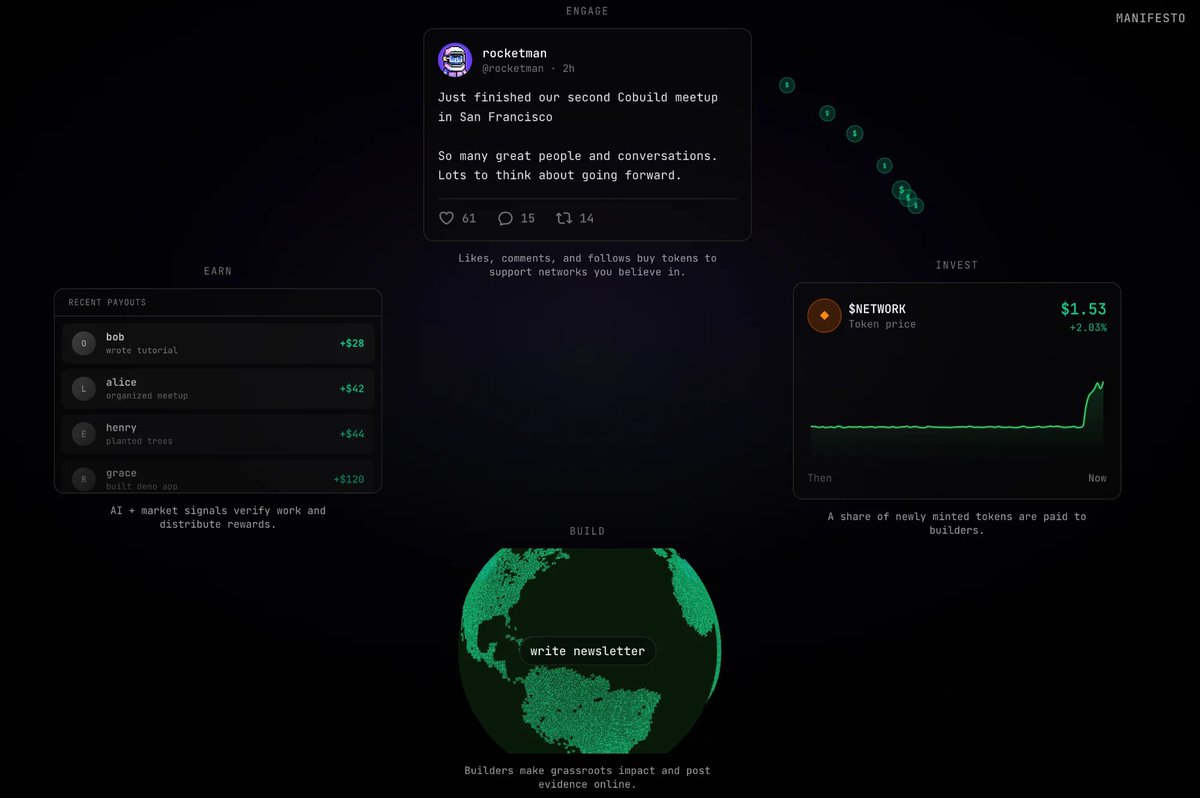
@0xBigNaturals @farcaster_xyz thanks for checking us out :)

Social and finance are progressively merging together in new and unique ways, especially in consumer crypto. Farcaster in particular has shown it's advantage in providing a neutral platform for developers to build these social x financial experiences. Lately, we've been excited about @justcobuild, which is one of the first projects to tie social behavior on the protocol to market activity. We wrote more about how Cobuild is enabling users to turn their existing social engagement into financial expressions of belief in communities and creators on Farcaster:

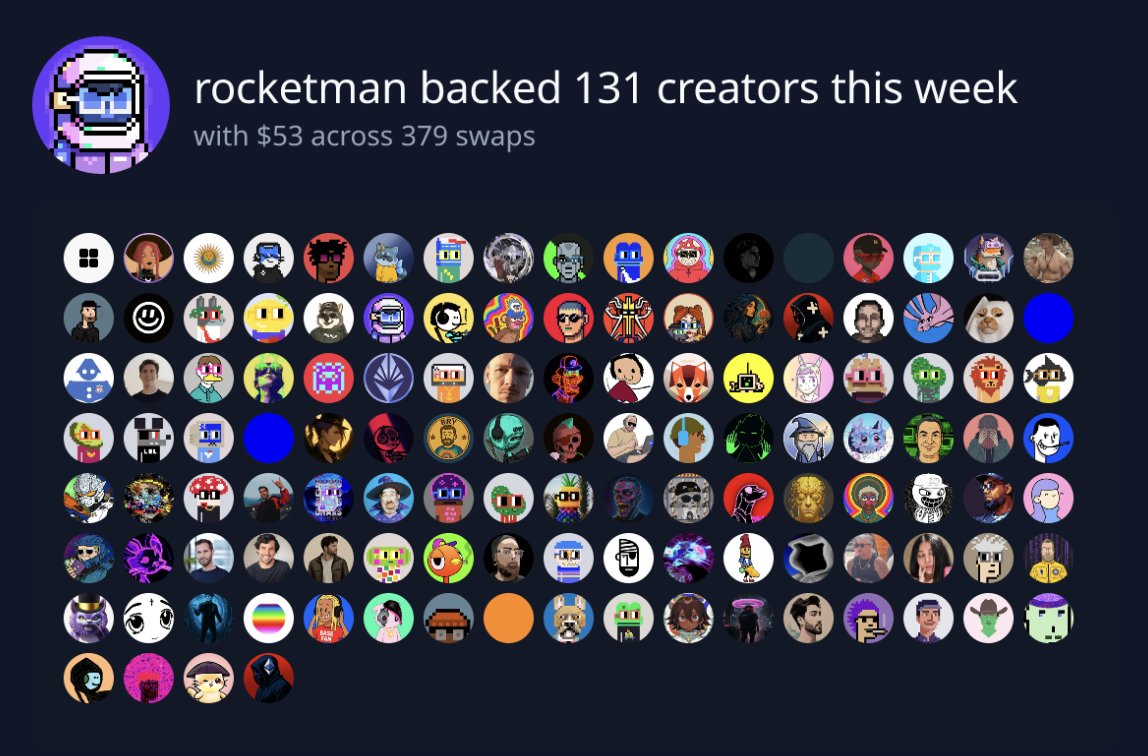
You can also see all the creators you've backed Across today, this week, and all time

Althia Goldberg @AlthiaGold90036
0 Followers 24 Following Binance's NFT universe: where creativity meets the blockchain. #NFTUniverse #BinanceCreativity

Milani | 7007 @milani7007
71 Followers 3K Following

Ready @readyonchain
370 Followers 6K Following

premsav03 k @premsav0336943
42 Followers 693 Following



0x539.eth @1337web3
1K Followers 1K Following Web3 Security Researcher @DefendersAudits | 🦅 @CodeHawks Eagle @Cyfrin | 100+ H/Ms Identified | 🇧🇬
tresnowoyo @tresnowoyo
54 Followers 533 Following
Goatinho @Crypto_Goatinho
2K Followers 7K Following Buying tops selling bottoms as a full time job, counter trade me for generational wealth

The Interfold @theInterfold
3K Followers 247 Following Multiplayer Privacy: private inputs, collective outcomes (formerly Enclave)
K3x3 @go3x3a
156 Followers 400 Following BTC holder | 一级alpha Alpha K3x3 DEV: @alphak3x3 美股监控(DEV):https://t.co/eZ70M0lGPY #Bitcoin #EVM #Code
Laurentia @8vN9D2z88m04l0F
162 Followers 6K Following No one can make you feel inferior without your consent.
tim @tim16744267
156 Followers 5K Following
Greenpill Dev Guild @greenpilldevs
525 Followers 439 Following We're a community of builders supporting @GreenpillNet & regen communities with tools & workshops focused on impact, capital allocation/formation & coordination


ethto5k @btcto100kk
5 Followers 335 Following

Dvrk @Dvrk97
720 Followers 1K Following “Believe in you”. @ bullish, aff @TrySoar , building @privacybotTG , prev @MetaSolanaBot CM
daboy.o @rts1024
368 Followers 3K Following


AlexDDim | Ap3x @alexddim19
567 Followers 5K Following CBO at @ap3xio | GTM Engineering | Community Liquidity | Fueling TGE Momentum & Strategic Raises | Marketing Partner | Investor| @estatexeu @AITECHio @LABtrade_
Kien @FamKien
5K Followers 3K Following building @tradeonmidas 👑 early discovery for Base traders Prev: @beliefssocial
jordi Morris ¯\_(ツ... @JordiMorris1
2K Followers 4K Following Network Neutrality · Sovereign Individuals · Break the Chains · Run Node · Run Flywheel PARODY, seriously end the 1913 fed
0x|Kaisar.Isul @0xkaisar_
97 Followers 1K Following Bismillah yakin bisa 100 milliar. account trenches on crypto

kami... @1_kami1
903 Followers 3K Following NFTs . Crypto. Defi..Writer..Here for the Tech... Chilling on Chain

Asher | APAC | Ave @asher501h
3K Followers 2K Following Builder AZCoinvest: https://t.co/o75bMkhsDw CM APAC: https://t.co/XRNyW3ThAY Ave Ambassador: https://t.co/tZMoyuwhpA https://t.co/C7kj75P2dY
olaph @olaph_lol
553 Followers 3K Following
Aped | ETHGas ⛽ @Daosfunlove
181 Followers 2K Following Empowering communities through decentralized innovation. 🌐 @daosdotfun #daosdotfun Ⓜ️Ⓜ️T


👁️ @pulsarcj
217 Followers 1K Following
baseisbase @baseisbase5
58 Followers 2K Following

Kekkin @TrillKek
673 Followers 2K Following Always Early | Best Trading Bot: https://t.co/CVE2Cvf2ie
Nava | Finance Resear... @Quamfynavas
5K Followers 3K Following Founder BNV Apex/ Crypto & Stock Researcher / Internet Capital Markets. All in since 2017 #Bitcoin #Atlcoin #stocks Asymmetric Alpha
0x539.eth @1337web3
1K Followers 1K Following Web3 Security Researcher @DefendersAudits | 🦅 @CodeHawks Eagle @Cyfrin | 100+ H/Ms Identified | 🇧🇬
The Interfold @theInterfold
3K Followers 247 Following Multiplayer Privacy: private inputs, collective outcomes (formerly Enclave)
Jim McDonald @jgm
849 Followers 53 Following Advisor, Bitwise. Opinions are my own and do not necessarily express the views of my employer.

Varun Srinivasan @varunsrin
15K Followers 805 Following Working on @tempo. Previously @farcaster_xyz, @Coinbase.
Sebastien Bubeck @SebastienBubeck
77K Followers 1K Following I work on AI at OpenAI. Former VP AI and Distinguished Scientist at Microsoft.


Lennart 🎢🟦 @Lennart_up
9K Followers 2K Following building onchain communities since 2019 || two-time crypto bear market survivor
Nikki Wordsmith @NikkiWordsmith
168 Followers 248 Following Creative Communication 🗣️💡 Play The Emoji Alphabet 🍏🐝😸 https://t.co/ckJyPaN0no




Nicolaus Sherrill @its_nicolaus
50 Followers 39 Following

JG @jongall45
3K Followers 7K Following consumer crypto | partner @PalmTreeCrypto | vibing @frontrunvc @ostiatrade
Eren @callereneth
2K Followers 2K Following Crypto developer. Keeping life simple, traveling when I can.
Garance @AGarance
440 Followers 779 Following Meditative artist-author, creating the Solars universe. AI art, Stories, Video.
Elad Mallel ⌐◨-�... @eladmallel
2K Followers 3K Following Building a village in Playa Venao with @noun142 Core contributor @nounsdao
will minshew @wminshew
2K Followers 2K Following here to learn | @0xSplits | https://t.co/xuobuEjaM2




Goldy ⌐◨-◨ @Goldypix
4K Followers 452 Following Curiosity Maxi 💡 Director, Gif Artst. Co-Founder @nounish, @nounsfest, @goatclub116. Director @lostandfoundaus.
₿Ξnbodhi @benbodhi
4K Followers 2K Following INF❍RMATI❍N SUPΞRHIGHWAY ₿ΞING HUMAN ✦ historically from the future at present

OCR @OCRClassic
258 Followers 113 Following 𝔗𝔥𝔢𝔯𝔢 𝔞𝔯𝔢 𝔡𝔢𝔠𝔞𝔡𝔢𝔰 𝔴𝔥𝔢𝔯𝔢 𝔫𝔬𝔱𝔥𝔦𝔫𝔤 𝔥𝔞𝔭𝔭𝔢𝔫𝔰 𝔞𝔫𝔡 𝔱𝔥𝔢𝔯𝔢 𝔞𝔯𝔢 𝔴𝔢𝔢𝔨𝔰 𝔴𝔥𝔢𝔯𝔢 𝔡𝔢𝔠𝔞𝔡𝔢𝔰 𝔥𝔞𝔭𝔭𝔢𝔫 |@8453group
Seer @seer_pm
1K Followers 154 Following Next generation prediction marketplace. https://t.co/nBHTWFDzb8
DerekHoiem.eth @DerekHoiem
3K Followers 6K Following ex visual studio ux lead/builder/designer/product manager/creator economy consultant/virtual reality resident/audio aficianado



SpaceX @SpaceX
41.7M Followers 123 Following SpaceX designs, manufactures and launches the world’s most advanced rockets and spacecraftYou might like